

Key takeaways
- Compare the best fishing gloves for harsh sun, cold water and safe fish handling, from UPF 50+ fingerless sun gloves to neoprene and cut-resistant picks.
As an Amazon Associate we earn from qualifying purchases.
“Fishing gloves” sounds like one product category, but it is really three different jobs wearing the same name. One job is keeping the sun off the backs of your hands during long, bright days on the water. A second is keeping your hands warm and functional when the water and air are cold. The third is protecting your skin at the moments fishing actually draws blood: unhooking a toothy fish, gripping a gill plate, or running a fillet knife at the camp table. A glove built for one of these jobs is usually poor at the other two, and the gloves marketed as doing all three tend to do none of them well.
This guide is therefore organized by job rather than by brand. It compares five gloves sold on Amazon: three sun gloves with different finger coverage, one full neoprene glove for cold and wet work, and one cut-resistant glove for handling and filleting. Each entry states plainly what the glove cannot do, because with gloves the limitations are usually the deciding factor.
Affiliate Disclosure: This article contains affiliate links. If you buy through a link on this page, the site may earn a commission at no extra cost to you. Products are chosen for their specifications and suitability for the use described, and each glove’s limitations are stated as plainly as its strengths.
1. Glacier Glove Abaco Bay Sun Glove

The Abaco Bay is the glove that defined the sun-glove category for fly and flats anglers, and its formula has barely changed: a lightweight stretch back that blocks ultraviolet light, a synthetic leather palm that stands up to a rod handle and fly line, and fingers cut away so your fingertips stay bare. Glacier Glove rates the fabric UPF 50+, the highest fabric rating commonly sold, and an extended cuff covers the wrist — the strip of skin that burns where a short cuff ends and a shirt sleeve begins.
The fingerless cut is the point and the limitation at the same time. Bare fingertips tie knots, pinch split shot and feel a fly line exactly as well as ungloved fingers, which is why sun gloves outsell full-finger designs for warm-weather fishing. But UPF protection only exists where fabric covers skin. Your fingertips, the part of the hand that also gets wettest and loses sunscreen fastest, get no protection from any fingerless glove, this one included. Anglers who burn easily still need sunscreen on the exposed fingers.
Two more honest caveats apply to every sun glove here. A UPF rating is measured on fabric in a lab; stretched thin over knuckles and thinned further by seasons of wear and washing, real-world protection drops below the number on the tag. Within those limits, the Abaco Bay remains a benchmark: light enough to forget you are wearing it, durable in the palm where line and cork abrade, and sized in S/M and L/XL.
Specs
- Sun protection: UPF 50+ rated fabric
- Design: Fingerless, with extended wrist cuff
- Material: Stretch Lycra/spandex back, synthetic leather palm
- Sizes: S/M and L/XL
- Model: 009VR
2. KastKing Sol Armis Sun Gloves
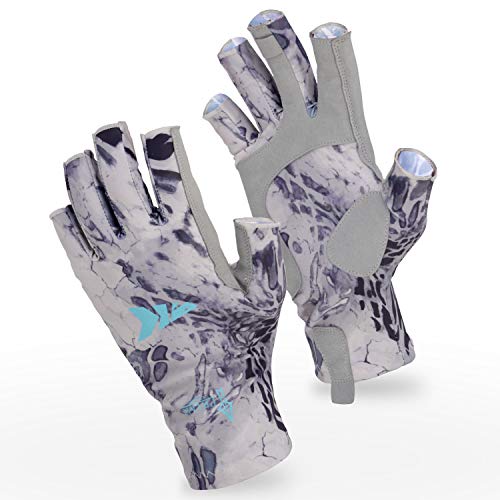
The Sol Armis takes the same fingerless sun-glove brief as the Abaco Bay and answers it with a more athletic build. The back is a breathable poly-spandex with UPF 50+ protection woven in rather than coated on, so the protection does not wash off. The palm is microfiber instead of synthetic leather, which keeps the glove thinner and cooler, and pull tabs at the fingers make it easy to peel off with wet hands. The cuff runs extra long, overlapping a sun shirt sleeve so no wrist stripe is left exposed.
KastKing also offers the widest size range in this guide, running from extra small through 2XL, which makes the Sol Armis the easiest pick for anglers with small hands whom two-size ranges leave swimming, or large hands that two-size ranges exclude. The gloves are machine washable, a genuine advantage in a category where fish slime and sunscreen build up fast.
The trade-offs sit in the palm. Microfiber is cooler and dries faster than the Abaco Bay’s synthetic leather, but it is less abrasion-resistant under a paddle shaft or a heavily loaded rod butt, and the stitching at the finger openings is the known wear point on this design. Like every sun glove, it protects only covered skin, leaves fingertips bare, and provides no warmth and no defense against hooks or teeth. As a pure sun glove for casting, kayaking and rowing in hot weather, though, it is a well-sorted one.
Specs
- Sun protection: UPF 50+ woven into the fabric
- Design: Fingerless, extra-long cuff, finger pull tabs
- Material: Breathable poly-spandex back, microfiber palm
- Sizes: XS through 2XL
- Part number: KK-FG-1
3. Palmyth UV Fishing Gloves
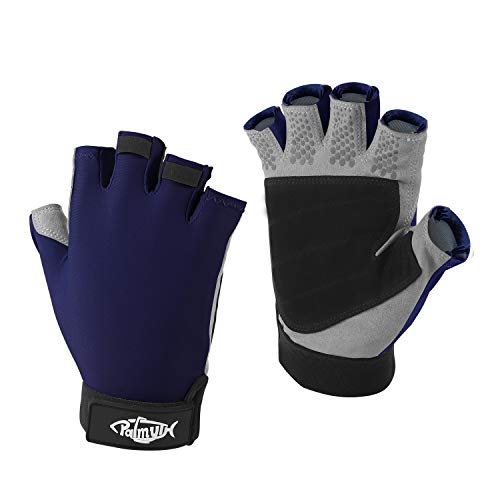
Palmyth’s UV glove is the coverage compromise between the two gloves above and a full-finger design. Instead of cutting the fingers at the first knuckle, it uses a three-quarter finger cut: most of each finger stays covered, and only the fingertip pads — the parts that tie knots, work a phone screen and pick at backlashes — are left open. For anglers whose fingers burn along their length, not just on the backs of their hands, that extra coverage is the reason to choose it. The fabric carries a UPF 50+ rating, and the palm pairs partial synthetic leather with silicone grip dots for purchase on a wet rod handle.
The three-quarter cut changes the dexterity bargain less than you might expect. Fine work in fishing happens at the very fingertips, and those stay bare; what you give up is the fully naked finger’s feel along a line, which matters most to fly anglers stripping line by hand. In return you get meaningfully more covered skin, exactly where sunscreen gets rubbed away by line and rod handles.
The honest limits mirror the other sun gloves: fingertips remain exposed to sun, the rating applies to unstretched new fabric, and there is no cut, puncture or cold protection here at all. The synthetic leather palm sections also deserve a rinse after saltwater use, since dried salt stiffens them over time. Within the sun-glove job, the Palmyth is the pick for anglers who want maximum coverage short of a full finger.
Specs
- Sun protection: UPF 50+
- Design: Three-quarter finger cut, fingertip pads exposed
- Material: Quick-dry stretch fabric, partial synthetic leather palm with silicone grip dots
- Features: Pull tabs for removal with wet hands
- Sizes: S through XL
4. Glacier Glove Ice Bay

The Ice Bay answers the opposite problem from everything above: not sun, but cold water. It is a full-finger glove built from 2mm neoprene — the same wetsuit material logic — fleece-lined, with seams blind-stitched and glued so the glove is waterproof rather than merely water-resistant. Neoprene insulates when wet instead of collapsing like fleece or cotton, which is why it remains the standard material for ice fishing, cold-weather paddling and winter steelhead work. The palm is seamless with a sharkskin texture for grip on wet rods and fish.
Warmth, however, is bought with dexterity, and buyers should be clear-eyed about the exchange rate. Two millimeters of neoprene over every finger keeps hands working in near-freezing water, but tying a small knot, threading a hook eye or picking a jig out of a compartment becomes slow, clumsy work. Many cold-water anglers fish in these and bare their hands briefly for rigging, accepting cold fingers for thirty seconds rather than fighting the glove for five minutes. The Ice Bay is a tool for sustained cold and wet, not a glove for mild weather — in mild weather it simply makes your hands sweat, and a damp glove taken off in cold air chills fast.
Sizing runs from XS to XXL, and fit matters more here: too loose and water flushes in and out, too tight and circulation suffers and hands get colder, not warmer. Note also what this glove is not: neoprene offers little cut or puncture protection against hooks and spines, despite its thickness.
Specs
- Material: 2mm fleece-lined neoprene
- Construction: Blind-stitched and glued seams, waterproof
- Design: Full finger, seamless palm with sharkskin grip texture
- Use: Ice fishing, cold-water paddling, winter fishing
- Sizes: XS through XXL
5. KastKing Kut Safe Fillet Gloves

The Kut Safe is not a glove you fish in; it is the glove you put on when the fishing is done and the knife work starts. It is a full-finger cut-resistant glove built for filleting and fish cleaning, with protection that wraps the whole hand rather than only the palm. KastKing rates it to ANSI/ISEA cut level A6, near the top of the scale used for cut-resistant work gloves, which reflects how the glove performs against a slicing blade edge — the fillet knife that slips on a slimy fish, the gill plate edge, the fin spine dragged sideways across a knuckle.
Understanding what that rating does and does not mean is the whole buying decision. Cut resistance measures a blade drawn across fabric under load. It does not measure a point driven straight in. A hook point, a catfish spine or a knife tip pushed perpendicular into the glove is a puncture force, and no flexible knit glove — this one included — is puncture-proof against it. The Kut Safe sharply reduces the slicing injuries that make up most fish-cleaning accidents; it does not make your hand invulnerable, and treating it as armor invites exactly the carelessness that causes injuries.
One more consideration belongs in any handling-glove discussion: the fish. For catch-and-release, the kindest tools are wet bare hands or a soft rubber-mesh net, because dry fabric — including glove fabric — strips the slime coat that protects fish from infection. A cut-resistant glove earns its place where the risk runs the other way: filleting at the table, cleaning a catch you are keeping, or controlling a toothy fish for unhooking. Keep release fish in the water, support them horizontally with wet hands, and save the armored glove for the cleaning board.
Specs
- Protection: ANSI/ISEA cut level A6, full-hand (360-degree) coverage
- Design: Full finger, cut-resistant fiber knit
- Use: Filleting, fish cleaning and handling
- Sold as: One pair
- Care: Machine washable
How to Choose Fishing Gloves
Name the job first. Sun, cold and handling are separate purchases. A UPF glove gives no warmth and no cut protection; a neoprene glove is miserable in summer sun; a cut-resistant glove is too stiff to cast in. Most anglers who fish year-round end up with two pairs: a sun glove and one of the other two, chosen by whether their water is cold or their fish are toothy.
Read UPF claims correctly. UPF 50+ means the fabric blocks at least 98 percent of ultraviolet radiation when new, dry and unstretched. Protection falls where fabric stretches over knuckles, where it wears thin, and everywhere it does not cover — which, on a fingerless glove, includes your fingertips. Treat sun gloves as the base layer of a sun strategy that still includes sunscreen on exposed skin.
Choose finger coverage by task. Fingerless gloves preserve full knot-tying dexterity and are the default for warm weather. A three-quarter cut adds coverage along the fingers while keeping the pads free. Full-finger gloves are for cold and for protection, and both cost you fine feel; if you need to rig while wearing them, expect to work slowly or bare a hand briefly.
For cold, fit is the insulation. Neoprene works by trapping a thin layer of water your body warms, so a sloppy fit that flushes cold water defeats the material, while a tight fit restricts circulation and also leaves you cold. Measure your hand and use the maker’s size chart rather than guessing.
For handling, match the rating to the risk. An ANSI cut level describes slicing resistance only. It is the right protection for fillet knives and gill edges, and the wrong thing to trust against hook points and spines. Whatever glove you choose for release fishing, wet it first and keep the fish in the water as much as possible; the glove should protect you without costing the fish its slime coat.
Frequently Asked Questions
Can one pair of fishing gloves cover sun, cold and fish handling?
Not well. The three jobs demand opposite properties: sun gloves are thin and fingerless, cold gloves are thick and sealed, and cut-resistant gloves are dense and stiff. A glove blending all three ends up too warm for summer, too thin for winter and too clumsy for knife work. Two specialized pairs cover the year better.
Do UPF 50+ gloves mean I can skip sunscreen?
Only on the skin the fabric actually covers. Fingerless and three-quarter designs leave fingertips exposed, cuffs leave a gap if they do not overlap your sleeve, and stretched or worn fabric blocks less than its rating. Sunscreen still belongs on fingertips, and on any gap between glove and sleeve.
Are cut-resistant gloves puncture-proof against hooks and spines?
No. Cut ratings measure resistance to a blade slicing across the fabric. A hook point or fish spine driven straight in applies puncture force, which is a different test that flexible gloves do not pass. Cut-resistant gloves are excellent insurance for filleting and cleaning; they are not armor for grabbing toothy fish bare-handed by the jaw.
Should I wear gloves when releasing fish?
Wet bare hands or a soft rubber-mesh net are gentlest on a fish’s slime coat, and dry fabric of any kind removes that protective layer. If you wear a glove for a release, wet it thoroughly first, keep the fish in the water, and support it horizontally. Save dry handling gloves for fish you are keeping and for the cleaning table.
Conclusion
The best fishing glove is the one matched to the hazard you actually face. For sun, the Glacier Glove Abaco Bay is the proven fingerless benchmark, the KastKing Sol Armis adds a cooler microfiber palm and the widest size range, and the Palmyth covers more of each finger for anglers who burn easily. For cold and wet work, the Ice Bay’s sealed neoprene trades dexterity for real warmth. And for the cleaning table, the KastKing Kut Safe provides serious cut resistance — used with the understanding that cut resistance is not puncture-proofing, and that fish being released are better served by wet hands than by any glove at all.
More from Amazon
Programs that pair well with the guide above. Offers and eligibility are set by Amazon and may change.
Free shipping on eligible items, Prime Video and more. Eligible new members can start with a free trial.
Start a Prime free trialA Prime membership for ages 18-24 with a trial period. Eligibility is set by Amazon.
See Prime for Young AdultsAudiobooks and podcasts to listen to on the go. Eligible new members can start with a free trial.
Try Audible freeAd-free music streaming. Eligible new subscribers can start with a free trial.
Try Music Unlimited freeAs an Amazon Associate we earn from qualifying purchases.










Write Your Review
No reviews yet. Be the first to share your experience!