

Key takeaways
- Do not wipe the inside of the lens. Wet snow and condensation can remove or scratch the inner coating. Shake off moisture and let the goggles dry.
- Do not wear the goggle on your forehead while climbing. Heat and sweat can saturate the foam and make fogging worse when you put it back on.
- Keep helmet vents compatible. A helmet that blocks the goggle’s upper vents can trap warm air.
- Use a soft, clean microfiber cloth only on the exterior. Dirt trapped in a pocket or sleeve can create fine scratches.
- Replace damaged foam promptly. Compressed or peeling foam allows wind, snow, and moisture into the frame.
The best ski goggles are the ones whose lens, fit, and ventilation match the light and weather you actually ski in: for most people, that means a medium-light lens around 20–30% VLT plus a genuinely low-light lens below 20%.
Our top picks


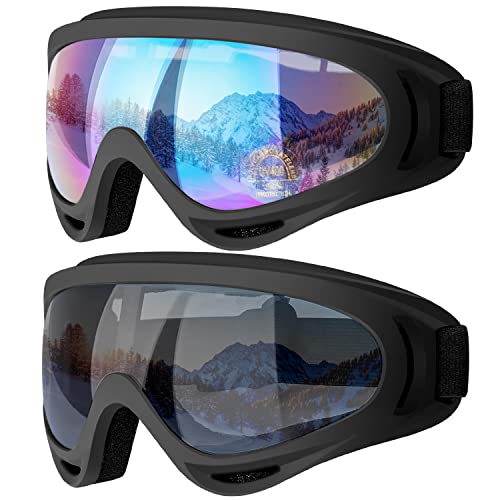

As an Amazon Associate we earn from qualifying purchases at no extra cost to you. Ratings are shown as listed on Amazon.
Best ski goggles by skiing situation
| Situation | Best choice | Lens target | Why it works |
|---|---|---|---|
| One-goggle skier in mixed weather | Interchangeable-lens model | 18–30% VLT main lens; 50–70% VLT spare | Useful across sunny, cloudy, and storm days without buying two frames |
| Frequent sunny, high-altitude skiing | Premium cylindrical or toric goggle | 8–18% VLT | More glare control and strong contrast in bright snow |
| Storm skiing, trees, or night sessions | Dedicated low-light lens | 50–70% VLT | Admits substantially more light and reveals terrain changes better |
| Glasses wearer | OTG (over-the-glasses) goggle | 20–40% VLT for general use | Extra internal volume reduces pressure on spectacle frames |
| New skier on a limited budget | Medium-frame goggle with two lenses | 15–25% and 55–70% VLT | More versatile than an expensive single-lens model |
How lens tint and VLT determine visibility
VLT, or visible light transmission, is the percentage of visible light that passes through a lens. A lower number is darker; a higher number is brighter. Tint color matters, but VLT is the more useful specification when comparing goggles from different brands.
| VLT range | Typical conditions | Useful tint families | Limitations |
|---|---|---|---|
| 8–15% | Strong sun, exposed bowls, spring snow | Dark gray, black, bronze | Too dark for heavy cloud or tree shadows |
| 16–30% | Partly cloudy and changing light | Rose, copper, amber, brown | Not ideal for flat storm light at the low end |
| 31–50% | Cloud, light snowfall, shaded pistes | Rose, gold, yellow-rose | Can feel uncomfortably bright in full sun |
| 51–70% | Heavy snow, fog, dusk, or night skiing | Yellow, pale amber, clear | Provides little glare protection in sunlight |
A rose or amber lens can make bumps and ridges easier to distinguish by increasing contrast, but no tint can restore detail that is hidden by dense fog. If you regularly ski from morning through afternoon, an interchangeable system is usually more practical than trying to find one “all-weather” lens.
Top goggle designs worth considering
Smith I/O MAG
The Smith I/O MAG is a strong premium choice for skiers who want fast lens changes and a broad view. Its magnetic lens system is convenient when weather changes at the lift, and the I/O family is offered in different frame sizes. Look for a package that includes both a sun lens and a storm or low-light lens rather than assuming every package has the same contents. Smith’s ChromaPop lenses are commonly available across the range, with VLT varying by lens.
Oakley Flight Deck M
The Oakley Flight Deck M uses a rimless, oversized design that prioritizes peripheral vision and an unobstructed view. The medium size suits more faces than the larger Flight Deck versions, though it still has a substantial footprint. Its Prizm Snow lenses are available in several light levels. This is a good head-to-head alternative to the Smith I/O MAG if your priority is visual openness rather than the smallest frame profile.
Giro Contour
The Giro Contour is a premium toric goggle with a lens-change system and a wide field of view. Giro’s VIVID lens options are designed around contrast in snow, and the model is commonly sold with a second lens in higher-priced packages. Check the included VLT values carefully: a “bonus lens” is far more useful when it is genuinely storm-rated rather than simply another medium tint.
Anon M4
The Anon M4 is a large-frame option known for magnetic lens attachment and broad coverage. It is particularly appealing to skiers who prefer a roomy fit or use Anon’s face-covering accessories. Its size can be excessive on a small face, so helmet and nose clearance matter more than the impressive lens area alone.
Good-value interchangeable goggles
Mid-priced lines from brands such as Giro, Smith, Oakley, and Dragon can provide the most sensible balance for occasional skiers. Expect roughly $60–$150 for a basic goggle and about $120–$250 for a model with a second lens, depending on lens technology and seasonal pricing. A well-fitting two-lens package is usually better value than a fashionable single-lens goggle that leaves you unable to see in changing conditions.
Anti-fog performance: what actually matters
Anti-fog treatment helps, but it is only one part of the system. The most effective designs combine a double-layer lens, an anti-fog inner coating, open lower and upper vents, and enough space between your face and the lens for air to circulate. A large field of view is not useful if the lens fogs as soon as you stop on the slope.
- Do not wipe the inside of the lens. Wet snow and condensation can remove or scratch the inner coating. Shake off moisture and let the goggles dry.
- Do not wear the goggle on your forehead while climbing. Heat and sweat can saturate the foam and make fogging worse when you put it back on.
- Keep helmet vents compatible. A helmet that blocks the goggle’s upper vents can trap warm air.
- Use a soft, clean microfiber cloth only on the exterior. Dirt trapped in a pocket or sleeve can create fine scratches.
- Replace damaged foam promptly. Compressed or peeling foam allows wind, snow, and moisture into the frame.
Field of view versus fit
Oversized and frameless goggles generally provide more peripheral vision, which helps when checking nearby skiers or reading terrain at the edge of your sight. Toric lenses—curved vertically and horizontally—often offer a spacious view with less visual distortion than a basic spherical shape. Cylindrical lenses can be less expensive and still perform well, but their edge vision may feel narrower.
Do not choose solely by lens size. The goggle should sit evenly around your eye sockets without pressure points, and the nose bridge should not be crushed. There should be no gap between the helmet and the top of the frame, known as “gaper gap.” A small gap is primarily a comfort and warmth problem; a poorly aligned helmet can also obstruct ventilation.
Helmet compatibility and sizing checklist
- Put on the helmet you normally ski in.
- Place the goggle in its normal position, not pushed high onto the forehead.
- Check that the top edge follows the helmet without a visible gap.
- Look down and side to side for frame pressure or distorted vision.
- Wear your usual balaclava or face covering during the fit check.
- If you wear glasses, choose an OTG design and confirm that the arms do not press into the foam.
Many goggles are offered in small, medium, and large versions, but these labels are not standardized. A medium from one brand can be close to a large from another. Try the goggle with your helmet whenever possible; frame width and helmet shape are more predictive than the size label.
Interchangeable lenses: calculate the real value
Suppose a two-lens goggle costs $180 and lasts four seasons. If you ski 12 days per season, its estimated cost is $180 ÷ 48 days, or $3.75 per ski day. A single-lens goggle costing $110 may look cheaper, but if you later buy a compatible storm lens for $70, the total becomes $180 anyway. The two-lens package is worthwhile when its lenses cover genuinely different conditions and the change mechanism is easy to use with cold fingers.
Magnetic systems are generally the quickest to operate. Mechanical locking systems can feel more secure and may be preferable if you frequently carry goggles in a crowded pack, but they take longer to change. Whichever system you choose, carry the spare lens in a rigid or semi-rigid case rather than loose in a jacket pocket.
What wears out first
The lens coating, face foam, strap elastic, and lens-change contact points usually age before the frame itself. Salt from sweat, sunscreen, and repeated damp storage accelerate deterioration. Air-dry goggles completely at room temperature before storing them; do not place them on a radiator or use a hair dryer. Keep the lens facing upward inside its bag to reduce accidental scratching.
For most buyers, the best ski goggles are a medium or large frame with reliable double-lens ventilation, a 16–30% VLT lens for ordinary days, and a second lens above 50% VLT for storms. Spend more on the fit and lens range than on cosmetic finishes: clear vision, comfortable helmet integration, and a lens you can actually change in bad weather matter far more than the logo.





Write Your Review
No reviews yet. Be the first to share your experience!