

Key takeaways
- Flex 70–90: appropriate for beginners, lighter skiers, and low-frequency resort use.
- Flex 90–110: the most versatile range for progressing intermediates and many all-mountain skiers.
- Flex 110–130: intended for advanced skiers who ski aggressively, weigh more, or want maximum support.
The best ski boots are the ones that hold your heel securely, match your foot volume and skiing ability, and provide enough flex to control your skis without making every run uncomfortable.
For most recreational skiers, the safest starting point is a medium-volume boot with a medium flex: roughly 90–110 for many women and lighter men, or 100–120 for stronger or heavier men. Advanced skiers may prefer a stiffer 120–130 boot, while beginners often benefit from a softer 70–90 flex that is easier to bend and walk in. Flex numbers are not standardized between brands, so use them as a comparison within a product line rather than as an absolute rating.
Our top picks
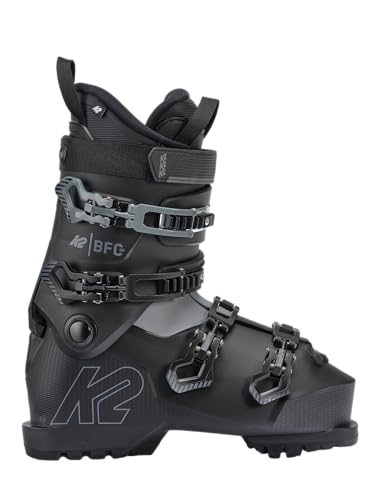


As an Amazon Associate we earn from qualifying purchases at no extra cost to you. Ratings are shown as listed on Amazon.
Best ski boots by skier and situation
| Skier or priority | Recommended boot type | Useful specifications | Examples of established lines | Typical 2026 price range |
|---|---|---|---|---|
| First-time or occasional skier | Comfort-focused resort boot | Flex 70–90, medium or high volume, conventional four-buckle shell | Nordica Sportmachine, Atomic Hawx Magna, Salomon S/Pro HV | $250–$450 |
| Regular intermediate skier | All-mountain performance boot | Flex 90–110, 100–104 mm last, heat-moldable liner | Nordica Speedmachine, Tecnica Mach1 MV, Atomic Hawx Prime | $400–$650 |
| Narrow feet or precise fit | Low-volume performance boot | Flex 100–130, 97–100 mm last, strong heel pocket | Atomic Hawx Ultra, Lange Shadow MV or LV, Tecnica Mach1 LV | $500–$800 |
| Strong advanced resort skier | Stiff alpine boot | Flex 120–130, 98–100 mm last, snug liner, race-inspired shell | Salomon S/Pro Supra, Lange RS, Tecnica Mach1 MV | $600–$900 |
| Resort and short uphill routes | Hybrid freeride or crossover boot | Flex 100–130, walk mode, GripWalk sole, 1,500–1,900 g per boot | Salomon Shift Pro, Atomic Hawx Ultra XTD, Tecnica Cochise | $550–$950 |
Prices are broad market ranges rather than fixed recommendations. Seasonal discounts can change them substantially, but a professional fitting is often more valuable than spending an extra $100 on a higher-level shell that does not match your feet.
Flex: comfort versus control
Flex describes how much resistance the boot provides when you drive your shin forward. A softer boot is easier to flex, more forgiving when balance is imperfect, and generally more comfortable for beginners. A stiffer boot transfers pressure quickly to the ski and gives confident skiers better support at speed, but it can feel painful or difficult to control if the skier cannot bend it.
- Flex 70–90: appropriate for beginners, lighter skiers, and low-frequency resort use.
- Flex 90–110: the most versatile range for progressing intermediates and many all-mountain skiers.
- Flex 110–130: intended for advanced skiers who ski aggressively, weigh more, or want maximum support.
Temperature also affects perceived flex. Plastic becomes firmer in cold conditions, so a boot that feels moderate indoors may feel substantially stiffer on the mountain. Do not choose a softer boot simply because it feels comfortable in a warm shop if your heel moves inside it.
Last width and shell volume matter more than the label
The last is the internal width of the boot around the forefoot, usually measured in millimeters. A 97–98 mm last is generally narrow, 100–102 mm is medium, and 103–106 mm is high volume. These categories vary by brand and by boot shape; a narrow boot can still have generous instep height, while a medium-last boot may feel tight over a broad forefoot.
Choose a low-volume shell when your foot is narrow, your heel is slim, or you need precise edge control. Choose a high-volume shell when you have a broad forefoot, tall instep, or need more room across the midfoot. Do not solve a heel-lift problem by buying a shell that is too short or too wide. A boot fitter can often add targeted padding, adjust the shell, or modify the liner while preserving a close fit.
Shell fit: the test that prevents most bad purchases
Remove the liner and place your bare foot inside the empty shell with your toes lightly touching the front. Have a fitter measure the space behind your heel.
- 10–15 mm: performance-oriented fit for many advanced skiers.
- 15–20 mm: balanced fit for many recreational and intermediate skiers.
- 20–25 mm: roomier comfort fit, but it may permit excess movement as the liner packs out.
With the liner installed, your toes may touch the front while standing upright. When you flex your knees, your toes should pull away slightly as your heel settles back. Your heel should remain planted when you flex forward, and your foot should not slide noticeably from side to side. Never judge size by walking around for two minutes in a fully open boot; ski boots are designed to be evaluated buckled and flexed.
Liner warmth and fit
Thicker, softer liners usually feel warmer and more comfortable on day one, but they compress with use. A dense performance liner can provide better control and last longer, yet it may require careful fitting and thinner ski socks. For cold feet, first check boot fit, circulation, and moisture management rather than automatically choosing the largest liner.
Wear one thin, technical ski sock. Thick cotton or multiple socks create pressure points, hold moisture, and can reduce circulation. Heated insoles or heated socks can help some skiers, but they require charging and careful cable placement; they should not be used to justify a shell that is too tight.
Walk modes: useful feature or unnecessary complexity?
A walk mode releases the upper cuff so the ankle can move more naturally while walking. It is valuable for bootpacks, ski-hill stairs, hut trips, and short touring approaches. It adds hinges, locks, and moving parts, however, and a hybrid boot may be heavier or less laterally rigid than a dedicated alpine boot.
Choose a conventional alpine boot if you spend nearly all day on lifts and groomed or lift-accessed terrain. Choose a hybrid boot if you regularly walk more than a few minutes, ski sidecountry routes, or need touring compatibility. Check that the boot’s sole standard matches your bindings: GripWalk-compatible boots require compatible bindings or approved adjustment. Touring boots also need bindings that accept their range of motion and tech fittings where applicable.
Decision matrix: match the boot to your use
| Your situation | Prioritize | Avoid |
|---|---|---|
| Fewer than 5 ski days per year | Comfort, easy buckles, moderate flex, serviceable liner | Very stiff race shells and expensive touring mechanisms |
| 10–30 resort days per year | Accurate shell fit, heat-moldable liner, replaceable soles | Oversizing for immediate comfort |
| Narrow heel and wide toes | Snug heel pocket with a moldable forefoot or shell punch capability | Buying solely by last-width number |
| Large calves or limited ankle mobility | Adjustable cuff, appropriate cuff height, moderate flex | High, rigid race cuffs without professional fitting |
| Resort skiing plus occasional touring | Hybrid boot with walk mode and binding compatibility | Assuming any GripWalk boot is a touring boot |
How to size and break in ski boots
- Measure both feet late in the day. Feet often change slightly in length and volume during the day. Use the larger foot as the starting point.
- Try boots in your ski socks. Bring the socks, footbeds, and any heated accessories you actually use.
- Buckle the boot correctly. Close the lower buckles only enough to hold the shell around the foot, then secure the power strap and upper buckles.
- Flex repeatedly for 10–15 minutes. Your toes should relax away from the front, while the heel remains stable. Persistent numbness, sharp pressure, or tingling indicates a fitting problem.
- Allow for liner packing. A new liner commonly becomes roomier after several ski days. A slightly snug initial fit is usually preferable to a roomy fit, provided there is no painful pressure.
A professional fitter can heat-mold compatible liners, shape the shell, install a footbed, adjust buckles, and align the cuff. These changes should be made after assessing the shell size; modifications cannot reliably rescue a shell that is fundamentally too large.
Durability, maintenance, and ownership costs
The liner usually compresses before the plastic shell fails. Buckle ladders, power-strap hardware, walk-mode levers, and toe or heel soles are common wear points. Replace worn soles when the boot no longer interfaces correctly with the binding, and inspect walk-mode locks for snow, ice, and looseness.
After every ski day, remove the liners or open the boots fully and dry them with a boot dryer on a low-temperature setting. Do not place liners directly on a radiator or use high heat, which can deform foam and adhesives. Never store wet boots closed in a gear bag. Brush snow from buckles and hinges, and check screws periodically without overtightening them.
As a simple ownership calculation, a $600 boot used for 30 ski days costs about $20 per day before service. If a better-fitting $750 boot remains comfortable for 50 days, its effective cost is $15 per day. The cheaper purchase is not the better value if poor fit causes early replacement, abandoned ski days, or repeated professional modifications.
Bottom line
For a first or second pair, start with a medium-volume boot in the 90–110 flex range and spend time getting the shell size right. Move to a narrow, stiffer performance boot only when you can use its added support. Select a high-volume model for genuine foot volume rather than extra comfort from oversizing, and choose a walk-mode hybrid only when you will use that mobility. The best ski boots should feel snug, secure, and predictable—not spacious like casual footwear.






Write Your Review
No reviews yet. Be the first to share your experience!