

Key takeaways
- Measure the flange bolt spacing and outlet position before ordering.
- Record the distance from the flange center to the rear wall and nearest side wall.
- Check seat height, bowl width, total projection, and pedal clearance.
- Confirm the water inlet side and whether the existing shutoff valve uses the same fitting.
- For a macerating, vacuum, or custom waste system, select a toilet designed for that system rather than adapting a gravity model.
Best RV Toilets for Comfort and Easy Cleaning
The best RV toilets for most travelers are the Dometic 310 for a comfortable residential-style bowl, the Thetford Aqua-Magic Style II for a lightweight replacement, and the Dometic 510H for owners who want a powerful flush and a taller bowl. The right choice depends less on brand than on four fit questions: your available floor space, the height you prefer, the type of RV waste system, and how much water you can spare at each flush.
Quick comparison: leading RV toilet choices
| Toilet | Approx. seat height | Flush-water use | Bowl and seat characteristics | Best fit |
|---|---|---|---|---|
| Dometic 310 | 18 in | About 1 pint per flush | Full-size ceramic bowl; slow-close seat commonly included | Comfort-focused replacement in a standard black-tank RV |
| Dometic 320 | About 19 in | About 1 pint per flush | Large ceramic bowl and residential-style seat | Maximum bowl room and taller seating |
| Dometic 510H | About 18 in | Roughly 0.4 to 0.5 gal per flush, depending on setting | Full-size ceramic bowl; pressurized flushing system | Frequent use and owners prioritizing rinse performance |
| Thetford Aqua-Magic Style II | About 17.5 in | Approximately 0.3 gal per flush | Lightweight china bowl with elongated residential-style seat | Easy replacement where weight and water use matter |
| Thetford Aqua-Magic V | About 17.5 in | Approximately 0.3 gal per flush | Lightweight plastic bowl; compact and simple | Budget upgrades and smaller RV bathrooms |
| Composting toilet | Usually 19 to 21 in | No flush water | Separate liquid and solids containers; fan-assisted ventilation | Dry camping, limited black-tank capacity, and suitable custom installations |
Manufacturers offer multiple versions and replacement seats, so treat these figures as buying ranges rather than a substitute for the installation drawing. Measure your own toilet before ordering.
Our top picks
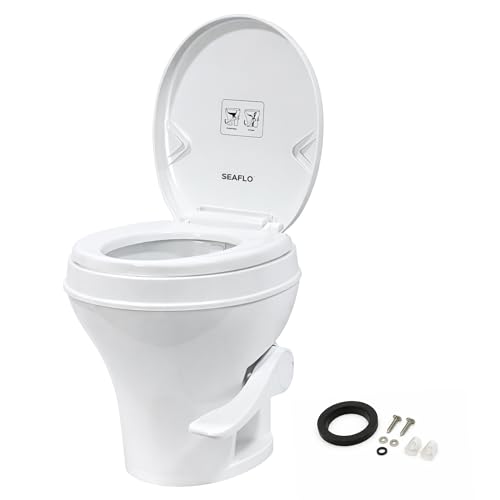

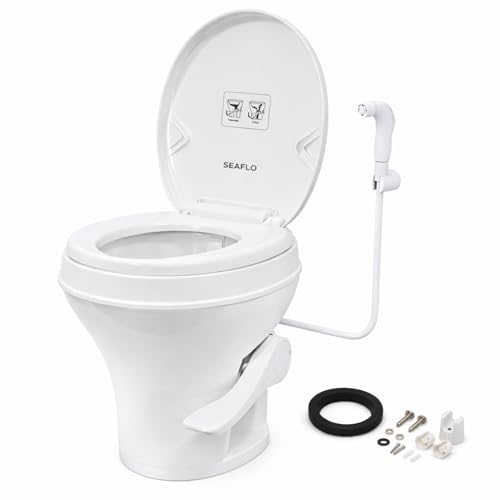

As an Amazon Associate we earn from qualifying purchases at no extra cost to you. Ratings are shown as listed on Amazon.
Best overall for comfort: Dometic 310
The Dometic 310 is a strong all-around choice because it combines a full-height seat with a ceramic bowl, a residential-style profile, and low water use. Its bowl is noticeably more spacious than many compact RV toilets, which makes it easier to use on longer trips. The foot-pedal flush also leaves both hands free.
Its seal design is important to ownership. A blade-style valve seals the bowl from the holding tank, while a separate water valve controls the flush. If the bowl slowly loses water, the blade seal may need cleaning or replacement; if water continues entering after flushing, the water valve may be the problem. Those are inexpensive service parts compared with replacing the entire toilet.
Choose the 310 when your RV already has a conventional gravity black-tank system and the bathroom can accept its larger bowl. It is not automatically the best choice for a very narrow wet bath: the bowl and seat project farther than compact plastic models.
Best for the largest bowl: Dometic 320
The Dometic 320 is the comfort pick for travelers who want the closest RV equivalent to a home toilet. It has a taller seating position and a wide ceramic bowl, but that comfort requires more bathroom clearance. Before purchasing, check the distance from the center of the floor flange to the bathroom wall, cabinet, shower door, and vanity. Also measure the door swing and the distance to the foot pedal.
The 320 uses a gravity flush and approximately one pint of water per flush. That is efficient for a residential-style bowl, but a household-size bowl can encourage longer or repeated flushing. On a 40-gallon black tank, a simple water budget illustrates the difference: 100 flushes at one pint use about 12.5 gallons, while 100 flushes at 0.3 gallon use 30 gallons. Actual tank capacity is reduced by waste and tank sensors are not always precise, but the calculation shows why low-flow performance matters for extended boondocking.
Best for powerful rinsing: Dometic 510H
The Dometic 510H uses a pressurized flushing approach rather than relying only on a gravity drop. That can help rinse the bowl and move waste through the outlet when the RV’s plumbing is installed correctly. It is worth considering for full-time use, families, or owners who dislike residue around the bowl after a weak flush.
The trade-off is water consumption and system complexity. Its flush may use roughly 0.4 to 0.5 gallon, depending on the selected flush cycle, so it is less attractive for dry camping than a pint-flush model. It also requires the appropriate water pressure and electrical connection for its flush system. Verify the model’s supply requirements and the RV’s available wiring before treating it as a direct swap.
Best lightweight replacement: Thetford Aqua-Magic Style II
The Aqua-Magic Style II is a practical middle ground. Its china bowl offers a more substantial feel than an all-plastic toilet, while the overall design remains relatively light and uses about 0.3 gallon per flush. That combination suits older travel trailers and motorhomes where payload is limited or the original toilet is a small low-profile unit.
Thetford uses a blade seal at the bowl outlet, and replacement seals are available. Regularly lubricating the seal with a product approved for RV toilet seals helps it remain flexible, but ordinary petroleum grease can damage some rubber components. The Style II is usually a good choice for a standard gravity black tank, provided the bolt pattern, rough-in, seat height, and water connection match the existing installation.
Best budget and compact option: Thetford Aqua-Magic V
The Aqua-Magic V favors simplicity and low weight over a residential appearance. Its plastic bowl is easier to lift during installation and often fits bathrooms where a wider ceramic bowl would interfere with a shower curtain or cabinet. It is especially sensible when the existing toilet is already a compact Thetford model and the goal is an uncomplicated replacement.
Plastic can show mineral staining and scratches sooner than ceramic, so avoid abrasive powders and stiff metal brushes. A soft brush, mild bathroom cleaner compatible with plastic, and occasional seal cleaning will usually produce better long-term results than aggressive scrubbing.
When a composting toilet makes sense
A composting toilet eliminates flush-water consumption and can reduce dependence on a black tank, but it is not a drop-in replacement for every RV. It needs a solids container, a urine container, a vent hose, a small fan, and enough vertical and side clearance for maintenance. Some installations also require sealing the old floor flange and routing ventilation through the roof or wall.
It is most suitable for owners who spend substantial time off-grid and are prepared to empty separate containers. It is less convenient for a family that wants a familiar flush, for an RV under a manufacturer warranty that restricts modifications, or for a bathroom without room to remove the solids container. Odor control depends on correct venting, a functioning fan, keeping liquids separated, and not overfilling the solids compartment.
Decision matrix: choose by situation
| Your situation | Most suitable direction | Why |
|---|---|---|
| Small wet bath or limited floor clearance | Compact plastic gravity toilet | Shorter projection, lower weight, and easier installation |
| Two or more people using the RV daily | Full-size ceramic toilet | Larger bowl and more comfortable seating reduce compromises |
| Long periods without a sewer hookup | Low-flow gravity toilet or composting toilet | Reduces water consumption and black-tank filling |
| Weak rinsing or persistent bowl residue | Pressurized-flush model, if compatible | Provides a more forceful rinse, with higher water and installation demands |
| First-time DIY installation | Same-brand gravity replacement | Existing flange, water line, and footprint are more likely to align |
| No black tank and extensive boondocking | Properly vented composting toilet | Uses no flush water, but requires a custom installation and different maintenance |
Installation dimensions and waste-system compatibility
Most conventional RV toilets connect to a floor flange above a gravity black tank. They do not macerate waste, pump it uphill, or replace a household toilet’s drain arrangement. A gravity toilet is therefore the safest match for a conventional RV black tank with the original flange in the floor.
- Measure the flange bolt spacing and outlet position before ordering.
- Record the distance from the flange center to the rear wall and nearest side wall.
- Check seat height, bowl width, total projection, and pedal clearance.
- Confirm the water inlet side and whether the existing shutoff valve uses the same fitting.
- For a macerating, vacuum, or custom waste system, select a toilet designed for that system rather than adapting a gravity model.
A basic replacement usually involves shutting off water, draining the supply, removing the old nuts, cleaning the flange, installing a new floor seal, and tightening the new mounting hardware evenly. Do not overtighten: porcelain can crack and plastic bases can distort. After reconnecting the water line, run several flushes, inspect the floor and supply connection, and leave the bowl filled overnight to check whether the blade seal holds water.
Odor control and the parts that wear first
Most RV toilet odors come from a failed bowl seal, a blocked or poorly vented holding-tank vent, inadequate tank water, or waste left on the bowl surface. The toilet itself cannot compensate for a vent pipe that is obstructed by debris or a tank that is allowed to dry out completely.
- Keep enough water in the bowl to cover the seal when the RV is in use.
- Clean the blade seal and surrounding groove before replacing it.
- Use RV-safe toilet chemicals compatible with the tank treatment and seals.
- Do not flush paper towels, wipes, sanitary products, or harsh household drain chemicals.
- Inspect the pedal return spring, water valve, seat hinges, and mounting bolts annually.
The parts most likely to need attention are the blade seal, water valve, seat hardware, and foot-pedal mechanism. Ceramic bowls generally resist staining and scratching, while plastic bowls reduce weight and installation effort. A good purchase is therefore not simply the tallest or most powerful model; it is the one whose dimensions, flush volume, seal parts, and waste-system requirements match the way you actually use the RV.
Bottom line
Choose the Dometic 310 for the best balance of comfort, low water use, and easy parts replacement. Choose the Dometic 320 when bowl size and height matter more than bathroom space. Choose the Dometic 510H when rinsing power justifies higher water use and a more involved installation. Choose the Thetford Aqua-Magic Style II or V for lighter, compact gravity replacements, and consider a composting toilet only when your RV and camping style support the required ventilation and separate-container maintenance.





Write Your Review
No reviews yet. Be the first to share your experience!