

Key takeaways
- Water resistance: 10 ATM or 100 m is a useful baseline for rain, swimming and accidental immersion. It does not mean every watch is suitable for deep diving, hot tubs or high-pressure water jets.
- Dust resistance: An IP6X rating indicates strong dust protection, but watches without that marking can still be well sealed. Check the full manufacturer specification.
- Impact resistance: Sapphire crystal resists scratching better than mineral glass, while polymer bezels can absorb knocks and weigh less. Neither makes the watch indestructible.
- Standards testing: Military-standard testing can indicate exposure to shock, heat, cold and humidity, but it is not a promise that a particular fall will cause no damage.
The best rugged smartwatches for outdoor use in 2026 are the Garmin Instinct 3 for value and long battery life, the Garmin fēnix 8 for all-round navigation, the COROS VERTIX 2S for expedition endurance, and the Apple Watch Ultra 2 for iPhone users who want the strongest everyday smartwatch features.
The right choice depends less on the longest specification-sheet battery figure than on how you navigate, whether you need detailed maps, how often you use GPS, and whether you must operate the watch with cold or gloved hands. A large water-resistance number also does not automatically mean better protection from impacts, mud, or rapid temperature changes.
Our top picks


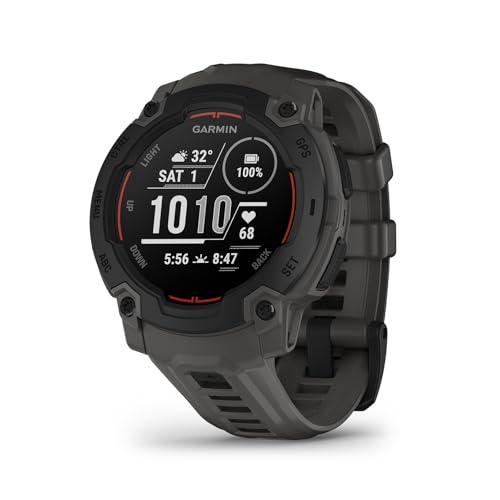
As an Amazon Associate we earn from qualifying purchases at no extra cost to you. Ratings are shown as listed on Amazon.
Quick comparison of the leading rugged watches
| Watch | Impact and water protection | Battery with GPS enabled | Navigation | Weight / case | Best for |
|---|---|---|---|---|---|
| Garmin Instinct 3 Solar 50 mm | Fiber-reinforced polymer; 10 ATM; tested to U.S. military thermal, shock and water-resistance standards | Up to about 40 hours in GPS mode; solar conditions can extend overall use | Trackback, breadcrumb routes, compass, altitude and barometer; no full-color topographic maps | About 59 g with strap; 50 mm polymer case | Budget-conscious hikers, runners and campers |
| Garmin fēnix 8 Solar 51 mm | Fiber-reinforced polymer with metal bezel; 10 ATM; tested to military thermal, shock and water standards | Up to about 95 hours in GPS mode, depending on settings and satellite mode | Full-color maps, turn-by-turn routing, multi-band GNSS, altimeter, barometer and compass | About 95 g with silicone strap; 51 mm case | Frequent hikers who want maps and extensive training tools |
| COROS VERTIX 2S | Titanium bezel, sapphire glass; 10 ATM; designed for high-altitude and endurance use | Up to about 118 hours in standard GPS mode | Offline maps, route following, breadcrumb navigation and dual-frequency GNSS | About 70 g without strap; 50.3 mm case | Long expeditions and ultradistance activities |
| Suunto Vertical | Stainless-steel or titanium versions; 100 m water resistance; sapphire-glass option | Up to about 60 hours in best-accuracy GPS mode; substantially longer in lower-power modes | Offline maps, route planning, dual-band GNSS, compass and storm alarm | About 74–86 g depending on version; 49 mm case | Map-focused hiking and mountain travel |
| Apple Watch Ultra 2 | Titanium case, sapphire crystal; IP6X dust resistance; 100 m water resistance and recreational diving support | Up to about 12 hours of outdoor workout GPS; less than expedition-oriented rivals | Offline maps, compass waypoints, backtrack, cellular option and detailed route guidance | About 61 g without strap; 49 mm case | iPhone owners wanting navigation plus a full smartwatch |
Battery figures are manufacturer maximums rather than guaranteed trail results. Cold temperatures, bright displays, multi-band positioning, music, cellular service and frequent map use can reduce runtime significantly. Solar charging is also supplementary: it can slow battery drain in strong sunlight, but it should not be treated as a replacement for charging before a multi-day trip.
Which rugged smartwatch should you buy?
Best value: Garmin Instinct 3
The Instinct 3 is the sensible pick when durability, readable data and long runtime matter more than a detailed map. Its high-contrast display is easier to read in direct sunlight than many glossy smartwatch screens, and its physical buttons remain practical in rain, gloves and muddy conditions. The 10 ATM rating is suitable for swimming and substantial water exposure, while the polymer construction keeps weight and replacement costs below those of titanium expedition watches.
Its compromise is navigation detail. You can follow a line, use Trackback and monitor elevation, but you do not get the same visual map experience as a fēnix 8, Suunto Vertical or VERTIX 2S. Choose it for established trails, bike routes and backcountry trips where you already carry a phone or paper map for terrain context.
Best for detailed navigation: Garmin fēnix 8
The fēnix 8 is the strongest all-round choice for hikers who regularly download routes and want maps, turn guidance, elevation data and multi-band GNSS in one device. Its ABC sensors—altimeter, barometer and compass—are more useful than a basic step counter when judging ascent, weather changes and direction. The touchscreen is convenient for panning around a map, while buttons provide a dependable alternative in wet conditions.
It is large and expensive compared with the Instinct 3. A 51 mm case can feel cumbersome on a smaller wrist, and the metal components add weight. The 47 mm version is a better fit for many users, though its battery capacity is lower. Consider the fēnix 8 if you will use mapping several times each month rather than merely wanting the most rugged-looking watch.
Best for maximum GPS endurance: COROS VERTIX 2S
The VERTIX 2S makes the most sense for multi-day routes, ultramarathons and trips where charging opportunities are limited. Its very long standard-GPS rating reduces the need to carry a power bank, and the combination of sapphire glass, titanium hardware and 10 ATM water resistance is reassuring in demanding environments.
The watch is physically large, and its software is more focused on endurance training and route navigation than on broad smartwatch functionality. Sensor data is useful for trends and trip decisions, but no wrist optical heart-rate sensor should be treated as equally reliable during every activity, skin tone, temperature or fit condition. Wear it securely above the wrist bone and use a chest strap when precise exercise readings matter.
Best map-centric alternative: Suunto Vertical
The Suunto Vertical is a strong choice for hikers who prioritize offline maps and long GPS life without moving fully into Garmin’s larger ecosystem. Its maps, route tools, storm alarm and altitude functions are especially useful in mountainous terrain. The 100 m water-resistance rating is excellent, but water resistance is not an impact rating: a watch can tolerate pressure underwater yet still suffer damage from a sharp blow to the crystal or bezel.
Best smartwatch for iPhone users: Apple Watch Ultra 2
Choose the Apple Watch Ultra 2 when messaging, calls, emergency connectivity, music, contactless payments and everyday apps are as important as trail functions. Its Action button, large crown and bright display are easier to operate than a small touchscreen, and the combination of offline maps, compass waypoints and backtrack works well for day hikes.
Its key weakness is multi-day battery life. A 12-hour outdoor GPS maximum leaves less margin for navigation mistakes, cold weather or an unplanned night outside than the Garmin, COROS or Suunto options. It also requires an iPhone, so it is not the right choice for Android users.
Impact rating, water rating and real-world durability
Look for several protections rather than one headline number:
- Water resistance: 10 ATM or 100 m is a useful baseline for rain, swimming and accidental immersion. It does not mean every watch is suitable for deep diving, hot tubs or high-pressure water jets.
- Dust resistance: An IP6X rating indicates strong dust protection, but watches without that marking can still be well sealed. Check the full manufacturer specification.
- Impact resistance: Sapphire crystal resists scratching better than mineral glass, while polymer bezels can absorb knocks and weigh less. Neither makes the watch indestructible.
- Standards testing: Military-standard testing can indicate exposure to shock, heat, cold and humidity, but it is not a promise that a particular fall will cause no damage.
The parts that commonly wear first are the strap, charging contacts, seals around buttons and the screen coating. Rinse salt, sweat and grit with fresh water, dry the watch before charging, and avoid charging it while wet. Do not press buttons underwater unless the manufacturer specifically permits it. Inspect the strap lugs before a remote trip; a cracked strap is a more common practical failure than a broken case.
Glove-friendly controls and sensor accuracy
Physical buttons are the safest choice for winter camping, cycling and wet-weather work. Touchscreens can register poorly through thick gloves, and a wet screen may interpret droplets as taps. The Garmin Instinct 3 and COROS VERTIX 2S are particularly straightforward when used primarily by buttons. The fēnix 8 and Apple Watch Ultra 2 offer both touch and physical controls, which is preferable when you want map interaction without giving up glove usability.
For navigation accuracy, dual-frequency or multi-band GNSS generally performs better around steep cliffs, dense forest and tall buildings than basic single-band positioning, although satellite geometry and canopy can still create errors. A watch’s compass must be calibrated away from vehicles, speakers, camp stoves and other magnetic objects. Barometric altitude is useful but can drift when weather pressure changes, so compare it with known map contours rather than treating every elevation number as exact.
Decision matrix by trip type
| Your situation | Recommended choice | Why |
|---|---|---|
| Occasional day hikes and a limited budget | Garmin Instinct 3 | Long runtime, physical controls and strong protection without paying for full maps |
| Weekly hiking with downloaded routes | Garmin fēnix 8 or Suunto Vertical | Offline maps and stronger route planning justify the extra cost |
| Several days away from outlets | COROS VERTIX 2S | Its GPS endurance leaves the largest charging margin |
| Winter use with thick gloves | Garmin Instinct 3 or COROS VERTIX 2S | Button-first operation is less frustrating than touchscreen dependence |
| iPhone-based everyday use plus hiking | Apple Watch Ultra 2 | Best integration with phone, communications and daily apps |
How to calculate the battery margin you actually need
Suppose a planned route includes 8 hours of walking per day for three days: 24 hours of active GPS use. Add 25% for cold, bright-screen map checks and occasional poor satellite conditions: 24 × 1.25 = 30 hours. A watch rated for 40 hours of GPS has a workable margin; a 12-hour GPS watch does not, unless you plan charging stops or carry a battery pack.
For a trip of this kind, choose the Instinct 3 if line navigation is sufficient, or the VERTIX 2S, fēnix 8 and Suunto Vertical if you need offline maps. Before leaving, download the route, set the satellite mode, confirm the battery percentage, and record a paper backup of key junctions. The most rugged smartwatch is an aid to navigation, not a substitute for route planning and basic map skills.






Write Your Review
No reviews yet. Be the first to share your experience!