

Key takeaways
- Independent front and rear straps: Let you control both seat-base position and backrest angle.
- Long enough webbing: Provides room to fit thick clothing or a wider kayak seat well.
- Cam or ladder-lock buckles: Hold tension more reliably than simple sliding adjusters.
- Fold-down backrest: Makes storage easier and can help with transport.
- Removable stiffener: Allows a supportive back panel to be stored flat or replaced if damaged.
- Lumbar panel or adjustable lower strap: Helps fine-tune where the seat contacts your back without forcing the entire backrest forward.
The best kayak seats for better back support are high-back, adjustable seats with a firm padded panel, four-point attachment straps, breathable fabric, and enough height to support your mid-back without interfering with paddling.
A seat can improve comfort substantially, but the right choice depends on your kayak’s attachment points and cockpit space. A tall seat that works well on a sit-on-top fishing kayak may be too bulky for a compact recreational kayak, while a thin clip-in seat may leave the lower back unsupported during a long day on the water.
Our top picks
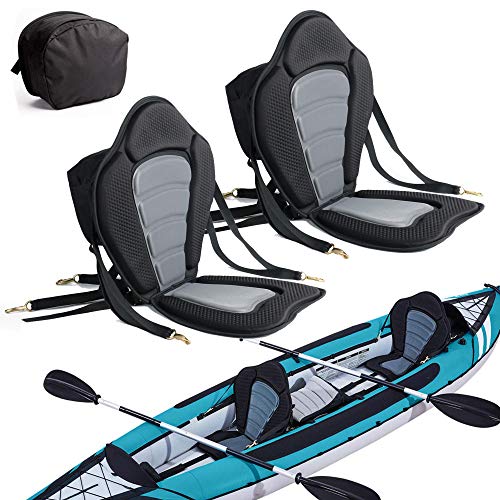


As an Amazon Associate we earn from qualifying purchases at no extra cost to you. Ratings are shown as listed on Amazon.
Best kayak seats by situation
| Situation | Best seat type | Key specifications to seek | Typical price range |
|---|---|---|---|
| Occasional recreational paddling | Standard padded high-back seat | 12–16 in back height, four straps, quick-release buckles | $35–$70 |
| Frequent day trips | Adjustable breathable touring seat | 16–20 in back height, ventilated mesh, lumbar adjustment | $70–$140 |
| Fishing or photography from a sit-on-top kayak | High-back elevated seat | 18–22 in back height, reinforced straps, corrosion-resistant hardware | $90–$180 |
| Small storage compartments | Low-profile folding seat | Under 3 in folded thickness, removable stiffener, compact strap layout | $30–$80 |
| Inflatable or broad recreational kayak | Universal adjustable seat | Four independent straps, 16–19 in width, wide hook-and-loop or clip points | $45–$100 |
What separates a supportive kayak seat from a padded cushion?
Seat-back height
Back height is the most visible difference between kayak seats, but taller is not automatically better. A low-back seat usually supports the lower back and allows unrestricted shoulder movement. It suits compact recreational kayaks and paddlers who prefer a more active, forward-leaning position.
A medium or high back, generally 16 to 22 inches above the seat base, gives more support when you are sitting upright for several hours. It is particularly useful on sit-on-top kayaks, where there is more room behind the paddler. Check that the upper edge does not press into your shoulder blades or obstruct a life jacket.
Cushioning: firm support beats maximum softness
Look for foam that is dense enough not to flatten quickly. Closed-cell foam resists water absorption and is easier to dry, while open-cell foam can feel softer but may retain water and lose shape sooner. A practical compromise is a firm molded or laminated foam base with a slightly softer contact surface.
Extra-thick padding can raise your hips and change the kayak’s balance. It may also make the paddle shaft feel too short because your hands sit higher relative to the water. For most recreational kayaks, a base cushion around 1 to 2 inches thick is sufficient. Elevated fishing seats may use more cushioning, but they should be installed only where the kayak is designed to remain stable with a higher seating position.
Ventilation and water management
Mesh or perforated fabric is valuable on warm days because it allows air to move between your back and the seat. It also drains faster than a solid, heavily padded back panel. Look for mesh that is supported by a strong perimeter rather than loosely stitched directly to the foam.
Ventilation does not mean the seat should stay wet. After paddling, remove it if possible, rinse away salt or sand, and dry it in shade. Persistent dampness encourages mildew and can corrode metal adjusters hidden inside the webbing.
Attachment points matter more than universal sizing claims
Most sit-on-top kayak seats use two front and two rear straps. The straps connect to molded D-rings, loops, or clips on the kayak. This four-point arrangement lets you adjust seat-back angle and keeps the seat from sliding forward when you brace with your feet.
Before buying, count and inspect your kayak’s attachment points. Some recreational kayaks have four dedicated rings; others have only rear rings and rely on a seat with front hooks. A seat cannot be made secure by tightening straps around an unsuitable carry handle or paddle bungee.
For saltwater use, prefer stainless-steel or corrosion-resistant plastic hardware. Plastic buckles are light and do not rust, but inexpensive versions can crack after repeated ultraviolet exposure. Webbing should be at least about 1 inch wide, with reinforced stitching at the buckle and attachment ends.
Adjustability: the features worth paying for
- Independent front and rear straps: Let you control both seat-base position and backrest angle.
- Long enough webbing: Provides room to fit thick clothing or a wider kayak seat well.
- Cam or ladder-lock buckles: Hold tension more reliably than simple sliding adjusters.
- Fold-down backrest: Makes storage easier and can help with transport.
- Removable stiffener: Allows a supportive back panel to be stored flat or replaced if damaged.
- Lumbar panel or adjustable lower strap: Helps fine-tune where the seat contacts your back without forcing the entire backrest forward.
A seat with four straps is not necessarily more adjustable than one with two. The useful question is whether each strap can be tightened independently while you are seated in the kayak. Buckles positioned where a life jacket or spray top covers them are frustrating to operate and may loosen unnoticed.
Sit-on-top versus recreational kayak compatibility
Sit-on-top kayaks
Sit-on-top kayaks generally offer the easiest seat compatibility because the seat rests on an open molded deck. High-back seats work well when the kayak has enough rear clearance and secure attachment loops. Anglers and photographers often prefer an elevated seat, but raising your center of gravity can reduce stability. Use the lowest comfortable position unless the kayak manufacturer specifically supports a raised seat.
Recreational sit-inside kayaks
A sit-inside kayak has less room for a replacement seat. The seat may need to fit between the cockpit rim, backband, thigh braces, and rear bulkhead. Measure the cockpit opening and the distance from the seat base to the back of the cockpit before ordering.
A tall universal seat can restrict torso rotation and make it harder to exit in an emergency. For a narrow or enclosed cockpit, choose a low-profile seat pad or a replacement backband designed for that kayak rather than forcing a large sit-on-top seat into the opening.
How to fit and adjust a kayak seat
- Place the seat centrally. Align it with the kayak’s centerline. An off-center seat can make paddling feel uneven and affect balance.
- Attach all available straps. Connect the front and rear straps to proper D-rings, clips, or loops before tightening any one strap fully.
- Set the backrest nearly upright. Begin with an angle that supports your back without pushing your shoulders forward.
- Adjust while seated. Tighten the rear straps until the backrest supports you, then adjust the front straps so the seat base does not slide.
- Check paddle clearance. Take several strokes on both sides. Your elbows and paddle should move freely without striking the seat.
- Test stability close to shore. Shift your weight gradually and confirm that the seat remains fixed before going on a long trip.
Do not use the seat as a substitute for a properly fitted personal flotation device. A bulky backrest can also interfere with the flotation device, so try both together before committing to a seat.
Durability and ownership costs
The parts that usually wear first are buckle teeth, strap stitching, mesh panels, and foam edges. Sand trapped under the seat accelerates abrasion, while leaving a wet seat folded in a hatch encourages mildew. Rinse after saltwater use, allow the seat to dry completely, and store it loosely folded away from direct sunlight.
Replacement straps and buckles are often inexpensive, but a torn back panel or collapsed foam may make replacement more practical than repair. As a simple ownership calculation, a $90 seat used for 30 outings costs about $3 per outing in its first season. If careful cleaning extends it to 75 outings, the cost falls to about $1.20 per outing. That makes secure hardware and washable, quick-drying materials worth prioritizing over decorative padding.
Bottom line
Choose a medium- or high-back seat with firm water-resistant foam, breathable covering, four independent attachment straps, and hardware suited to your water conditions. For a sit-on-top kayak, prioritize back support and secure attachment points; for a recreational sit-inside kayak, prioritize low profile and cockpit clearance. The best kayak seats are not simply the thickest ones—they are the seats that fit the kayak, hold their adjustment, drain quickly, and support a natural paddling position.






Write Your Review
No reviews yet. Be the first to share your experience!