

Key takeaways
- Aluminum: light and naturally resistant to rust, making it a strong choice for saltwater users. Thin tubing can bend if the cart is dragged sideways or overloaded.
- Stainless steel: strong and durable, but usually heavier. Rinse it after saltwater use; “stainless” does not mean corrosion-proof.
- Powder-coated steel: often offers good value and stiffness. Scratches can expose the steel, so rinse, dry, and touch up damaged areas.
- Plastic or composite components: useful for cradles, hubs, and bumpers because they do not rust. Inspect them for cracking after impacts and winter storage.
The best kayak carts are chosen by terrain and kayak shape first: use a large pneumatic-wheel cart for sand and rough ground, a compact folding cart for car-to-launch trips, and a wide bunk-style cart for heavy, flat-bottomed, or fishing kayaks.
Our top picks

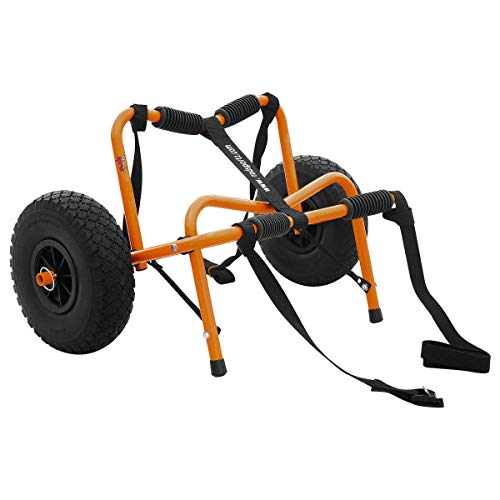

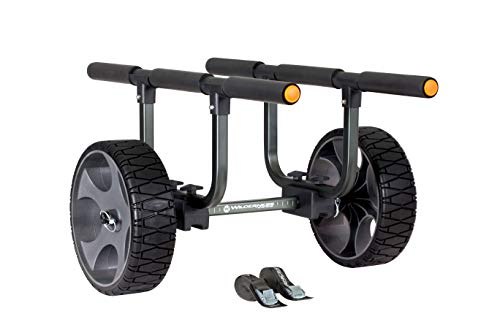
As an Amazon Associate we earn from qualifying purchases at no extra cost to you. Ratings are shown as listed on Amazon.
Quick picks by paddling situation
| Situation | Best cart type | Useful target specification | Why it fits |
|---|---|---|---|
| Short walks on pavement or a firm trail | Folding two-wheel frame cart | 8–10 inch solid or semi-pneumatic wheels; 100–150 lb capacity | Light, compact, and quick to store |
| Sand, gravel, roots, and soft ground | Wide pneumatic-wheel cart | 12–16 inch tires; 150–200 lb capacity | Larger tires roll over obstacles and spread the load |
| Heavy fishing or tandem kayak | Wide bunk or cradle cart | Adjustable supports; 150–250 lb capacity | Supports more hull area and reduces point loading |
| Limited vehicle or apartment storage | Folding frame cart | Folded length under about 24 inches; under 10 lb preferred | Fits in a hatchback, trunk, or gear cupboard |
| Frequent launches and long portages | Corrosion-resistant aluminum or stainless-steel cart | Replaceable wheels and robust strap system | Better long-term ownership than the cheapest utility cart |
What separates the best kayak carts
A kayak cart is not simply a pair of wheels. The frame must keep the boat balanced, the supports must suit the hull, and the strap must stop the kayak from shifting when the path becomes uneven. A cart rated for 150 pounds may carry a 70-pound recreational kayak easily but still be a poor choice if its narrow supports sit on a curved hull.
Wheel size and terrain performance
Wheel diameter has a larger effect than many buyers expect. Small 6–8 inch wheels are compact and work well on concrete, asphalt, docks, and hard-packed paths. They catch more easily on cracks, gravel, and roots. Wheels around 10–12 inches are a useful compromise for mixed surfaces.
For beaches and soft trails, look for 12–16 inch pneumatic tires with a broad tread. The extra diameter rolls over small obstacles, while lower tire pressure creates a larger contact patch. Wide wheels are especially valuable on sand, but they also make the cart heavier and wider to store. Check that the tire valve remains accessible after the kayak is loaded, and carry a small pump if you travel far from the car.
Solid wheels eliminate punctures and usually require less maintenance. They are convenient for short, predictable routes, but can transmit more vibration to the boat and may sink into loose sand. Pneumatic tires ride more smoothly but eventually need air, and their tubes or sidewalls can be damaged by sharp rocks.
Frame material
- Aluminum: light and naturally resistant to rust, making it a strong choice for saltwater users. Thin tubing can bend if the cart is dragged sideways or overloaded.
- Stainless steel: strong and durable, but usually heavier. Rinse it after saltwater use; “stainless” does not mean corrosion-proof.
- Powder-coated steel: often offers good value and stiffness. Scratches can expose the steel, so rinse, dry, and touch up damaged areas.
- Plastic or composite components: useful for cradles, hubs, and bumpers because they do not rust. Inspect them for cracking after impacts and winter storage.
For occasional flat-water paddling, a lightweight aluminum frame is generally sufficient. A heavy tandem, pedal-drive fishing kayak, or route involving curbs justifies a sturdier frame and wider supports more than a higher advertised load rating alone.
Head-to-head: narrow carts versus bunk-style carts
Narrow center-support carts
These carts place a padded bar, V-shaped cradle, or pair of supports beneath the kayak’s keel area. They are usually lighter, fold more compactly, and work well with sit-in kayaks and narrower recreational boats. Their weakness is concentrated pressure: on a wide, flat hull, the cart may rock or leave the sides unsupported.
Wide bunk and cradle carts
Bunk-style carts use two padded rails or adjustable arms to support more of the hull. They are the safer design for broad fishing kayaks, tandem kayaks, and boats loaded with a seat, pedal drive, battery, or tackle. The trade-off is greater width, weight, and setup time. The bunks must be positioned symmetrically; otherwise the cart can steer the boat to one side.
For a sit-on-top kayak with a pronounced center keel, either design may work. For a hull with a deep V, rounded bottom, or unusual chines, prioritize adjustable padding over a nominally higher weight capacity.
Straps, kickstands, and folding designs
A good strap system has a long webbing strap, a protected cam buckle, and enough adjustment to pass around the hull without contacting sharp fittings. Cam buckles are generally easier to release than ratchet mechanisms and are less likely to crush a lightweight hull. A padded strap or buckle cover helps prevent scratches.
Two strap points are preferable for uneven trails. One strap near the center can hold a kayak on a smooth path, but the boat may rotate around the cart when crossing roots or a slope. Do not rely on the bow or stern carry handle as the only restraint; those handles are designed for carrying the unloaded boat, not necessarily for controlling a loaded cart.
Folding carts differ in useful ways. A hinged frame folds quickly but may occupy more space than a collapsible model. A telescoping frame can fit different hull widths but adds joints that need inspection. Removable wheels reduce storage width, while permanently attached wheels are faster at the launch. A kickstand is valuable because it lets one person load the kayak without holding both the boat and the cart, although it can catch on uneven ground if left deployed.
Decision matrix: match the cart to your ownership pattern
| Your priority | Choose | Avoid |
|---|---|---|
| Lowest reasonable cost and occasional use | Basic aluminum or coated-steel cart with 8–10 inch wheels | Oversized beach tires that add cost and storage bulk |
| Beginner who wants simple loading | Cart with a kickstand, padded cradle, and one clearly routed strap | A bare frame requiring the kayak to be balanced by hand |
| Frequent use in saltwater | Aluminum or stainless frame, polymer hubs, replaceable pneumatic tires | Unprotected mild steel and sealed parts that cannot be rinsed |
| Small car or limited storage | Removable-wheel or folding cart under roughly 10 lb | Fixed wide frames with 16-inch wheels |
| Heavy fishing kayak | Wide adjustable bunks and at least a 150 lb rated capacity | Narrow keel-only supports or a cart used close to its limit |
Capacity: calculate the real load
Use the fully loaded kayak weight, not the empty-hull specification. For example:
55 lb kayak + 12 lb seat and accessories + 15 lb water and safety gear + 18 lb tackle = 100 lb loaded weight.
A sensible target is a cart rated for at least 125–150 lb, leaving roughly 25–50 percent capacity in reserve for bumps, uneven loading, and imperfect weight distribution. If the cart will carry a 90 lb fishing kayak plus 40 lb of equipment, a 150 lb rating is a minimum rather than a comfortable margin. Capacity ratings are not always measured under identical conditions, so frame width, axle strength, and support design still matter.
Setup and maintenance that prevent most failures
- Find the balance point. Place the cart near the kayak’s center of gravity, commonly somewhat behind the cockpit on a sit-in kayak. A bow that drops heavily indicates the cart is too far aft; a stern that drags indicates it is too far forward.
- Center the hull. Both supports should contact the hull evenly. Do not let a sharp keel rest on an unpadded metal edge.
- Attach the strap before moving. Tighten until the hull cannot shift, but stop before deforming a thin plastic or composite deck.
- Test with a short push. Walk a few yards, check the strap and wheel alignment, then continue. This catches slipping supports before a long portage.
- Rinse after every saltwater trip. Flush axles, wheel hubs, buckles, and frame joints with fresh water, then dry them. Salt and sand can work into wheel bearings and folding hinges.
- Inspect wear points. Replace frayed straps, cracked cradles, bent axle retainers, and tires with deep cuts. Check pneumatic pressure before each trip.
The parts most likely to wear first are straps, tire tubes, wheel bearings, and foam padding. These are usually replaceable, but confirm that replacement wheels and hardware are available before buying an unusually specialized cart. Store the cart dry and avoid leaving it strapped under a kayak in direct sun for weeks; ultraviolet exposure weakens webbing and foam.
Bottom line
For most paddlers, the best kayak cart is a corrosion-resistant folding model with 10–12 inch wheels, padded adjustable supports, a two-point strap, and a capacity comfortably above the kayak’s loaded weight. Move up to wide pneumatic tires for sand and rough trails, or to a bunk-style frame for a heavy, broad, or unusually shaped kayak. The right fit and wheel design will matter more than the highest capacity number printed on the package.





Write Your Review
No reviews yet. Be the first to share your experience!