

Key takeaways
- Compare the best water containers for camping, RV trips and emergency storage, from rigid spigot jugs and military cans to collapsible carriers and bags.
As an Amazon Associate we earn from qualifying purchases.
Affiliate Disclosure: This article contains affiliate links. If you buy through a link on this page, we may earn a commission at no extra cost to you.
Water is the one supply no campsite, RV park or emergency kit can run short on, and the container you haul it in matters more than most people expect. A good water container pours without glugging, seals tightly enough to ride in a trunk, and is shaped for the space it has to live in. A bad one leaks at the cap, cracks at a seam, or is simply too heavy to move once it is full.
The five containers below cover the main formats campers and preppers actually use: a large rigid jug with a hideaway spigot, a military-spec can built for abuse, a classic spigot carrier for picnic tables and tailgates, a collapsible cube that folds flat when empty, and a soft expedition bag that rolls into a pack. Capacity is the first filter, because water is heavy — one gallon weighs about 8.3 pounds, so a full seven-gallon jug is close to 58 pounds of water alone. Match the size to who has to lift it, then look at how it pours.
1. Reliance Aqua-Tainer 7 Gallon — the big rigid jug for basecamp and storage

The Aqua-Tainer is the container most people picture when they think of stored camp water: a square, rigid jug with a molded handle and a spigot that stores inside the cap when it is not in use. At 7 gallons it is the largest option here, which makes it a natural fit for a family basecamp, an RV site with no hookup, or a home emergency shelf where it can sit filled and ready.
The square footprint stacks neatly against other gear, and the hideaway spigot design means there is no protruding tap to snap off in transit — you unscrew the cap assembly, flip the spigot out, and pour. Reliance describes the container as food-grade, and the rigid walls hold their shape year after year in a way soft containers cannot. The honest trade-off is bulk: full or empty, it takes up the same 11.3 by 11.0 by 15.3 inches, and full it is a two-hand, bend-your-knees lift.
Specs
- Capacity: 7 gallons (26.5 liters)
- Dimensions: 11.3 x 11.0 x 15.3 inches
- Construction: rigid molded plastic, square stackable body
- Dispensing: hideaway spigot stored inside the cap, reversible pour spout
- Model: 9410-03 (part number 941003)
ASIN: B001QC31G6
Source: https://www.amazon.com/dp/B001QC31G6
2. Scepter 5 Gallon Military Water Container — the durability pick

Scepter builds fuel and water cans for military use, and this 5-gallon (20-liter) container follows the same pattern: thick food-grade polyethylene walls, a single chunky carry handle, and a shape — tall and narrow at 13.5 x 6.75 x 19 inches — that slides into vehicle cargo areas and stays upright. The listing states the material is BPA-free and PVC-free, and the can is built to military specifications for impact resistance.
Instead of a spigot, the Scepter uses a pour spout with a separate vent cap. Loosen the vent and water flows smoothly instead of surging; that two-part system has fewer moving parts than a faucet-style tap, which is exactly what you want in a container that gets thrown in trucks and stored for years. At 4.5 pounds empty it is the heaviest shell here relative to its size, but that weight is wall thickness, and wall thickness is what survives drops onto concrete. If a container will live in a work vehicle or an emergency cache and only come out when things go wrong, this is the format to beat.
Specs
- Capacity: 5 gallons (20 liters)
- Dimensions: 13.5 x 6.75 x 19 inches
- Empty weight: 4.5 pounds
- Material: food-grade polyethylene, BPA-free and PVC-free per the listing
- Dispensing: pour spout with vent cap for smooth, controlled pouring
- Model: 05935 (AM Sand)
ASIN: B001IV8IYA
Source: https://www.amazon.com/dp/B001IV8IYA
3. Coleman Chiller 5-Gallon Water Container — the tabletop spigot carrier

Coleman’s Chiller water container is the classic picnic-table jug: a 5-gallon rigid carrier with a molded-in handle and a fast-flow spigot at the base, so it sits on the edge of a table or tailgate and fills cups and pots by gravity. For car camping and RV use, that hands-free dispensing is the whole point — nobody has to tip a 40-plus-pound jug every time someone wants a drink.
The Chiller line is a carrier rather than an insulated cooler jug, so do not expect it to keep water cold the way an insulated beverage cooler would; its job is storage and easy pouring. The spigot is the component to treat kindly — it is replaceable on this style of carrier, and keeping a spare faucet assembly in the camp kitchen box is cheap insurance against the one part that can end a trip’s water plan. Five gallons is also a sensible ceiling for a container one person needs to carry from a campground spigot back to the site.
Specs
- Capacity: 5 gallons
- Dispensing: fast-flow spigot for gravity dispensing from a table edge
- Carry: molded-in handle and hand grip
- Construction: rigid plastic carrier (non-insulated)
- Part number: 2161495
ASIN: B09HN15V31
Source: https://www.amazon.com/dp/B09HN15V31
4. WaterStorageCube Collapsible Water Container 5.3 Gallon — the space saver
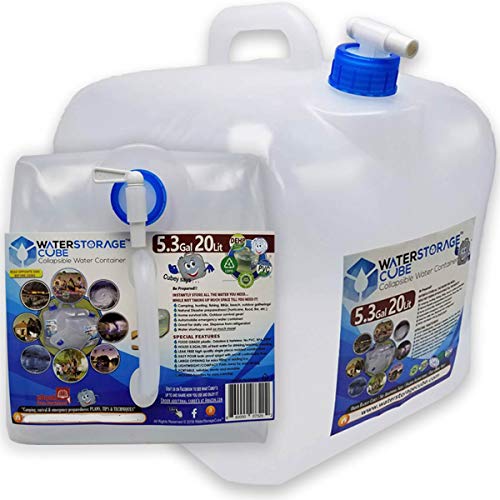
The WaterStorageCube solves the rigid jug’s biggest flaw: it folds flat when empty. The 5.3-gallon version is a soft cube of food-grade, BPA-free material (per the brand) with a spigot at the base, so in use it behaves like a tabletop dispenser, and in storage it flattens into a drawer, a door pocket or the bottom of a tote. For apartment dwellers building an emergency kit, or RVers whose storage bays are measured in inches, that difference is decisive.
The trade-offs are real and worth stating plainly. Soft walls need a flat, stable surface to dispense well, the material will not shrug off the drops and abrasion a military can takes, and like every container here, the spigot and its seal are the most likely leak points — check them before a trip, not during one. In exchange you get full-size capacity with near-zero storage cost, which no rigid jug can match. Many owners keep two: one filled for emergencies, one folded as the travel spare.
Specs
- Capacity: 5.3 gallons (20 liters)
- Material: food-grade, BPA-free per the brand
- Dispensing: built-in spigot
- Packed size: folds flat when empty
- Also sold in smaller 1.3- and 2.6-gallon sizes under the same line
ASIN: B07FVJLYZ4
Source: https://www.amazon.com/dp/B07FVJLYZ4
5. MSR Dromedary Bag 4-Liter — the packable expedition bag

The Dromedary is the soft option built for people who carry their water on their backs. The 4-liter size weighs just 6.9 ounces empty, measures 10 by 18.3 inches flat, and rolls or folds into a pack once it is empty — yet the shell is 1,000-denier fabric laminated with a food-grade polyurethane lining, which is why these bags have an expedition reputation that thin collapsible cubes do not. MSR describes the lining as BPA-free, and the bags are assembled in the USA.
The 3-in-1 cap is the clever part: one closure handles wide-mouth filling, controlled pouring and a small drink spout, and perimeter webbing makes the bag easy to lash to a pack or hang at camp. Four liters is roughly one gallon, so this is a personal or two-person solution rather than a family water station — bigger 6- and 10-liter versions exist in the same line for basecamp hauling. It will not stand on a table and dispense like the spigot jugs, and that is fine: it is solving a different problem.
Specs
- Capacity: 4 liters (about 1.06 gallons)
- Empty weight: 6.9 ounces
- Dimensions: 10 x 18.3 inches (flat)
- Material: 1,000-denier fabric with food-grade polyurethane laminate lining, BPA-free per MSR
- Cap: 3-in-1 cap for filling, pouring and drinking; perimeter webbing for lashing and hanging
- Part number: 09586
ASIN: B01MXWBDLV
Source: https://www.amazon.com/dp/B01MXWBDLV
How to Choose the Right Water Container
Start with capacity and lifting math. Water weighs about 8.3 pounds per gallon. A 5-gallon container is a 42-pound lift before the jug itself; a 7-gallon jug approaches 60 pounds full. Choose the largest size the person refilling it can genuinely carry from the tap, or plan on filling in place with a hose.
Pick the dispensing style for the setting. Spigot jugs (the Aqua-Tainer, Coleman and WaterStorageCube) belong on a table edge at a fixed camp. A pour spout with a vent (the Scepter) suits vehicle storage and topping off pots and bottles. A soft bag with a multi-use cap (the Dromedary) suits carrying water to camp rather than serving it.
Rigid versus collapsible is a storage question. Rigid containers protect water, stack well and last for years, but they consume the same space empty as full. Collapsible containers nearly vanish in storage but need flat surfaces, gentler handling and more frequent seam and spigot checks.
Check the closure before anything else. Across every format, caps and spigots are where containers fail. Look for closures that can be opened for cleaning, confirm replacement spigots exist for tabletop models, and inspect gaskets at the start of each season.
Remember what a container cannot do. These products store water; they do not purify it. Water from a lake, river or questionable tap still needs filtration or treatment before drinking, and stored water should be kept cool and dark and refreshed periodically.
FAQ
How long can water be stored in these containers?
Municipal tap water stored in a clean, food-grade container kept in a cool, dark place is commonly refreshed every six months as a precaution. The container matters less than cleanliness at filling time and storage conditions.
Are these containers safe for drinking water?
Each pick here is described by its maker as food-grade, and several list BPA-free materials. Rinse a new container before first use, and only use containers intended for potable water — never a can that has held fuel.
Which size is best for a family campsite?
For a family of four at a dry campsite, a 5- to 7-gallon spigot jug at the kitchen plus a smaller container for the tent area is a practical setup, refilled daily where a tap is available.
Can collapsible containers really hold up?
They hold up to normal camp use, but they are not the equal of rigid cans for abrasion and drops. Treat them as space-saving carriers, keep them off sharp ground, and check the spigot seal regularly.
How do I clean a water container?
Wash with warm water and a small amount of mild dish soap, rinse thoroughly, and let it dry completely with the cap off before storing. Wide openings and removable spigots make this much easier, which is worth weighing when you buy.
Conclusion
The right water container is the one that fits your water source, your vehicle and your storage space. Choose the Reliance Aqua-Tainer for maximum rigid capacity with a protected spigot, the Scepter military can when durability outranks everything, the Coleman Chiller for easy tabletop dispensing, the WaterStorageCube when storage space is the constraint, and the MSR Dromedary when the water has to travel in a pack. Whichever format you pick, test the cap and spigot at home first — a container that seals on day one and pours cleanly is the whole point of carrying one.
More from Amazon
Programs that pair well with the guide above. Offers and eligibility are set by Amazon and may change.
Free shipping on eligible items, Prime Video and more. Eligible new members can start with a free trial.
Start a Prime free trialA Prime membership for ages 18-24 with a trial period. Eligibility is set by Amazon.
See Prime for Young AdultsAudiobooks and podcasts to listen to on the go. Eligible new members can start with a free trial.
Try Audible freeAd-free music streaming. Eligible new subscribers can start with a free trial.
Try Music Unlimited freeAs an Amazon Associate we earn from qualifying purchases.










Write Your Review
No reviews yet. Be the first to share your experience!