

Key takeaways
- Compare five shade sails for patios, decks and campsite yards, with fabric weights, UV block figures, corner hardware and tensioning advice for each.
As an Amazon Associate we earn from qualifying purchases.
A shade sail is the simplest permanent-looking shade you can put over a patio, a deck or a campsite yard: a sheet of knitted HDPE fabric, tensioned between posts, walls or trees, that cuts the sun while still letting air move through it. There are no poles in the middle of your seating area, no frame to fold away, and nothing to crank open every morning. The trade-off is that a sail is only as good as its installation. Hung flat and slack, the same sail that should give you a cool corner will flap, pool rainwater and eventually tear its own corners apart.
This guide compares five sails sold on Amazon, from a heavy 190 GSM rectangle built for a fixed backyard install to a ready-to-hang triangle with ropes already attached that suits a seasonal campsite pitch. Every pick below is a permeable HDPE sail, and each Specs block lists the fabric weight, the maker’s UV block figure, the edge and corner construction, and whether any hardware or ropes come in the package.
Affiliate Disclosure: This article contains affiliate links. If you buy through a link on this page, the site may earn a commission at no extra cost to you.
What to check before you buy a shade sail
Shape and real coverage. Triangle sails are easier to tension and suit corners and small decks, but they shade less area than the headline size suggests because the edges curve inward. Rectangle and square sails cover more ground and work better over dining sets and camp kitchens, but they need four solid anchor points and more careful tensioning. On every listing here, the stated size is the finished sail measured from D-ring to D-ring, not the distance between your posts.
Leave room for hardware. A sail must sit smaller than the span between its anchor points. Makers generally advise leaving roughly 1.5 to 2 feet of total allowance for turnbuckles, rope and tensioning space. If your posts are exactly 16 feet apart, a 16 foot sail will never get tight.
Slope is not optional. A sail needs a deliberate slope, with one side or one corner set noticeably lower than the others, so rain runs off instead of gathering. A flat sail pools water in the middle; that standing water is heavy, and the load transfers straight to the corners, which is how D-rings tear out and seams let go. Several makers below specify a 20 to 40 degree installation angle for exactly this reason.
Permeable means it is not a rain shelter. All five sails in this guide are woven or knitted HDPE that lets some rain pass through. They will soften a drizzle and stop it feeling like a downpour underneath, but in real rain you will get wet. If you need waterproof cover, you need a different, coated product class entirely, and those come with their own pooling problems.
Fabric weight and UV figures. Fabric weight is listed in GSM (grams per square metre). Around 185 GSM is the common standard for residential sails; 190 GSM and up is the heavier commercial end. UV block percentages are figures stated by each maker for that fabric, and they vary by colour, so treat them as the maker’s claim for the listed colour rather than a lab result you can compare across brands with total confidence.
Hardware is often a separate purchase. Most sails ship as fabric only: corner D-rings fitted, but no turnbuckles, pad eyes or posts. Two picks below include ropes instead, which suits temporary rigs. Budget your install accordingly and take any sail down ahead of storms and high winds, whatever the hardware.
1. ColourTree 12′ x 16′ Rectangle Shade Sail (CTAPR1216)
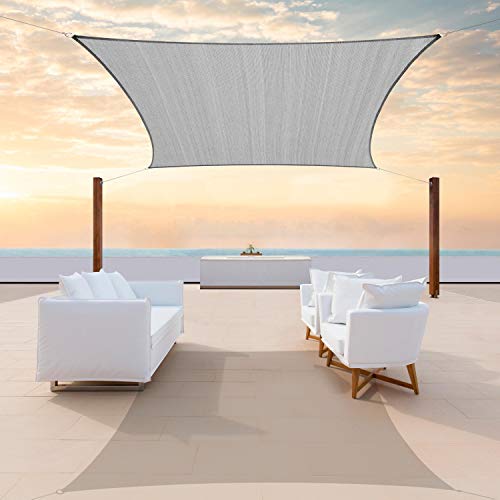
ColourTree is the heavy-duty pick of this group. The fabric is 190 GSM HDPE, which the maker describes as 100 percent virgin (non-recycled) material, and the range is built around commercial-style construction: curved concave edges that keep the centre of the sail flat under tension, reinforced webbing around the perimeter, and stainless steel D-rings at each corner. The 12 by 16 foot rectangle in grey is a sensible size over a six-seat patio set or a camp kitchen, and the same listing family runs to many other rectangles, squares and triangles, plus custom sizes if your anchor points fall between standard dimensions.
The maker’s stated figure is UPF 50 UV block for the fabric. ColourTree sells its stainless hardware kits separately, and this sail ships as fabric with D-rings only, so a fixed install needs a turnbuckle kit on top. For a permanent backyard or cabin deck setup where the sail goes up in spring and comes down in autumn, this is the most substantial fabric in the guide.
Specs
- Shape and size: Rectangle, 12′ x 16′ (other sizes and custom sizes in the same range)
- Fabric: 190 GSM HDPE, stated by the maker as virgin (non-recycled) material
- UV protection: UPF 50 block, as stated by the maker
- Edges: Curved (concave) edges with reinforced perimeter webbing
- Corners: Stainless steel D-rings
- Hardware: Not included; mounting hardware kit sold separately
- Colour shown: Grey (many other colours in the range)
2. Shade&Beyond 16′ x 16′ x 16′ Triangle Shade Sail

Shade&Beyond’s 16 foot triangle is the big-coverage triangle here, sized for the corner of a deck, over a pool edge or across a campsite seating area where three anchor points are easier to find than four. The fabric is 185 GSM HDPE with stainless steel D-rings, and the maker is unusually clear about the details that matter: the 16 foot measurement runs D-ring to D-ring, the sail should be mounted at a 20 to 40 degree angle so water sheds instead of pooling, and the fabric carries a stated service life of five years against UV degradation.
Shade&Beyond states up to 95 percent UV block for this fabric. One point to plan around: the package contains the sail only, with no hardware kit and no ropes, so trees, posts or walls plus a separate fitting kit are on you. That is normal for sails at this size, but it is worth knowing before the box arrives. For a semi-permanent backyard install with proper turnbuckles, this is a well-documented triangle with honest instructions.
Specs
- Shape and size: Triangle, 16′ x 16′ x 16′, measured D-ring to D-ring
- Fabric: 185 GSM HDPE
- UV protection: Up to 95% block, as stated by the maker
- Edges: Curved edges, reinforced stitching
- Corners: Stainless steel D-rings
- Hardware: Not included; no ropes included
- Colour shown: Sand (other colours in the range)
3. Coolaroo Ready-to-Hang Triangle Shade Sail, 16′ 5″
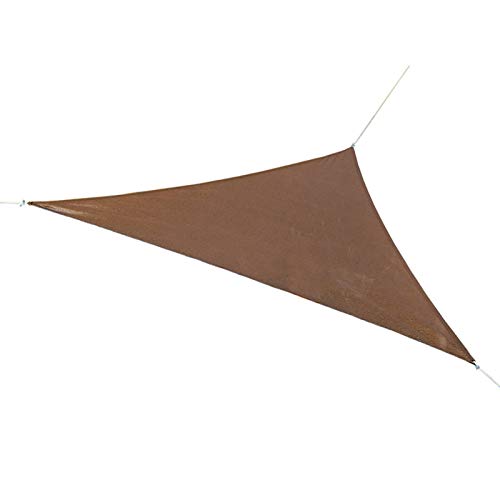
Coolaroo takes the opposite approach to the two sails above: instead of asking you to source turnbuckles, this triangle arrives with 16 foot ropes pre-attached at the corners, so it can go up between trees, posts or a fence in minutes and come down just as fast. That makes it the natural campsite and seasonal pick of this guide, and a good fit for renters or anyone testing whether a sail works over their deck before committing to drilled pad eyes and posts.
The knitted HDPE fabric is breathable, which helps hot air escape upward instead of trapping it under the canopy, and the listing states 90 percent UV block. At 16 feet 5 inches per side it is a large triangle, so it still needs a proper slope and real tension on those ropes; ready-to-hang does not mean throw it up level and forget it. Coolaroo does not publish a GSM figure for this ready-to-hang line, so the Specs block records that plainly rather than guessing.
Specs
- Shape and size: Triangle, 16′ 5″ per side
- Fabric: Knitted HDPE, breathable weave
- Fabric weight: Not published by the maker for this line
- UV protection: 90% block, as stated in the listing
- Edges: Reinforced corners
- Hardware: Included — ropes pre-attached at the corners (16 ft ropes); no separate kit required
- Colour shown: Mocha (other colours in the range)
4. Artpuch 12′ x 16′ Rectangle Shade Sail, Cream

Artpuch’s rectangle is the value-leaning fixed install of the group: 185 GSM HDPE with deeply curved edges, reinforced webbing and stainless steel D-rings, in a 12 by 16 foot size that matches the ColourTree above, so the two are easy to compare directly. Artpuch states up to 95 percent UV protection for the fabric, and its instructions repeat the key installation points: mount at a 20 to 40 degree angle with maximum tension so water runs off, and take the sail down during storms and periods of strong wind.
As with most fixed sails, the hardware kit is not included in the package, so a turnbuckle and pad-eye set is a separate purchase. The range covers rectangles, squares and triangles in a wide spread of sizes, including custom dimensions. If you are fitting out a cabin deck or a permanent camp kitchen shelter and want the curved-edge, D-ring construction without moving up to 190 GSM fabric, this is the straightforward option.
Specs
- Shape and size: Rectangle, 12′ x 16′ (other sizes and custom sizes in the same range)
- Fabric: 185 GSM HDPE
- UV protection: Up to 95% block, as stated by the maker
- Edges: Curved edges with reinforced webbing
- Corners: Stainless steel D-rings
- Hardware: Not included; hardware kit sold separately
- Colour shown: Cream (other colours in the range)
5. Coolyard 12′ x 16′ Rectangle Shade Sail, Sand

Coolyard splits the difference between the fixed and temporary camps. The sail itself is a standard permeable rectangle in 185 GSM HDPE with stainless steel D-rings, but the package includes PE ropes for all four corners, so a first install between posts or trees needs nothing extra. The maker states a 90 percent shading rate and 98 percent UV block for this fabric; as noted above, UV percentages are maker figures and are not measured the same way by every brand, so read this one as Coolyard’s claim for its own cloth rather than proof it out-blocks the 190 GSM sail in this guide.
The listing also walks through the allowance rule, advising 1.5 to 2 feet between the fixing point and the sail corner for hooks or ropes, which is the detail first-time installers most often miss. Coolyard states free exchange within five years under normal use and weather. For a campsite yard or a garden where the sail goes up and comes down with the seasons, ropes included in the box is a genuine convenience.
Specs
- Shape and size: Rectangle, 12′ x 16′
- Fabric: 185 GSM HDPE, permeable (not waterproof)
- UV protection: 98% UV block and 90% shading rate, as stated by the maker
- Edges: Reinforced edges
- Corners: Stainless steel D-rings
- Hardware: PE ropes included (four for rectangle sails); no metal hardware kit
- Colour shown: Sand
Hanging it, and keeping it alive
Whichever sail you choose, the same rules decide whether it lasts. Anchor points take serious load once a sail is tensioned and the wind picks up, so posts need to be set deep and house fixings need to land in structure, not siding. Tension the sail until the centre is flat with no wrinkles, keep that runoff slope, and re-tension after the first week as the fabric and ropes settle. Take the sail down before storms, high winds and, in cold climates, before snow load can sit on it. A quick wash with mild soap and a hose is all the cleaning knitted HDPE asks for; let it dry fully before storing it rolled rather than folded.
Match the pick to the job: the ColourTree for a heavy fixed install, the Shade&Beyond for a large triangle on proper hardware, the Coolaroo for fast seasonal or campsite rigging, the Artpuch for a curved-edge rectangle on a tighter budget of effort, and the Coolyard when you want ropes in the box and a sail that travels between sites.
More from Amazon
Programs that pair well with the guide above. Offers and eligibility are set by Amazon and may change.
Free shipping on eligible items, Prime Video and more. Eligible new members can start with a free trial.
Start a Prime free trialA Prime membership for ages 18-24 with a trial period. Eligibility is set by Amazon.
See Prime for Young AdultsAudiobooks and podcasts to listen to on the go. Eligible new members can start with a free trial.
Try Audible freeAd-free music streaming. Eligible new subscribers can start with a free trial.
Try Music Unlimited freeAs an Amazon Associate we earn from qualifying purchases.







Write Your Review
No reviews yet. Be the first to share your experience!