

Key takeaways
- The best room dividers for studios, bedrooms and shared spaces, compared on usable span, height, light, stability, hinges and folded storage.
As an Amazon Associate we earn from qualifying purchases.
A folding room divider is the fastest way to turn one room into two without building anything. It can screen off a bed in a studio, give a home office a clean backdrop, or carve a dressing corner out of a shared bedroom, and when the lease ends or the guests leave, it folds flat and goes back in a closet. That renter-friendly, no-tools quality is exactly why these screens stay popular.
It is also worth being clear about what a divider cannot do before choosing one. A folding screen provides visual privacy only. It blocks sight lines; it does not block sound at all. Conversation, television audio and a roommate’s alarm clock pass straight over and around it. If the problem is noise, a divider is the wrong tool. If the problem is being seen, it is the right one.
How to Choose a Room Divider
Measure the span honestly. Divider widths are quoted flat, with every panel stretched in a straight line. A screen cannot stand like that — stood dead straight, the first draft knocks it over. It has to zigzag, and the zigzag costs width. A useful rule is that the usable standing span is roughly 80 percent of the quoted flat width. A screen sold as 96 inches wide really covers about 76 inches of floor line. Buy for the 80 percent figure, not the headline figure.
Check the height against the job. Most folding screens stand between about 5.5 and 6 feet tall. That is enough to hide a bed, a desk or a person sitting down, and to block the view from a doorway. It does not reach the ceiling, and it is not meant to: the gap at the top keeps the room feeling open and lets air and light circulate. Only the extra-tall format, at over 7 feet, gets close to ceiling height in a standard room.
Match the material to the light. Translucent panels, such as shoji rice paper, glow when light falls behind them. That looks beautiful and keeps a divided room bright, but it also means silhouettes show through: anyone standing between a lamp and a shoji screen is visible as a shadow figure. Woven fiber sits in the middle, blocking direct views while letting a little texture of light through the weave. Opaque wood and heavier fabric block light completely and give the firmest visual privacy.
Look at the hinges. Two-way (double) hinges let panels fold in either direction, so the screen can zigzag left or right and wrap corners either way. One-way hinges are cheaper but force a single fold pattern, which can fight your floor plan. Full 360-degree hinges, found on the extra-tall pick below, allow the widest range of shapes, including curves.
Take stability seriously. Every divider in this guide is a tall, light, freestanding object, and tall light objects tip. Screens stand safest in a zigzag or gentle curve, never fully straight. In homes with small children or large pets, position the screen away from play routes, consider the models with support feet or added shelf weight, and never let a child climb or hang on a panel. One maker below prints a top-heavy warning on its own listing; treat that warning as applying to the whole category.
Keep screens away from heat. Paper and fabric panels are combustible. Keep any divider well clear of space heaters, radiators, fireplaces and candles — a sensible minimum is several feet of clearance, and never drape or lean a screen near a heat source. The flame-retardant fabric on the extra-tall pick is the exception that proves the rule; the other four should be treated as ordinary household furnishings around heat.
With those ground rules set, here are five dividers that cover the main formats: a wood-frame shoji screen, a fabric panel divider, a woven fiber screen, a divider with display shelves, and an extra-tall model for high ceilings.
1. Roundhill Furniture Oriental Shoji 4-Panel Screen Room Divider (Natural) — Wood-Frame Shoji

The classic of the category. Four wood-framed panels carry rice paper in a square lattice grid, the traditional shoji pattern, in a natural wood finish. The grid appears on the front face only; the back is plain paper, so the screen has a show side and a quiet side worth remembering when you place it.
At 71 inches tall it stands right at the top of the standard height band, and the four 17-inch panels give a 68-inch flat span, which works out to roughly 54 inches of real standing coverage — enough to screen a bed corner or a desk, not enough to split a wide living room. The rice paper diffuses daylight instead of blocking it, so a room divided by this screen stays bright on both sides. The trade-off is the silhouette effect: backlit, the paper shows shapes clearly. Use it where soft screening is the goal, not blackout privacy.
The two-way hinges fold in either direction, which makes placement flexible, and at 15 pounds it is easy to carry from room to room. The maker is unusually candid that the screen is top-heavy and may tip if placed carelessly, so give it a proper zigzag and keep it out of toddler and pet traffic lanes.
Specs
- Panels: 4, each 17 in wide
- Flat span: 68 in; usable standing span about 54 in
- Height: 71 in
- Material: wood frame with rice paper panels; lattice grid on the front face
- Light behaviour: translucent — diffuses light, shows silhouettes when backlit
- Hinges: two-way, panels fold in either direction
- Weight: 15 lb
- Stability: no feet; stands on the panel bottoms in a zigzag; maker cautions the screen is top-heavy
- Storage: folds flat to a single panel width
2. RANTILA 3-Panel Room Divider (Grey) — Fabric Panels

Fabric dividers trade the furniture look for practicality, and this is the format most shared flats end up with. Three wide panels of dense fabric hang on a steel tube frame, and removable support feet at the base give it a 20-inch-deep footprint — a different stability strategy from the zigzag-only wooden screens.
Each panel is about 34 inches wide, so the flat span is a generous 102 inches and the realistic standing span is about 82 inches, the widest coverage in this guide. The frame stands 71 inches tall. The fabric itself is opaque, so unlike the shoji it blocks light rather than glowing, which suits bedroom use and anyone screening a sleeping area. The maker describes the fabric as a high-density 180 g polyethylene with a water-resistant, anti-UV finish; it wipes clean, which matters in a divider that will live near dining tables and pet beds.
Assembly is required out of the box — the frame poles, fabric and feet go together by hand — and the feet unscrew when it is time to fold the screen flat for storage. At 13.3 pounds it is the lightest pick here. Double hinges let the panels fold either way, so it can zigzag even with the feet fitted.
Specs
- Panels: 3, each about 34 in wide
- Flat span: 102 in; usable standing span about 82 in
- Height: 71 in
- Footprint: 20 in deep with support feet fitted
- Material: steel tube frame; high-density 180 g polyethylene fabric, water-resistant per maker
- Light behaviour: opaque — blocks light, no silhouette show-through
- Hinges: double hinges, panels fold in either direction
- Weight: 13.3 lb
- Stability: removable support feet widen the base; feet remove for flat folding
- Storage: folds flat once feet are removed; assembly required
3. DURASPACE 6-Panel Weave Fiber Room Divider (Off White) — Woven / Rattan Style
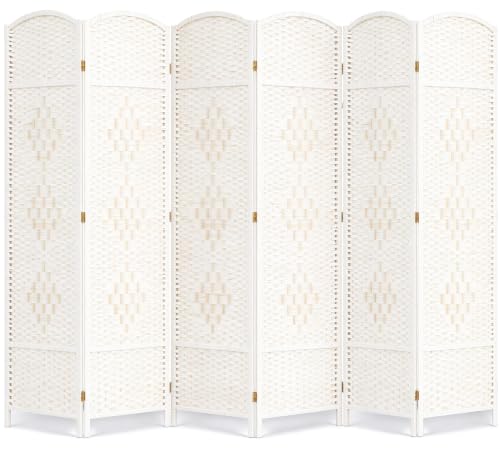
Woven screens are the warm, textured option. Six panels of woven paper fiber — a paper wicker weave over a wood frame — give this divider a natural, slightly rustic surface that suits living rooms better than the office-style fabric models. The off-white finish keeps it light in a room.
Six panels at roughly 16 inches each produce a 95.7-inch flat span and about 76 inches of standing coverage, with a height of 68.9 inches. More panels also means more fold options: the screen can zigzag tightly around a small corner, stretch into a long shallow wave, or wrap three sides of a nook. The double hinges fold both ways, which is what makes those shapes practical.
The weave blocks direct sight lines, but it is not a sealed surface — strong backlight picks out the texture of the weave and vague shapes, so count it as strong visual screening rather than total blackout. At 21.3 pounds it has a bit more heft than the fabric divider, which helps it feel planted, though the usual rule still applies: zigzag it, and keep it out of the path of running children and big dogs.
Specs
- Panels: 6, each about 16 in wide
- Flat span: 95.7 in; usable standing span about 76 in
- Height: 68.9 in
- Material: wood frame with woven paper fiber (paper wicker) panels
- Light behaviour: mostly opaque; weave texture and faint shapes visible in strong backlight
- Hinges: double hinges, two-way folding
- Weight: 21.3 lb
- Stability: no feet; stands in a zigzag or curve across six panels
- Storage: folds flat to a single panel width
4. HOMCOM 6-Panel Room Divider with 3 Display Shelves (Walnut) — Divider with Shelves

This one answers the obvious objection to dividers — that they take up floor space and give nothing back — by building storage into the screen. Six louvered paulownia wood panels in a walnut finish carry three removable display shelves that span across the folds, sized for framed photos, small plants and books. The maker rates each shelf at 22 pounds of capacity, and the shelves double as bracing that stiffens the whole screen.
The numbers: panels are 15.75 inches wide, giving a 94.5-inch flat span and about 75 inches standing, at 67 inches tall. Folded, it packs down to 15.75 by 67 by 4.5 inches. Elevated feet lift the panels 2 inches off the floor on protective footpads, which helps air circulate and keeps the bottom edge out of mop water. At 32 pounds it is the heaviest divider here by a wide margin — a drawback for moving it, a genuine advantage for stability. It arrives with no assembly required.
Two honest caveats. The louvered, blinds-style slats ventilate and look sharp, but slats pass slivers of view and light at oblique angles, so this is a space definer rather than a dressing-room-grade privacy screen. And the maker’s own safety notes say to avoid heavy objects on the shelves and to keep the screen away from heat sources — loaded shelves raise the stakes if it ever does tip, so keep the weight low and light.
Specs
- Panels: 6, each 15.75 in wide
- Flat span: 94.5 in; usable standing span about 75 in
- Height: 67 in
- Material: paulownia wood, louvered slat panels, walnut finish
- Light behaviour: slatted — slats pass angled light and partial views; not fully opaque
- Hinges: steel hinges; maker does not advertise two-way folding, so plan on a standard accordion fold
- Shelves: 3 removable display shelves, each 67 in long x 6.25 in wide, rated 22 lb each per maker
- Feet: elevated feet, 2 in clearance, with floor-protecting footpads
- Weight: 32 lb
- Storage: folds to 15.75 x 67 x 4.5 in; no assembly required
5. Versare Privacy Screen Folding Panel, 7’6″ Wide x 7’4″ Tall (Red) — Extra Tall

Standard screens stop at about 6 feet. This one keeps going: at 88 inches tall (7 feet 4 inches) it is the extra-tall pick, built for lofts, high-ceilinged studios and anyone who wants a screen that still hides a standing person with headroom to spare. It comes from an office-furniture maker, and the design reflects that: three 30-inch panels of fabric stretched over aluminum frames, joined by patented 360-degree hinges.
The full rotation hinges are the standout feature. Panels swing all the way around, so the screen can run straight-ish, zigzag, curve, or fold back on itself into a U — shapes the wooden screens cannot manage. The flat span is 90 inches, giving about 72 inches of standing coverage. The fabric is opaque, tackable (notes and artwork can be pinned to it, a genuinely useful trick in a home office), and specified by the maker as acoustical and flame-retardant.
On sound, honesty matters. The acoustical fabric absorbs some echo and takes the edge off a hard, bare room. It does not soundproof anything: a conversation on the other side remains fully audible. Treat the acoustic claim as mild softening, never isolation. The maker does not publish a weight in its manual specifications, describing the screen instead as lightweight and portable; the stability guidance in that same manual is to angle the panels into a zigzag or curve rather than running them dead straight.
Specs
- Panels: 3, each 30 in wide
- Flat span: 90 in; usable standing span about 72 in
- Height: 88 in (7 ft 4 in)
- Material: acoustical, flame-retardant fabric over aluminum frames; tackable surface
- Light behaviour: opaque — blocks light fully
- Hinges: 360-degree hinges, panels rotate fully in either direction
- Weight: not published in the manufacturer’s manual specifications; maker describes the design as lightweight and portable
- Stability: no separate feet; stands via panel angles — maker advises a zigzag or curve over a straight run
- Storage: folds compactly flat
Safety and Care Notes
A few closing points apply to every screen in this guide. First, stability: set dividers in a zigzag or curve, on a level floor, and re-check them after vacuuming or moving furniture — a screen nudged straight is a screen waiting to fall. In homes with children or pets, the footed fabric model and the heavier shelved model are the safer shapes, and no divider should stand where a child can climb it.
Second, heat: paper, woven fiber and ordinary fabric panels are combustible furnishings. Keep them several feet from space heaters, radiators, fireplaces and open flames, and never use a screen to hide a heater. The flame-retardant fabric on the extra-tall pick adds a margin, not immunity.
Third, recalls: a check of the CPSC SaferProducts recall database for this product class returned no recalls covering any of the five models listed here. Recall status can change, so it is worth a quick database check on any specific model before buying, especially second-hand.
Care is simple for all five: dust or wipe with a dry cloth, keep paper and woven panels dry, and store folded screens flat in a dry place so hinges and panels stay true. Looked after that way, a folding divider should last for years of rearranging — which is, after all, the entire point of a wall you can fold up and put in a closet.
Affiliate Disclosure: This article contains affiliate links. If you buy through a link on this page, we may earn a commission at no extra cost to you. Products are selected on their published specifications and maker documentation, not on commission rates.
More from Amazon
Programs that pair well with the guide above. Offers and eligibility are set by Amazon and may change.
Free shipping on eligible items, Prime Video and more. Eligible new members can start with a free trial.
Start a Prime free trialA Prime membership for ages 18-24 with a trial period. Eligibility is set by Amazon.
See Prime for Young AdultsAudiobooks and podcasts to listen to on the go. Eligible new members can start with a free trial.
Try Audible freeAd-free music streaming. Eligible new subscribers can start with a free trial.
Try Music Unlimited freeAs an Amazon Associate we earn from qualifying purchases.










Write Your Review
No reviews yet. Be the first to share your experience!