

Key takeaways
- Compare five photo storage boxes for 4x6, 5x7 and large prints, with photo capacities, inner case counts, materials and straight archival advice.
As an Amazon Associate we earn from qualifying purchases.
Loose prints age badly in shoeboxes. They curl, stick together, pick up dust, and get bent every time someone digs through the pile looking for one picture. A proper photo storage box fixes the handling problem first: prints sit flat or upright in a rigid container, grouped so they can be found without shuffling through hundreds of others. The five boxes below cover the main formats on the market, from plastic multi-case organizers for standard snapshots to archival board boxes for enlargements and documents.
One warning before the picks. The words “acid-free” on a listing are a maker’s claim, not a certification, and a box alone does not make storage archival. True long-term preservation also depends on lignin-free materials in contact with the prints and on where the box lives: a cool, dry room with stable temperature beats an attic with summer heat swings or a basement floor that can flood. Plastic cases guard prints against dust, light and rough handling. They do not protect against heat, and none of the boxes here should be treated as waterproof or fireproof storage for irreplaceable originals.
What to look for in a photo storage box
Print size comes first. Cases are built around one print size, and the sizes do not substitute for each other. A 4×6 inner case holds 4×6 prints; a 5×7 print will not fit in it, and a 5×7 case leaves 4×6 prints loose enough to slide and scuff. Measure your largest common print size before choosing, and keep enlargements separate in a flat box sized for them.
Capacity is stated per case and per box. Multi-case organizers hold roughly 80 to 100 prints per inner case, so total capacity is the case count multiplied out. Single board boxes hold prints in one stack, and their capacity depends on how tightly the stack is packed; overfilling a board box makes prints hard to remove without bending corners.
Material decides the protection type. Clear polypropylene cases are rigid, stackable and easy to browse, and makers commonly state the plastic is acid-free, BPA-free and PVC-free. Archival board boxes use acid-free, lignin-free board, sometimes with metal-reinforced corners, and suit prints that will sit untouched for years. Board is not water resistant in any meaningful sense, and plastic is not a heat shield; choose based on the room the box will live in.
Dividers and labels decide whether the system stays organized. Index cards, fixed partitions and label stickers are what turn a container into a filing system. Without them, a 1,800-print box becomes a bigger shoebox.
1. IRIS USA 4 x 6 Photo Keeper with 16 Inner Cases

The IRIS USA Photo Keeper is the reference design for snapshot storage: one clear outer case with a handle, holding sixteen individual 4×6 photo cases. Each inner case snaps shut on its own, so a single year, trip or event can be pulled out and carried without opening the whole system. The cases are made in the USA, and the clear polypropylene lets the contents be identified at a glance.
This is strictly a 4×6 system. The inner cases are sized for 4 x 6 inch prints and small flat items of similar size; 5×7 prints do not fit, and anything larger needs a different box entirely. Within that limit it is the most browsable format here, because every case is its own labeled unit rather than a layer in a stack.
Specs
- Print size: 4 x 6 inches only
- Inner cases: 16, each with its own snap-tight lid
- Capacity: about 100 photos per inner case, about 1,600 photos total
- Material: clear polypropylene
- Outer case: rigid case with carry handle, stackable
- Model: 215626 (manufacturer part number)
- Country of manufacture: USA
2. Gbivbe Photo Storage Box 4×6 with 18 Inner Cases

The Gbivbe box pushes the same multi-case idea to the largest common capacity: eighteen inner cases inside one handled outer box, for a stated total of up to 1,800 4×6 prints. The outer case measures 14.25 x 10.6 x 4.72 inches, and each inner case measures 4.25 x 6.88 x 0.98 inches, holding about 100 photos. Both the outer box and the inner cases use snap-tight closures.
Gbivbe states the polypropylene is acid-free. Treat that as a maker’s claim, as with every plastic case in this roundup: the practical protection here is rigidity, dust exclusion and separation into eighteen sortable units. For a household digitizing or sorting several decades of family snapshots, the extra two cases over a 16-case system and the low per-case sorting effort are the appeal. Like the IRIS, it accepts 4×6 prints only.
Specs
- Print size: 4 x 6 inches only
- Inner cases: 18, each with snap-tight lid
- Capacity: about 100 photos per inner case, up to 1,800 photos total
- Outer box dimensions: 14.25 x 10.6 x 4.72 inches
- Inner case dimensions: 4.25 x 6.88 x 0.98 inches
- Material: polypropylene, stated acid-free by the maker
- Outer case: clear, with carry handle
3. Pioneer Photo Albums Photo Storage Box, Black
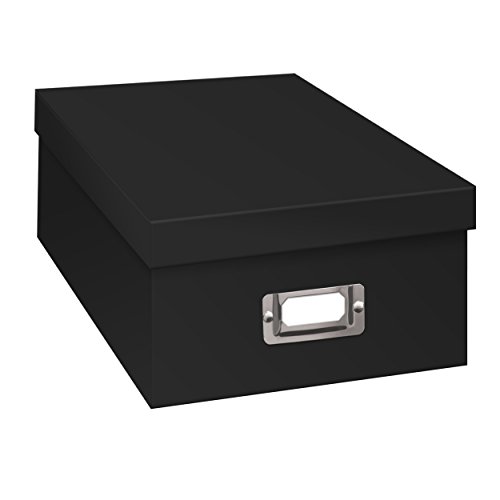
Pioneer takes the opposite approach: one heavy-duty board box, no inner cases, with a set of index cards for dividing the stack and a metal identification plate on the front for labeling. The box holds over 1,100 photos up to 4 x 7 inches, which gives it one real advantage over the plastic 4×6 systems — it swallows 4×6 and the less common 4×7 prints in the same box, along with postcards, negatives and similar flat keepsakes.
The board is described by Pioneer as acid free and photo safe, and the outside dimensions are 11.75 x 7.75 x 4.5 inches with a lift-off lid. The trade-offs are the format’s usual ones: a single compartment means finding one print means working through a stack, and board offers no protection against water. For prints that will be sorted once and stored in a dry closet, it remains the simplest archival-style option in this group.
Specs
- Print size: up to 4 x 7 inches
- Compartments: 1, with a set of index cards included for dividing
- Capacity: over 1,100 photos
- Material: heavy-duty acid-free board (maker’s description)
- Outside dimensions: 11.75 x 7.75 x 4.5 inches
- Lid: lift-off lid, metal identification plate on the front
- Item weight: about 10.2 ounces
- Model: B-1BLK
4. Lifewit Photo Storage Box 5×7 with 9 Inner Cases

Collections heavy on 5×7 prints need cases built for that size, and the Lifewit 5×7 box is the multi-case option here: nine inner cases in a clear outer box measuring 11.1 x 8.6 x 5.9 inches. Each inner case holds 80 to 100 prints up to 5 x 7 inches, for a total of about 900 photos. The inner boxes have fixed partitions to keep prints from sliding, buckles on both the inner and outer boxes, and a sheet of label stickers is included for naming each case.
Lifewit states the polypropylene is free of BPA, acid, PVC and lignin. As noted above, that is a listing claim rather than an independent certification, but the combination of claims is the right checklist for plastic in contact with prints. Note the size discipline: 4×6 prints fit loosely in these cases and can shift, so this box is best kept for a genuinely 5×7 collection rather than mixed sizes.
Specs
- Print size: up to 5 x 7 inches
- Inner cases: 9, with fixed partitions and buckle latches
- Capacity: 80 to 100 photos per inner case, about 900 photos total
- Outer box dimensions: 11.1 x 8.6 x 5.9 inches
- Material: polypropylene, stated by the maker to be free of BPA, acid, PVC and lignin
- Included: 1 sheet of label stickers
- Model: MPN 23017
5. Lineco Museum Archival Storage Box, 14.75 x 18.75 x 3 Inches

Enlargements, certificates and oversized prints cannot go in snapshot cases at all. The Lineco Museum box is built for them: a rigid archival board box measuring 14.75 x 18.75 x 3 inches, with a drop front and a lift-off lid so a large print can be slid out flat instead of lifted and flexed. The construction uses metal edge corners, the point where board boxes usually fail first, and Lineco’s museum line uses acid-free, lignin-free board.
There is no per-photo count for a box like this, because capacity depends on what is stored: a stack of 8×10 or 11×14 prints, 9×12 documents, certificates or a folded newspaper all use the 3-inch depth differently. What it provides is flat, rigid, light-blocking storage for the prints that matter most individually, which is a different job from bulk snapshot filing. It is also the format most dependent on storage conditions — board this size belongs in a dry interior room, off the floor.
Specs
- Print and document size: large prints and documents up to about 14 x 18 inches, stored flat
- Dimensions: 14.75 x 18.75 x 3 inches
- Opening: drop front with lift-off lid
- Material: archival board, acid-free with metal edge corners
- Color: tan
- Capacity: flat storage in a 3-inch depth; no per-photo count is published by the maker
- Part number: W.LC16045_G1_R6780
How to choose between these boxes
Start with print size, because it eliminates most of the list. A collection that is almost entirely 4×6 snapshots belongs in the IRIS or Gbivbe multi-case systems; choose between them on capacity and on whether the extra cases justify a larger footprint. Mixed 4×6 and 4×7 prints, or prints stored with postcards and negatives, fit the single Pioneer box better than any case system. A 5×7 collection belongs in the Lifewit. Enlargements and documents belong flat in the Lineco, one size class per box.
Then think about access. Prints that get browsed often do better in individual cases that can be pulled out one at a time. Prints being archived for the long term do better in board, handled rarely, in a room with stable conditions. Whichever format is chosen, the environment rules stay the same: interior room, off the floor, away from exterior walls that sweat, and away from heat sources. No box in this roundup changes those rules, and any storage plan that relies on a box to defeat a damp basement or a hot attic will fail the prints eventually.
Finally, label as you fill. Index cards, partitions and label stickers only work if they are written on during the first sort, not promised for later. A box of unsorted prints is storage; a box of labeled groups is an archive.
Affiliate Disclosure
This article contains affiliate links. If a reader buys a product through a link on this page, the site may earn a commission from the retailer at no additional charge to the buyer. Product selection for this roundup was based on format, specifications and availability, not on commission rates.
More from Amazon
Programs that pair well with the guide above. Offers and eligibility are set by Amazon and may change.
Free shipping on eligible items, Prime Video and more. Eligible new members can start with a free trial.
Start a Prime free trialA Prime membership for ages 18-24 with a trial period. Eligibility is set by Amazon.
See Prime for Young AdultsAudiobooks and podcasts to listen to on the go. Eligible new members can start with a free trial.
Try Audible freeAd-free music streaming. Eligible new subscribers can start with a free trial.
Try Music Unlimited freeAs an Amazon Associate we earn from qualifying purchases.










Write Your Review
No reviews yet. Be the first to share your experience!