

Key takeaways
- Compare the best mechanic's stethoscopes for tracing engine noises, from classic probe tools to amplified electronic kits, with honest specs.
As an Amazon Associate we earn from qualifying purchases.
An engine bay is a wall of noise. A failing water pump bearing, a ticking lifter, a chattering injector and a worn idler pulley all blend into one general roar, and guessing which part to replace gets expensive fast. A mechanic’s stethoscope solves the localisation problem: touch its probe to a component and you hear that component, and mostly only that component, through the earpieces. Move the probe from the alternator to the power steering pump to the tensioner, and the part that sounds rough, grinding or out of rhythm compared with its neighbours is usually your culprit.
Be honest with yourself about what the tool does. It does not diagnose anything. It amplifies whatever the probe tip touches, faithfully, including noises that are perfectly normal. The diagnosis comes from method: working point to point, comparing like with like, and listening for the one spot where the sound changes character. That is why the cheapest stethoscope in practiced hands beats an electronic kit waved around at random.
Two families of tool are covered below. Mechanical stethoscopes are a diaphragm chamber, a probe rod and earpieces — nothing to charge, nothing to break, and the shop standard for decades. Electronic stethoscopes put a microphone and amplifier between the part and your ears; they add volume control and, in the Steelman’s case, a meter, and earn their keep in loud bays or when a noise is faint. Ultrasonic leak detectors are a different class of instrument — for finding pressurised gas leaks by ultrasound — and are not covered here.
Two safety rules govern everything that follows. First, a probe belongs on stationary housings only: valve covers, pump bodies, alternator cases, gearbox casings. Never reach a probe or a dangling lead anywhere near a spinning belt, fan or pulley on a running engine — keep hands, tubing and your own clothing clear of the belt run, and work from the side, never over the top of it. Second, mind your hearing. A stethoscope pipes mechanical noise straight into your ear canals; a sudden loud knock through an amplified electronic unit can genuinely hurt. Start every electronic tool at its lowest volume setting and turn it up slowly.
Affiliate Disclosure: This article contains affiliate links. If you buy through them, we may earn a commission at no extra cost to you.
1. Lisle 52500 Mechanic’s Stethoscope

The Lisle 52500 is the benchmark the rest of the category is measured against, and it earns that position with one part: the sound chamber. Lisle fits an unusually thin diaphragm in the chamber, and that diaphragm is what turns faint structure-borne vibration into clear, separated sound at the earpieces. A ticking injector sounds like a ticking injector; a rumbling bearing sounds like gravel. The screw-in steel probe rod puts the pickup in hard contact with the housing you are testing, which is exactly what you want for bearing, valvetrain, transmission and differential noises.
There is nothing else to it, and that is the point. No batteries, no amplifier, no settings. The stainless construction shrugs off oil and shop knocks, the earpieces seal well enough to shut out most bay noise, and the whole tool coils into a toolbox drawer. Lisle backs it with a limited lifetime warranty. If you buy one mechanical stethoscope and keep it for twenty years, this is the conventional choice.
Its limits are the limits of the type. The fixed probe rod sets your reach: deep-set components behind brackets or low on the block can be awkward, and you cannot swap in a longer or flexible probe. And because there is no volume control, a very loud fault is simply loud — press the probe firmly and briefly rather than leaning on it.
Specs
- Type: mechanical probe stethoscope
- Pickup: sound chamber with ultra-thin diaphragm
- Probe: screw-in steel probe rod, fixed length
- Construction: stainless steel
- Typical work: bearings, engines, transmissions, differentials
- Power: none — fully mechanical
- Warranty: limited lifetime
- UPC: 083045525004
2. Lisle 52750 Dual Purpose Stethoscope Kit

The 52750 takes the same diaphragm-chamber idea as the 52500 and adds the second half of noise diagnosis: air. Mechanical faults — bearings, gears, valves — travel through metal, and the kit handles them the usual way, with the black diaphragm chamber and its screw-in metal probe. But a whole class of faults makes noise in moving air instead: vacuum leaks, leaking intake gaskets, exhaust manifold leaks, wind noise around seals. For those, the kit swaps the probe for a vinyl hose, hollow tube and funnel assembly that you sweep slowly along hoses, gaskets and seams, listening for the hiss to peak.
That dual coverage suits diagnostic work on complete vehicles, not just rotating machinery. A whistle under load that no probe on the block can find often gives itself away in seconds with the funnel. The trade-offs are modest: you swap attachments mid-job, the funnel is a listening aid rather than a pinpoint instrument, and there is no amplification, so a faint air leak in a loud bay can be hard work.
If your noise hunting regularly includes vacuum and boost leaks alongside bearing and valvetrain work, this is the most versatile purely mechanical tool in this roundup. If you only ever chase mechanical noise, the simpler 52500 above does the same job with fewer pieces to lose.
Specs
- Type: dual-purpose mechanical stethoscope kit
- Mechanical mode: diaphragm chamber with screw-in metal probe
- Air mode: vinyl hose with hollow tube and funnel for air-induced sounds
- Typical work: bearings, engines, transmissions, vacuum and air leaks
- Power: none — fully mechanical
- Attachments: probe, hose, tube and funnel included in kit
3. GEARWRENCH 835D Mechanic’s Stethoscope
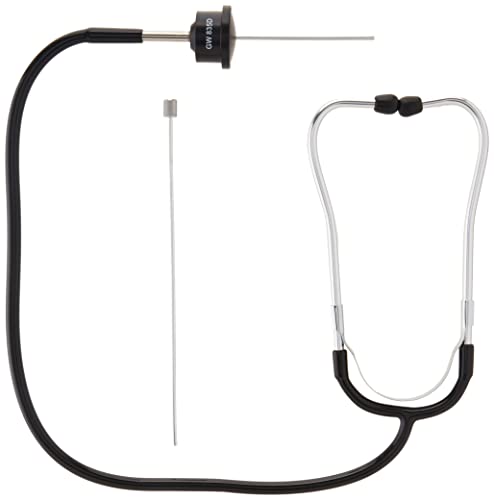
The GEARWRENCH 835D, a long-running design from KD Tools, is the mechanic’s stethoscope built for life in a working toolbox. The handle is shock-resistant, so the knocks and drops that are routine around a lift do not faze it, and the tool disassembles for storage — the probe and handle separate, so it packs flat instead of spearing everything else in the drawer. That sounds like a small thing until you have fished a bent probe rod out of a tool bag for the third time.
In use it follows the classic pattern: a diaphragm sound chamber feeding earpieces, with a steel probe that puts solid contact on the part under test. It is aimed squarely at the standard workload — pinpointing noise in engines, bearings, gears and accessories — and GEARWRENCH backs it with a lifetime warranty, which matters more for a tool that lives loose in a box than for one that lives in a case.
Against the Lisle 52500, the honest summary is that you are choosing between two proven mechanical tools with different emphases: the Lisle’s ultra-thin diaphragm is the clarity pick, the GEARWRENCH is the durability and storage pick. Neither has volume control, a flexible probe or any answer to air-borne leaks, so your wider diagnostic habits should make the decision.
Specs
- Type: mechanical probe stethoscope
- Pickup: diaphragm sound chamber
- Probe: steel probe; tool disassembles for flat storage
- Handle: shock-resistant
- Typical work: engines, bearings, gears, accessories
- Power: none — fully mechanical
- Warranty: lifetime
- UPC: 082171008351
4. Steelman EngineEAR II Electronic Stethoscope (06800)

The EngineEAR II is where the electronic class starts, and its defining feature is measurement. A supersensitive microphone in the probe feeds an amplifier with a built-in decibel meter and seven sound level settings spanning 60 to 120 decibels. In practice the meter turns “it sounds louder here” into something repeatable: set the range so the needle sits near the centre of the scale, then move the probe and watch the reading climb as you close in on the source. A high-low tone control lets you favour the part of the sound that carries best for your own hearing.
The hardware is built for engine bays. The probe is solid aluminium on a flexible gooseneck shaft, so it bends into the gaps a rigid rod cannot reach — down the back of a bellhousing or along a pan rail — and the probe wears a non-conductive rubber boot, so brushing a connector or solenoid while you work does not short anything. Over-ear mono headphones block a good share of the surrounding bay noise, and the kit lives in a foam-padded case. It runs on a 9-volt battery, and the control switch includes a battery-check position so a weak battery does not quietly make a real noise seem to fade.
The honest costs of going electronic are money, complexity and care. This kit costs several times what a mechanical stethoscope costs, it has a battery to go flat, and the volume discipline rule matters: the amplifier will happily deliver a damaging blast if you touch a loud fault with the gain set high. Start low, every time.
Specs
- Type: electronic stethoscope, single probe, labelled electronic listening kit
- Sound levels: 7 settings, 60 to 120 decibel meter range
- Probe: solid aluminium probe on flexible gooseneck shaft
- Probe insulation: non-conductive rubber boot
- Controls: decibel range dial, high-low tone switch, battery-check position
- Headphones: over-ear mono headphones included
- Power: 9-volt battery
- Storage: foam-padded case included
- Typical work: bearings, valves, gear teeth, fuel injectors, air leaks
5. OTC 3590 Electronic Stethoscope

The OTC 3590 is the professional-counter alternative to the Steelman: an electronic stethoscope from OTC, the diagnostic brand of Bosch Automotive Service Solutions, built around a sensitive microphone pickup and amplified headphones. Where a mechanical tool relies entirely on the sound a housing conducts, the 3590 amplifies faint signals, which is what you want for the marginal cases — an injector that ticks slightly differently from its five neighbours, an alternator bearing that is just beginning to rumble, a valve that is noisier than its partners but not yet noisy in absolute terms.
It is a single-point listening tool rather than a multi-channel kit: you still work by comparison, moving the pickup point to point, and the amplification simply makes smaller changes audible. That keeps it simpler than multi-sensor chassis kits, at the cost of their trick — clamping sensors to several corners of a car at once and switching between them on a road test. For noises that only appear while driving, that approach is better; for stationary engine diagnosis, this is the more direct tool.
As with the Steelman, treat the amplifier with respect: begin at low volume, and remember that amplification does not add information, only loudness. The method — systematic comparison, one component at a time — is still the diagnostic.
Specs
- Type: electronic stethoscope, single-point amplified listening
- Pickup: sensitive microphone sound sensor
- Output: amplified headphones
- Typical work: worn bearings, faulty valves, injectors, accessory drives
- Power: battery powered
- UPC: 731413037849
How to Choose a Mechanic’s Stethoscope
Start with the kind of noise you chase. Solid-borne mechanical noise — bearings, gears, valvetrain, pumps — is probe work, and any tool here does it. Air-borne noise — vacuum leaks, intake leaks, wind whistle — needs the funnel-and-hose approach of the Lisle 52750, or an electronic probe worked slowly along the seam. Noises that only happen on the road, under load, belong to multi-channel chassis-ear kits with clamp-on sensors; none of the five tools above is that, and no amount of amplifier gain changes it.
Mechanical or electronic? A mechanical stethoscope is cheaper, indestructible in normal use, always ready and entirely adequate for most home and light professional work. An electronic unit adds three things: volume control, reach into faint noises, and in the EngineEAR II a meter that makes comparisons repeatable. It also adds a battery, a case to keep track of, and a real need for volume discipline. Buy electronic when faint or intermittent noises are your actual problem, not as a general upgrade.
Reach is a physical spec, not a feature list. A rigid probe rod is the most sensitive contact but the least forgiving of awkward angles. A flexible gooseneck trades a little contact pressure for access to components you otherwise cannot touch at all. Check the probe arrangement against your own engine bay before you buy, and remember the standing rule: stationary housings only, and never reach across a moving belt run.
Work the method. Warm the engine, note when the noise occurs — idle, raised revs, load, overrun — then probe in a deliberate sequence: each accessory in turn, each end of the valve cover, the pump bodies, the bellhousing, the sump rail. Compare cylinders, banks and ends of the same shaft. The loudest, roughest or most irregular point is your answer, and noting what each point sounded like beats trusting memory.
Protect your ears. Especially with electronic tools, start at minimum volume and increase slowly. A stethoscope removes every layer of protection between a mechanical fault and your eardrums, and a sudden knock at full gain is a genuine injury risk, not a figure of speech.
More from Amazon
Programs that pair well with the guide above. Offers and eligibility are set by Amazon and may change.
Free shipping on eligible items, Prime Video and more. Eligible new members can start with a free trial.
Start a Prime free trialA Prime membership for ages 18-24 with a trial period. Eligibility is set by Amazon.
See Prime for Young AdultsAudiobooks and podcasts to listen to on the go. Eligible new members can start with a free trial.
Try Audible freeAd-free music streaming. Eligible new subscribers can start with a free trial.
Try Music Unlimited freeAs an Amazon Associate we earn from qualifying purchases.










Write Your Review
No reviews yet. Be the first to share your experience!