

Key takeaways
- Five loaf pans compared for bread, meatloaf and pound cakes: two aluminized steel pans, a lidded Pullman, cast iron and glass, with sizes and care notes.
As an Amazon Associate we earn from qualifying purchases.
A loaf pan is a small purchase that quietly decides a lot of baking outcomes. Its volume decides whether a batter crowns neatly or spills over the rim onto the oven floor. Its material decides whether the crust comes out pale and tender or dark and firm. Its coating — or the absence of one — decides whether the loaf drops out in one piece and how the pan behaves after a hundred bakes instead of after the first one.
The five pans below cover the formats a home baker actually needs: a standard 8.5 x 4.5 inch coated steel pan for everyday 1 pound loaves, a larger 9 x 5 inch pan for 1.5 pound recipes, a lidded Pullman pan for square sandwich bread, a pre-seasoned cast iron pan for deep crusts, and a glass loaf dish that doubles as a serving and storage vessel. Every Specs block pins the size class with interior dimensions and volume, the material, the coating in the maker’s own wording, the published oven limit, the handle or lip design, and the maker’s care instructions, because those are the details that decide whether a pan suits your recipes, your oven and your sink.
How to Choose a Loaf Pan
Start with volume, not with the inches on the box. The two standard sizes look almost identical on a shelf and behave very differently in the oven. An 8.5 x 4.5 inch pan is the 1 pound class: filled no more than two-thirds to three-quarters full, it holds roughly 6 cups of batter. A 9 x 5 inch pan is the 1.5 pound class and holds roughly 8 cups on the same fill rule. That gap matters. A quick bread or pound cake recipe written for a 9 x 5 pan produces about 8 cups of batter; poured into an 8.5 x 4.5 pan it will rise over the rim, bake onto the oven floor and leave the centre underdone. The reverse swap is safer but sadder — a 1 pound batter in a 9 x 5 pan spreads thin and bakes up short and dry. Match the pan to the size your recipes call for, and when a recipe just says “a loaf pan,” the 8.5 x 4.5 inch 1 pound size is the safer assumption for older cookbooks and the 9 x 5 for most modern ones. Pullman pans are the exception to the fill rule: their capacity is quoted in dough weight, because the lid caps the rise.
Material controls the crust. Aluminized steel is the all-rounder: steel’s stiffness with much of aluminium’s heat conductivity, and a light grey surface that browns evenly without rushing. Cast iron is the heavyweight — it takes longer to heat, then holds that heat and produces the deepest, firmest crust of any pan here, which is why bakers preheat it for sandwich loaves and cornbread; it is also the heaviest pan in this group by a wide margin, and a full one needs two hands and a confident grip. Glass heats slowly and keeps heating after the loaf leaves the oven, so glass loaves should come out of the pan promptly; in return you can watch the sides and bottom brown through the walls, and the dish goes to the table and then, with its lid, straight into the fridge.
Be honest about nonstick coatings. A nonstick finish is a consumable surface, not a permanent one. It releases beautifully when new and slowly loses that release over years of use. Two habits shorten its life fastest: metal utensils prising at stuck corners, and aerosol cooking sprays, whose additives bake into a sticky film that makes sticking worse rather than better. Grease a coated pan with butter, oil or a brush instead, free loaves with a thin silicone or wooden tool, and hand wash even when the maker permits the dishwasher. Three of the five pans below are coated; the cast iron and glass picks exist for bakers who would rather maintain seasoning or wash glass than think about a coating at all.
Dark pans brown faster than light ones. A dark grey or dark-finished pan absorbs more heat than a pale one and will brown bottoms and edges sooner at the same setting. When you move a recipe from a light aluminized steel pan to a dark nonstick one, drop the oven temperature by about 25 degrees or start checking several minutes early. The Wilton below is the darker pan in this group; the two USA Pan models are the pale reference point.
Glass demands temperature-shock discipline. The glass dish below is tempered soda-lime glass, and its rules are not optional decoration. It goes into a preheated oven only — never under a broiler, never on a stovetop burner, and never straight from freezer to oven. When it comes out, it goes onto a dry cloth potholder or a trivet, never onto a cold stone counter, a wet surface or a metal sink edge, because a sudden temperature difference is what makes glass bakeware fail. Handled that way it lasts for decades; handled carelessly it can shatter without warning. If that discipline sounds tiresome, buy one of the metal pans instead.
1. USA Pan Nonstick Standard Bread Loaf Pan, 1 Pound (1140LF)

This is the reference pan for the standard size: heavy-gauge aluminized steel with USA Pan’s Americoat Plus silicone nonstick coating, in the 8.5 x 4.5 inch baking surface that 1 pound recipes are written for. The body is drawn from a single piece of steel with folded corners and rolled edges, so there are no seams for batter to creep into and no sharp rim to catch a mitt. The corrugated surface texture is the maker’s signature — it is meant to improve air circulation and release, and in practice the practical point is simpler: loaves come out of this pan cleanly with nothing more than a light greasing, and the pan rinses clean under a tap.
The honest limits are the coating’s limits, and they are stated in the care section above: the finish is a wear surface, the maker directs hand washing in hot water with mild soap and a soft sponge, and aerosol sprays and metal tools will shorten its life. The maker publishes an upper oven limit of 450°F, which covers every bread, meatloaf and pound cake recipe in normal use. Made in the USA, with a limited lifetime warranty from the maker.
Specs
- Size class: standard 1 lb loaf pan; baking surface 8.5 x 4.5 x 2.75 in; outer dimensions 9.125 x 5.0625 x 2.75 in
- Capacity: 1 lb loaf as published by the maker (about 6 cups of batter at a two-thirds fill)
- Material: heavy-gauge aluminized steel
- Coating: Americoat Plus silicone nonstick; the maker states it is made without PTFE, PFOA or BPA
- Maximum oven temperature: 450°F as published by the maker
- Handles and lip: folded corners with rolled rim edges; no extended handles
- Care: hand wash in hot water with mild soap and a soft sponge; maker advises against aerosol cooking sprays and metal utensils
2. Wilton Platinum Non-Stick Loaf Pan, 9 x 5 Inch

The Wilton Platinum is the big-pan pick: a true 9 x 5 inch loaf pan for the 1.5 pound recipes — larger banana breads, family meatloaves and pound cakes — that overflow or crowd a standard pan. Its Duralast coating is a silicone-infused double nonstick layer that Wilton markets as made without PFAS, and the listing publishes an upper temperature figure of 450°F. Extended handles at both ends are a genuine ergonomic plus on a pan this size, because a 9 x 5 meatloaf is a heavy, sloshing load to pull from a hot oven with a folded towel. At 16 ounces as listed, the pan itself is light; the weight you feel is the food.
Two qualifications belong in the open. The finish is dark, and everything said above about dark pans applies: expect faster browning than a pale steel pan gives, and drop the temperature slightly or check early when a recipe was developed in light metal. And while Wilton lists the pan as dishwasher safe, that permission is best treated as an emergency option — the same listing ecosystem and the maker’s own guidance note that hand washing prolongs the coating’s life, and a double coating is still a coating. Wilton does not publish a cup volume for this pan; treat it as the 1.5 pound class and respect the two-thirds fill rule.
Specs
- Size class: large 9 x 5 loaf pan; 9 x 5 x 2.7 in
- Capacity: 1.5 lb loaf class (maker does not publish a cup volume; about 8 cups of batter at a two-thirds fill)
- Material: steel (the maker lists the Platinum line as stainless steel bakeware)
- Coating: Duralast silicone-infused double nonstick coating, made without PFAS per the maker
- Maximum oven temperature: 450°F (published upper temperature figure)
- Handles and lip: extended handles at both ends
- Care: dishwasher safe per the maker; hand washing recommended to extend coating life
3. USA Pan Pullman Loaf Pan with Cover, 9 x 4 Inch (1170PM)

A Pullman pan is a different tool from an open loaf pan, and it earns its place for one job: square sandwich bread. The straight, tall sides and the sliding lid force the rising dough to fill the corners and finish with a flat top and a fine, even crumb, so every slice comes out the same size — the format behind pain de mie and Japanese milk bread. This is USA Pan’s 9 x 4 x 4 inch version, in the same heavy-gauge aluminized steel and Americoat coating as the first pick, with a steel wire set into the rim to resist warping and a lid whose curled front edge works as its handle. Run it with the lid off and it doubles as a deep, straight-sided standard pan.
Capacity here is a dough figure, not a batter figure: the pan is built around roughly 1 pound of dough, and overfilling shows up as dough squeezing out at the lid seam rather than as a taller loaf. The lid is also the part to treat with respect — it must slide freely, so it should never be forced, pried or put through the dishwasher. Care follows the rest of the USA Pan line: hand wash in hot water with mild soap, dry thoroughly, and keep metal tools away from the coating. Published oven limit is 450°F, and the pan is made in the USA.
Specs
- Size class: Pullman (lidded) loaf pan; baking surface 9 x 4 x 4 in; outer dimensions 10.5 x 4.625 x 4.5 in
- Capacity: about 1 lb of dough with the lid on, as published for this size
- Material: heavy-gauge aluminized steel, with a steel wire in the rim for warp resistance
- Coating: Americoat Plus silicone nonstick; the maker states it is made without PTFE, PFOA or BPA
- Maximum oven temperature: 450°F as published by the maker
- Handles and lip: sliding cover included; the curled edge of the cover serves as its handle; no separate side handles
- Care: hand wash in hot water with mild soap and a soft sponge; keep the lid’s sliding edges clean and dry so it moves freely
4. Lodge Seasoned Cast Iron Loaf Pan, 8.5 x 4.5 Inch

Cast iron is the pick for bakers who chase crust. This Lodge pan matches the standard 8.5 x 4.5 inch footprint, but the thick iron walls hold oven heat and drive it into the loaf from every side, giving sandwich bread and cornbread a deeper, firmer crust than thin steel can manage — especially if the empty pan preheats with the oven. It arrives pre-seasoned with the maker’s vegetable-oil seasoning, so there is no synthetic coating anywhere on it: the release surface is the seasoning layer, which is maintained rather than replaced and which improves with fatty bakes such as meatloaf.
The trade-offs are physical and should not be minimised. This is by far the heaviest pan in the group, and full of wet batter it is a two-handed lift, helped by the dual handles at each end. It also asks for the cast iron routine: hand wash, dry promptly and thoroughly — ideally with a moment on a warm burner — and wipe with a thin layer of oil before storage, because a seasoned pan left wet will rust. Lodge publishes no maximum oven temperature for its seasoned cast iron bakeware; the material tolerates any temperature a home oven produces. Made in the USA.
Specs
- Size class: standard loaf pan; baking surface 8.5 x 4.5 in
- Capacity: 1 lb loaf class (about 6 cups of batter at a two-thirds fill)
- Material: cast iron, pre-seasoned with vegetable oil
- Coating: none — seasoned finish only; no synthetic nonstick coating
- Maximum oven temperature: none published by the maker; seasoned cast iron is made for full home-oven heat
- Handles and lip: dual handles at both ends; poured rim edge
- Care: hand wash, dry promptly and thoroughly, and rub with a light layer of oil; avoid prolonged soaking
5. Pyrex Easy Grab 1.5-Qt Glass Loaf Dish with Lid
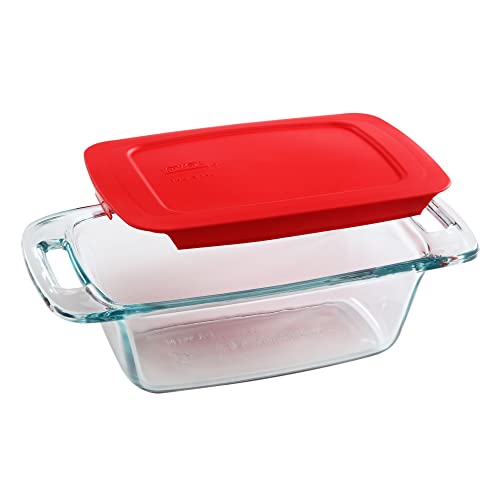
The glass option plays a different role from the four metal pans: it bakes, serves, stores and reheats in one vessel. The Easy Grab loaf dish holds 1.5 quarts — 6 cups — which puts it in the same working class as the standard 1 pound pans, and its wide integrated handles are the easiest grip in this group for a dish that gives no visual warning of how hot it is. The glass is non-porous, so it does not hold onto meatloaf or garlic odours between bakes, and the see-through walls let you judge browning on the sides and bottom that metal pans hide. A BPA-free plastic lid is included for storage; it is a fridge lid only and does not go in the oven.
Everything in the glass section of the buying guide applies to this dish with full force. It is tempered soda-lime glass: preheated oven only, no broiler and no stovetop, no freezer-to-oven transfers, and out of the oven it belongs on a dry cloth potholder or trivet — never on a cold or wet counter. The maker publishes no single maximum temperature figure for the dish, instead specifying preheated-oven use and the temperature-shock rules above; ordinary loaf temperatures sit comfortably inside that guidance. The glass itself is dishwasher safe, and the lid washes on the top rack.
Specs
- Size class: glass loaf dish; 1.5 qt capacity as published by the maker (6 cups)
- Capacity: 1.5 qt — the 1 lb loaf class in working terms, on the two-thirds fill rule for batters
- Material: tempered soda-lime glass; BPA-free plastic storage lid included
- Coating: none — non-porous glass surface
- Maximum oven temperature: no single figure published; maker specifies preheated-oven use only, with no broiler or stovetop use
- Handles and lip: large integrated Easy Grab handles at both ends
- Care: glass is dishwasher safe; lid is top-rack dishwasher safe; avoid sudden temperature changes and set the hot dish on a dry cloth potholder or trivet, never a cold or wet surface
Care, Coatings and a Note on Recalls
Most loaf pan disappointment comes down to two things: a batter matched to the wrong volume, and a coating treated as if it were permanent. The volume fix is free — weigh or measure your batter once, learn which of your pans it fills to two-thirds, and write it on the recipe. The coating fix is a habit: grease with butter or oil rather than aerosol spray, free loaves with silicone or wood rather than steel, and hand wash coated pans even when the maker allows a dishwasher. Cast iron and glass invert the bargain — no coating to protect, but a seasoning layer to keep dry and oiled, and a set of temperature-shock rules to respect every single time.
Before publication, the U.S. Consumer Product Safety Commission recall database was checked for the loaf pan, bread pan, bakeware and glass bakeware classes. The searches returned no recalls covering any of the five pans in this guide, and no recall for glass loaf dishes as a class; the genuine hazard with glass bakeware is thermal shock in the kitchen, which is why the maker’s handling rules are spelled out in full above rather than summarised. The database check takes two minutes and is worth repeating on any bakeware bought secondhand, where age and invisible damage change the picture.
Affiliate Disclosure
This article contains affiliate links. If you buy through a link on this page, we may earn a commission at no additional cost to you. This does not influence which products are included or how they are described; every pan above was selected on its specifications, construction and suitability for the job.
More from Amazon
Programs that pair well with the guide above. Offers and eligibility are set by Amazon and may change.
Free shipping on eligible items, Prime Video and more. Eligible new members can start with a free trial.
Start a Prime free trialA Prime membership for ages 18-24 with a trial period. Eligibility is set by Amazon.
See Prime for Young AdultsAudiobooks and podcasts to listen to on the go. Eligible new members can start with a free trial.
Try Audible freeAd-free music streaming. Eligible new subscribers can start with a free trial.
Try Music Unlimited freeAs an Amazon Associate we earn from qualifying purchases.







Write Your Review
No reviews yet. Be the first to share your experience!