

Key takeaways
- Five infrared thermometer guns compared for grills, engines and HVAC work, with ranges, spot ratios, emissivity and accuracy explained clearly.
As an Amazon Associate we earn from qualifying purchases.
An infrared thermometer gun measures the temperature of a surface from a distance, without touching it. That makes it the right tool for jobs where a probe cannot go or should not go: checking whether a grill grate or pizza stone is ready, finding a hot spot on an engine block, spotting a dragging brake, or reading the air temperature at an HVAC vent. Point, pull the trigger, and the reading appears in about half a second.
One limitation has to be stated before any product list. An infrared thermometer reads surface temperature only. It cannot measure the internal temperature of meat, so it can never confirm that food is cooked through and safe to eat. For that job you need a probe thermometer inserted into the food itself. Use the infrared gun for the grate, the stone, the oil surface and the engine — and a probe for anything you plan to eat.
The five guns below were chosen for verified availability and for published specifications that can be checked against the makers’ own manuals and data sheets. They span dual-laser professional models, wide-range general-purpose guns, and simple fixed-emissivity tools for quick checks.
Affiliate Disclosure
This article contains affiliate links. If you buy through a link on this page, the site may earn a commission at no additional cost to you. Products are selected on their published specifications and suitability for the jobs described, not on commission rates.
How an Infrared Thermometer Works
Every object gives off infrared energy, and the gun’s sensor converts that energy into a temperature reading. Two specifications decide how useful a given gun is in practice.
The first is the distance-to-spot ratio, written as 12:1 or 16:1. It describes the size of the circle being measured at a given distance. At 12 inches from the target, a 12:1 gun averages the temperature of a 1-inch circle. Step back to 24 inches and the circle grows to 2 inches, so readings on small parts — a thermostat housing, a single brake rotor — get less precise the farther away you stand. A higher ratio lets you measure smaller targets from farther off.
The second is emissivity, a measure of how efficiently a surface radiates infrared energy, on a scale from 0 to 1. Most organic materials, painted surfaces, rubber and food sit near 0.95, which is why many guns are fixed at that value. Shiny metal is the problem case: polished aluminium or bare stainless steel can have an emissivity near 0.1, and a gun set to 0.95 will read it far below its real temperature. Guns with adjustable emissivity let you dial the setting down for bare metal. Without adjustment, the standard workaround is to stick a piece of matte tape on the surface or dab it with flat paint and measure that spot instead.
1. Fluke 62 MAX+ — Dual-Laser Professional Pick

Fluke builds test instruments for industrial maintenance, and the 62 MAX+ is its compact infrared gun for plant, HVAC and automotive work. The dual lasers are its signature feature: the two beams converge at the distance where the measurement spot is best defined, so you can see the size of the area you are averaging instead of guessing from a single dot. It covers the widest span of working temperatures in this guide alongside the Etekcity, and it is sealed to IP54 against dust and water spray, with a housing rated to survive a 3-metre drop onto hard surfaces — relevant for a tool that lives in a van or on a belt at a campsite workshop.
The accuracy specification is the tightest here: plus or minus 1.0 degree Celsius or 1.0 percent of reading. Adjustable emissivity from 0.10 to 1.00 means it can be set up for bare metal ducting and engine castings as well as painted surfaces. Minimum, maximum, average and difference readings are shown on a large backlit display, which helps when scanning a radiator or a run of ductwork for hot and cold spots. It runs on a single AA battery.
Specs
- Temperature range: -30°C to 650°C (-22°F to 1202°F)
- Distance-to-spot ratio: 12:1
- Emissivity: adjustable, 0.10 to 1.00
- Accuracy: ±1.0°C or ±1.0% of reading, whichever is greater (-10°C to 0°C: ±2.0°C; -30°C to -10°C: ±3.0°C)
- Laser: dual laser
- Battery: 1 x AA
- Response time: under 500 ms; IP54 dust and water resistance; 3-metre drop test
2. Etekcity Lasergrip 800 — Widest Range, Tightest Spot

The Lasergrip 800 is a long-running general-purpose gun aimed at cooking, home repair and automotive checks. Its headline numbers are the temperature ceiling and the optics: it reads up to 750°C, higher than anything else in this guide, and its 16:1 distance-to-spot ratio keeps the measurement circle smaller at a given distance. Standing a foot from a grill grate, it averages a circle well under an inch across, which makes it genuinely useful for mapping hot and cool zones across a cooking surface or a pizza stone before food goes on.
The trade-off is emissivity: it is fixed at 0.95, with no adjustment. On cast iron, stone, painted metal and food surfaces that setting is appropriate. On polished stainless or aluminium it will read low, and the tape workaround described above is the fix. Accuracy is quoted at plus or minus 2 percent or 2 degrees Celsius. The unit is powered by a single 9V battery, which is included, and the display is backlit for use around a dim engine bay or an evening grill session.
Specs
- Temperature range: -58°F to 1382°F (-50°C to 750°C)
- Distance-to-spot ratio: 16:1
- Emissivity: fixed at 0.95
- Accuracy: ±2% or ±2°C (±3.6°F)
- Laser: single laser
- Battery: 1 x 9V (included)
- Response time: 500 ms
3. TempPro TP30 — Adjustable Emissivity for Mixed Surfaces
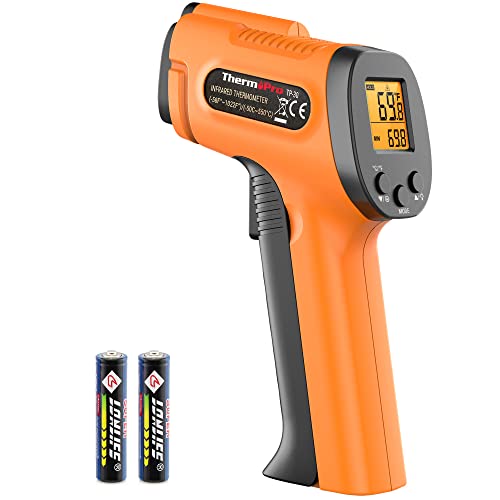
The TP30, sold under the TempPro name after earlier ThermoPro branding, is the flexible middle option. Its emissivity adjusts across the full 0.1 to 1.0 range, so it handles the shiny-surface problem that fixed-setting guns cannot: exhaust manifolds, polished cookware and bare duct metal all become measurable once the setting matches the material, using the emissivity table supplied in the manual. The range tops out at 550°C, which still covers pizza ovens, brake components, engines and HVAC work comfortably.
Accuracy is quoted at plus or minus 1.5 percent, and a maximum-reading mode holds the highest temperature seen during a scan — handy when sweeping across a manifold or a set of vents. The 12:1 optics are the class standard, the laser is a single targeting beam, and the gun runs on two AAA batteries, which are included in the box. For a household that wants one gun for the kitchen, the garage and the heating system, this is the specification set that covers all three without paying for industrial sealing or drop ratings.
Specs
- Temperature range: -58°F to 1022°F (-50°C to 550°C)
- Distance-to-spot ratio: 12:1
- Emissivity: adjustable, 0.1 to 1.0
- Accuracy: ±1.5%
- Laser: single laser
- Battery: 2 x AAA (included)
- Response time: 500 ms; maximum-temperature hold
4. Klein Tools IR1 — Simple, Rugged Trade Gun
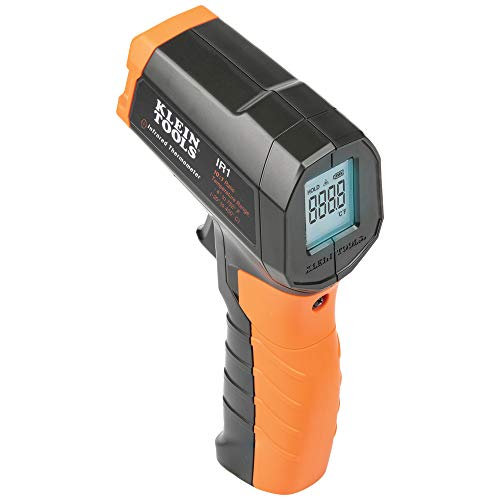
Klein Tools sells to electricians and HVAC technicians, and the IR1 is deliberately simple: fixed emissivity, a single targeting laser, and a backlit display with data hold. There is nothing to configure, which suits quick panel, vent and motor checks where the surfaces are painted, oxidised or wrapped — all near the 0.95 emissivity the gun is set to. Klein rates the housing for a 2-metre drop, and the measurement range to 400°C covers electrical and building work, engine checks and grill surfaces, though not the top end of a pizza oven.
Its published accuracy deserves a plain reading: at or above freezing, Klein quotes plus or minus 4°F (2°C) or 2 percent, whichever is greater — a looser figure than the Fluke’s, and one reason this is a screening tool for finding differences rather than a precision instrument. Below freezing the tolerance widens further by a stated formula. Like the Etekcity, it takes a single 9V battery. If your surfaces are mostly painted metal, plastic, rubber and cast iron, the fixed setting is not a handicap in practice.
Specs
- Temperature range: -4°F to 752°F (-20°C to 400°C)
- Distance-to-spot ratio: 10:1
- Emissivity: fixed at 0.95
- Accuracy: ±4°F (±2°C) or ±2%, whichever is greater, at 32°F (0°C) and above; ±(4°F + 0.1°F per degree below 32°F) below that
- Laser: single targeting laser (Class 2)
- Battery: 1 x 9V
- Drop protection: 6.6 ft (2 m)
5. Kizen LaserPro LP300 — Wide Range for Cooking and Engines

The LaserPro LP300 is a cooking-focused gun from a small kitchen brand, and its specification sheet is stronger than its size suggests. The range runs to 600°C, enough for pizza stones and steel griddles, and emissivity adjusts from 0.10 to 1.00 with a dedicated button, so moving from a cast-iron pan to a stainless pot does not require menu-diving. Kizen states accuracy of plus or minus 1.5 percent in its product listing; the printed manual does not publish a separate accuracy table, so treat the figure as a listing claim rather than a data-sheet guarantee.
Optics are 12:1, the laser is a single beam, and the maker recommends a working distance of about 14 inches for the most reliable readings. Power comes from two included AAA batteries. The backlit display uses a blue backlight that some users will find lower in contrast than a white one. Within its limits — it is a plastic-bodied home tool, not a sealed industrial instrument — it covers the grill, oven and engine-bay jobs this guide is about.
Specs
- Temperature range: -58°F to 1112°F (-50°C to 600°C)
- Distance-to-spot ratio: 12:1
- Emissivity: adjustable, 0.10 to 1.00
- Accuracy: ±1.5%, as stated in the maker’s product listing
- Laser: single laser
- Battery: 2 x AAA (included)
- Response time: 500 ms
How to Choose
Start with the surfaces you will measure most. If they are cast iron, stone, painted metal, rubber or food, a fixed 0.95 emissivity gun such as the Lasergrip 800 or the Klein IR1 will read them correctly, and you can choose on range and optics. If bare or polished metal is on your list — manifolds, stainless cookware, aluminium housings — adjustable emissivity stops being optional, which points to the Fluke 62 MAX+, the TempPro TP30 or the Kizen LP300.
Next, match the range to the job. HVAC vents, engines and brakes live well below 400°C. Pizza ovens and steel planchas push past 500°C, which rules the Klein out and favours the Etekcity, Kizen and Fluke. Then consider distance: the further you must stand from the target — a high duct, a hot exhaust — the more a 16:1 ratio or dual-laser targeting helps keep the reading on the part you actually mean.
Using One Safely and Honestly
Three rules govern every gun in this guide. First, never point the laser at anyone’s eyes, and never look into the beam; these are Class 2 lasers, intended as aiming aids for surfaces, not pointers. Treat reflections off shiny surfaces the same way.
Second, remember what the number means. The reading is the average surface temperature of the spot, nothing more. Steam, smoke and dust between the gun and the target will distort it, and glass blocks infrared entirely — a gun pointed through a window or oven door reads the glass, not what is behind it. On shiny, low-emissivity metal, an unadjusted gun reads falsely low, sometimes by a wide margin; adjust the emissivity or measure a taped patch instead.
Third, food safety. A surface reading cannot tell you the internal temperature of a chicken breast, a burger or a joint of meat, and it cannot confirm that food has reached a safe temperature. Use the infrared gun to manage the cooking surface — grate, stone, pan and oil — and verify the food itself with a probe thermometer. Every maker in this guide states the same limit in its own manual: these instruments are not for measuring people, and they are not a substitute for a food probe.
Safety and Recall Check
Before publication, the US Consumer Product Safety Commission recall database at SaferProducts.gov was searched on 2026-11-21 for infrared thermometer guns under the product names “infrared thermometer”, “thermometer gun” and “laser thermometer”. All three searches returned no recall records, and none of the five products in this guide — the Fluke 62 MAX+, Etekcity Lasergrip 800, TempPro TP30, Klein Tools IR1 or Kizen LaserPro LP300 — appears in any CPSC recall notice found. This check covers one database at one point in time and is not a guarantee; the laser and surface-only warnings in the section above apply to every model listed regardless of recall status.
More from Amazon
Programs that pair well with the guide above. Offers and eligibility are set by Amazon and may change.
Free shipping on eligible items, Prime Video and more. Eligible new members can start with a free trial.
Start a Prime free trialA Prime membership for ages 18-24 with a trial period. Eligibility is set by Amazon.
See Prime for Young AdultsAudiobooks and podcasts to listen to on the go. Eligible new members can start with a free trial.
Try Audible freeAd-free music streaming. Eligible new subscribers can start with a free trial.
Try Music Unlimited freeAs an Amazon Associate we earn from qualifying purchases.










Write Your Review
No reviews yet. Be the first to share your experience!