

Key takeaways
- Hunting bipods for prone and sitting shots compared: sling stud, Picatinny and M-LOK mounts, pivot and pan heads, leg heights and carry weight.
As an Amazon Associate we earn from qualifying purchases.
A hunting bipod is the rest that lives on the rifle. Unlike shooting sticks, which you carry in your hand and plant when a shot appears, a mounted bipod clamps to the forend and folds flat against the barrel channel, so it is always with the gun and deploys in seconds. The first decision is height. A short bipod in the 6 to 9 inch class is built for prone shooting and bench work, where your body is flat and the muzzle only needs to clear grass and ground clutter. A tall bipod in the 13.5 to 27 inch class exists for seated field shots, lifting the rifle over sagebrush, wheat stubble and fence lines while you sit against a pack or a hillside. The five bipods below are all rifle-mounted models, spanning the prone class, a mid-height option that reaches into kneeling and low sitting shots, and the three main mounting systems hunters use.
Affiliate Disclosure: This article contains affiliate links. If you buy through a link on this page, we may earn a commission at no extra cost to you.
Height Classes: Prone, Kneeling and Sitting
Bipod height is measured from the ground to the barrel line, and each band maps to a body position. The 6 to 9 inch band is the prone standard: lying flat, most shooters need only enough clearance for the magazine and a comfortable cheek weld, and the low stance is the steadiest position a hunter can take. The 9 to 13 inch band covers high prone on rough or sloping ground and kneeling shots, and it is the lowest height at which many hunters can shoot sitting with legs crossed on flat ground. The 13.5 to 27 inch band is true sitting territory. Those long three-section legs clear tall cover but add bulk and flex at full extension, so most hunters treat them as specialist tools. Match the band to your most-used position.
Mounts, Legs and Leveling Heads
Three mounting systems dominate. The sling swivel stud clamp is the traditional hunting mount: it pinches the front stud on most bolt-action stocks, keeps a sling attachment point, and swaps between rifles with a thumbscrew. Picatinny models clamp a rail section under the forend, common on chassis and AR-style rifles, and often include a quick-detach lever. M-LOK models bolt or cam directly into handguard slots for the lowest, cleanest fit on modern sporting rifles. Adapters bridge the gaps, but each one adds height and a little play.
Legs deploy three ways. Spring-loaded legs snap down and extend at a button press, fastest in the field. Notched legs index into fixed steps, repeating the same height on both sides. Friction legs slide steplessly and lock with a collar or lever, giving fine control at the cost of speed. On top, the head matters: a pivot base lets the rifle cant to level the reticle on uneven ground, and a panning head lets you track a walking animal without lifting the feet.
1. Harris S-BRM 6–9 Inch Bipod — The Prone Benchmark

The S-BRM is the bipod other prone bipods get measured against. It clamps to a standard sling swivel stud, and its hinged base lets the rifle roll side to side so you can level the crosshairs on a sidehill without shimming a leg. The legs are the notched version of the Harris design: press a button and the spring-loaded inner leg drops and locks into positive notches, so both sides return to the same height every time, and the legs fold forward flat against the forend for carry.
Construction is heat-treated steel and hard alloy with a black anodized finish, and the whole unit weighs roughly 13 ounces — noticeable on a mountain rifle, trivial on a deer setup that mostly rides to a stand. There is no pan function, which prone shooters rarely miss, and the clamp swaps rifles in under a minute with no tools. For prone and bench shooters who want one bipod that keeps working season after season, this remains the reference point in the 6 to 9 inch class.
Specs
- Height range: 6–9 in
- Mount: Sling swivel stud clamp
- Base: Hinged swivel base for cant and leveling
- Legs: Notched, spring-loaded, fold forward
- Construction: Heat-treated steel and hard alloy, black anodized finish
- Weight: About 13 oz
- Feet: Rubber caps
- Model: S-BRM
2. Caldwell XLA Pivot Bipod 6–9 Inch — The Value Pivot Pick

The XLA Pivot delivers the one feature prone hunters use most — cant — in a lighter, simpler package. Its base pivots about 18 degrees in either direction, so leveling on uneven ground is a quick roll of the rifle rather than a leg-length puzzle, and a tension adjustment keeps the head from flopping while the rifle rides slung. The legs are spring-loaded and notched, deploying at the touch of a button, with soft rubber feet.
The mount is a conventional sling swivel stud clamp with a padded contact area that protects a wood or synthetic forend, and a sling connection point keeps your carry strap in play. The aluminum build keeps weight around 12 ounces. What you give up versus the Harris is a degree of long-haul ruggedness in the fittings, and there is no pan movement. What you get is a prone and bench bipod with a genuinely useful pivot head, plus a line of accessories — adapters and lock levers — that fit the same mount.
Specs
- Height range: 6–9 in
- Mount: Sling swivel stud clamp, padded base
- Head: Pivot model, about 18 degrees of cant each way
- Legs: Spring-loaded, notched, multi-section
- Construction: Aluminum with non-rust finish
- Weight: About 12 oz
- Feet: Soft rubber
- Model: 247142
3. Magpul Bipod for M-LOK — The Modern Lightweight

Magpul built this bipod for rifles that wear an M-LOK handguard, and it attaches directly to the slots with no rail section in between, keeping the folded package slim. The legs spring down and lock with one hand, then extend on seven half-inch-spaced detents from 6.3 to 10.3 inches — a little taller than the classic prone class, which helps on uneven ground and over low brush. A knurled locking knob between the legs controls a head with 50 degrees of total tilt and 40 degrees of total pan, so the rifle can level and track without moving the feet.
The structure mixes Mil-Spec hard-anodized 6061 T-6 aluminum with injection-molded polymer, landing just over 11 ounces, and the rubber feet are removable and accept most Atlas-pattern replacements if you want spikes. Folded, the legs stow forward and the mechanism stays shrouded, so it brushes through cover instead of snagging. Just confirm your handguard has a free slot pair far enough forward.
Specs
- Height range: 6.3–10.3 in
- Mount: Direct M-LOK attachment
- Head: 50 degrees total tilt, 40 degrees total pan, locking knob
- Legs: Spring-tension, 7 locking detents at 0.5 in spacing
- Construction: 6061 T-6 aluminum and injection-molded polymer
- Weight: Just over 11 oz
- Feet: Rubber, replaceable with Atlas-pattern feet
- Model: MAG933
4. UTG Recon 360 TL Bipod, 7–9 Inch — The Panning Pick
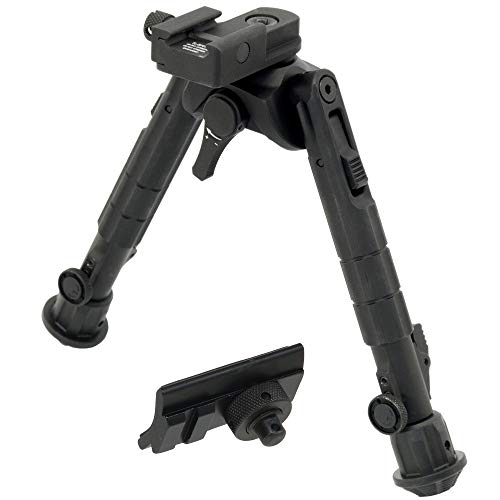
The Recon 360 TL is built around its head. The base rotates a full 360 degrees and tilts 15 degrees, so from a fixed set of legs you can follow an animal crossing a clearing and level the rifle on a slope — the two movements field hunters ask for most after basic height. A tension system keeps the head from spinning freely when you do not want it to. The legs set the center height between 7 and 9 inches, squarely in prone and bench territory, and fold with positive locks.
It mounts to a Picatinny rail with a quick-locking clamp, and UTG includes a swivel stud adapter in the box, which makes this the most flexible single purchase for a household with both a chassis rifle and a traditional stocked rifle. The build is aircraft-grade aluminum with a matte black finish and rubberized feet. If your hunting involves watching a field edge and swinging on animals that will not stand still, the panning head earns its place over a fixed-base bipod.
Specs
- Center height: 7–9 in
- Mount: Picatinny clamp, swivel stud adapter included
- Head: 360-degree panning base, 15-degree tilt
- Legs: Folding with position locks, height adjustable
- Construction: Aircraft-grade aluminum, matte black finish
- Feet: Rubberized
- Model: TL-BP01-A
5. CVLIFE Pivot Tilt Bipod 9–13 Inch — The Tallest Pick Here

This CVLIFE model stretches the format to 9–13 inches, the band that covers kneeling shots and low seated shots on flat ground where a 6–9 inch bipod leaves the muzzle in the dirt or the grass. It mounts directly to a sling swivel stud, and a Picatinny adapter is included for railed forends. The head pivots so the rifle can cant to level, and instead of a plain tension knob it uses a detachable S Lock lever — flip it to lock the cant firmly, which is easier with gloves than a small knurled knob.
The legs are notched and spring out at a button press, indexing to a repeatable height, and the construction mixes hardened steel and aluminum under a black anodized finish with soft rubber feet. It is a budget-brand bipod and feels like one in the small parts — check the leg locks and head tension before a hunt rather than during one. But as a first tall bipod, or a spare for a loaner rifle, it covers ground the shorter picks cannot.
Specs
- Height range: 9–13 in
- Mount: Sling swivel stud, Picatinny adapter included
- Head: Pivot tilt with detachable S Lock lever
- Legs: Notched, spring-loaded extension
- Construction: Hardened steel and aluminum, black anodized finish
- Feet: Soft rubber
- Included: Bipod, Picatinny adapter, S Lock lever
How to Choose a Hunting Bipod
Start with your real shooting position. Prone hunters should buy the 6 to 9 inch class and stop there; it is the steadiest and lightest setup. If you regularly shoot kneeling or sitting on flat, open ground, the 9 to 13 inch class is the minimum that works. If you sit to shoot over tall grass, sage or crop stubble, you need the 13.5 to 27 inch class — none of the picks above fully replaces it, and the honest trade is more weight, more folded bulk and more flex at full extension. Decide which compromise fits your country.
Match the mount to the rifle you actually carry. A sling stud clamp fits nearly every traditional hunting rifle and moves between guns fastest. Picatinny suits chassis and railed forends and gives the most rigid lockup. M-LOK gives the slimmest folded profile on compatible handguards. Adapters work, but each one adds stack height that raises your prone position and can introduce a faint wobble — prefer a native mount when you have the choice.
Pick leg controls you can run cold and gloved. Notched spring legs are the fastest to deploy and the easiest to set evenly. Friction legs allow in-between heights for odd slopes but take two hands and more time. Whatever the system, extend both legs before settling behind the rifle; adjusting under load is where bipods feel cheap.
Decide how much head movement you need. Cant is close to non-negotiable in the field because flat ground is rare. Pan matters if you watch trails, field edges or water where animals move laterally. Then check the lock: a lever or large knob you can torque with gloves beats a small screw head every time.
Count the carry cost. Every bipod here adds roughly 11 to 14 ounces at the worst place — the front of the rifle, where it changes balance and swing. Folded legs should sit tight and forward so they do not catch brush, and a quick-detach mount lets you strip the bipod for a stalk and refit it at the shot.
FAQ
What bipod height do I need for sitting shots?
For a true seated position over grass and low brush, most hunters need the 13.5 to 27 inch class. A 9 to 13 inch bipod handles kneeling and low sitting on bare or flat ground, but it will not lift the rifle over tall cover. Measure against the vegetation where you hunt.
Are bipods better than shooting sticks for hunting?
They solve different problems. A mounted bipod is steadier, always attached and faster once you are set, but its height is fixed by the model you bought. Shooting sticks adjust from sitting to standing and pack separately, at the cost of an extra item to carry and deploy. Many hunters own both and choose by terrain.
Will a bipod change my rifle’s point of impact?
It can. Clamping to a sling stud loads the forend, and on flexible stocks that pressure can shift harmonics or even touch the barrel. Sight in with the bipod mounted and loaded the way you will shoot in the field.
Do I need a swivel or pivot base?
For field shooting, strongly consider it. A pivot base lets you cant the rifle to level the reticle when the feet land on uneven ground, which is most of the time outside a range. A fixed base is fine for bench and flat prone work.
Can I leave a bipod on the rifle while stalking?
Yes — folded legs ride parallel to the forend and add little snag if they lock forward securely. Hunters in thick brush sometimes prefer a quick-detach model they can pull off and pocket, then refit for the final shot. Either way, check that folded legs cannot swing open against brush or a sling.
Conclusion
Buy height first, mount second, and head features third. For prone and bench work on a traditional rifle, the Harris S-BRM remains the durable benchmark, and the Caldwell XLA Pivot brings the same stud mount and cant in a lighter, simpler build. Modern rifles split by handguard: the Magpul is the clean M-LOK answer with real pan and tilt, while the UTG Recon 360 TL gives Picatinny rifles a full panning head plus a stud adapter for a second gun. The CVLIFE 9–13 reaches highest here, into kneeling and low sitting shots. If your hunts demand seated shots over tall cover, step up to the 13.5 to 27 inch class knowingly — and whichever you mount, practice deploying it at home until the legs, locks and leveling are one quiet motion.
More from Amazon
Programs that pair well with the guide above. Offers and eligibility are set by Amazon and may change.
Free shipping on eligible items, Prime Video and more. Eligible new members can start with a free trial.
Start a Prime free trialA Prime membership for ages 18-24 with a trial period. Eligibility is set by Amazon.
See Prime for Young AdultsAudiobooks and podcasts to listen to on the go. Eligible new members can start with a free trial.
Try Audible freeAd-free music streaming. Eligible new subscribers can start with a free trial.
Try Music Unlimited freeAs an Amazon Associate we earn from qualifying purchases.

Write Your Review
No reviews yet. Be the first to share your experience!