

Key takeaways
- The best fermentation crocks for sauerkraut and pickles: German water-seal stoneware, ceramic crock kits, and mason jar sets with airlocks and weights.
As an Amazon Associate we earn from qualifying purchases.
A fermentation crock does one job: it keeps vegetables under brine and oxygen out while lactic acid bacteria do the work. Everything else — the water channel, the weights, the glaze — exists to protect that one arrangement for the two to six weeks a batch of sauerkraut or pickles needs. The five vessels below split into two honest families. Traditional water-sealed stoneware crocks are the volume tools: heavy, light-proof, temperature-stable, and built around a moat of water that lets fermentation gas escape while blocking air from getting back in. Glass mason jar kits with airlock lids and weights are the small-batch tools: cheap to multiply, easy to watch, and sized for experimenting with a quart or two at a time.
Neither family forgives the two classic mistakes. Produce that floats above the brine grows mold — weights are not an accessory, they are the mechanism. And a water channel left to dry out mid-ferment is an open door: the seal that makes a crock special becomes its contamination path the moment the moat evaporates or collects debris. Choose below based on batch size first, then on how much weekly attention you are genuinely willing to give the vessel.
Affiliate Disclosure: This article contains affiliate links. If you buy through them, we may earn a commission at no extra cost to you. Products were chosen on vessel type, capacity and build, not on commission.
How to Choose a Fermentation Crock
Start with batch size, honestly. A 2-litre crock takes roughly one medium cabbage or a small pile of cucumbers — enough kraut for a couple, or a first experiment. A 5-litre crock handles several cabbages at once and suits households that ferment a season’s worth in a few big sessions. Glass jar kits work in the opposite direction: each jar is a separate small batch, so four jars means four different recipes at four different stages, not one big batch. Gardeners with a glut of cabbage want crock volume; cooks who like variety want jars.
Understand the water channel before you buy a crock. The lid of a water-seal crock sits in a moat. Filled with water, the moat is a one-way valve: carbon dioxide bubbles out, oxygen cannot get in, and fruit flies stay out too. It is an elegant seal with one weakness — you. The water evaporates over a long ferment and must be topped up, and the channel must be kept clean, because a neglected moat grows its own film and sits directly above your food. If your fermenting spot is somewhere you will not look at for weeks, a glass jar with an airlock lid asks less of you.
Weights are not optional, in any vessel. Whatever floats above the brine is exposed to air, and exposed vegetables mold. Crocks use split stoneware weights that sit on the produce; jar kits use glass weights sized to the jar mouth. Unglazed stone weights work but absorb brine and odors over time and need boiling between batches; glazed stoneware and glass weights rinse clean. Whichever you choose, check the fit: a weight narrower than the vessel leaves a ring of exposed vegetables around the edge.
Take the glaze question seriously. A crock’s interior glaze is the food-contact surface, and it should be a food-safe glaze from a reputable maker. This is the practical argument against the charming vintage crock at the flea market: old and unmarked crocks can carry lead-bearing glazes, hairline cracks that harbour bacteria, and no way to verify either. Buy new from a maker who states the glaze is food-safe, and inspect any crock — new or old — for chips inside before food goes in.
Stoneware is heavy, and that cuts both ways. Thick ceramic walls buffer temperature swings and block light, both of which ferments like. The same crock full of cabbage and brine is a serious lift onto a counter, and a dropped crock is a dead crock — ceramic does not dent, it shatters. Glass jars are light and let you watch the brine level and the bubbles, which beginners find reassuring, but they need a dark cupboard and they break too, just more cheaply.
The 5 Best Fermentation Crocks for Sauerkraut and Pickles
1. K&K Keramik Kerazo 5 L Fermenting Crock

The Kerazo is the modern descendant of the classic German Gärtopf design: a handmade stoneware crock from K&K Keramik, the German pottery whose water-seal crocks are the reference shape for this whole category. At 5 litres it is the volume pick on this list — big enough for a serious sauerkraut session from several heads of cabbage, or a large batch of pickles, without stepping up to cellar-sized pottery.
The Form 1 body is glazed inside and out, so the food-contact surface is sealed stoneware rather than porous clay, and the two-piece stoneware weights drop in as halves, which makes them far easier to place and retrieve through the crock mouth than a single disc. The lid sits in a generous water channel; keep it filled and the seal is effectively self-managing for weeks. The honest costs are weight and fragility: this is a heavy vessel empty and a two-handed lift full, and it wants a permanent home on a low shelf rather than regular trips up to a high cupboard.
Specs
- Type: water-seal stoneware crock
- Capacity: 5 L (1.3 gal)
- Material: handmade German stoneware, glazed inside and out
- Weights: two-piece glazed stoneware weights included
- Lid: water-channel (moat) lid
- Best use: family-size sauerkraut, kimchi and pickle batches
2. Humble House Sauerkrock Fermentation Crock Kit, 2 L

Humble House builds the Sauerkrock as a complete small-batch kit: a half-gallon ceramic crock with a water-channel lid, glazed weights, and a wooden pounder for packing cabbage down tightly enough to release its brine. For a first crock, having the tamper in the box matters more than it sounds — under-packed cabbage traps air pockets, and air pockets are where ferments go wrong.
At 2 litres this is a countertop vessel for one cabbage at a time, and that is its real role: a low-commitment way to learn water-seal fermenting before deciding whether you want crock volume. The glaze is stated lead-free, the weights are glazed so they rinse clean instead of absorbing brine, and the whole kit is small enough to wash in a kitchen sink — something no 5-litre crock can claim. The limits are the flip side of the size: a household that eats kraut weekly will outgrow it in a season, and like every water-seal crock it needs its channel checked and topped up during long ferments.
Specs
- Type: water-seal ceramic crock kit
- Capacity: 2 L (1/2 gal)
- Material: ceramic stoneware, lead-free glaze
- Weights: glazed weights included, plus wooden pounder
- Lid: water-channel airlock lid
- Best use: small countertop batches and first-time fermenters
3. Kenley Fermentation Crock, 2 L

The Kenley is the other complete 2-litre crock kit on this list, and it follows the same proven formula: ceramic crock, water-sealed lid, weights, and a pounder, sized for pickling cabbage, cucumbers and vegetables in small batches. It earns its place as the straightforward value route into crock fermenting — everything needed for a first batch of sauerkraut or dill pickles is in the one box.
The water-sealed lid works the same way as on the German crocks: fill the channel, and gas escapes while air and insects stay out. The weights keep the produce submerged, which is the single most important variable in whether a batch comes out crisp and tangy or gets thrown away. Two honest cautions apply to this whole class and this crock is no exception: the channel water needs topping up on multi-week ferments, and ceramic this size is still breakable — carry it with two hands, especially full. Treat it well and a simple crock like this is a decades-long tool: nothing in it wears out, as long as metal utensils stay away from the glaze.
Specs
- Type: water-seal ceramic crock kit
- Capacity: 2 L (1/2 gal)
- Material: ceramic stoneware pickle pot
- Weights: weights and pounder included
- Lid: water-sealed channel lid
- Best use: pickles, sauerkraut and kimchi in small batches
4. Masontops Complete Mason Jar Fermentation Kit, Wide Mouth
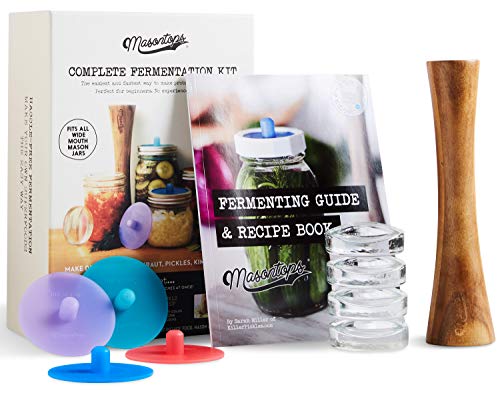
Masontops is the name most home fermenters meet first, and the Complete Kit shows why: four silicone Pickle Pipe airlock lids, four glass Pickle Pebble weights, a Pickle Packer tamper, and a recipe book, all built around wide mouth mason jars. The Pickle Pipe is a one-piece silicone lid with a self-sealing vent — gas pushes out, air does not come back, and there is no water to fill, top up, or spill, which removes the main chore of both crock channels and traditional three-piece airlocks.
The trade-offs are the mason jar trade-offs. Each jar is a small batch, the glass needs a dark place to ferment in, and wide mouth jars are the only fit. In exchange you get visibility — brine level, bubbles and any problem are right there to see — and parallelism: kraut in one jar, peppers in another, pickles in a third, all at different stages. For households that ferment a little of many things rather than a lot of one thing, this is the most practical format on the list, and the components fit jars most kitchens already own or can buy anywhere.
Specs
- Type: glass mason jar fermentation kit
- Capacity: per-jar batches in wide mouth mason jars
- Material: glass weights; silicone airlock lids
- Weights: 4 glass Pickle Pebble weights included
- Lid: 4 Pickle Pipe one-way silicone airlock lids; tamper and recipe book included
- Best use: varied small batches and several ferments at once
5. Hersolm Fermentation Kit for Wide Mouth Mason Jars

The Hersolm kit is the bring-your-own-jars option: four glass weights, four lids with built-in airlocks, and date markers on the lids for tracking when each batch went in — genuinely useful when four identical jars of cabbage are at four different ages. It fits wide mouth mason jars with a 3.3-inch opening, which covers the standard jars most people already have in a cupboard.
Be clear about what is and is not in the box: jars are not included, so this is an upgrade kit for existing jar owners, not a standalone starter set. Within that role it is well judged — the weights have easy-grip shaping that makes them simpler to lift out of a narrow jar mouth than smooth discs, the airlocks are the fill-and-forget water type scaled down to lid size, and the date dials end the masking-tape-and-guesswork system. If you are starting from zero jars, the Masontops kit above or a crock makes more sense; if your shelves already hold wide mouth jars, this kit turns them into proper fermenters for very little fuss.
Specs
- Type: glass mason jar fermentation kit (lids and weights set)
- Capacity: fits wide mouth mason jars, 3.3 in opening; jars not included
- Material: glass weights; lids with date markers
- Weights: 4 glass weights included
- Lid: 4 airlock lids with date-tracking dials
- Best use: upgrading jars you already own
Keeping a Ferment Alive: Care Notes That Apply to All Five
Mind the brine line, not the calendar. Recipes give times in weeks, but the real rule is submersion: everything solid stays under brine from day one to the day you move the batch to the fridge. Check crocks and jars every few days at the start, push down anything that has floated past a weight, and top up with fresh brine — not plain water — if the level drops.
Keep the seal working. On a water-seal crock, check the channel weekly and refill it before it runs dry; rinse the channel if it looks cloudy. On airlock lids, make sure vents are not blocked by brine foam during the most active first days. A ferment that smells sharply sour and clean is on track; surface mold on exposed food means that portion was above the brine — which is a weights problem, and fixable next batch by packing tighter and weighting honestly.
Wash like it matters, because it does. Crocks, weights and jars should be washed hot and clean between batches and dried fully before storage. Glazed stoneware and glass forgive normal washing; unglazed stone weights, if you ever use them, need boiling. Store crocks with the lid ajar so the interior stays fresh, and never seal a damp crock away for the season.
Pick your spot once. All five vessels ferment best in a cool, dark place with a steady temperature, out of direct sun. Stoneware tolerates a garage or cellar corner that would chill glass less evenly, but no ferment wants a spot beside the stove. Decide where the vessel lives before you fill it — moving a full crock is how crocks get dropped.
More from Amazon
Programs that pair well with the guide above. Offers and eligibility are set by Amazon and may change.
Free shipping on eligible items, Prime Video and more. Eligible new members can start with a free trial.
Start a Prime free trialA Prime membership for ages 18-24 with a trial period. Eligibility is set by Amazon.
See Prime for Young AdultsAudiobooks and podcasts to listen to on the go. Eligible new members can start with a free trial.
Try Audible freeAd-free music streaming. Eligible new subscribers can start with a free trial.
Try Music Unlimited freeAs an Amazon Associate we earn from qualifying purchases.










Write Your Review
No reviews yet. Be the first to share your experience!