

Key takeaways
- Five dog car barriers compared: tubular and wire-mesh cargo dividers, headrest-strap mesh panels and a padded backseat net for SUVs, wagons and trucks.
As an Amazon Associate we earn from qualifying purchases.
A dog car barrier has one job: keep the dog in the part of the vehicle you chose, so a wet nose, a paw on the console, or a full-body launch toward a squirrel never reaches the driver. Everything else — mesh versus tubing, straps versus pressure fit — is about how your vehicle is shaped and how determined your dog is. The five barriers below cover the three formats that dominate this category: pressure-fit dividers that fill a cargo opening from floor to headliner, wire-mesh panels that strap to the rear headrests, and a soft net barrier that closes the gap between the front seats.
One limit applies to every pick here, and it is worth stating before any product names. A barrier is a distraction reducer, not crash protection. It is not a restraint, it is not anchored to the vehicle’s structure the way a seatbelt is, and it will not protect your dog in a collision. A dog stopped by a barrier at parking-lot speeds can still be thrown by a hard impact, and the barrier itself can shift. If crash safety is your main concern, a barrier is the wrong tool on its own; treat it as a way to keep an unrestrained dog out of the front cabin during normal driving, and nothing more.
Fit decides everything else. Measure the cargo opening behind the seat your dog rides behind — width at the widest point, and height from floor to headliner — and check whether your rear headrests have exposed posts, because two of the formats below hang from them. Then match the barrier to the dog: calm riders do fine behind a net, while strong pushers need steel.
Affiliate Disclosure: This article contains affiliate links. If you buy through these links, we may earn a commission at no additional cost to you.
1. Heininger 3048 PortablePET Pet Partition

The PortablePET Pet Partition is the classic tubular cargo barrier: a grid of horizontal steel tubes that telescopes sideways and upward until it wedges between the cargo floor and the headliner. It expands from 34 to 60 inches wide and from 27 to 45 inches high, which covers the cargo openings of most mid-size and large SUVs and minivans. Because the tubes adjust independently, it can follow a sloped headliner better than a fixed panel, and the whole frame installs and removes without tools, drilling, or anything left behind in the vehicle.
Tubular construction is the right answer for a strong, pushy dog. There is no mesh to flex and no fabric to chew through; a dog that leans its full weight into this barrier is leaning on steel tubing held by friction at both ends. The trade-off is the pressure fit itself. The feet press hard enough to stay put, and on light-colored headliners that pressure can leave marks over time, especially if the barrier stays installed for months. Padding the contact points and loosening the fit when the dog is not riding reduces the risk, but if your headliner is pristine and that matters to you, look at the strap-mounted panels further down instead.
Specs
- Barrier type: adjustable tubular cargo barrier
- Adjustable range: expands 34–60 in wide, 27–45 in high
- Material: steel tubing
- Mounting: pressure fit between cargo floor and headliner; no tools or drilling
- Vehicle fit: SUVs and minivans; measure headliner height before ordering
- Caution: pressure feet can mark headliners; not a restraint and not crash protection
2. MidWest Wire Mesh Vehicle Barrier, Model 13

MidWest builds this barrier the way it builds its crates: steel wire mesh inside a tubular steel frame, finished in a black e-coat that cuts glare through the rear window. Instead of one expanding frame, you get two main mesh sections, each about 27.9 by 23.5 inches, that overlap each other to set the overall width, plus two small and two large extension panels that fill the gaps at the sides. Threaded rods with wing nuts then extend from the frame to press rubber feet against the floor and roof, locking the assembly in place.
That panel system makes the MidWest the most adaptable pick here for awkward cargo areas — wagons with curved sides, hatchbacks, and SUVs where the opening narrows toward the roof. It is also the fiddliest to install the first time, because width, panel overlap, and rod tension are all set by hand and clamp plates. One honest note from MidWest’s own instructions: the company states this product is a pet barrier and is not intended to be used as a cargo barrier, so do not rely on it to hold luggage or gear in place. As with the Heininger, the pressure rods can leave marks on the headliner, and the wing nuts are worth a re-check after the first few drives as everything settles.
Specs
- Barrier type: wire-mesh cargo barrier with extension panels
- Panels: 2 main sections (each approx. 27.9 x 23.5 in) that overlap to set width, plus 2 small and 2 large extension panels
- Material: steel wire mesh in a tubular steel frame, black e-coat finish, rubber feet and edge molding
- Mounting: threaded rods with wing nuts, pressure fit between floor and roof
- Vehicle fit: most cars, SUVs, vans and hatchbacks, including sloped cargo openings
- Caution: maker states it is a pet barrier, not a cargo barrier; pressure rods can mark headliners
3. rabbitgoo Dog Car Barrier

The rabbitgoo barrier takes the opposite approach to the two pressure-fit models: a steel wire-mesh panel that hangs from the rear headrests instead of wedging into the bodywork. The main panel measures 35.8 by 15.8 inches, two side panels at 16.5 by 11.8 inches extend the coverage, and the full assembly adjusts from 35.8 to 59.8 inches wide. Two nylon straps with metal grips wrap the headrest posts and hold the mesh tight against the seatback, so nothing presses on the headliner at all.
Because it mounts at the top of the seatback, this style suits dogs that ride on the rear seat as well as in a cargo area, and it folds down flat — the triple-folding panel packs to about 17.0 by 12.0 by 2.3 inches, small enough to slide under a cargo floor or behind a seat when the dog is not along. The limits are structural. The panel covers the band above the seatback, so a tall dog in a low-roofed car may still get a head over the top, and the whole design depends on rear headrests with exposed posts to strap to. Vehicles with fixed, one-piece rear seats have nothing for the straps to grip. Check your owner’s manual before strapping anything around a seatback, too: some seats contain side airbags, and a strap crossing the deployment seam is a bad idea.
Specs
- Barrier type: folding wire-mesh divider, headrest-mounted
- Adjustable range: 35.8–59.8 in wide; main panel 35.8 x 15.8 in, side panels 16.5 x 11.8 in each
- Material: steel wire mesh
- Mounting: two nylon straps with metal grips around rear headrest posts; no tools
- Folded size: approx. 17.0 x 12.0 x 2.3 in
- Vehicle fit: SUVs, vans, Jeeps and hatchbacks with rear headrests; check for seat-mounted side airbags before strapping around a seatback
4. NOAMOO Dog Car Barrier
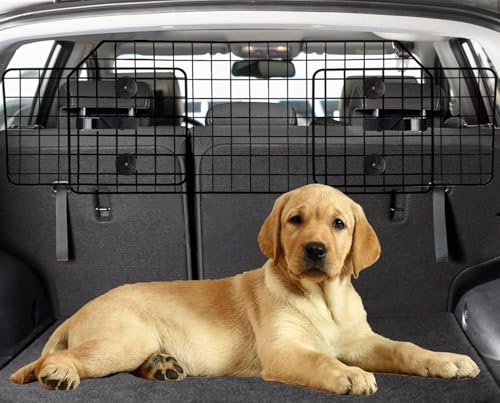
NOAMOO’s barrier is the same headrest-strap concept scaled up for the biggest cargo openings. In this largest size, the maker states an adjustable width of 38 to 66.5 inches — the widest span in this roundup — built from a main panel 38 by 16 inches and side panels of 16.6 by 12.2 inches, each side panel locked on with double clips for stability. The mesh is thickened steel wire with a sprayed finish, and at just under seven pounds the whole barrier still folds down to about 17.2 by 13.6 by 2.4 inches for storage.
This is the pick for full-size SUVs, vans, and trucks where narrower barriers leave open lanes at the sides that a medium dog can squeeze through. Width only helps if the side panels sit snug against the vehicle’s interior, so measure your opening at seatback height, not at the floor, and plan to use both side panels. Like the rabbitgoo, it needs rear headrest posts, covers the band above the seatback rather than the full height of the opening, and puts straps around a seatback — the same side-airbag check applies. For a very tall dog in a tall vehicle, a floor-to-headliner pressure barrier such as the Heininger or MidWest above closes more of the gap.
Specs
- Barrier type: large wire-mesh cargo divider, headrest-mounted
- Adjustable range: 38–66.5 in wide (maker-stated for this size); main panel 38 x 16 in, side panels 16.6 x 12.2 in each
- Material: thickened steel wire mesh with sprayed finish
- Mounting: adjustable straps to rear headrest posts; double clips secure each side panel; no tools
- Weight: 6.86 lb; folded size approx. 17.2 x 13.6 x 2.4 in
- Vehicle fit: full-size SUVs, vans and trucks with rear headrests; check for seat-mounted side airbags before strapping around a seatback
5. Wellbro Dog Car Backseat Barrier

Not every dog rides in the cargo area. For a dog that rides on the back seat, the problem is the gap between the front seats, and that is exactly what the Wellbro fills. It is a padded panel of nylon fabric with a waterproof lining and an EVA foam core, 24 by 24 inches, with two mesh windows that let air from the front vents reach the back seat and let the dog see forward. Four hooks go over the front headrest posts, elastic straps with metal hooks anchor the bottom edge under the front seats, and four clips adjust strap tension to fit the spacing.
Be clear-eyed about what a fabric barrier can and cannot do. It blocks the casual nose-through-the-gap, stops a small or calm dog from wandering onto the console, and keeps a dog from being pitched between the seats in a sudden stop. It will not stop a determined dog: a strong animal that wants the front seat will push under, climb over, or chew through a padded net, and for that dog the steel barriers above are the honest recommendation. Where the Wellbro wins is daily convenience — it folds away in seconds, works in cars with no cargo area at all, and never touches the headliner. Measure the space between your front seats first; the panel needs headrest posts and seat bottoms it can hook to, and very wide consoles can leave gaps at the edges.
Specs
- Barrier type: padded fabric and net barrier between the front seats (backseat barrier, not a cargo divider)
- Panel size: 24 x 24 in, with 2 mesh windows
- Material: nylon fabric with waterproof lining and EVA padding
- Mounting: hooks over front headrest posts; elastic straps with metal hooks under the front seats; 4 adjustable strap clips
- Vehicle fit: cars, SUVs and trucks with front headrest posts; measure the gap between the front seats first
- Caution: suited to calm and smaller dogs; a determined dog can defeat a net barrier — choose steel for strong pushers
How to Choose the Right Barrier
Start with where the dog rides. Cargo-area dogs need a divider behind the rear seats: pressure-fit tubular or mesh if your dog pushes hard or the opening is tall, headrest-strap mesh if you want fast removal and zero headliner contact. Back-seat dogs in a sedan or a wagon with the seats up need a between-seats barrier like the Wellbro, sized to the console gap.
Next, measure honestly. Width at the widest point of the opening, height from floor to headliner for pressure-fit models, and width at seatback height for strap-mounted panels. Confirm your rear headrests lift to expose their posts if you choose a strap design. Then check the owner’s manual for airbag locations: side-curtain airbags deploy from the roof rails and pillars, so keep pressure-barrier feet and mesh edges clear of pillar trim, and never strap around a seatback that houses a side airbag unless the manual allows it.
Finally, match the barrier to the dog in front of you. Steel tubing and welded mesh are for leaners, pawers, and dogs that test boundaries. Nets and fabric panels are for dogs that mostly stay put and just need the route forward closed. Whichever format you pick, re-check strap tension or pressure fit after the first few trips — barriers settle, straps stretch, and a barrier that has worked loose is only a suggestion. And keep the core limit in view: a barrier keeps the drive calmer and the dog where you put it, but it is not a restraint, and it does not make an unrestrained dog safe in a crash.
More from Amazon
Programs that pair well with the guide above. Offers and eligibility are set by Amazon and may change.
Free shipping on eligible items, Prime Video and more. Eligible new members can start with a free trial.
Start a Prime free trialA Prime membership for ages 18-24 with a trial period. Eligibility is set by Amazon.
See Prime for Young AdultsAudiobooks and podcasts to listen to on the go. Eligible new members can start with a free trial.
Try Audible freeAd-free music streaming. Eligible new subscribers can start with a free trial.
Try Music Unlimited freeAs an Amazon Associate we earn from qualifying purchases.

Write Your Review
No reviews yet. Be the first to share your experience!