

Key takeaways
- Case height: for air cooling, allow the cooler’s listed height plus a small margin. A 155 mm cooler in a case with exactly 155 mm of clearance is a risky fit because fan clips and side-panel tolerances vary.
- Radiator position: check the supported radiator length, thickness, and fan thickness together. A 38 mm radiator with 25 mm fans needs approximately 63 mm of vertical space before accounting for motherboard components.
- Memory clearance: confirm whether the front fan must be raised over tall DIMMs. This can turn a nominally 155 mm cooler into one taller than the case permits.
- Graphics-card and motherboard space: broad heatsinks can cover the upper PCIe slot area or crowd the first memory slot.
- Power connectors: liquid coolers may need pump power, several fan connections, and sometimes USB or controller cables.
Best CPU Coolers for Quiet, Reliable Builds
The best CPU coolers for most quiet, reliable builds are a quality dual-tower air cooler for value and low maintenance, or a 280/360 mm all-in-one liquid cooler when you need maximum thermal headroom for a high-power processor.
Air cooling is usually the safer long-term choice: it has no pump, radiator, or liquid-filled tubing to fail, and cleaning normally means removing dust from the heatsink and fan. Liquid cooling can move more heat away from the CPU, especially in sustained workloads, but adds pump noise, more cables, radiator-clearance constraints, and a finite pump lifespan. The right choice depends less on benchmark peaks than on your socket, case, workload, memory clearance, and tolerance for installation and maintenance.
Our top picks


As an Amazon Associate we earn from qualifying purchases at no extra cost to you. Ratings are shown as listed on Amazon.
Quick comparison: air versus liquid cooling
| Cooler type or example | Typical size | Approximate weight | Best sustained CPU class | Noise expectation | Maintenance and fit |
|---|---|---|---|---|---|
| Single-tower air cooler | 120 mm fan; 145–160 mm tall | 600–900 g | 65–125 W | Quiet at moderate loads | Simple installation; check RAM and case height |
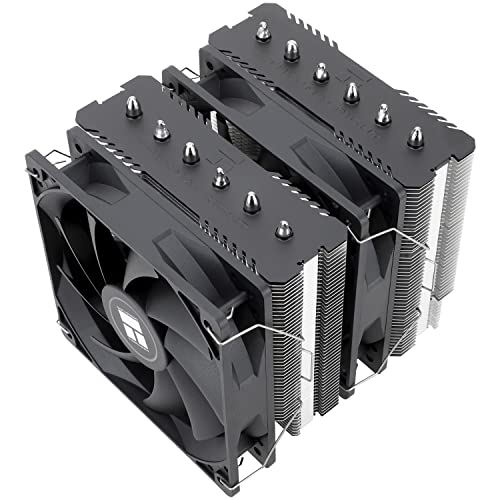
| Thermalright Peerless Assassin 120 SE | 125 × 135 × 155 mm; dual 120 mm fans | About 1.0 kg | 125–200 W, depending on case airflow | Quiet to moderate | Excellent value; verify AM5/LGA1700 mounting hardware |
| Noctua NH-D15 G2 | 168 mm tall; dual-tower, dual 140 mm fans | About 1.5 kg | 125–250 W, with strong case airflow | Very quiet at normal fan speeds | Premium mounting; large RAM and case-clearance footprint |
| Arctic Liquid Freezer III 280 | 280 mm radiator; two 140 mm fans | Roughly 1.7–2.0 kg including radiator and fans | 125–250 W | Low fan noise; pump adds a separate sound source | Requires radiator space and careful tube routing |
| Arctic Liquid Freezer III 360 | 397 × 120 × about 38 mm radiator assembly | Roughly 2.0–2.5 kg including fans | High-power CPUs and sustained rendering | Quiet when tuned, audible at maximum speed | Needs a compatible 360 mm mount and substantial top/front clearance |
Dimensions and weights vary slightly by fan, mounting hardware, and product revision. Always compare the cooler’s installation manual with your case and motherboard before buying.
Best CPU coolers by situation
Best value for a mainstream gaming PC: a dual-tower air cooler
A cooler such as the Thermalright Peerless Assassin 120 SE offers unusually high cooling capacity for its price range. Its two towers and six heatpipes spread heat through a large fin stack, while two 120 mm fans can run slowly during ordinary gaming. It is a strong match for processors such as the Ryzen 5, Ryzen 7, Core i5, and many Core i7 models when the processor’s power limits are sensible.
The trade-off is physical size rather than cooling performance. At approximately 155 mm tall, it fits many mid-tower cases but not every compact enclosure. The front fan may also overlap tall memory modules. Raising the fan increases the total height, so measure from the motherboard tray to the side panel rather than relying only on the advertised heatsink height.
Best premium air cooler: Noctua NH-D15 G2
The Noctua NH-D15 G2 is a premium choice when quiet operation, predictable mounting, and long-term serviceability matter more than minimum cost. Its dual 140 mm fans can move substantial air at low rotational speeds, and replacement fans are easier to source years later than a replacement pump assembly. The cooler supports current mainstream Intel and AMD platforms through its supplied mounting system, but socket-specific compatibility and offset mounting details should be checked for the exact package.
Its main limitation is clearance. The approximately 168 mm height rules out many small cases, and the two-tower design can compete with tall RGB memory, motherboard heatsinks, and large graphics cards in cramped layouts. It is a particularly good fit for a quiet workstation or gaming machine using a high-quality case with front-to-back airflow.
Best for maximum thermal headroom: a 280 or 360 mm liquid cooler
A 280 mm or 360 mm all-in-one cooler is appropriate for sustained compiling, 3D rendering, video production, or a high-end CPU that frequently operates near its power limit. The larger radiator provides more surface area than a typical air cooler, and placing it at the top or front of the case can remove heat efficiently.
The Arctic Liquid Freezer III 280 and 360 are examples of this class. Their thick radiator design can deliver strong temperatures, but that thickness matters: a top-mounted radiator may collide with motherboard VRM heatsinks or memory, while a front mount may reduce the fresh air reaching the graphics card. A 360 mm radiator also needs three 120 mm fan positions, not merely a case described as “liquid-cooling ready.”
Liquid cooling is not automatically quieter. At low and moderate loads, fans may be quiet, but the pump can produce a constant hum or tonal vibration. Set a conservative pump profile, avoid unnecessary maximum speed, and use the radiator fans’ temperature source deliberately. A liquid cooler also introduces a pump, seals, tubing, and a small amount of evaporation over years of use.
Socket compatibility is only the first fit check
Modern coolers commonly support AMD AM4 and AM5 and Intel LGA1700, but support depends on the included bracket and product revision. Some older stock may require a separate LGA1700 kit, while AM5 installations can use the motherboard’s original backplate or a supplied mounting system. Do not assume that a cooler advertised for “AM5” fits every board without checking the manual.
- Case height: for air cooling, allow the cooler’s listed height plus a small margin. A 155 mm cooler in a case with exactly 155 mm of clearance is a risky fit because fan clips and side-panel tolerances vary.
- Radiator position: check the supported radiator length, thickness, and fan thickness together. A 38 mm radiator with 25 mm fans needs approximately 63 mm of vertical space before accounting for motherboard components.
- Memory clearance: confirm whether the front fan must be raised over tall DIMMs. This can turn a nominally 155 mm cooler into one taller than the case permits.
- Graphics-card and motherboard space: broad heatsinks can cover the upper PCIe slot area or crowd the first memory slot.
- Power connectors: liquid coolers may need pump power, several fan connections, and sometimes USB or controller cables.
Decision matrix for choosing quickly
| Your situation | Recommended direction | Why |
|---|---|---|
| Budget build, occasional gaming, limited upgrades | Single-tower or affordable dual-tower air cooler | Lowest ownership complexity and adequate thermal capacity |
| Frequent gaming with a mid-range CPU | Dual-tower air cooler | Good noise-to-cost balance without pump noise |
| Long rendering or compiling sessions | 280 or 360 mm liquid, or premium dual-tower air | More thermal headroom; choose air if reliability is the priority |
| Small case or frequent transport | Low-profile or compact single-tower air cooler | Radiators and heavy tower coolers create more fit and handling problems |
| First PC build | Air cooler with a simple mounting kit | Fewer cables and no radiator or tube-routing decisions |
| Very quiet workstation used for many years | Premium air cooler, unless the case is designed for a radiator | Fans are easier to replace than a failed integrated pump |
Installation and maintenance that affect real-world noise
For either design, clean the CPU heat spreader, apply the supplied thermal compound in the manner specified by the manufacturer, and tighten mounting screws evenly in alternating turns. Excess paste rarely fixes poor contact; uneven pressure, a protective film left on the cold plate, or an incorrectly installed bracket is more often the problem.
After installation, use the motherboard firmware or fan-control software to create a gradual curve rather than reacting sharply to every short temperature spike. CPU temperatures can jump quickly during brief boosts. A fan that accelerates immediately and then slows down repeatedly is more distracting than one that responds with a short delay.
Dust the heatsink or radiator every few months in a dusty room, and inspect more often if the computer sits on carpet or near pets. Hold fan blades still while blowing compressed air through them. For a liquid cooler, check for unusual pump rattling, new vibration, dampness around fittings, or a sudden rise in temperatures. Do not open a sealed all-in-one cooler; replace it if it develops a leak or pump fault.
The most common air-cooling mistake is installing the rear fan or heatsink airflow backward. The usual pattern is front or bottom intake and rear or top exhaust. The most common liquid-cooling mistake is choosing a radiator that technically fits but blocks memory, motherboard heatsinks, or the graphics card. A slightly slower, correctly fitted cooler is preferable to a larger cooler forced into a poor airflow layout.
Bottom line
Choose a dual-tower air cooler for the best balance of cost, quiet operation, reliability, and easy ownership. Choose a premium model such as the Noctua NH-D15 G2 when you have generous case clearance and want a long-service build. Choose a 280 or 360 mm liquid cooler when sustained CPU power justifies the extra installation complexity and your case has confirmed radiator clearance. In every case, socket support is only the beginning: noise, thermals, and reliability depend just as much on clearance, fan curves, airflow direction, and sensible CPU power settings.






Write Your Review
No reviews yet. Be the first to share your experience!