
Our Short List of 3

- Best for: Off-trail backpacking, mountain travel, and navigation courses.
- Best for: Travel between hemispheres, map-based trip planning, and backpacking.

- Best for: Backcountry camping, orienteering practice, and hikers who measure distance and slope on the map.
All 4 Picks at a Glance
| Product | Specs | Action |
|---|---|---|
| 1. Suunto MC-2 Compass |
| Check price on Amazon |
| 2. Brunton TruArc 5 Baseplate Mapping Compass |
| Check price on Amazon |
| 3. Silva Ranger 2.0 Advanced Compass |
| Check price on Amazon |
 4. Suunto A-30 Compass |
| Check price on Amazon |
Key takeaways
- Find the best camping compass for hiking and backpacking, comparing mirror and baseplate models from Suunto, Silva and Brunton on declination, sighting and map scales.
As an Amazon Associate we earn from qualifying purchases.
A phone is a useful navigation tool right up until the battery fades, the signal drops, or rain makes the screen hard to use. A camping compass needs none of those things. Paired with a paper topographic map, a good baseplate or mirror compass lets you orient the map, take a bearing from the map, take a bearing on a landmark in the field, and walk that line with confidence. It is one of the lightest pieces of safety gear you can carry, and one of the most durable when you choose it well.
This guide explains how to choose the best camping compass for hiking, backpacking, and orienteering, then compares four proven models that all do the same core job: map-and-compass navigation. The Suunto MC-2 is the complete mirror option for off-trail travel, the Brunton TruArc 5 adds a global needle for travel between hemispheres, the Silva Ranger 2.0 brings a slope card and distance lanyard, and the Suunto A-30 is the simple, light choice for day hikes and learning navigation.
Disclosure: This article contains affiliate links to products on Amazon. If you buy through those links, we may earn a commission at no additional cost to you.
Quick Picks
- Best overall for off-trail navigation: Suunto MC-2 — mirror sighting, adjustable declination, and a clinometer in one instrument.
- Best for world travel: Brunton TruArc 5 — a global needle that stays level and responsive in both hemispheres.
- Best mirror compass for map work: Silva Ranger 2.0 — mirror sighting plus a slope card and a lanyard marked with distance scales.
- Best simple baseplate compass: Suunto A-30 — clear map scales, a magnifying lens, and luminous markings without extra complexity.
How to Choose a Camping Compass
Start With the Baseplate
For camping and hiking, the baseplate design is the right starting point. A transparent plate sits flat on a paper map, so you can see the terrain features underneath while you line up the edge of the plate with your route. A rotating capsule on the plate carries the needle, the orienting arrow, and the orienting lines you align with the map grid. Mirror compasses keep that same baseplate and add a hinged mirror lid, which is why the mirror models in this guide still count as map compasses rather than a separate category. Avoid a compass with no clear baseplate if your main use is plotting routes on a map, because an opaque body hides the map and makes accurate plotting much harder.
Declination Adjustment
A compass needle points to magnetic north, while maps are drawn to true north. The angle between the two is declination, and it changes with location and drifts slowly over time. In some regions it is small enough to ignore for a short walk. In others it is large enough that an uncorrected bearing can put you on the wrong ridge after a mile of walking.
There are two ways to handle it. A fixed declination correction scale, like the one on the Suunto A-30, prints the offset on the compass so you can apply the correction to each bearing by hand. An adjustable declination system, found on the MC-2, the TruArc 5, and the Ranger 2.0, lets you set the local value once so later bearings read true directly. Adjustable declination is the easier and less error-prone option if you hike in an area with a large declination, because it removes repeated arithmetic when you are tired or cold. Whichever system you choose, look up the current declination for your destination before each trip rather than relying on an old value printed years ago.
Sighting Mirror
A sighting mirror lets you hold the compass at eye level, line up a distant peak, tower, or tree through a notch or sighting line, and read the bearing in the mirror at the same time. That is more accurate than sighting over the top of a flat baseplate and then lowering the compass to read it, because lowering it is the moment a bearing often drifts. A mirror lid also protects the capsule in a pack and can double as a signaling mirror in an emergency. The trade-off is weight and bulk: a mirror compass is heavier and thicker than a plain baseplate model, so day hikers who mostly follow marked trails may not need one, while off-trail backpackers usually benefit from it.
Liquid-Filled Capsule and Needle Damping
The needle sits inside a liquid-filled capsule, and the liquid damps the swing so the needle settles quickly and stays readable while you move. Good damping matters in wind, on uneven ground, and when taking a bearing one-handed. A needle that sticks or settles slowly makes every reading less trustworthy. Check a compass by holding it level, turning it, and watching the needle return to the same reading. Also check for a large bubble in the capsule, and store the compass away from strong heat.
Needle Balance and Global Needles
Compass needles are balanced for the part of the world where they will be used, because the magnetic field dips at different angles in different regions. A northern-hemisphere needle works well across North America and Europe. Far from its balance zone, a standard needle can tilt, drag, and settle slowly. A global needle, like the one in the Brunton TruArc 5, stays level in both hemispheres. Choose one if you travel between hemispheres; if you hike in one region, a standard balanced needle is a sensible choice.
Map Scales, Rulers, and Magnifier
A useful baseplate carries rulers and map scales that match the maps you actually use, including inch and millimeter rulers for standard topographic maps. Those scales let you measure a route leg and convert it to real distance without extra tools. A magnifying lens helps with contour lines, small symbols, and fine print. Check that the scales match your usual map series before buying.
Luminous Markings, Bezel Grip, and Lanyard
Luminous markings help you take a rough bearing at dawn, at dusk, or inside a dark tent without a bright light. A textured bezel is easier to rotate with gloves or cold hands, and clear degree markings make precise bearings easier to set. A detachable lanyard keeps the compass around your neck while you work and lets you remove it quickly to lay it flat on a map. These details sound minor at home and matter on a wet hillside.
The Best Camping Compasses Compared
1. Suunto MC-2 Compass
- Best for: Off-trail backpacking, mountain travel, and navigation courses.
Off-trail backpacking, mountain travel, and navigation courses.
View the Suunto MC-2 on Amazon
The Suunto MC-2 is the most complete compass in this guide, and the natural first choice for campers and backpackers who navigate off trail. It combines a transparent baseplate for map work with a folding sighting mirror, so you can plot a route at camp and then sight an accurate bearing on a distant landmark without changing tools. The mirror has a sighting notch and line, and you read the bearing in the mirror while the landmark stays in view, which keeps the compass steady at eye level.
Declination is adjustable on the MC-2, with the adjustment key carried on the lanyard so it stays with the compass. Set the local correction once and the compass reads true bearings directly. A built-in clinometer measures slope angle, which helps with route planning and with judging the steepness of a slope before you commit to it. The baseplate includes a magnifying lens for fine map detail and map scales suited to common topographic maps, and luminous markings support low-light readings. The liquid-filled capsule uses a jewel-bearing needle for stable, responsive settling.
The MC-2 is larger and heavier than a simple baseplate compass, at about 65 by 101 millimeters with the lid closed, so it fills a pocket rather than disappearing into one. That size is the honest cost of the mirror, clinometer, and full feature set. For a camper who only follows marked trails, it may be more compass than needed. For anyone who crosses open country, travels in poor visibility, or wants one instrument to learn advanced navigation on, it is the strongest pick here.
2. Brunton TruArc 5 Baseplate Mapping Compass
- Best for: Travel between hemispheres, map-based trip planning, and backpacking.
Travel between hemispheres, map-based trip planning, and backpacking.
View the Brunton TruArc 5 on Amazon
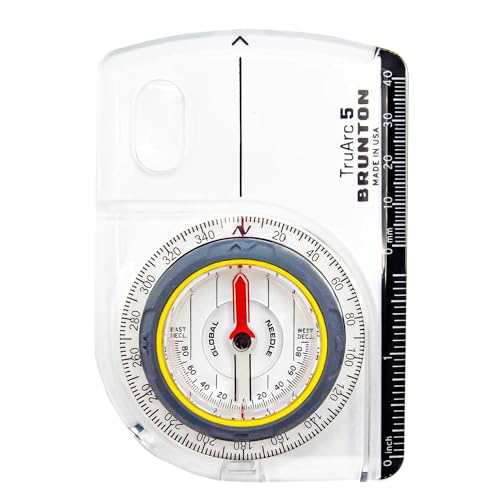
The Brunton TruArc 5 is a baseplate mapping compass built around a global needle, which makes it the pick for campers who travel widely. The needle is designed to remain level and responsive in both the northern and southern hemispheres, so the same compass that works on a home trail keeps working on a trip across the equator, where a single-zone needle can tilt and drag. If your camping includes international travel, that one feature removes a real limitation.
As a mapping compass, the TruArc 5 is made to live on a topographic map. The clear baseplate carries a magnifying lens for fine detail, and the design supports measuring and plotting routes in the usual way: lay the plate edge along your line of travel, rotate the capsule until the orienting lines match the map grid, then follow the direction-of-travel arrow in the field. Declination adjustment is built in, so you can set the local correction and read true bearings without repeated calculation. Luminous markings help with early starts and late finishes.
There is no sighting mirror or clinometer on this model, so field bearings are taken over the baseplate rather than through a mirror, and slope angle is judged by other means. In return you get a simpler, flatter compass that is easy to pack and easy to teach with, plus the global needle that none of the other picks here match. For a traveler who values map work and worldwide use over mirror sighting, the TruArc 5 is a well-judged balance.
3. Silva Ranger 2.0 Advanced Compass
- Best for: Backcountry camping, orienteering practice, and hikers who measure distance and slope on the map.
Backcountry camping, orienteering practice, and hikers who measure distance and slope on the map.
View the Silva Ranger 2.0 on Amazon
The Silva Ranger 2.0 follows the classic mirror compass pattern that orienteers and backcountry travelers have used for decades. The folding mirror carries a sighting line, so you can aim at a landmark and read the bearing in the mirror in the same view, holding the compass at eye level for a steadier and more accurate reading. The lid protects the capsule when closed, and the baseplate underneath remains transparent for plotting on a map.
What sets the Ranger 2.0 apart is how it handles the jobs around the bearing itself. It includes a slope card for estimating slope angle, a clinometer function for measuring it, and a distance lanyard marked with scales for measuring winding routes on a map, which is genuinely useful when a trail bends and a straight ruler understates the distance. Declination adjustment is built in, luminous markings support low-light use, and the baseplate grip helps you hold the compass steady with wet or gloved hands.
Like the MC-2, the Ranger 2.0 is bulkier than a plain baseplate compass, and new users should expect a short learning curve with mirror sighting. Once that technique clicks, it becomes the fastest way to take a precise field bearing. Choose the Ranger 2.0 if you like the mirror system and want the slope and distance tools included, or if you are building navigation skills for regular backcountry camping rather than occasional trail checks.
4. Suunto A-30 Compass
- Best for: Day hiking, beginners, scout and family camping, and as a lightweight backup.
Day hiking, beginners, scout and family camping, and as a lightweight backup.
View the Suunto A-30 on Amazon
The Suunto A-30 is the straightforward baseplate compass in this guide, and for many campers it covers everything that matters. The clear baseplate carries map scales and a magnifying lens for reading fine detail, the capsule is liquid-filled for steady needle settling, and luminous markings make the key points readable in low light. A lanyard keeps it close at hand, and the simple layout makes it easy to teach to a new hiker, a scout, or a family member who is learning map skills for the first time.
Declination is handled with a built-in correction scale rather than a mechanical adjustment. That means you note the local declination and apply the correction to your bearings by hand instead of setting it once on the compass. For day hikes and moderate declination values, that is a workable and transparent method, and it keeps the compass simple and light. There is no sighting mirror and no clinometer, so field bearings are taken over the baseplate and slope is judged from the map contours.
The A-30 makes sense as a first compass, as a light backup carried alongside a phone, and as the compass you hand to someone who is learning. Campers who later move into regular off-trail travel can step up to a mirror model and keep the A-30 as a spare. As a primary compass for marked trails, camp navigation, and orienteering practice, it is dependable, compact, and easy to live with.
How to Take a Basic Bearing
Place the baseplate edge along the line between your position and destination on the map, with the direction-of-travel arrow pointing toward the destination. Rotate the capsule until the orienting lines run parallel to the map grid and the orienting arrow points toward map north, with declination set first if your compass allows it. Then hold the compass level, turn your body until the needle sits inside the orienting arrow, pick a landmark on that line, walk to it, and repeat. Keep the compass away from phones, knives, and vehicles while you read it, because nearby metal can pull the needle off north.
Frequently Asked Questions
Do I need a mirror compass for camping?
Not for every trip. A plain baseplate compass is enough for marked trails, camp use, and learning navigation, and it is lighter and simpler. A mirror compass earns its extra weight when you navigate off trail, sight bearings on distant landmarks, or travel in poor visibility, because it lets you aim and read the bearing at the same time without lowering the compass.
What declination should I set?
Set the declination for the exact area where you will hike, using a current source such as the information printed on a recent topographic map or an official geomagnetic calculator for your destination and date. Declination differs by location and changes slowly over time, so a value that was right for one state or one decade may be wrong for another. Check it before each trip.
Can a compass replace a phone or GPS?
A compass and map can handle direction finding without batteries or signal, and they keep working in rain, cold, and deep valleys. They cannot show your live position the way a GPS device can. The most resilient setup is both: use the phone or GPS for position when it works, and keep the compass and map as the independent backup you have practiced with.
How do I keep a compass accurate?
Hold it level and away from metal and electronics when taking a reading, and take important bearings twice. Check the capsule for large bubbles and watch whether the needle swings freely and settles on the same reading each time. Store the compass dry, away from strong heat and away from magnets and speakers, and wipe the baseplate clean so map detail stays easy to read through it.
Which compass is best for a beginner?
The Suunto A-30 is the easiest starting point here because its layout is simple and its baseplate teaches the core map skills directly. A beginner who already knows they will travel off trail may prefer to start with the Silva Ranger 2.0 or Suunto MC-2 and learn mirror sighting from the beginning, rather than buying twice.
Conclusion
The best camping compass is the one that matches the navigation you actually do. Choose the Suunto MC-2 for the most complete mirror sighting instrument, the Brunton TruArc 5 for a global needle and strong map work, the Silva Ranger 2.0 for mirror sighting with slope and distance tools, and the Suunto A-30 for a light, simple baseplate compass that teaches the fundamentals well. Whichever model you pick, set the declination for your area, practice orienting a map and taking bearings before you need those skills on a real trip, and carry the compass where you can reach it. A compass only helps when it is in your hand, understood, and trusted.
More from Amazon
Programs that pair well with the guide above. Offers and eligibility are set by Amazon and may change.
Free shipping on eligible items, Prime Video and more. Eligible new members can start with a free trial.
Start a Prime free trialA Prime membership for ages 18-24 with a trial period. Eligibility is set by Amazon.
See Prime for Young AdultsAudiobooks and podcasts to listen to on the go. Eligible new members can start with a free trial.
Try Audible freeAd-free music streaming. Eligible new subscribers can start with a free trial.
Try Music Unlimited freeAs an Amazon Associate we earn from qualifying purchases.

Write Your Review
No reviews yet. Be the first to share your experience!