
Our Short List of 3


All 5 Picks at a Glance
| Product | Specs | Action |
|---|---|---|
| 1. Coleman Triton 2-Burner Propane Stove — best all-round two-burner | Check price on Amazon | |
 2. Camp Chef Everest 2X — best for high heat and busy cooking | Check price on Amazon | |
| 3. Coleman Cascade 222 2-Burner Camping Stove — best two-burner with matchless lighting | Check price on Amazon | |
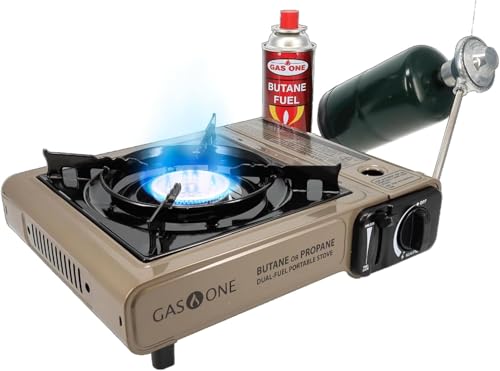 4. Gas One GS-3400P — best dual-fuel single burner | Check price on Amazon | |
 5. Coleman Cascade 18 1-Burner Camping Stove — best single burner for a larger pan | Check price on Amazon |
Our Top Picks
- Gas One GS-3400P Propane or Butane Stove Dual8,000 BTU13.5 x 11.2 x 4.4 inches3.1 poundsCheck on Amazon
As an Amazon Associate we earn from qualifying purchases.
A camping gas stove decides whether camp dinner is calm or chaotic. With the right stove, water boils while a pan is already warming, and a breezy picnic table does not keep blowing the flame sideways. With the wrong one, you cook one item at a time or discover at the campsite that your fuel does not match the connector in the box.
This guide covers five gas stoves built for the same job: portable camp cooking on propane, butane, or both. There are no wood, alcohol, or electric models mixed in. Inside the gas category, the real choices are simple. Do you need two burners or one? Do you want a 16-ounce propane cylinder, a flat butane cartridge, or a dual-fuel stove that can use either? And how much heat, wind protection, and pan space does your group need?
The picks below are organised by use case. A family base camp, a couple on a tailgate, and a solo camper making a one-pan breakfast do not need the same stove, even though all three are searching for the best camping gas stove.
Disclosure: This article contains affiliate links. If you buy through a link on this page, we may earn a commission at no extra cost to you.
Quick comparison
| Product | Burners | Fuel | Total output | Ignition | Best for |
|---|---|---|---|---|---|
| Coleman Triton | 2 | Propane | 22,000 BTU | Match lighting | All-round two-burner car camping |
| Camp Chef Everest 2X | 2 | Propane | 40,000 BTU | Matchless piezo | High heat and windy, busy cook stations |
| Coleman Cascade 222 | 2 | Propane | 22,000 BTU | Matchless lighting | Two burners with push-style convenience |
| Gas One GS-3400P | 1 | Butane or propane | 8,000 BTU | Piezo | Dual-fuel flexibility in a carry case |
| Coleman Cascade 18 | 1 | Propane | 8,000 BTU | Matchless lighting | Solo and couple cooking with a larger pan |
1. Coleman Triton 2-Burner Propane Stove — best all-round two-burner
View the Coleman Triton on Amazon
The Coleman Triton is the straightforward answer for most car campers: two adjustable propane burners in a folding case, with 22,000 BTU of total cooking power shared across the cooktop. That format is popular for a reason. One burner can hold a kettle or a pot of pasta water while the other handles a frying pan, and each burner has its own control so the two jobs do not have to run at the same heat.
Two wind guards help shield the burners at an exposed table, and the removable chrome-plated grate lifts off for cleanup after a meal. The case latches shut and has a handle, which matters more than it sounds when a stove is carried between a vehicle, a picnic table, and a storage box several times on one trip. It runs on a 16-ounce propane cylinder, sold separately, with a stated burn time of up to one hour on high on that cylinder. In normal mixed cooking, where burners spend much of the time below full power, planning still means carrying a spare cylinder for a weekend of group meals.
Choose the Triton if you want the classic two-burner layout without built-in push-button ignition. This standard version is lit with a match or a separate lighter, so pack one in the stove case and keep a backup in the kitchen box. If reaching for a lighter is a deal-breaker, look at the Cascade 222 or the Everest 2X below instead. If you mainly cook one-pot meals for one or two people, the Triton is more cooktop than you need, and a single-burner pick will pack smaller.
Key specs: 2 burners; propane; 22,000 BTU total; adjustable burners; wind guards; removable chrome-plated grate; latched case with carry handle; fuel sold separately.
2. Camp Chef Everest 2X — best for high heat and busy cooking
View the Camp Chef Everest 2X on Amazon
The Camp Chef Everest 2X is the high-output option in this group. Its two burners are rated at 20,000 BTU each, for 40,000 BTU in total — close to double the total output of the two Coleman two-burner models here. That extra power is most useful when you are boiling a large pot of water, heating a heavy pan, or cooking for a group that does not want to wait in stages. It also gives the stove more headroom in wind and cold, where a weaker burner can feel slow even when it is working exactly as designed.
Power alone is not the whole story, because a stove that only runs hot is awkward for rice, sauces, and eggs. The Everest 2X pairs its output with adjustable controls and matchless ignition, so each side can be set independently without a separate lighter. A stainless steel drip tray makes cleanup more manageable after greasy cooking, and the folding case includes a carry handle.
This is a tabletop propane stove for car camping, tailgating, and base camps, not a backpacking burner. Pick it if two pans are in regular use, if you often cook for four or more people, or if your campsites tend to be windy. Skip it if your meals are usually a kettle and a single small pan, because the single-burner models below do that job in a smaller case.
Key specs: 2 burners; propane; 40,000 BTU total, 20,000 BTU per burner; matchless ignition; adjustable controls; stainless steel drip tray; folding case with carry handle; fuel sold separately.
3. Coleman Cascade 222 2-Burner Camping Stove — best two-burner with matchless lighting
View the Coleman Cascade 222 on Amazon
The Coleman Cascade 222 sits in the same broad class as the Triton — two propane burners, 22,000 BTU of total cooking power, and dual wind guards — but it adds matchless lighting. For campers who have tried to light a stove with one hand shielding a match on a breezy evening, that difference is practical rather than cosmetic. You still need to follow the lighting instructions for the specific unit, keep hands and loose clothing clear of the burner, and check that a burner has actually lit before turning up a second control.
The Cascade 222 is a sensible middle path for families and couples who cook two things at once but do not need Everest 2X output. A pot and a pan can share the cooktop, the wind guards help at an open table, and the stated burn time is up to one hour on high on one 16-ounce propane cylinder, sold separately. That figure is a high-setting reference point, not a promise for a whole weekend, so count cooked meals when deciding how many spare cylinders to pack.
Compared with the Triton, the choice comes down mainly to ignition. Compared with the Everest 2X, the Cascade gives up peak heat for a simpler class of stove. For breakfasts, pasta, soups, and pan-fried dinners, 22,000 BTU across two burners is workable power, provided you give a large pot time to boil and use lids whenever you can.
Key specs: 2 burners; propane; 22,000 BTU total; matchless lighting; dual wind guards; up to 1 hour on high on one 16 oz propane cylinder; fuel sold separately.
4. Gas One GS-3400P — best dual-fuel single burner
View the Gas One GS-3400P on Amazon
The Gas One GS-3400P solves a different problem: fuel flexibility. This single-burner stove is designed to run on an 8-ounce butane cartridge or on propane with the included regulator connection for a 16.4-ounce propane cylinder, so you can use the fuel you can actually find before a trip instead of building the whole kitchen around one format. Output is 8,000 BTU, which is in line with the other single-burner pick here and is enough for a kettle, a saucepan, or a frying pan used one at a time.
The stove uses piezo ignition and is supplied with a carrying case, which makes it easy to keep the burner, regulator, and instructions together. Gas One also builds in a cartridge ejection safety system, a feature worth understanding before first use by reading the manual that comes with the unit. As with any butane cartridge stove, insert and lock the cartridge exactly as directed, check for the smell of gas before lighting, and never force a cartridge that does not seat properly.
Choose the GS-3400P if you want one compact burner for solo trips, a small backup burner beside a larger stove, or a portable stove that can switch between butane and propane. It is also a tidy option for a roadside picnic or a small tailgate where a two-burner case would dominate the table. Its limit is obvious and honest: one burner means one pan, so group cooking becomes sequential. If your normal dinner needs a main dish and a side finishing at the same time, buy a two-burner stove instead of trying to work around that limit.
Key specs: 1 burner; butane or propane dual fuel; 8,000 BTU; piezo ignition; carrying case included; propane regulator connection included; cartridge ejection safety system; fuel sold separately.
5. Coleman Cascade 18 1-Burner Camping Stove — best single burner for a larger pan
View the Coleman Cascade 18 on Amazon
The Coleman Cascade 18 is the propane-only single-burner option. It produces 8,000 BTU, lights without matches, and is built to fit a 12-inch pan, which is a useful step up for campers who find compact burners cramped under a family-size frying pan or a wide pot. A larger pan fit does not turn a single burner into a group stove, but it does make one-pan meals for two or three people much easier to manage.
Its stated burn time is up to 2.5 hours on high on one 16-ounce propane cylinder, sold separately — a longer high-setting figure than the two-burner Colemans list, which makes sense for a single 8,000 BTU burner drawing from the same size of cylinder. Propane is also widely sold in the United States in that 16-ounce format, so restocking before a trip is usually a simple stop rather than a special order.
Pick the Cascade 18 if your cooking is mostly one pan at a time, you prefer propane to butane cartridges, and you want matchless lighting in a compact cooktop. Pick the Gas One instead if dual-fuel use matters more than the 12-inch pan fit. Pick any of the two-burner models if you regularly boil and fry at the same time. There is no benefit in carrying a second burner you never light, and there is real frustration in missing one you need every evening.
Key specs: 1 burner; propane; 8,000 BTU total; matchless lighting; fits a 12-inch pan; up to 2.5 hours on high on one 16 oz propane cylinder; fuel sold separately.
How to choose the right camping gas stove
Start with burner count, not BTU
Burner count changes how a meal flows. Two burners let you boil on one side and fry, simmer, or warm on the other, which is why every family and group pick in this guide has two. One burner keeps packing simple and works well for coffee, soup, noodles, and one-pan meals, but it forces a sequence. Decide by picturing your most common dinner, not your most ambitious one. If that dinner is burgers in a pan while corn or beans heat in a pot, you need two burners. If it is a single pot that everyone eats from, you probably do not.
BTU figures come second. A BTU figure describes heat output, and higher output generally boils water faster and recovers heat faster when cold food hits a pan. It does not guarantee better cooking on its own. Pan size, lid use, wind, and air temperature all shape the result. The Everest 2X has the clear output advantage here, while the 22,000 BTU Colemans cover everyday meals and the 8,000 BTU single burners cover one-pot cooking.
Match the fuel to how you shop and travel
Propane in a 16-ounce cylinder is the common thread across four of these five stoves. It is easy to understand, the connector format is familiar, and a spare cylinder is simple to carry in a vehicle. Butane cartridges are flat and slide into compatible single-burner stoves, but a propane-only stove cannot use them, and a butane-only stove cannot use a propane cylinder. The Gas One GS-3400P is the exception that accepts both systems, using the correct connection for each.
Never treat fuel formats as interchangeable beyond what the manufacturer states for that exact model. Use only the cartridge or cylinder type, size, and connection described in the manual, and buy fuel from a reputable source with the container in good condition. Store cylinders and cartridges upright where required, away from heat and flames, and transport them according to the instructions printed on the container.
Check pan fit before you buy
A stove can have enough heat and still be annoying if your pan overhangs the grate, crowds the second burner, or sits unsteadily. The Cascade 18 states a 12-inch pan fit, which is a concrete check you can make against the pan you already own. On two-burner stoves, measure the two pans you would use together, not just the largest one alone. A wide pot plus a wide frying pan may each fit individually and still not sit well side by side. Bringing the cookware you already own into the decision avoids buying a stove that works on paper and fails at dinner.
Take wind protection seriously
Wind steals heat, bends flames away from the base of a pan, and lengthens cooking times. Built-in wind guards, such as those on the Triton and the Cascade 222, help on a breezy table, and higher reserve output, such as the Everest 2X provides, can compensate to a degree. Placement helps too: set the stove on a stable, level, heat-safe surface in the most sheltered spot available, while keeping it well away from tent fabric, awnings, dry grass, and stored fuel. Never enclose a stove so tightly that heat and exhaust cannot escape, and never use a camping gas stove inside a tent, vehicle, or other enclosed space.
Ignition is a convenience and a backup question
Matchless and piezo ignition mean a built-in way to light the burner, as on the Cascade models, the Everest 2X, and the Gas One. Match-lit models, such as the standard Triton, need a match or lighter kept with the stove. Either way, carry a backup ignition source in a dry place, because a trip is a bad time to discover your only lighter is damp at the bottom of a bag.
Safety and care basics
Read the manual for your exact stove before the first trip and do a first setup at home in daylight, outdoors, without rushing. Check hoses, regulators, and connections for damage, and confirm you know how the fuel connects and disconnects on that model. If you smell gas after connecting fuel, turn everything off, disconnect as directed, and do not light the stove until the cause is found.
Cook outdoors only, on a stable surface, with the stove attended while lit. Keep children and pets back, keep spare fuel away from the lit stove, and let the stove cool fully before closing the case. After cooking, wipe away food residue once parts are cool and dry everything before storage. Store the stove without fuel connected unless the manufacturer instructs otherwise.
Cold weather also matters. Gas pressure and performance can drop as temperatures fall, and butane in particular struggles in deep cold. Treat burn times as reference points, not guarantees for a frosty morning, and allow extra time and fuel in cold or exposed conditions.
Which stove should you buy?
For most car campers, the Coleman Triton is the balanced starting point: two burners, 22,000 BTU, wind guards, and a latched case, provided you are happy lighting it with a match or lighter. For the same two-burner format with matchless lighting, choose the Coleman Cascade 222. For groups, large pots, and the strongest heat in this guide, choose the Camp Chef Everest 2X and its two 20,000 BTU burners.
For compact cooking, the decision is about fuel and pan size. The Gas One GS-3400P is the flexible pick, running on butane or propane and packing into its own case. The Coleman Cascade 18 is the propane pick for a larger pan, with a stated 12-inch fit and a longer burn time on a 16-ounce cylinder.
Whichever model you choose, confirm the fuel type, check your pans against the cooktop, pack a spare cylinder or cartridge for multi-day cooking, and keep a backup lighter in the kitchen box. Those four small checks do more for a good camp dinner than chasing the largest BTU number on the page.
More from Amazon
Programs that pair well with the guide above. Offers and eligibility are set by Amazon and may change.
Free shipping on eligible items, Prime Video and more. Eligible new members can start with a free trial.
Start a Prime free trialA Prime membership for ages 18-24 with a trial period. Eligibility is set by Amazon.
See Prime for Young AdultsAudiobooks and podcasts to listen to on the go. Eligible new members can start with a free trial.
Try Audible freeAd-free music streaming. Eligible new subscribers can start with a free trial.
Try Music Unlimited freeAs an Amazon Associate we earn from qualifying purchases.


Write Your Review
No reviews yet. Be the first to share your experience!