
Our Short List of 3

- Best for: Two-person desert basecamps of three to five nights where ice resupply is a long drive away.
- Brand: YETI
- Color: Rescue Red
- Capacity: 45 quarts
- Holds 26 cans at a 2:1 ice-to-contents ratio, or 37 lb of ice alone
- Best for: Solo desert campers and couples who load, carry and reposition the cooler without a second pair of hands.
- Brand: RTIC
- Capacity: 52 quarts
- Can capacity: Up to 76 cans
- Insulation: Closed-cell foam, up to 3 inches

- Best for: Two-night desert weekends and festival-style camps where an ice refill is available on the way in or out.
- Brand: Coleman
- Color: Red
- Capacity: 54 quarts
- Can capacity: Up to 85 cans
All 3 Picks at a Glance
| Product | Specs | Action |
|---|---|---|
| YETI Tundra 45 Hard Cooler |
| Check price on Amazon |
| RTIC 52 QT Ultra-Light Hard Cooler |
| Check price on Amazon |
| Coleman Vintage 54qt Steel Belted Cooler |
| Check price on Amazon |
Key takeaways
- Compare three hard coolers for desert camping by insulation thickness, stated ice retention, capacity and lid seals, so food stays cold in serious heat.
Desert camping punishes a cooler in ways a shaded forest site never does: the box sits near hot ground, the air around it stays warm long after sunset, and the nearest ice refill can be an hour of driving away. The real decision is not which cooler looks toughest, but which one’s insulation thickness, lid seal and capacity match the number of days you will spend far from a store, because every maker states ice retention under its own conditions.
This guide is for car campers heading to desert sites for two to five nights, for small groups who cook fresh food at camp, and for solo travellers who need a lighter box they can still load alone. The three hard coolers below were chosen from their Amazon listings, comparing stated insulation, capacity, can counts, drain designs and carry weight from each listing.
Quick Picks
As an Amazon Associate we earn from qualifying purchases
| Product | Best for | Key spec from title |
|---|---|---|
| YETI Tundra 45 Hard Cooler | Multi-day desert basecamps where ice must last | Up to 3 inches of PermaFrost insulation |
| RTIC 52 QT Ultra-Light Hard Cooler | Solo campers who load and carry the cooler alone | 52 qt capacity at 21 lb empty weight |
| Coleman Vintage 54qt Steel Belted Cooler | Shorter desert weekends with frequent ice top-ups nearby | Keeps ice up to 4 days, 85-can capacity |
How to Choose
Insulation thickness and where the foam sits
Wall and lid foam does the actual work in desert heat, so compare the stated thickness before anything else. The YETI below lists up to three inches of pressure-injected insulation in its walls and lid, and the RTIC lists up to three inches of closed-cell foam, while thinner-walled chests rely on an insulated lid alone. Foam in the lid matters as much as foam in the walls, because hot air presses down on the top of the box all afternoon. A cooler that only insulates its body leaves its weakest surface facing the sun.
Lid gasket and latch pressure
A freezer-style gasket only helps if the latches pull the lid down onto it evenly, sealing the gap where warm air would otherwise leak in every time the desert wind picks up. Look for a full-length gasket named in the listing, plus latches that compress it rather than a lid that simply rests in place. The YETI uses a freezer-quality gasket around the full length of its lid with rubber latches, and the RTIC pairs its foam with a freezer-style gasket. On any model, check that the gasket is replaceable or at least seated in a channel, not glued flat.
Capacity measured against ice, not just cans
Can counts in listings assume little or no ice, which is not how a desert cooler gets packed. YETI states its 45 with a two-to-one ice-to-contents ratio holds 26 cans, a far more honest planning figure than the 54 cans it holds with no ice at all. Work backwards from your trip: food and drinks for three desert days, plus enough ice to fill roughly half the interior, usually means a 45 to 54 quart box for two people. Oversizing wastes ice melt on empty air space, while undersizing forces warm restocking runs.
Drain, handles and loaded weight
Meltwater left sitting against food speeds up warming, so a leakproof drain you can open without tipping the box is a genuine desert feature, not a convenience extra. Handles matter just as much: a loaded 52 quart cooler is a two-person lift unless the empty weight stays low, which is where the 21 pound RTIC separates itself from 23 pound rotomolded boxes. Rope handles, molded grips and tie-down slots also decide whether the cooler rides securely in a truck bed on washboard desert roads without sliding into your other gear.
The 3 Best Options
YETI Tundra 45 Hard Cooler
- Best for: Two-person desert basecamps of three to five nights where ice resupply is a long drive away.
- Brand: YETI
- Color: Rescue Red
- Capacity: 45 quarts
- Holds 26 cans at a 2:1 ice-to-contents ratio, or 37 lb of ice alone
Two-person desert basecamps of three to five nights where ice resupply is a long drive away.
Interior height is 10.7 inches, so measure tall bottles before assuming they stand upright inside.
For a desert basecamp of three or more nights, this is the specification sheet that reads most seriously: a one-piece rotomolded shell, extra-thick walls with up to three inches of PermaFrost insulation, and a freezer-style ColdLock gasket running the full length of the lid to block heat entry. YETI states a capacity of 26 cans at its recommended two-to-one ice ratio, which suits two campers who cook fresh food and refill drinks daily. The included dry goods basket keeps items above meltwater, and tie-down slots let the box ride fixed in a truck bed.
RTIC 52 QT Ultra-Light Hard Cooler
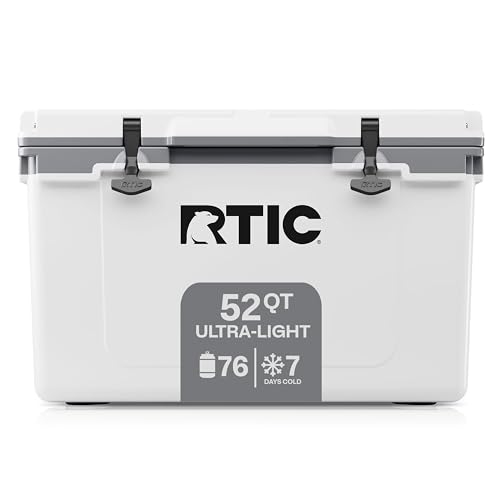
- Best for: Solo desert campers and couples who load, carry and reposition the cooler without a second pair of hands.
- Brand: RTIC
- Capacity: 52 quarts
- Can capacity: Up to 76 cans
- Insulation: Closed-cell foam, up to 3 inches
Solo desert campers and couples who load, carry and reposition the cooler without a second pair of hands.
The seven-day figure depends on following the maker’s cooling procedure, so pre-chilling and ice ratio decide real results.
The RTIC answers the desert problem from the opposite direction: instead of a heavier rotomolded shell, it uses an injection-molded body with up to three inches of closed-cell foam insulation and a freezer-style gasket, and RTIC states it keeps contents cold for up to seven days when its cooling tips are followed. At 21 pounds empty it is the one cooler here a solo camper can lift loaded without help, yet the true-to-size 52 quart interior still holds up to 76 cans. Marine-grade rope handles and a dual rapid drain system round out a listing aimed at people who move their cooler often.
Coleman Vintage 54qt Steel Belted Cooler
- Best for: Two-night desert weekends and festival-style camps where an ice refill is available on the way in or out.
- Brand: Coleman
- Color: Red
- Capacity: 54 quarts
- Can capacity: Up to 85 cans
Two-night desert weekends and festival-style camps where an ice refill is available on the way in or out.
A steel exterior absorbs heat in direct sun, so this cooler needs a shaded parking spot at camp to reach its stated retention.
Coleman’s steel-belted chest is the honest short-trip option in this group: the listing states it keeps ice up to four days, which frames it for desert weekends rather than week-long stays far from resupply. Its 54 quart interior holds up to 85 cans, the Have-A-Seat lid doubles as camp seating, and a drain handles meltwater without tipping the box. The steel-belted body and retro styling will not match rotomolded insulation thickness, so this pick makes sense where nights are fewer, shade is reliable, and an ice stop exists on the route home.
Which One Fits Your Situation
Three to five nights at a remote desert site
Choose the YETI Tundra 45. Distance from resupply is the situation where insulation thickness and a full-length gasket earn their keep, and its stated 26-can capacity at a two-to-one ice ratio is planned around exactly that loading pattern. The rotomolded shell also tolerates being strapped down in a truck bed over rough access roads, and the dry goods basket keeps food out of meltwater on the final day.
Solo trips where you load the cooler alone
Choose the RTIC 52 QT Ultra-Light. At 21 pounds empty, it leaves more of your lifting capacity for ice and food, and the rope handles give a secure grip for the carry from vehicle to shaded camp spot. You still get up to three inches of foam and a freezer-style gasket, so the lighter shell does not mean giving up the specifications that matter in heat.
A two-night weekend with a store on the route
Choose the Coleman Vintage 54qt Steel Belted Cooler. When a refill is guaranteed, paying for maximum insulation buys less than capacity and convenience, and this chest holds up to 85 cans with a lid that doubles as a seat. Its stated four-day ice keeping covers a long weekend with margin, provided you park it in shade and start with cold contents. It is also the easiest of the three to justify if desert trips are a few weekends a year.
A shared camp kitchen for a small group
Start with the RTIC for drinks and the YETI for food if two coolers are realistic, because separating frequently opened drinks from food protects the food box’s ice every time someone reaches for a can. If only one box fits the vehicle, take the RTIC’s 52 quarts and pack food in sealed containers at the bottom under the ice layer, with drinks on top where the lid openings do the least harm to the coldest zone.
Common Mistakes
- Parking the cooler in direct sun all afternoon, which overwhelms any insulation spec; a shaded spot or a light cover over the lid protects ice more than a model upgrade does.
- Loading warm drinks and room-temperature food, forcing the ice to cool the contents and the box itself before it can hold temperature.
- Opening the lid every few minutes for single items instead of grouping trips, since each opening dumps cold air and admits desert heat.
- Draining meltwater constantly on the first day; cold meltwater still insulates contents, so drain mainly when it threatens food packaging.
- Buying on can count alone without checking the ice-to-contents ratio the maker assumes, which leads to a box that is full but under-iced by day two.
Frequently Asked Questions
How long will ice actually last in desert heat?
Treat every figure in a listing as a maker-stated maximum under its own conditions, not a promise for a hot campsite. The coolers here state four days for the Coleman and up to seven for the RTIC when its cooling tips are followed. Pre-chilling the box, starting with cold food, keeping the lid closed and parking in shade move real results toward those figures.
Is a rotomolded cooler always the right choice for the desert?
Not always. Rotomolded construction, like the YETI here, brings thick uniform walls and a shell that shrugs off knocks in a truck bed, which suits remote multi-day camps. But a lighter injection-molded cooler with similar foam thickness, such as the RTIC, can be smarter when one person must carry the loaded box, because a cooler left in a hot vehicle holds ice worse than one placed in shade.
What size cooler suits two people for three desert days?
A 45 to 54 quart cooler suits two people over three days, based on the listings here. Plan the interior around ice first: at a two-to-one ice-to-contents ratio, the YETI’s 45 quart body holds 26 cans plus food, while the 52 and 54 quart options trade some insulation approach for more volume. If most of your load is drinks, size up; if it is fresh food, prioritise gasket and foam.
Should I use block ice, cubed ice or frozen bottles?
Listings do not settle this, but the logic of the specifications does: larger blocks melt slower because less surface touches warm air, while cubes fill gaps around food. Many desert campers combine both, blocks at the bottom and cubes poured over the top. Frozen water bottles add drinking water as they thaw and keep meltwater contained, though they take longer to chill a warm box at loading time.
More from Amazon
Programs that pair well with the guide above. Offers and eligibility are set by Amazon and may change.
Free shipping on eligible items, Prime Video and more. Eligible new members can start with a free trial.
Start a Prime free trialA Prime membership for ages 18-24 with a trial period. Eligibility is set by Amazon.
See Prime for Young AdultsAudiobooks and podcasts to listen to on the go. Eligible new members can start with a free trial.
Try Audible freeAd-free music streaming. Eligible new subscribers can start with a free trial.
Try Music Unlimited freeAs an Amazon Associate we earn from qualifying purchases.




Write Your Review
No reviews yet. Be the first to share your experience!