

Our Short List of 3

- Pieces: 15
- Head: Locking flex-head ratcheting wrench, 5 locking positions
- Ratchet: 72-tooth, 5-degree swing arc
- Sockets: 13, 14, 15, 16, 17, 18, 19 mm, 6-point short (Vortex)
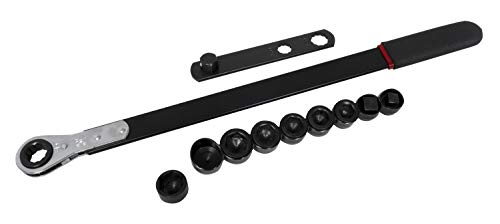
- Head: Ratcheting with freewheel (neutral) position; locks to hold tensioner open
- Sockets: Low-profile 13, 14, 15, 16, 17, 18, 19 mm (19 mm specified for Honda and Toyota applications)
- Square drives: 3/8 in and 1/2 in adapters
- Extension: Extension bar included for hard-to-reach idler pulleys

- Pieces: 7
- Handle: 3/8 in drive steel handle
- Sockets: 13, 15, 16, 18 mm, shallow profile
- Adapters: 1/2 in and 3/8 in square drive
All 4 Picks at a Glance
| Product | Specs | Action |
|---|---|---|
| 1. GEARWRENCH 89000 Serpentine Belt Tool Set with Locking Flex Head |
| Check price on Amazon |
| 3. Lisle 59000 Ratcheting Serpentine Belt Tool |
| Check price on Amazon |
| 4. OEMTOOLS 24687 Serpentine Belt Tool Set |
| Check price on Amazon |
 5. Powerbuilt 648629 Serpentine Belt Tool Set |
| Check price on Amazon |
Key takeaways
- Five serpentine belt tools compared for tight engine bays: ratcheting flex-head kits, long-handle bars, crowfoot coverage and safe tensioner release tips.
As an Amazon Associate we earn from qualifying purchases.
A serpentine belt change is simple work made hard by one obstacle: the spring-loaded tensioner sits deep in a crowded engine bay, and a standard ratchet or combination wrench rarely has the swing room or the leverage to hold it open while the other hand walks the belt off a pulley. A dedicated serpentine belt tool solves that with a long, flat handle, a low-profile head, and a set of sockets, crowfoot wrenches, and square-drive adapters matched to the fasteners tensioners actually use.
This guide compares five serpentine belt tools built around that job. Each one releases a spring-loaded tensioner; none of them replaces parts. If a belt keeps walking off, squealing, or losing tension minutes after a careful install, the cause is a worn tensioner, a stretched belt, or a failing idler bearing, and no handle, however long, fixes that. The tool only holds the tensioner open. What separates the picks below is reach, head design, and how much fastener coverage comes in the box.
Affiliate Disclosure: This article contains affiliate links. If you buy through them, the site may earn a commission at no extra cost to you.
What to Look For in a Serpentine Belt Tool
Handle length and profile. The handle does two jobs: it reaches past fans, shrouds, and hose bundles, and it multiplies hand force so the tensioner spring can be held open with one hand. Longer bars give more leverage but need more swing room above the engine. Flat, thin handles slip into the gap between the tensioner and the frame rail where a round breaker-bar handle will not fit.
Head style. A plain fixed bar is the simplest design and the easiest to control. A ratcheting head lets the user reposition the handle without lifting the socket off the bolt, which matters when the available swing arc is only a few degrees. A locking flex head goes further, angling the handle away from obstructions while the head stays square on the fastener.
Fastener coverage. Tensioners present three kinds of drive points: a hex bolt head (commonly 13 mm through 19 mm), a 3/8 inch square hole, or a 1/2 inch square hole cast into the arm. A useful kit covers all three families. Crowfoot wrenches in 13, 14, and 15 mm handle the recessed bolt heads that sit too close to a pulley face for any socket to seat.
Adapter fit and retention. Adapters that wobble on the handle cost control at the exact moment the spring is fully loaded. Sockets and crowfeet should snap onto the bar positively, and square-drive adapters should match the holes in the tensioner arm without rocking.
Safety. A loaded tensioner stores real energy. If the tool slips off the bolt mid-release, the arm snaps back fast enough to injure fingers and damage nearby components. Full socket engagement, a steady two-stage pull rather than a jerk, keeping the free hand out of the belt path, and easing the tensioner back instead of letting it slam home are the habits that make this a routine job instead of a risky one. Work on a cool engine, and keep hands, sleeves, and hair clear of the belt run.
1. GEARWRENCH 89000 Serpentine Belt Tool Set with Locking Flex Head
- Pieces: 15
- Head: Locking flex-head ratcheting wrench, 5 locking positions
- Ratchet: 72-tooth, 5-degree swing arc
- Sockets: 13, 14, 15, 16, 17, 18, 19 mm, 6-point short (Vortex)
The 89000 is the most access-focused kit in this lineup. Its centerpiece is a locking flex-head ratcheting wrench: the head pivots and locks in five positions, so the handle can be angled away from a radiator hose or strut tower while the socket stays flat on the tensioner bolt. The ratchet mechanism uses a 72-tooth gear with a 5-degree swing arc, which keeps the tensioner moving in bays where only a short pull is possible before the handle meets an obstruction.
Coverage is the joint-widest here. Seven 6-point short sockets span 13 mm to 19 mm, three crowfoot wrenches cover 13, 14, and 15 mm for recessed heads, and three square adapters (3/8, 1/2, and 3/4 inch) handle cast-arm tensioners. A 14-inch extension bar adds reach for tensioners buried low on the front of the engine. For a single kit expected to handle an unknown mix of vehicles, this is the most complete answer.
2. GEARWRENCH 3680D Ratcheting Serpentine Belt Tool Set
The 3680D pairs the same broad accessory set with a fixed-head ratcheting wrench. The ratcheting action still removes the lift-and-reseat cycle of a plain bar, so the tensioner can be walked open in short strokes, but the head angle is fixed, which makes the tool slightly less adaptable when the bolt sits at an odd angle behind a bracket. In exchange, the fixed head is a simpler, stiffer joint with no lock to manage.
The accessory count matches the flex-head set: seven 6-point sockets from 13 mm to 19 mm, crowfoot wrenches in 13, 14, and 15 mm, square-drive adapters, and a long bar for reach. It suits a home garage that services a few known vehicles and wants ratcheting convenience and full fastener coverage without the flex-head mechanism.
Specs
- Pieces: 15
- Head: Fixed-head ratcheting wrench
- Sockets: 13, 14, 15, 16, 17, 18, 19 mm, 6-point
- Crowfoot wrenches: 13, 14, 15 mm
- Square adapters: 3/8 in and 1/2 in drive adapters included
- Bar: Long bar included for added reach
- Item length: 39.5 cm
- Item weight: 1.35 lb
- Warranty: Standard limited lifetime
3. Lisle 59000 Ratcheting Serpentine Belt Tool
- Head: Ratcheting with freewheel (neutral) position; locks to hold tensioner open
- Sockets: Low-profile 13, 14, 15, 16, 17, 18, 19 mm (19 mm specified for Honda and Toyota applications)
- Square drives: 3/8 in and 1/2 in adapters
- Extension: Extension bar included for hard-to-reach idler pulleys
Lisle’s 59000 takes a different approach to control. Its ratcheting head has three settings: forward, reverse, and a freewheel (neutral) position. The freewheel setting lets the user swing the handle back and reposition without the ratchet dragging the tensioner with it, and the head can be locked at full travel to hold the tensioner open while both hands deal with the belt. That hold-open behavior is the feature owners of transverse-engine cars reach for, because those bays rarely leave a spare hand.
The kit is built around low-profile sockets, including the 19 mm socket Lisle specifies for Honda and Toyota tensioners, plus an extension bar for idler pulleys set deep in the bay. Square-drive adapters in 3/8 and 1/2 inch cover cast-arm tensioners, and the set packs into a storage case. The socket range runs 13 mm through 19 mm, matching the hex sizes used on most passenger-car tensioner bolts.
4. OEMTOOLS 24687 Serpentine Belt Tool Set
- Pieces: 7
- Handle: 3/8 in drive steel handle
- Sockets: 13, 15, 16, 18 mm, shallow profile
- Adapters: 1/2 in and 3/8 in square drive
The 24687 is the stripped-down option: a 7-piece set built around a single long 3/8 inch drive handle, one 1/2 inch drive adapter, and four shallow sockets in 13, 15, 16, and 18 mm. The shallow socket depth is the point of the design. On tensioners where the bolt head sits close to the pulley face or a bracket, a standard-depth socket bottoms out or tilts; the shallow profile seats fully and stays square under load.
There are no crowfoot wrenches and no ratcheting head, so recessed bolt heads and minimal swing room are this kit’s weak spots. What it offers instead is simplicity and a black oxide finish over alloy steel that resists the corrosion a tool picks up living in a trunk or under a seat. For an owner whose vehicle uses one of the four covered socket sizes or a square-drive arm, it covers the job with nothing extra to lose.
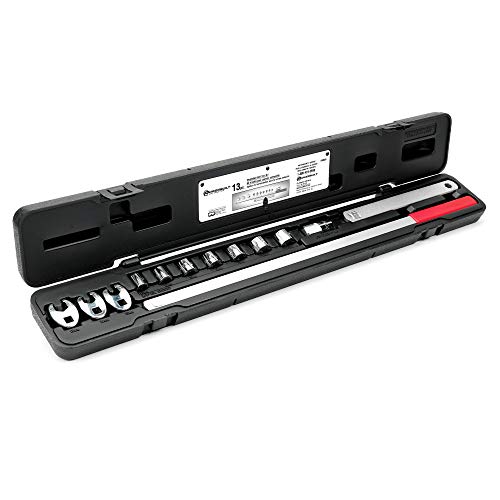
5. Powerbuilt 648629 Serpentine Belt Tool Set
- Design: Two-piece extension bar and handle; handle angle adjustable
- Application: Serpentine belts on spring-loaded tensioners that standard tools cannot access
- Listed vehicle coverage: GM, Ford, Chrysler, SAAB, VW, Volvo
- Standards: Meets or exceeds ANSI and ASME standards (manufacturer statement)
Powerbuilt’s set is built around a two-piece handle: an extra-long bar plus an extension piece that lets the user change the handle angle partway through the pull. That adjustable geometry helps when a straight pull runs the end of the handle into the fender or the fan shroud before the tensioner is fully open; re-angling the second piece keeps the stroke going without reseating the socket.
The included accessory kit targets the domestic and European applications Powerbuilt lists for the set: GM, Ford, Chrysler, SAAB, VW, and Volvo vehicles with spring-loaded tensioners. The assembled tool is the longest in this group, with the packaged length just over 28 inches, which translates to generous leverage on stiff springs. The kit meets or exceeds applicable ANSI and ASME standards according to the manufacturer, and it ships with a storage case and photo-illustrated instructions.
How to Release a Tensioner Safely
Photograph or find the belt routing diagram before anything comes off; it is usually on a sticker under the hood. Seat the socket or adapter fully on the tensioner drive point, then pull smoothly in the direction that unwinds the spring. Jerking invites the socket to cam off the bolt. Once the belt is slack, slip it off a smooth idler pulley rather than the grooved pulley the tool hand is near, and keep fingers out of the belt run while the tensioner is held open. On reassembly, route the belt everywhere except one accessible pulley, hold the tensioner open, slip the belt home, and ease the arm back slowly. Before starting the engine, check that every rib sits in its groove on every pulley; a belt one rib off will shred itself quickly.
One boundary worth repeating: these tools release tensioners, they do not diagnose them. A tensioner arm that feels gritty, sits at an angle, or lets the new belt flutter at idle is worn out, and the fix is a replacement tensioner and usually a belt, not a longer handle.
Verdict
For the widest coverage and the best tight-bay access, the GEARWRENCH 89000’s locking flex head and full socket, crowfoot, and adapter set make it the default pick. The 3680D delivers nearly the same coverage with a simpler fixed ratcheting head. The Lisle 59000 is the control specialist, with a freewheel head that can hold a tensioner open hands-free. The OEMTOOLS 24687 strips the idea down to a shallow-socket essentials kit, and the Powerbuilt 648629 answers with raw reach and an angle-adjustable two-piece handle for the deepest tensioners.
More from Amazon
Programs that pair well with the guide above. Offers and eligibility are set by Amazon and may change.
Free shipping on eligible items, Prime Video and more. Eligible new members can start with a free trial.
Start a Prime free trialA Prime membership for ages 18-24 with a trial period. Eligibility is set by Amazon.
See Prime for Young AdultsAudiobooks and podcasts to listen to on the go. Eligible new members can start with a free trial.
Try Audible freeAd-free music streaming. Eligible new subscribers can start with a free trial.
Try Music Unlimited freeAs an Amazon Associate we earn from qualifying purchases.

Write Your Review
No reviews yet. Be the first to share your experience!