

Key takeaways
- Compare the best solar chargers for camping and off-grid trips by rated watts, USB ports, folded size and weather sealing, with specs for each pick.
As an Amazon Associate we earn from qualifying purchases.
A folding solar charger is the simplest way to keep small electronics alive away from outlets: unfold it, aim it at the sun, and let it feed a phone, a headlamp or a power bank while you do other things. The five panels below are all packable USB-class chargers in the 20 to 40 watt range, the size band that makes sense for tents, backpacks and car-camping kits. None of them is a power station, and none stores energy — each one is just a panel with ports, which is exactly the class this guide covers.


One fact shapes everything about these products: the wattage on the box is a peak figure measured under laboratory conditions — full sun, a panel aimed squarely at it, a cool cell temperature. Real output in camp is lower, sometimes much lower. Heat, a low sun angle, thin cloud, haze and a panel lying flat all take their share. Treat rated watts as a way to compare panels against each other, not as a promise of what will flow into your phone at 4 p.m. in October. The job of a panel this size is to top up a power bank steadily over a day, and judged on that job, the better ones do it well.
Affiliate Disclosure: This article contains affiliate links. If you buy through a link on this page, we may earn a commission at no extra cost to you. This helps support our work and allows us to continue providing free content.
1. BigBlue 28W Solar Panel Charger — The Three-Port All-Rounder
BigBlue’s 28W is the panel to look at when several small devices need feeding at once. It carries three USB ports — two USB-C and one USB-A — each rated by the maker at 5V/3A, with a combined ceiling of 5V/4.8A. In practice that means a power bank on one port and a phone or headlamp on another, sharing whatever the sun is giving. The cells are N-type, and BigBlue states a conversion efficiency of up to 25.4 percent, with a shadow-free front surface that leaves off the metal grid lines of older panel designs.
The panel folds to about the size of a magazine — 11.1 by 6.3 by 1.34 inches — and weighs 1.48 pounds, so it disappears into a pack lid or a car kit. Four carabiners are included for hanging it from a pack, a ridgeline or a branch, which is how this panel is meant to be aimed: it has no kickstand, so hanging points and whatever you can prop it against do the aiming. The panel surface is rated IP44, enough for splashes and light rain, but the maker is clear that the USB junction box is not waterproof — that box needs to stay under cover in wet weather, a caveat that applies to nearly every panel in this class.
It is USB-only — no DC output, so it cannot feed a power station — and like every panel here it holds no charge. As a daytime power-bank filler with ports to spare, it is the most flexible of the five.
Specs
- Rated power: 28W
- Cells: N-type monocrystalline, up to 25.4 percent conversion efficiency as stated by the maker
- Ports: 2 USB-C and 1 USB-A
- Output: 5V/3A per port, 5V/4.8A combined maximum, as stated by the maker
- Weather resistance: IP44 panel surface; USB junction box is not waterproof
- Folded size: 11.1 x 6.3 x 1.34 in
- Weight: 1.48 lb
- Included: USB-C to USB-C cable (50 cm), 4 carabiners
- Model: B401DD
2. FlexSolar 40W Foldable Solar Panel Charger — The Most Rated Watts
The FlexSolar 40W, model E40, is the strongest panel in this group on paper and the only one that reaches beyond USB. Six monocrystalline sections with an ETFE surface coating unfold to 48.8 by 11.1 inches, and the maker states a conversion efficiency of 24 percent. The output box offers a USB-C port with Power Delivery, a USB-A port with QC3.0 fast charging (18W maximum per the maker), and a DC5521 output at 19V — that DC port lets this panel trickle energy into small power stations and other DC-input gear with the right cable, something the USB-only panels here cannot do.
It is also the toughest sealed panel in the five: the maker rates it IP67 for dust and water resistance, a step above the splash-level sealing on most folding chargers. Folded, it comes down to 11.1 by 8.0 by 1.8 inches, and the maker’s current specification sheet puts the weight at about 1.65 pounds (750 g), light for a 40W panel. Two carabiners are included for hanging it off a pack while walking — spread across the back of a pack, a long panel catches sun all day without a campsite setup.
The trade-offs are the long unfolded span, which needs a clear patch of ground or a pack to lie on, and the usual one: 40 rated watts is a laboratory ceiling, and the DC output is a slow trickle for any power station — fine for topping up over a day, useless for a fast refill. Within those limits, it is the pick for campers who want one panel serving phones directly and a small station indirectly.
Specs
- Rated power: 40W
- Cells: monocrystalline with ETFE coating, 24 percent conversion efficiency as stated by the maker
- Ports: 1 USB-C with Power Delivery, 1 USB-A with QC3.0 (18W max), 1 DC5521 output (19V)
- Weather resistance: IP67, as stated by the maker
- Layout: 6 folding sections
- Unfolded size: 48.8 x 11.1 in
- Folded size: 11.1 x 8.0 x 1.8 in
- Weight: approx. 1.65 lb (750 g), per the maker’s specification sheet
- Included: 2 carabiners
- Model: E40
3. Renogy E.FLEX 30 Pro — The Lightest Panel Here

Renogy’s E.FLEX 30 Pro is built around one number: 1.23 pounds. That is the lightest carry in this group, and it folds to 10.55 by 8.86 by 0.71 inches — genuinely laptop-sized — which makes it the panel most likely to be in the pack when a trip turns longer than planned. The cells are monocrystalline, the rated output is 30W, and the port set is modern: USB-C with PD3.0 fast charging (20W maximum per the maker), USB-A with QC3.0 (18W maximum), and a DC output that can feed small power stations. A USB-A to USB-C cable and four carabiners come in the box.
Renogy wires this panel in a parallel layout and states that it keeps at least 75 percent of its output when one section is shaded — a direct answer to the most common real-world failure of folding panels, where one shadowed strip drags the whole array down. Six metal hanging holes give more tie-off options than the usual corner eyelets, and the maker rates the panel IP67 against dust and water, the joint-best sealing in this group.
The limits are the expected ones for the lightest panel: 30 peak watts shared across ports, and a DC output sized for small stations rather than anything large. For backpackers counting ounces who still want USB-C fast charging and a shade-tolerant layout, this is the natural first look.
Specs
- Rated power: 30W
- Cells: monocrystalline silicon, parallel-connected layout
- Ports: 1 USB-C (PD3.0, 20W max), 1 USB-A (QC3.0, 18W max), 1 DC output — all per the maker
- Shade behavior: maker states at least 75 percent output retained when one section is shaded
- Weather resistance: IP67, as stated by the maker
- Folded size: 10.55 x 8.86 x 0.71 in
- Weight: 1.23 lb
- Hanging points: 6 metal holes; 4 carabiners included
- Included cable: USB-A to USB-C
- Model: RPP30EF-LN-US
4. Anker Solix PS30 — The Sealed Two-Device Panel
Anker’s Solix PS30 is a 30W folding panel with the cleanest brief in the group: charge two USB devices at once, shrug off weather, fold flat. The ports are one USB-C at 5V/3A and one USB-A at 5V/2.4A — plain 5V USB with no Power Delivery profile, which suits phones, power banks, headlamps and GPS units and is slower with devices that expect negotiated fast charging. Anker rates the panel IP65 for water and dust resistance: fine in rain showers and dusty sites, short of the immersion-grade sealing on the FlexSolar and Renogy.
Folded, the PS30 measures 10.7 by 8.8 by 1.7 inches. The surprise is the weight: about 2.4 pounds (1.1 kg), the heaviest panel in this group despite mid-pack wattage. That buys a sturdier build and Anker’s support network, but ounce-counters will notice it next to the Renogy. Two carabiners are included for hanging.
One compatibility note matters, and Anker states it plainly: the PS30 is a USB phone charger, not a station panel — Anker lists it as not compatible with its own Solix power stations, which need a higher-voltage panel input. Buy it to keep handheld devices alive, not as the first piece of a power-station setup.
Specs
- Rated power: 30W peak
- Cells: monocrystalline
- Ports: 1 USB-C (5V/3A), 1 USB-A (5V/2.4A); charges 2 devices at once
- Weather resistance: IP65, as stated by the maker
- Folded size: 10.7 x 8.8 x 1.7 in (272 x 224 x 43 mm)
- Weight: approx. 2.4 lb (1.1 kg)
- Included: 2 carabiners
- Compatibility note: maker states it is not compatible with Anker Solix power stations
- Model: A2426
5. Goal Zero Nomad 20 — The Kickstand and Ecosystem Pick
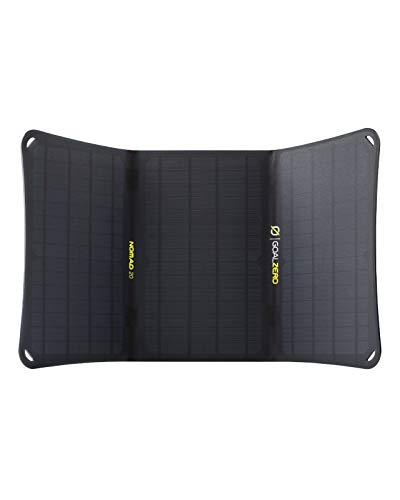
The Nomad 20 is the smallest panel here at 20 rated watts, and it earns its place on two features none of the others match. The first is a built-in adjustable kickstand that clicks into place at multiple angles, so the panel stands on its own and can be re-aimed in seconds as the sun moves — no hanging, no propping against a log. The second is the integrated 8mm charging cable alongside the USB port: that cable is the native input for Goal Zero’s Sherpa power packs and Yeti power stations, and Nomad panels can be chained together to combine output, so this panel can grow into a Goal Zero setup in a way the USB-only panels cannot.
The costs of that focus are real. The USB port is a single USB-A output at 5V, up to 2.1A (10W maximum, regulated) — one device, at yesterday’s charging speed. The three monocrystalline sections fold to 11.5 by 7.4 by 1.25 inches and the panel weighs 2.28 pounds, heavy for 20 watts; you are paying the weight for the stand, the laminated build and the ecosystem cable rather than raw output. Goal Zero also states the obvious on the listing, because buyers get it wrong: the panel does not hold a charge — it produces power only while the sun is on it.
Specs
- Rated power: 20W
- Cells: monocrystalline, 3 folding sections
- Ports: 1 USB-A (5V, up to 2.1A, 10W max, regulated) plus integrated 8mm cable (14–22V, up to 1.3A, 20W max) — per the maker
- Stand: built-in adjustable kickstand, multiple angles
- Chaining: can be chained with other Nomad panels, per the maker
- Unfolded size: 11.5 x 21.75 x 0.75 in
- Folded size: 11.5 x 7.4 x 1.25 in
- Weight: 2.28 lb (1.03 kg)
- Model: 11910
How to Choose
Start with the daily load, not the wattage. List what actually needs charging: a phone and a headlamp is a light load that any panel here covers; add a tablet, a camera and a second phone and you want 30 watts or more and at least two ports. Work through a power bank rather than straight into devices: phones renegotiate charging every time a cloud crosses and some do not restart cleanly, while a bank accepts whatever comes, whenever it comes. Panel into bank all day, devices off the bank at night.
Treat rated watts as a comparison scale. All five makers measure peak output the same laboratory way, so 40W versus 20W is a meaningful ranking, but neither figure is what you will see in camp. Heat trims output on a hot afternoon, a flat panel loses more, and passing cloud can pause charging entirely. If your trips run in winter or at northern latitudes, step one size up from what the load math suggests.
Match the ports to your gear. USB-C with Power Delivery (FlexSolar, Renogy) fast-charges modern phones and some tablets; plain 5V USB (Anker, Goal Zero) charges everything eventually but slowly. If a small power station is part of the kit, only a panel with a DC output — or Goal Zero’s 8mm cable for its own stations — can feed it. Check the station’s input voltage range against the panel’s DC output before buying.
Decide how the panel will be aimed. A kickstand (Goal Zero) is the easiest setup on flat ground. Hanging points and carabiners (the other four) suit packs, ridgelines and fences, and a panel spread on a pack charges while you walk. Either way, a panel that is quick to re-aim gets re-aimed; one that is fiddly sits at the wrong angle all day.
Read the weather sealing carefully. The IP code describes the panel surface. On every design here, the output box and your connected device are the weak points in rain — keep them under the panel’s own fold or a dry bag. Higher codes (IP67 on the FlexSolar and Renogy, IP65 on the Anker) buy tolerance for being caught out, not permission to leave the setup in a storm.
FAQ
How long does a panel like this take to charge a phone?
In strong, direct sun, a modern phone gains charge at a pace comparable to a basic wall adapter from the faster USB-C panels, and noticeably slower from the plain 5V USB ones. In weak sun the same charge can take most of a day. The honest unit is hours of good sun, not minutes.
Can these panels charge a power station?
Only the ones with a DC output — the FlexSolar and the Renogy — and the Goal Zero through its 8mm cable into Goal Zero stations. USB-only panels cannot. Even with DC, a 30 or 40 watt panel refills a small station slowly, over a full day or more of sun.
Do solar chargers work on cloudy days?
They produce some power in bright overcast conditions, but output falls steeply — often to a small fraction of the rated figure — and charging may pause under heavy cloud. A power bank buffer matters most on exactly those days, because it smooths the gaps.
Can I leave the panel out in the rain?
The higher-sealed panels tolerate rain on the panel surface, but the output box, cables and the device being charged should stay dry on all five. Bring the setup in for storms, and never leave a connected phone sitting in wet grass.
Do any of these panels store power for later?
No. None of the five has a battery; each produces power only while sunlight is on it. Storage is the power bank’s job, which is why the panel-plus-bank pairing runs through this guide.
Conclusion
For most campers, the BigBlue 28W is the balanced default: three ports, a pack-friendly fold and enough rated output to keep a power bank and a phone moving. The FlexSolar 40W is the step up for heavier loads, and the only pick here that also trickles into small power stations over DC. The Renogy E.FLEX 30 Pro wins on weight and shade tolerance for backpackers, the Anker Solix PS30 suits anyone who wants a sealed, simple two-device panel from a major brand, and the Goal Zero Nomad 20 is the pick when a real kickstand or the Goal Zero battery ecosystem matters more than ports. Whichever one goes in the pack, pair it with a power bank and re-aim it at lunch — that combination, more than any single specification, is what keeps devices alive off-grid.
More from Amazon
Programs that pair well with the guide above. Offers and eligibility are set by Amazon and may change.
Free shipping on eligible items, Prime Video and more. Eligible new members can start with a free trial.
Start a Prime free trialA Prime membership for ages 18-24 with a trial period. Eligibility is set by Amazon.
See Prime for Young AdultsAudiobooks and podcasts to listen to on the go. Eligible new members can start with a free trial.
Try Audible freeAd-free music streaming. Eligible new subscribers can start with a free trial.
Try Music Unlimited freeAs an Amazon Associate we earn from qualifying purchases.
Write Your Review
No reviews yet. Be the first to share your experience!