

Key takeaways
- The best fuel line disconnect tools for quick-connect fittings: five sets compared by size range, fitting type and build for fuel, AC and cooler lines.
As an Amazon Associate we earn from qualifying purchases.
Modern fuel systems rarely use hose clamps at the filter, pump or rail. Instead they use quick-connect fittings that lock onto the line with an internal retainer, and they are designed to stay locked until the correct tool releases them. Pulling harder does not work: the fitting either refuses to move or breaks, and a broken retainer usually means replacing a line section rather than a filter. A fuel line disconnect tool is a small sleeve, ring or scissor tool that slides over the line and into the fitting, pushing the locking tabs or garter spring open so the two halves separate with a straight pull.
Three fitting families cover most of what you will meet. Spring-lock couplings, common on Ford and Chrysler air conditioning lines and some fuel lines, hide a circular garter spring inside the joint; the tool’s flared lip expands that spring. Push-connect fittings, used widely on GM, Ford and Chrysler fuel lines, hold the line with plastic or metal retainer fingers that the tool’s sleeve depresses. Jiffy-Tite fittings on GM transmission and oil cooler lines use a retaining clip arrangement that is released differently again, and the cooler-line tools in the master kits below are what address many of them. This guide compares five disconnect tool sets by size coverage, fitting types and build, from a basic six-size set to full master kits.
Affiliate Disclosure: This article contains affiliate links. If you buy through these links, we may earn a commission at no additional cost to you. This helps support our work and allows us to continue providing detailed tool guides.
Safety First: Depressurize Before You Disconnect
A quick-connect fitting can hold fuel at full system pressure, and opening one without relieving that pressure sprays fuel across the engine bay. Before any fitting comes apart, relieve the fuel system pressure using the vehicle maker’s procedure. The usual sequence is to pull the fuel pump fuse or relay, run the engine until it stalls, crank it briefly once more, then disconnect the battery. Some vehicles also have a Schrader valve on the fuel rail for bleeding pressure with a gauge or a rag-wrapped tool. Work away from ignition sources, wear eye protection, keep a container and rags under the joint to catch the fuel that remains in the line, and have a suitable fire extinguisher within reach. On air conditioning lines, the refrigerant circuit is a separate sealed system that has its own service rules; the disconnect tools here release the coupling mechanically, but refrigerant recovery is a job for proper AC service equipment.
How to Choose a Disconnect Tool Set
Match the tool to the fitting, not just the line. Size is the first filter: disconnect tools are sized by the line’s outside diameter, and the common range runs from 1/4 inch up to 7/8 inch. Fuel filters and feed lines most often need 5/16 and 3/8 inch; larger sizes serve AC lines and cooler lines. A tool one size off will either refuse to enter the fitting or fail to release the retainer fully.
Know your tool styles. Sleeve and ring tools are the classic form: a short split sleeve that wraps around the line and slides into the fitting. Scissor tools close around the line like pliers and give better leverage on the two most common fuel filter sizes, which is why they are popular for filter swaps. Angled tools bend the handle away from the fitting so your hand clears nearby brackets and firewall sheet metal. Master kits combine several styles plus specialty pieces for specific vehicles.
Plastic versus metal is a real trade-off, not a quality ranking. Fuel-resistant plastic tools glide into nylon retainers without scoring them and are kinder to fittings you intend to reuse, but they can flex or crack on a corroded joint. Alloy steel and anodized aluminum tools survive stubborn, grit-caked fittings and years of shop use. Many mechanics own both: plastic for clean work, metal for the fitting that has not moved in a decade.
Buy coverage for the vehicles you actually service. A single-make owner can be well served by a focused six-size set. Anyone working across Ford, GM and Chrysler vehicles, or across fuel, AC and transmission cooler lines, will use the extra specialty tools in a master kit sooner than they expect.
The 5 Best Fuel Line Disconnect Tools
1. Lisle 37000 Air Conditioning/Fuel Line Disconnect Tool Set

The Lisle 37000 is the reference set in this category: six individual sleeve-style tools in alloy steel covering 5/16, 3/8, 1/2, 5/8, 3/4 and 7/8 inch lines. Lisle designs the set to disconnect the spring lock couplings on Ford and Chrysler air conditioning lines, and it also works on the fuel line quick connect couplings found on GM, Ford and Chrysler vehicles, which makes it a genuine two-system set rather than a fuel-only one.
The sleeve design is the point. Each tool wraps the line and slides straight into the fitting, expanding a garter spring or depressing retainer fingers evenly all the way around, so the fitting releases without the cocked, one-sided prying that damages retainers. Steel construction matters on older vehicles, where road grit packs into the joint and a plastic tool can deform before the spring lets go. The trade-off is storage: the 37000 is six loose tools with no case, so they live in a drawer or a tool roll rather than a fitted box. For a first disconnect set that covers the standard sizes in durable material, this remains the straightforward choice.
Specs
- Contents: 6 disconnect tools
- Sizes: 5/16, 3/8, 1/2, 5/8, 3/4 and 7/8 inch
- Material: alloy steel
- Fitting types: spring-lock couplings and push-connect quick connects
- Applications: Ford and Chrysler AC lines; GM, Ford and Chrysler fuel lines
- Model: Lisle 37000
2. Lisle 39400 Angled Disconnect Tool Set

The Lisle 39400 covers the same six sizes as the 37000 — 5/16 through 7/8 inch — but changes the two things that matter in tight engine bays: the handles are angled, and the tools are made of durable plastic that resists fuels and solvents. The angled handle offsets your hand from the axis of the line, which is what lets the tool seat fully when a fitting sits close behind a bracket, a rail or the firewall, where a straight tool forces a knuckle-scraping compromise angle.
Plastic is a deliberate choice here, not a downgrade. The smooth polymer sleeve slides into nylon retainer clips without scoring them, which matters on OEM fittings that will be reconnected and expected to seal. The honest limitation is the mirror of the 37000’s strength: on a corroded spring-lock joint that has not moved in years, a plastic tool can flex where the steel version would not. Like the 37000, the set disconnects spring lock couplings on Ford and Chrysler AC lines and works on fuel line and other quick disconnect couplings on domestic and import vehicles. Owners who regularly fight fittings in confined spaces will reach for this set first; owners with rusty vehicles may want it alongside, not instead of, a steel set.
Specs
- Contents: 6 angled disconnect tools
- Sizes: 5/16, 3/8, 1/2, 5/8, 3/4 and 7/8 inch
- Material: fuel- and solvent-resistant plastic
- Fitting types: spring-lock couplings and push-connect quick connects
- Applications: Ford and Chrysler AC lines; fuel lines on domestic and import vehicles
- Model: Lisle 39400
3. Orion Motor Tech Master Quick Disconnect Tool Set, 25-Piece

Orion Motor Tech’s 25-piece master kit is the coverage play. Where the Lisle sets stop at six sizes of one tool style, this kit spreads across seven plastic fuel line removers from 1/4 to 7/8 inch, six aluminum transmission oil cooler line removers, four plastic AC quick disconnect tools, a steel dual-headed scissor tool in 5/16 and 3/8 inch, and specialty tools aimed at late-model GM trucks and the 4.0L V6 Ford Ranger and Explorer, all in a blow-molded case. The tools are color coded by size, which speeds up selection when you are working under a vehicle.
The breadth is aimed squarely at mixed work: fuel, air conditioning, radiator and heater lines, and transmission cooler lines across Ford, Chevy, Dodge and other domestic vehicles. The scissor tool deserves its place in the kit because fuel filter fittings in 5/16 and 3/8 inch are the most common disconnect job of all, and the scissor form gives controlled leverage on exactly those sizes. Anodized aluminum, steel and plastic are all used where each suits the job. Be aware that even this kit is not universal: some Ford transmission cooler line fittings still fall outside its range, and cooler lines that use Jiffy-Tite fittings can require their own release approach. For a single kit that handles the widest spread of domestic line work, though, this is the most complete set here.
Specs
- Contents: 25 pieces including 7 plastic fuel line removers, 6 aluminum cooler line removers, 4 AC disconnect tools, 1 steel scissor tool, specialty vehicle tools
- Size range: 1/4 to 7/8 inch
- Materials: anodized aluminum, steel and plastic
- Fitting types: spring-lock and push-connect, plus cooler line fittings
- Applications: fuel, AC, transmission, radiator and heater lines; Ford, Chevy, GM, Dodge and more
- Storage: blow-molded case
- Model: Orion Motor Tech Master Quick Disconnect Tool Set (25pc)
4. Janhemei Master Quick Disconnect Tool Set, 22-Piece

The Janhemei 22-piece set is a second master-kit option built around the same idea: every common line system in one case. Its contents break down as four quick AC fuel line disconnectors, six transmission oil cooler line disconnectors, seven fuel line disconnectors, two oil cooler line disconnectors and a scissor-style fuel line disconnector, covering the commonly used SAE sizes across fuel lines, automotive AC hoses, radiator and heater hoses. Construction mixes aluminum alloy, plastic and steel, and the set ships in a plastic storage case.
Against the Orion Motor Tech kit, the differences are in the mix rather than the concept: Janhemei leans slightly harder into cooler line coverage with its dedicated oil cooler pieces, while the OMT kit counters with its named specialty tools for specific GM and Ford applications. Either kit suits a home mechanic who services several vehicles and does not want to discover mid-job that the one fitting on the car is the one style a basic set lacks. As with every master kit, the honest caveat applies: coverage is broad across Ford, Chevy and GM models, but no kit releases every fitting ever fitted, and unusual cooler line connectors may still need a vehicle-specific tool.
Specs
- Contents: 22 pieces including 4 AC fuel line disconnectors, 6 transmission oil cooler disconnectors, 7 fuel line disconnectors, 2 oil cooler line disconnectors, 1 scissor-style disconnector
- Size range: common SAE sizes for fuel, AC and cooler lines
- Materials: aluminum alloy, plastic and steel
- Fitting types: push-connect and spring-lock quick connects, cooler line fittings
- Applications: fuel lines, AC hoses, radiator and heater hoses; most Ford, Chevy and GM models
- Storage: plastic case
- Model: Janhemei Master Quick Disconnect Tool Set (22pcs)
5. HZHSSG Metal Fuel Line Disconnect Scissor Tool Set

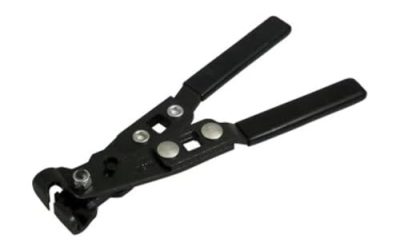
Not every disconnect job needs a master kit. The most frequent one — a fuel filter swap — usually involves a single fitting size, and the HZHSSG scissor tool is built for exactly that job. It is a metal scissor-style tool covering the two sizes that dominate fuel filter work, 5/16 inch and 3/8 inch, listed for fuel, heater and A/C line service on GM vehicles from 1989 onward, Ford vehicles from 1990 onward, and some Mazda vehicles from the same era.
The scissor form is the advantage. Closing the handles drives the tool’s jaws into the fitting squarely and holds them there under steady pressure, so both hands are not occupied keeping a loose sleeve seated while the other hand pulls the line. The metal build suits filters that have sat through years of road spray, where the coupling is coated in grit. The limitation is equally clear: with two sizes and one tool style, this is a specialist. It will not help with larger AC spring-lock couplings or cooler lines, and it is best bought by someone who knows their vehicle’s filter fitting is one of the two sizes it covers. As a dedicated filter tool kept with the spare filters, it earns its drawer space.
Specs
- Contents: 1 scissor-style disconnect tool
- Sizes: 5/16 inch and 3/8 inch
- Material: metal
- Fitting types: push-connect fuel filter couplings
- Applications: fuel, heater and A/C line service; GM 1989 and newer, Ford 1990 and newer, some Mazda
- Model: HZHSSG CX01
Using a Disconnect Tool, and Knowing Its Limits
The technique is the same across these sets. With the system depressurized, clean the joint first — grit blown or brushed out of the fitting is the difference between a clean release and a stuck one. Push the two halves of the fitting together slightly, slide the correct-size tool fully into the fitting until it seats against the retainer, then pull the line straight off while keeping the tool in place. If it does not release with moderate force, stop: the tool is the wrong size, not fully seated, or the retainer is packed with corrosion, and more force only breaks plastic retainers.
Two honest limits apply to every set in this guide. First, some fittings are not tool-release designs at all — squeeze-tab connectors release by hand, and hairpin-clip fittings need the clip drawn out with a pick, which is why the master kits include clip tools. Second, Jiffy-Tite cooler line fittings, common on GM trucks, use a threaded retaining arrangement that dedicated cooler line tools address only in some sizes; the cooler line pieces in the master kits cover many of them, but a stubborn Jiffy-Tite joint may still need its specific release tool. A disconnect set removes the fittings it is sized and shaped for, cleanly and without damage — and knowing which fittings those are is most of the skill.
Which Set Should You Buy?
For a first set that covers the standard fuel and AC sizes in durable steel, the Lisle 37000 is the dependable default. If your fittings hide in tight corners, the angled plastic Lisle 39400 trades some toughness for access and a gentler touch on nylon retainers. Mechanics and serious home users working across fuel, AC and transmission cooler lines on several vehicles should go straight to a master kit: the Orion Motor Tech 25-piece for its specialty vehicle tools and scissor piece, or the Janhemei 22-piece for its cooler line emphasis. And if your disconnect work is really just fuel filter changes on a GM or Ford vehicle, the HZHSSG scissor tool does that one job with the least fuss. Whichever set you choose, depressurize the system first — no fitting is worth a fuel spray.
More from Amazon
Programs that pair well with the guide above. Offers and eligibility are set by Amazon and may change.
Free shipping on eligible items, Prime Video and more. Eligible new members can start with a free trial.
Start a Prime free trialA Prime membership for ages 18-24 with a trial period. Eligibility is set by Amazon.
See Prime for Young AdultsAudiobooks and podcasts to listen to on the go. Eligible new members can start with a free trial.
Try Audible freeAd-free music streaming. Eligible new subscribers can start with a free trial.
Try Music Unlimited freeAs an Amazon Associate we earn from qualifying purchases.
Write Your Review
No reviews yet. Be the first to share your experience!