

Key takeaways
- Compare fluid transfer pumps for fuel, oil, water and DEF: battery, 12V and drill-powered pumps plus hand siphons, with flow rates and fluid limits.
As an Amazon Associate we earn from qualifying purchases.
Moving liquid between containers sounds simple until you are holding a full fuel can at shoulder height, trying not to spill diesel across the garage floor. A fluid transfer pump removes the lifting, the tipping and most of the mess. The category covers a wide range: a battery stick pump that drops into a gas can, a 12-volt rotary vane pump bolted to a farm tank, a drill attachment that empties a flooded basement, and hand siphons that need no power at all.
This guide compares five fluid transfer pumps covering fuel, oil, water and DEF work. Each pick lists its power source, its maker-stated flow rate and, just as importantly, exactly which fluids the manufacturer says it can and cannot handle.
Affiliate Disclosure: This article contains affiliate links. If you buy a product through one of these links, we may earn a commission at no additional cost to you. This helps support our work and allows us to keep publishing buying guides like this one.
The safety rule that decides this list
Here is the rule that shapes every recommendation below: only use a pump for gasoline if the manufacturer explicitly rates that pump for gasoline. Gasoline vapour ignites easily, and a pump that is perfectly safe for diesel, oil or water may use seals, plastics or an unsealed motor that make it a genuine hazard with petrol. Diesel is far less volatile, which is why so many pumps are diesel-only — and why “fuel pump” on a listing does not automatically mean “gasoline pump.”
Each product below therefore states its fluid compatibility in plain language. Two of the five picks are gasoline-rated by their makers. One is a drum pump aimed at DEF and chemicals that the maker warns away from flammable liquids. One is a water-only drill pump that should never see fuel. If gasoline is involved, the shortlist shortens fast, and it should.
Whatever you buy: work outdoors or in moving air when transferring fuel, keep ignition sources away, ground metal containers where the maker instructs it, and never leave a running transfer unattended. With hand siphons, remember the physics — once primed, liquid flows downhill, so the receiving container sits lower than the source.
How to choose a fluid transfer pump
Power source. Battery stick pumps are the most convenient for cans and jugs because there is nothing to wire up. A 12V pump clips to a vehicle battery and moves far more liquid, but ties you to that battery. Drill-powered pumps borrow a tool you already own and suit water jobs. Hand siphons need no power at all — the reliable backup that always works.
Flow rate. Makers quote flow in gallons per minute (GPM) or gallons per hour (GPH), usually as a maximum with water-thin liquid and no lift. Thick oil on a cold morning moves much more slowly. A couple of gallons per minute is plenty for a mower or generator; refuelling tractors from a tank is where double-digit GPM saves real time.
Reach and fittings. Check intake length against your container’s depth and the discharge hose against the distance to the filler neck. Gas-can pumps need adapters matching your can’s threads; drum pumps need a bung fitting matching your barrel.
Duty and storage. Small electric pumps are built for short, intermittent runs, and several makers publish a duty limit. Draining a pump before storage, and removing it from ethanol-blend fuel after use where the maker advises it, keeps seals alive for the next season.
1. TERA PUMP TRFA01-XL (2nd Gen) — battery power for gas cans and racing jugs
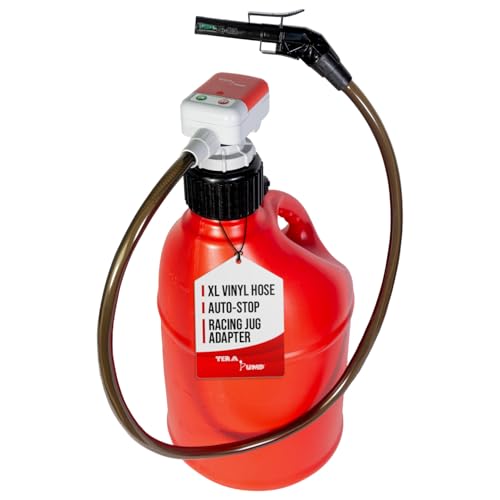
The TRFA01-XL is the pump most home users picture in this category: a stick-style pump that sits in the opening of a fuel can, runs on four AA batteries and sends fuel through a long vinyl hose with a nozzle, so the can stays on the ground. A sensor in the nozzle stops the flow automatically when the receiving tank is full — the feature that prevents the classic overfill spill.
TERA PUMP rates this model for gasoline, diesel and kerosene, plus E15 and E85 ethanol blends and non-potable water, so it clears the gasoline rule on the maker’s own word. One caveat from the maker’s instructions: after using it with E85, remove the pump from the fuel rather than storing it fitted, because strong ethanol blends are hard on seals over time. The XL version adds a utility jug adapter for racing-style jugs alongside the standard gas can adapters.
Specs
- Power source: 4 x AA batteries (not included)
- Flow rate: up to 2.5 gallons per minute
- Discharge hose: 51 in (4.27 ft) vinyl hose
- Intake: rigid suction tube, approx. 18 in
- Fluids (maker-stated): gasoline, diesel, kerosene, E15, E85, non-potable water
- Overfill protection: auto-stop sensor nozzle
- Adapters: universal gas can adapters and utility/racing jug adapter included
- Weight: 1.59 lb
This is the pick for garages, campsites and pit lanes where the job is emptying cans and jugs into equipment. It will not drain a drum quickly, and AA batteries are a consumable to keep spares of, but for can-to-tank work nothing else here is as simple to use.
2. Fill-Rite FR1210H — the 12V heavy-duty option for tanks and drums
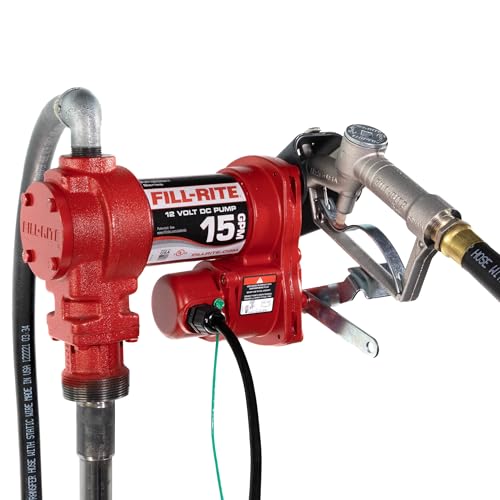
At the other end of the scale, the FR1210H is a cast-iron rotary vane pump from Fill-Rite, a brand built around fuel transfer for farms, fleets and construction sites. It runs on 12V DC from a vehicle or equipment battery and moves up to 15 gallons per minute, roughly six times the flow of the battery stick pump above. The kit includes a discharge hose, a manual nozzle and a telescoping suction pipe, set up to draw from a tank or drum and refuel machinery directly.
Fill-Rite rates the FR1210H for gasoline as well as diesel, kerosene, ethanol and methanol blends and biodiesel, so it passes the gasoline rule with the paperwork to back it: professional fuel-handling equipment with a cast-iron housing, not a plastic convenience pump. The trade-offs are size, weight and commitment. It needs a 12V battery at hand, it is built for intermittent transfer work rather than continuous running, and it makes sense only if you refuel often enough to justify a semi-permanent setup.
Specs
- Power source: 12V DC, battery cable with clips
- Flow rate: up to 15 gallons per minute
- Construction: cast-iron pump housing, rotary vane design
- Fluids (maker-stated): gasoline, diesel, kerosene, ethanol and methanol blends, biodiesel
- Kit contents: discharge hose, manual nozzle, telescoping suction pipe
- Typical mounting: tank or drum bung mount
Choose it for a farm tank, a truck-mounted transfer tank or a workshop drum feeding several machines — far more pump than a campervan owner needs, and exactly right for anyone tired of slow refuelling stops.
3. Milescraft DrillPump750 — drill-powered water moving
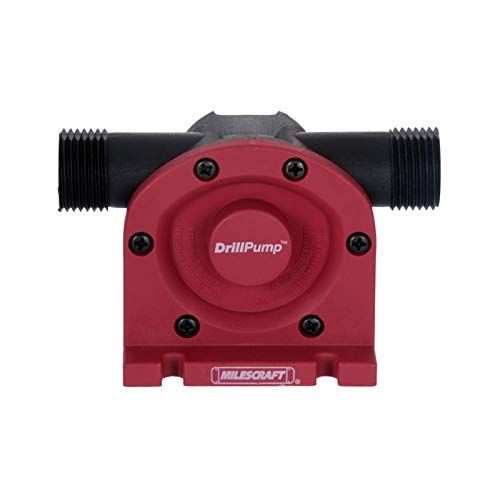
The DrillPump750 has no motor of its own. Its 3/8 in shank chucks into any corded or cordless drill, and the drill’s rotation drives the pump. Milescraft quotes up to 750 gallons per hour with a drill running at up to 2,800 RPM; the pump is self-priming with a lift of up to 12 feet, with standard 3/4 in garden hose connections on both sides.
Be clear about its lane, because the maker is: this is a water pump. It is aimed at draining ponds, aquariums, pools, water heaters and flooded basements, and it is not rated for gasoline, diesel or any other fuel. Putting fuel through it would break the safety rule at the top of this guide, quite apart from what solvents do to its seals. Kept to water work, it lives in a drawer and turns a drill you already own into a transfer pump in seconds.
Specs
- Power source: corded or cordless drill (up to 2,800 RPM)
- Flow rate: up to 750 gallons per hour
- Self-priming lift: up to 12 ft
- Shank: 3/8 in, fits standard drill chucks
- Connections: 3/4 in garden hose fittings
- Fluids (maker-stated): water only — not for fuel or flammable liquids
For household and campsite water jobs — emptying a water butt, draining a portable tank, clearing a flooded pit — this is the lowest-effort pick here, provided a drill is already in the kit bag.
4. Luigi’s Siphon Pump — the manual backup that always works

Every powered pump on this page can be stopped by a flat battery; a hand siphon cannot. Luigi’s Siphon Pump is a squeeze-bulb manual pump: put the intake into the source liquid, squeeze to prime, and gravity does the rest, at a maker-quoted rate of around 10 litres per minute while the receiving container sits lower than the source.
The maker lists it for water and gasoline transfer, along with other light liquids such as alcohol, so by the rule at the top of this guide it can handle the mower-fuel jobs the water-only drill pump cannot. The compromises are physical: flow stops if the levels equalise, the rate depends on the height difference between containers, and thin liquids move far better than cold oil. As a glovebox and shed backup, though, it earns its place — no batteries, no cables, and it works the day everything else is flat.
Specs
- Power source: manual squeeze bulb, no power required
- Flow rate: approx. 10 litres per minute (maker-stated, gravity dependent)
- Fluids (maker-stated): water, gasoline, petrol, alcohol and similar light liquids
- Operation: prime by squeezing, then gravity siphon flow
- Requirement: receiving container lower than the source liquid level
Pick this up as the emergency option and the small-job option. Draining a fuel tank before winter storage or emptying a jerry can into a mower is exactly its territory.
5. Zeeline ZE369W — drum siphon for DEF and workshop chemicals

The ZE369W from Zeeline by Milton answers a different question: how to get DEF, antifreeze or detergent out of a 55-gallon drum without tipping it. It is a manual siphon drum pump in polyethylene and polypropylene with a 48 in flexible hose, and the maker quotes up to 7 gallons per minute — brisk for a hand pump, because drum work usually means moving more than a can’s worth at a time.
Its fluid list is the reason it closes this guide. Zeeline rates it for DEF, antifreeze, acids, alkalis and similar drum chemicals, and states plainly that it is not recommended for solvents or flammable liquids. That makes it a firm no for gasoline despite being a drum pump, and this guide will not pretend otherwise. Modern diesel owners will recognise the real use case: DEF lives in drums and totes, attacks the wrong materials, and needs a dedicated pump that never touches fuel. This is that pump.
Specs
- Power source: manual hand siphon (plunger action)
- Flow rate: up to 7 gallons per minute
- Hose: 48 in flexible discharge hose
- Fitment: 55-gallon drums and smaller containers
- Construction: polyethylene and polypropylene
- Fluids (maker-stated): DEF, antifreeze, detergents, water-based chemicals
- Fluid limits (maker-stated): not recommended for solvents or flammable liquids — not a gasoline pump
If your diesel truck, tractor or generator drinks DEF from a drum, this is the pick. If you need to move petrol, go back to picks one and two.
Care habits that make transfer pumps last
Ethanol-blend fuels and seals are long-term enemies, so follow the maker’s storage advice — TERA PUMP, for example, tells users to take the pump out of E85 after use. Strain fuel from dirty cans before pumping rather than asking a small impeller to swallow grit. Coil hoses loosely so vinyl does not kink at the fittings, and store stick pumps upright and dry. For 12V pumps, check cable clips for corrosion each season; a poor connection is the most common reason a healthy pump runs slowly. Finally, dedicate pumps to fluid families where you can: a pump in DEF service should stay in DEF service, and a water pump should never be promoted to fuel duty.
FAQ
Can I use a water transfer pump for gasoline?
No. Unless the manufacturer explicitly rates a pump for gasoline, treat it as water- or diesel-only. The Milescraft drill pump here is a clear example: a capable water mover its maker does not rate for fuel of any kind.
Why do flow rates drop with oil?
Maker flow figures are maximums, usually with thin liquid and little lift. Oil is far more viscous than water or petrol, especially when cold, so the same pump moves it much more slowly. If oil is your main job, pick a pump whose maker lists oil among its approved fluids and expect a gentler pace.
What does an auto-stop nozzle actually do?
On pumps like the TERA PUMP above, a sensor in the discharge nozzle detects when liquid reaches the top of the receiving tank and cuts the flow. It is overfill protection, not a meter: it will not measure out an exact quantity.
Do I need a special pump for DEF?
DEF is mildly corrosive and easily contaminated, so a dedicated pump in compatible plastics is the right call. The Zeeline ZE369W is built for exactly that work — and, like most DEF equipment, should never be shared with fuel.
More from Amazon
Programs that pair well with the guide above. Offers and eligibility are set by Amazon and may change.
Free shipping on eligible items, Prime Video and more. Eligible new members can start with a free trial.
Start a Prime free trialA Prime membership for ages 18-24 with a trial period. Eligibility is set by Amazon.
See Prime for Young AdultsAudiobooks and podcasts to listen to on the go. Eligible new members can start with a free trial.
Try Audible freeAd-free music streaming. Eligible new subscribers can start with a free trial.
Try Music Unlimited freeAs an Amazon Associate we earn from qualifying purchases.
Write Your Review
No reviews yet. Be the first to share your experience!