

Key takeaways
- Compare the best AC vacuum pumps for automotive air conditioning by CFM, stage design, micron rating, oil capacity and intake fittings before you buy.
As an Amazon Associate we earn from qualifying purchases.
Every automotive AC repair that opens the refrigerant circuit ends the same way: before new refrigerant goes in, the air and moisture that got in while the system was open have to come out. That job belongs to a rotary vane vacuum pump. It pulls the system into a deep vacuum, boils off the water hiding in the lines and oil, and confirms the repair holds before any refrigerant is charged. Rush it, and the moisture left behind forms acids, eats the compressor from inside, and turns a finished repair into a comeback.
Every pump here is an oil-sealed rotary vane pump built for AC service. That boundary matters. Hand-operated vacuum pumps sold for brake bleeding belong to a different class and cannot evacuate a refrigerant circuit, and venturi boxes that run off shop air top out at a shallow vacuum that leaves moisture behind. The five pumps below are compared on the numbers that decide an evacuation: free air displacement in CFM, single-stage or two-stage construction, the ultimate vacuum the maker publishes in microns, oil capacity, and intake fittings.
Affiliate Disclosure: This article contains affiliate links. If you buy through a link, the site may earn a commission at no additional cost to you.
How to choose an AC vacuum pump
CFM is about system size, not bragging rights. Free air displacement describes how fast the pump moves air at the start of the pull. A passenger car system is small, and a 3 CFM pump evacuates it comfortably. Larger SUV and truck systems, long hose runs, and shop work on several vehicles a day reward 5 CFM and up. Going far oversize on a small car system brings little benefit, because the hoses and service ports become the bottleneck first.
Two stages pull deeper. A single-stage pump does the whole job with one vane set and typically lands between 50 and 100 microns on the maker’s rating. A two-stage design runs the vapor through a second, deeper stage and reaches lower ultimate vacuum, which matters most on humid days and on systems that sat open a long time. For occasional DIY work a good single-stage pump is honest equipment; for regular service work the two-stage pumps earn their keep.
Read micron ratings as maker figures. The micron numbers in each Specs block are the values the manufacturers publish for these exact models, measured at the pump under controlled conditions. What the system actually reaches depends on hose diameter, hose length, oil condition, and leaks. A separate electronic micron gauge teed into the system, away from the pump, is the only way to know the real number.
Oil is a working fluid, not a lifetime fill. Vacuum pump oil absorbs the moisture the pump removes. Every maker here calls for fresh oil before demanding jobs and a change whenever the oil turns cloudy. Note each pump’s oil capacity in the Specs: it tells you how much a full change takes and how much reserve the reservoir holds.
Fittings decide what connects without adapters. Car service hoses terminate in 1/4 inch flare and 1/2 inch ACME connections. Pumps that carry both on the intake tee connect to a standard manifold set directly.
1. Robinair 15500 VacuMaster — the two-stage benchmark

The Robinair 15500 is the pump most often treated as the reference point in this class, and the specification sheet explains why. It is a two-stage rotary vane pump with 5 CFM of free air displacement and a factory rating of 35 microns, driven by a 1/3 HP thermally protected motor on 115V power. That combination — mid-range displacement with a genuinely deep two-stage pull — suits everything from a compact sedan to a full-size truck system.
The intake hardware is thorough. The pump head carries 1/4 inch male flare and 3/8 inch ACME inlet fittings, and Robinair includes a 3/8 inch female flare by 1/2 inch ACME adapter in the box, so both common hose standards connect without extra parts. The oil reservoir holds 7.5 ounces, with a sight glass, an accessible fill port, and a drain valve angled at the bottom of the reservoir so oil changes are quick enough that they actually happen. Finned aluminum housing surfaces shed heat during long pulls, and the inlet fitting is shaped to resist oil backflow when the pump stops.
Choose the 15500 if one pump has to cover home garage work and heavier weekend jobs for years. The trade-offs are modest: at 21 pounds it is not the lightest pump here, and the small reservoir wants its oil changed on schedule rather than on memory.
Specs
- Free air displacement: 5 CFM
- Stages: 2-stage rotary vane
- Factory micron rating: 35 microns
- Motor: 1/3 HP, 115V / 60 Hz, thermally protected
- Intake fittings: 1/4 in male flare, 3/8 in ACME, plus 3/8 in female flare x 1/2 in ACME adapter
- Oil capacity: 7.5 oz (220 ml)
- Weight: 21 lb
- Model: 15500
2. Yellow Jacket 93600 BULLET X — the high-flow professional pick

Yellow Jacket’s 93600, sold in the BULLET X line, is the biggest pump in this guide: 7.0 CFM of free air displacement from a two-stage rotary vane design, with a field blank-off rating of 25 microns. That flow rate is aimed at technicians who evacuate larger systems all day — dual-air SUVs, trucks, and light commercial work — where pull-down time adds up across a week.
The motor is a 1/2 hp unit spinning 1725 rpm with thermal overload protection, on 115V single-phase power with a six-foot cord and a motor-mounted switch. The intake is a three-port tree with 1/4 inch by 3/8 inch by 3/8 inch connections, which lets a manifold set and a separate micron gauge stay connected at once — a small detail that saves real time on decay tests. An internal intake check valve helps stop oil migrating back into the system if power fails mid-pull, and an intake screen keeps debris out of the vane cavity. The oil reservoir is the largest here at 28 ounces, with an elongated sight glass.
Choose the 93600 if evacuation speed and deep vacuum on big systems justify a pump that weighs 31.7 pounds filled. For a single-car garage it is more pump than the work demands, and its size argues for a fixed spot on the bench rather than life in a trunk.
Specs
- Free air displacement: 7.0 CFM
- Stages: 2-stage rotary vane
- Field blank-off rating: 25 microns
- Motor: 1/2 hp, 1725 rpm, 115V / 60 Hz, thermal overload protection
- Intake fittings: 1/4 in x 3/8 in x 3/8 in intake tree
- Oil capacity: 28 oz (0.828 L)
- Weight: 31.7 lb
- Model: 93600
3. Mastercool 90066-B — fast pull-down from a single stage
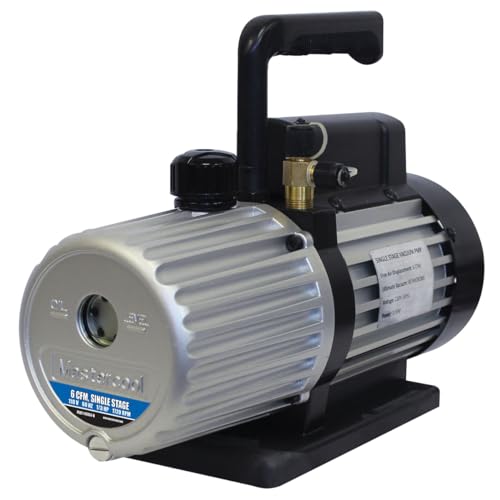
The Mastercool 90066-B makes the opposite trade from the Yellow Jacket: it gives up the second stage and spends on displacement instead. The result is 6 CFM of free air displacement — second highest in this guide — from a single-stage pump with an ultimate vacuum rating of 80 microns. On a sound, tight car system, that flow pulls the bulk of the air out quickly, and 80 microns sits well below the level a recharge requires.
The motor is a 1/3 HP unit on 110V power, turning 1720 RPM. Mastercool builds the pump around an aluminum housing, and the 6 CFM models carry a gas ballast valve: opened a quarter turn for the first part of the evacuation, it sweeps moisture vapor through the pump instead of letting it collect in the oil, then closes for the final pull. Oil capacity is 18 ounces, the largest of the single-stage pumps here. The body measures 15 by 6.5 by 11 inches and the pump weighs about 21 pounds.
Choose the 90066-B if most jobs are routine recharges on sealed, healthy systems, where pull-down speed matters more than the last few microns. On a system that sat open through a compressor failure, a two-stage pump is the better tool for the final dehydration.
Specs
- Free air displacement: 6 CFM
- Stages: Single-stage rotary vane
- Ultimate vacuum: 80 microns
- Motor: 1/3 HP, 110V / 60 Hz, 1720 RPM
- Intake fitting: 1/4 in flare
- Oil capacity: 18 oz
- Dimensions: 15 x 6.5 x 11 in
- Weight: about 21 lb
- Model: 90066-B
4. Kozyvacu TA500 — two-stage depth in a lighter frame

The Kozyvacu TA500 pairs the two numbers most buyers shop for: 5.0 CFM of flow and a two-stage design, in a pump that weighs 19 pounds — lighter than the other two-stage picks here. Kozyvacu’s model-specific manual rates the ultimate vacuum at 50 microns, and the 1/2 HP motor runs on 110V household power.
The intake offers both connections car work needs: a 1/4 inch flare port and a 1/2 inch ACME port, so R134a manifold hoses connect directly. The oil reservoir holds 380 ml, watched through a transparent sight window, and the fill cap doubles as an exhaust filter element that knocks down oil mist. The housing measures 14.7 by 7 by 11 inches, compact enough for a service cart shelf, and Kozyvacu’s published model ladder around this pump makes parts and documentation easy to trace back to the maker.
Choose the TA500 if the work is regular DIY and side-job AC service and the pump has to travel to the car rather than live in one bay. Its published ultimate vacuum sits a step behind the 15500’s factory figure, so on a badly moisture-soaked system, budget extra run time and a mid-job oil change.
Specs
- Free air displacement: 5.0 CFM
- Stages: Dual-stage (2-stage) rotary vane
- Ultimate vacuum: 50 microns
- Motor: 1/2 HP, 110V / 60 Hz
- Intake fittings: 1/4 in flare and 1/2 in ACME
- Oil capacity: 380 ml
- Dimensions: 14.7 x 7 x 11 in
- Weight: 19 lb
- Model: TA500
5. Robinair 15310 VacuMaster — the compact single-stage

The 15310 is Robinair’s single-stage entry in the VacuMaster family, built for the home garage that services one or two vehicles rather than a fleet. It displaces 3 CFM — enough for passenger car systems, where hose and port restrictions dominate anyway — and its factory rating is 75 microns, squarely in honest single-stage territory. The motor is a 1/4 HP unit, and the smaller pump head keeps the unit easy to carry and store.
The intake carries the same dual-standard arrangement as its bigger sibling: 1/4 inch flare and 1/2 inch ACME ports, so a standard manifold set connects with no adapter hunt. Oil capacity is 250 ml (8.5 oz), checked through a sight glass, with the fill cap at the front of the handle and a drain fitting at the reservoir base. Because the reservoir is small, a full oil change takes little oil — and fresh oil is exactly what a single-stage pump needs to reach its rated vacuum.
Choose the 15310 if the workload is seasonal: a compressor swap in spring, a recharge after a condenser replacement, the occasional favor for family cars. Technicians pulling vacuum daily will outgrow its flow rate, but for periodic work it delivers Robinair’s build and parts support in the smallest package here.
Specs
- Free air displacement: 3 CFM
- Stages: Single-stage rotary vane
- Factory micron rating: 75 microns
- Motor: 1/4 HP, 115V / 60 Hz
- Intake fittings: 1/4 in flare and 1/2 in ACME
- Oil capacity: 250 ml (8.5 oz)
- Model: 15310
Running any of these pumps well
Fresh oil is the cheapest performance upgrade in this guide. Fill to the sight glass line before a job, and change the oil whenever it looks milky — that cloudiness is moisture from the last system, and oil carrying water cannot pull a deep vacuum. Run the pump with the intake capped for a couple of minutes before connecting, keep the gas ballast open for the first stretch of a wet evacuation where fitted, and let the pump run after the manifold gauge bottoms out; the needle reaching the stop is the start of dehydration, not the end. Verify with a micron gauge and a standing decay test before charging.
On the safety and recall side: every model here was checked against the CPSC recall database at SaferProducts.gov before inclusion, and none of the five pumps — nor their makers’ vacuum pump lines — appears in a recall. The one entry that surfaces under a shared brand name is a 1997 go-kart recall with no connection to HVAC service equipment. Standard discipline still applies: eye protection when disconnecting charged hoses, no evacuation of a system still holding pressure, and refrigerant recovered with proper equipment before the pump connects — a vacuum pump is never a recovery machine.
The short version
For one pump that does everything well, the Robinair 15500 remains the benchmark: 5 CFM, two stages, a 35 micron factory rating, and both hose standards on the intake. The Yellow Jacket 93600 is the step up for big systems and daily work. The Mastercool 90066-B trades depth for speed, the Kozyvacu TA500 brings two-stage pulling to a lighter frame, and the Robinair 15310 covers seasonal home use without wasted capacity. Match the pump to the systems actually on the driveway, keep its oil fresh, and evacuation stops being the weak point of an AC repair.
More from Amazon
Programs that pair well with the guide above. Offers and eligibility are set by Amazon and may change.
Free shipping on eligible items, Prime Video and more. Eligible new members can start with a free trial.
Start a Prime free trialA Prime membership for ages 18-24 with a trial period. Eligibility is set by Amazon.
See Prime for Young AdultsAudiobooks and podcasts to listen to on the go. Eligible new members can start with a free trial.
Try Audible freeAd-free music streaming. Eligible new subscribers can start with a free trial.
Try Music Unlimited freeAs an Amazon Associate we earn from qualifying purchases.

Write Your Review
No reviews yet. Be the first to share your experience!