

Key takeaways
- Compare the best shooting glasses for the range, hunting and clay sports, with ballistic standards, lens colors and kit specs for five picks.
As an Amazon Associate we earn from qualifying purchases.
Affiliate Disclosure: This article contains affiliate links. If you buy through a link on this page, the site may earn a commission at no extra cost to you.
Shooting glasses do three different jobs depending on where they are worn. On an indoor range the threat is ricochet fragments and ejected brass in flat light. In the hunting field it is brush, thorns, and recoil in changing weather. On a clay course the glasses are also a visual tool, because the right tint makes an orange target stand out against trees and sky. The five models below cover those jobs with different strengths: three ballistic eyeshields built to the US military impact specification, one four-lens interchangeable kit for changing light, and one clay-sports specialist with a target-enhancing purple lens.
Two impact standards recur through this roundup, and they are not equal. ANSI Z87.1 is the civilian safety-eyewear standard, and its high-impact grade is marked Z87+. MIL-PRF-32432 is the US military ballistic fragmentation specification, which drives a small steel projectile at several times the impact energy of the ANSI high-velocity test. Every pick below states plainly which standard its maker claims, and the buying guidance at the end explains how to match the rating to the shooting you actually do.
1. Wiley X Saber Advanced (Clear, Matte Black)

The Saber Advanced is Wiley X’s long-running ballistic eyeshield, and the maker rates it to both MIL-PRF-32432 and ANSI Z87.1+. The configuration listed here is the single-lens clear version (model 303) in a matte black frame, the setup most shooters want for indoor ranges and low-light lanes. The lens is Wiley X’s shatterproof Selenite polycarbonate with a T-Shell scratch-resistant coating, and the maker lists clear-lens light transmission at 89 percent, which is why clear stays usable under range lighting where a tinted lens would go murky.
The Saber is built as a system rather than a fixed pair. Lenses interchange in the frame, and the wider line adds smoke grey lenses for bright sun and light rust lenses for contrast in flat, overcast light, including multi-lens kits that bundle the set. Fit hardware is a strength: the temples telescope for length, the nose piece adjusts, and a foam insert on the changeable lens helps seal out dust and wind in the field. Shooters who need correction can add the PTX prescription lens carrier, which clips in behind the shield and is sold separately.
Specs
- Model: 303 (Saber Advanced, Clear / Matte Black)
- Standards: MIL-PRF-32432 ballistic and ANSI Z87.1+
- Lens: Shatterproof Selenite polycarbonate, clear, 89% light transmission
- Coating: T-Shell scratch-resistant
- UV protection: 100% UVA/UVB
- Fit dimensions: 25 mm bridge, 138 mm lens width, 50 mm lens height, 114 mm temple
- Adjustment: Telescoping temples, adjustable nose piece, foam lens insert
- Prescription: PTX Rx carrier compatible (sold separately)
2. Oakley SI Ballistic M Frame 3.0 (OO9146, Prizm TR22)
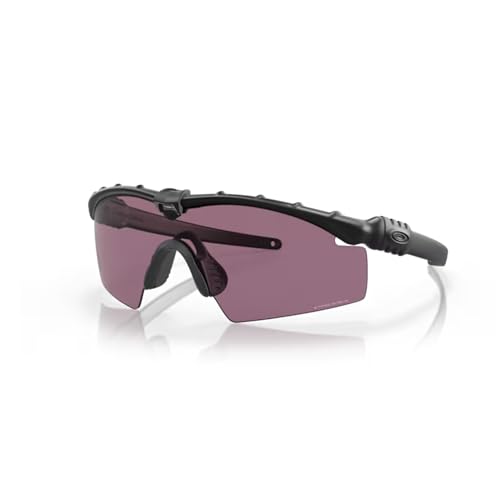
Oakley’s Standard Issue line is built for military and law-enforcement issue, and the Ballistic M Frame 3.0 sits on the US Army’s Authorized Protective Eyewear List (APEL). Oakley rates the frame to MIL-PRF-32432 ballistic impact and ANSI Z87.1. The single shield lens is Plutonite, Oakley’s polycarbonate, which the maker states filters out 100 percent of UVA, UVB, and UVC light. The lens fitted here is the Prizm TR22, the shooting tint in Oakley’s Prizm line tuned for bright conditions; its sibling TR45 covers dimmer light in the same lens family.
Two design details matter for range use. The ear stems are slim, a deliberate choice so the glasses sit under over-ear hearing protection and communication headsets without levering the ear cups away from the head as much as thick temples do. The lens also carries an anti-fog coating, which matters on humid lanes and during summer matches. The Amazon listing bundles the glasses with a leash kit and a microfiber pouch. For shooters who want one ballistic shield with a shooting-specific tint already fitted, this is the most specialized configuration in the roundup.
Specs
- Model: OO9146 SI Ballistic M Frame 3.0 (Prizm TR22 shield)
- Standards: MIL-PRF-32432 ballistic and ANSI Z87.1; APEL-listed
- Lens: Plutonite polycarbonate shield, Prizm TR22 shooting tint
- UV protection: 100% UVA/UVB/UVC per maker
- Coating: Anti-fog lens coating
- Frame: O Matter with slim, comms-compatible ear stems
- Includes (per listing): Leash kit and microfiber pouch
3. ESS Crossblade One (Black Frame, Clear Lens)

ESS supplies much of the eyewear issued to US and coalition forces, and the Crossblade is its current Cross Series eyeshield. ESS states that the Crossblade exceeds MIL-PRF-32432 and meets ANSI Z87.1-2015, with the polarized versions in the line as the stated exception on the military test. The configuration listed here is the Crossblade One: a black frame with a single clear lens, the indoor and general-purpose setup.
The lens technology is the draw. ClearZone FlowCoat puts an anti-fog treatment on the inside of the lens and an anti-scratch treatment on the outside, and the ESSOPTICS lens profile is ground for distortion-free vision across the whole shield rather than only at the center. All Crossblade lenses block 100 percent of UVA and UVB light. Because the Crossblade belongs to the Cross Series, its lenses interchange with Crossbow frames and lenses, so a clear One can grow into a multi-lens system over time, and the series accepts ESS prescription inserts such as the P-2B and Vice carriers. Additional lens colors in the line include smoke gray, hi-def yellow, and hi-def copper for contrast work outdoors.
Specs
- Model: Crossblade One (Black frame, Clear lens)
- Standards: Exceeds MIL-PRF-32432; ANSI Z87.1-2015 (per maker)
- Lens: High-impact polycarbonate, clear
- Coatings: ClearZone FlowCoat anti-fog (inside) and anti-scratch (outside)
- Optics: ESSOPTICS distortion-free lens profile
- UV protection: 100% UVA/UVB
- System: Cross Series lenses interchange with Crossbow; P-2B and Vice Rx inserts compatible
4. Smith & Wesson M&P Harrier Interchangeable Kit

The M&P Harrier answers a different problem: one shooter moving between an indoor range, a bright outdoor bay, and a clay field in the same week. It is a half-frame kit with four interchangeable polycarbonate lenses — smoke, clear mirror, vermillion, and amber — that cover the main lighting conditions a recreational shooter meets. The maker rates the lenses to the ANSI Z87+ high-impact grade, with an anti-fog coating and UV400 protection across all four tints.
Lens changes use a one-touch pop-out system, so a swap does not require flexing or bending the frame, and the rubberized nose piece and temple tips adjust to keep the half frame seated through recoil and head movement. The mapping is straightforward: clear mirror for indoor lanes, smoke for full sun, vermillion to lift orange clays against green backgrounds, and amber for dawn, dusk, and overcast hunting light. A hard zippered case and a microfiber cloth are included for storing the spare lenses. The Harrier carries a civilian high-impact rating rather than a military ballistic one, so it suits club ranges and fields where ANSI Z87+ is the accepted standard.
Specs
- Model: M&P Harrier half-frame interchangeable kit
- Standard: ANSI Z87+ high-impact (per maker)
- Lenses: 4 interchangeable polycarbonate — smoke, clear mirror, vermillion, amber
- Lens change: One-touch pop-out system
- Coating: Anti-fog
- UV protection: UV400
- Fit: Rubberized adjustable nose piece and temple tips
- Includes: Hard zippered case and microfiber cloth
5. Beretta Challenge EVO (Purple Lens, Black Frame)

The Challenge EVO is the clay-sports specialist in this roundup, built by Beretta specifically for shooters rather than adapted from industrial safety eyewear. The purple lens fitted here follows Beretta’s own color logic: purple suppresses green backgrounds, adds depth perception against them, and makes orange targets stand out — the exact problem a sporting clays or skeet shooter faces when a bird crosses a tree line. The same line offers yellow for dim light and fog, orange for very bright days and orange targets, and a neutral tint that adds no contrast for all-light use.
The frame is a full-rim wraparound in polycarbonate and nylon with a wide lens that extends coverage toward the temples and forehead, an adjustable rubber nose pad, and anti-slip temple tips to keep the glasses planted during the gun mount. Beretta lists UV400 protection for the line, and the listing specifies an anti-fog lens coating. One honest distinction: Beretta markets the Challenge EVO for clay sports and lists UV400 protection rather than a military ballistic rating, so shooters whose range mandates a named impact standard should look at the ballistic picks above, while clay shooters get a purpose-built tint system here.
Specs
- Model: Challenge EVO, style OC061A28540316UNI (Purple lens, Black frame)
- Lens: Polycarbonate, purple — mutes green backgrounds, enhances orange targets
- UV protection: UV400 (per maker)
- Coating: Anti-fog lens coating (per listing)
- Frame: Full-rim wraparound, polycarbonate and nylon
- Fit: Adjustable rubber nose pad, anti-slip temple tips
- Line colors: Yellow, purple, orange, and neutral tints
How to Choose Shooting Glasses
Start with the impact standard. ANSI Z87.1 is the civilian baseline for safety eyewear, and the plus mark (Z87+) means the eyewear passed the high-impact tests rather than only the basic ones; most ranges that specify a standard ask for Z87 or Z87+. MIL-PRF-32432 is the US military ballistic fragmentation specification. Its test drives a small steel fragment-simulating projectile far faster than the ANSI high-velocity steel-ball test, so ballistic eyewear is verified against several times the impact energy. Models on the APEL list, like the M Frame 3.0 above, have additionally been approved for US military issue. For hunting, where the realistic hazards are branches and brush rather than fragments, Z87+ is a sensible floor; for steel-target ranges and tactical bays, a ballistic rating buys margin.
Match the lens color to the conditions. Clear lenses transmit the most light — the Wiley X clear lens above passes 89 percent — and belong indoors and at dawn or dusk. Smoke grey cuts glare in full sun without shifting colors. Yellow and amber brighten flat, overcast, and low light and add contrast, which is why they appear in hunting kits. Vermillion and purple are clay tools: they mute green backgrounds so orange targets separate from tree lines. Copper and bronze tints split the difference for hunters who want contrast in varied terrain without a full clay tint.
Decide between a kit and a single lens. Interchangeable systems (the Harrier’s four lenses, or the Saber and Crossblade lens families) cost more handling but cover every condition with one frame. A single fixed lens is simpler and is the right call for a shooter who only shoots indoors or only shoots clays. Whichever route you take, anti-fog treatment matters more than most buyers expect: coated lenses, vented frames, and half-frame designs all fog less than sealed full frames.
Check fit with your hearing protection. Thick temples break the seal of ear cups and let noise leak in. Slim stems, like those on the M Frame 3.0 and the ESS Suppressor variant of the Crossbow frame, are designed to sit under ear cups; if your glasses have standard temples, foam ear plugs avoid the conflict entirely. Finally, prescription wearers should look for an Rx carrier system — Wiley X’s PTX and the ESS P-2B and Vice inserts clip a corrective lens behind the protective shield, which keeps the rated lens in front of the eye.
FAQ
What is the difference between ANSI Z87.1+ and MIL-PRF-32432?
ANSI Z87.1+ certifies high-impact resistance under the civilian safety standard, using tests such as a steel ball dropped or driven at the lens. MIL-PRF-32432 is the military ballistic specification and uses a fragment-simulating projectile at much higher velocity, so it verifies the lens against several times the impact energy. Both are legitimate ratings; the military one is simply the harder test.
Which lens color is best for clay shooting?
It depends on the background. Purple and vermillion tints mute green backgrounds and make orange targets stand out, which suits most sporting clays and skeet fields. Orange tints help in very bright light, and yellow suits dim, foggy, or overcast rounds. Many clay shooters carry two tints and swap as the light changes.
Can shooting glasses be worn comfortably with earmuffs?
Yes, with the right frame. Slim or flat temple arms slide under ear cups without pushing them off the seal, and several ballistic lines offer thin-temple variants made for exactly this. If a standard temple breaks the muff seal, switching to in-ear plugs removes the interference while keeping hearing protection in place.
What if I wear prescription glasses?
Look for a system with a prescription insert. Wiley X offers the PTX carrier for frames like the Saber Advanced, and ESS offers P-2B and Vice inserts for its Cross Series; an optician fills the insert with your prescription and it clips behind the rated shield lens. That keeps certified impact protection in front of your eyes, which ordinary prescription frames do not provide.
Conclusion
The right shooting glasses depend on where the shooting happens. For a ballistic shield that covers range, field, and tactical use, the Wiley X Saber Advanced and ESS Crossblade One pair military-spec impact protection with interchangeable lens systems that grow with the shooter. The Oakley SI Ballistic M Frame 3.0 adds a shooting-specific Prizm TR22 tint and ear stems shaped for hearing protection. The Smith & Wesson M&P Harrier is the flexible club option, one ANSI Z87+ kit with four tints for changing light. And for the clay course, the Beretta Challenge EVO’s purple lens does the one job the others do not: making orange targets separate from green backgrounds. Match the rating to your range’s rules, the tint to your light, and the frame to your ear protection, and any of the five will serve for years.
More from Amazon
Programs that pair well with the guide above. Offers and eligibility are set by Amazon and may change.
Free shipping on eligible items, Prime Video and more. Eligible new members can start with a free trial.
Start a Prime free trialA Prime membership for ages 18-24 with a trial period. Eligibility is set by Amazon.
See Prime for Young AdultsAudiobooks and podcasts to listen to on the go. Eligible new members can start with a free trial.
Try Audible freeAd-free music streaming. Eligible new subscribers can start with a free trial.
Try Music Unlimited freeAs an Amazon Associate we earn from qualifying purchases.

Write Your Review
No reviews yet. Be the first to share your experience!