

Key takeaways
- Allow roughly 35–40% of the interior for ice if you need multi-day cooling.
- Reserve another 5–10% for dividers, baskets, or awkwardly shaped containers.
- Expect bottles and cans to waste more space than flat food containers.
The best wheeled coolers are the YETI Tundra Haul for rugged all-purpose use, the RovR RollR 60 for rough terrain and built-in organization, the Pelican 80QW Elite for maximum usable capacity, and a large Igloo or Coleman roller for budget-minded trips on paved surfaces.
Our top picks


As an Amazon Associate we earn from qualifying purchases at no extra cost to you. Ratings are shown as listed on Amazon.
Quick comparison: the best wheeled coolers
| Cooler | Advertised capacity | Approx. empty weight | Wheel and handle design | Best use | Typical market range |
|---|---|---|---|---|---|
| YETI Tundra Haul | 55 qt | 37 lb | Two all-terrain wheels; welded aluminum handle | Frequent camping, beach access, general durability | $400–$500 |
| RovR RollR 60 | 60 qt | 37–40 lb, depending on configuration | Large treaded wheels; telescoping handle; accessory-ready design | Uneven ground and organized camp cooking | $400–$550 |
| Pelican 80QW Elite | 80 qt | About 50 lb | Oversized wheels; telescoping pull handle | Large groups and extended base-camp trips | $350–$500 |
| Igloo MaxCold Latitude 62 Roller | About 62 qt | About 20–25 lb | Plastic wheels; telescoping handle | Budget trips, drive-in camping, paved paths | $80–$150 |
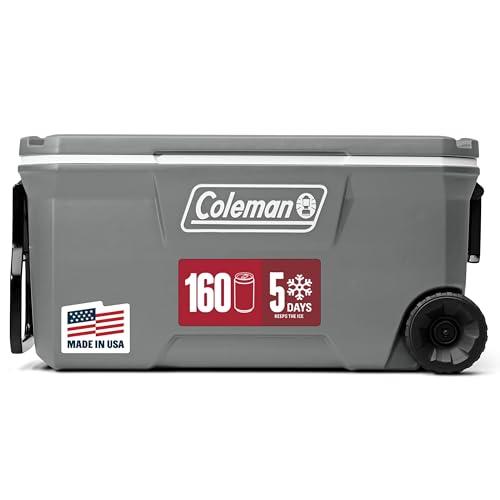
| Coleman Xtreme 5 70-Quart Wheeled Cooler | 70 qt | About 15–20 lb | Large molded wheels; pull handle | High-volume drinks and occasional use | $60–$120 |
Capacities and weights can vary slightly by production version and accessories. “Advertised capacity” is not the same as practical food-and-ice capacity: ice, baskets, dividers, and irregularly shaped bottles reduce the space available for food.
Best overall: YETI Tundra Haul
The YETI Tundra Haul is the safest choice when you want a rotomolded cooler that can be pulled repeatedly without feeling like a disposable box with wheels attached. Its welded aluminum handle is more confidence-inspiring than a thin plastic pull bar, and the oversized wheels handle grass, packed dirt, and gravel better than small cooler casters.
The trade-off is weight. At roughly 37 pounds empty, it becomes difficult to move once filled with food, drinks, and ice. Its 55-quart shell is also less spacious inside than a lightweight 60- or 70-quart cooler because thick insulation consumes room. Choose it when long-term durability and cold retention matter more than maximum volume.
Best for rough ground and camp organization: RovR RollR 60
The RovR RollR 60 is particularly useful when the cooler has to travel beyond a parking lot. Its large, air-filled-style terrain wheels and long handle make it easier to control across roots, gravel, and uneven grass. The design also supports useful add-ons such as a dry-goods compartment and seat or wagon-style accessories, depending on the configuration.
Its strongest advantage is not simply insulation; it is workflow. A removable basket can keep sandwiches and produce above melting ice, while the main compartment holds drinks and perishables. That separation reduces the common mistake of repeatedly rummaging through ice to find lunch. The price, added weight, and larger footprint make it excessive for short picnics.
Best large-capacity option: Pelican 80QW Elite
The Pelican 80QW Elite is the better match for group camping, fishing weekends, or a base camp where one person can load it and the cooler does not need to travel far every day. Its nominal 80-quart capacity gives it a meaningful advantage over 55- or 60-quart models when several people need drinks and food.
That capacity comes with a serious transport penalty. At approximately 50 pounds empty, a fully loaded Pelican can exceed what one person can comfortably pull over soft ground. The wheels are useful, but no wheeled cooler becomes light when it contains several days of food and a large ice load. Pick it when volume is the priority and the route from vehicle to campsite is relatively manageable.
Best budget choice: Igloo or Coleman wheeled coolers
Large Igloo and Coleman rollers offer the most capacity per dollar and are often much easier to lift into a vehicle because their insulated plastic walls are thinner and lighter. For drive-in camping, sports fields, tailgates, and paved campground roads, that can be a better practical choice than paying for a heavy premium cooler.
The limitations are clear. Small molded wheels can catch on stones, the pull handles have more flex, and insulation performance usually falls short of premium rotomolded models. Drain plugs, hinges, and handles are also the parts most likely to become troublesome after repeated rough use. These coolers make sense when occasional replacement is acceptable and the surface is mostly smooth.
What matters when a cooler is fully loaded?
Usable capacity, not the number on the lid
A cooler rated at 60 quarts does not provide 60 quarts for food. A practical packing estimate is:
- Allow roughly 35–40% of the interior for ice if you need multi-day cooling.
- Reserve another 5–10% for dividers, baskets, or awkwardly shaped containers.
- Expect bottles and cans to waste more space than flat food containers.
For example, a 60-quart cooler may leave about 32–36 quarts for food and drinks after a substantial ice load. A 70-quart lightweight cooler may therefore hold more usable provisions than a heavily insulated 55-quart model, even though their advertised capacities look similar.
Wheel and handle durability
Two features matter more than wheel diameter alone: the axle mounting and how much the handle flexes under load. A rigid handle transfers pulling force more efficiently and is easier to steer. Large wheels help on grass and gravel, but they do not compensate for a cooler that is too heavy to control.
When comparing models, look for a handle that locks firmly in both its extended and stored positions, wheels that do not wobble, and hardware protected from direct impact. A cooler pulled sideways over rocks places more stress on the axle than one pulled straight behind you.
Insulation performance
Thick insulation and a well-sealing lid improve ice retention, but published ice-retention claims are not directly comparable. Results depend on starting temperature, ice type, sun exposure, how often the lid opens, and whether the cooler is pre-chilled.
For normal camping, pre-chill the cooler with sacrificial ice or frozen water bottles, load cold food, and keep it shaded. A premium cooler is worth considering for multi-day trips or hot, exposed campsites. For a one-day picnic, better packing habits often matter more than buying the thickest walls available.
Drainage and cleaning
A low drain is valuable after ice melts, but it should be easy to open without tools and positioned so water does not pool in the opposite corner. Some cooler drains release water slowly when the unit is packed tightly, so do not assume the plug eliminates the need to lift or tilt the cooler.
After each trip, empty meltwater promptly, wash the interior with mild dish soap, and leave the lid open until fully dry. Clean the gasket and drain area separately, since food residue there can cause odors. Avoid abrasive cleaners that can roughen plastic surfaces and make future cleaning harder.
Decision matrix by trip and terrain
| Your situation | Best fit | Why | What to avoid |
|---|---|---|---|
| Mostly paved paths and occasional use | Igloo MaxCold Latitude or Coleman Xtreme roller | Low cost, low empty weight, generous volume | Paying for a 40–50 lb premium shell |
| Week
Affiliate disclosure. As an Amazon Associate we earn from qualifying purchases at no extra cost to you. Prices accurate as of the date shown. Best Wheeled Coolers for Easy TransportCheck price on Amazon More ways to save on Amazon 
Canadian Snacks You Need to Try on a TripCanadian snacks you need to try on a camping or road trip...
Red Bull Flavors Ranked for CampingRed Bull flavors ranked for camping: Red Bull Sugarfree is the best...
Dr Pepper Flavors Ranked: Best to WorstFor most campers, Original Dr Pepper ranks first because its balanced cherry-almond...
Zucchini Soup Recipe for Camp CookingThis zucchini soup recipe for camp cooking is a one-pot, 30-minute soup...
Zucchini Brownie Recipe: Fudgy and EasyA fudgy zucchini brownie recipe uses 1 1/2 cups of finely shredded...
Fresh Fig Dessert Recipes for Camp and HomeThe best fresh fig dessert recipes for camping are skillet-roasted figs with... 
Easy Monkey Bread Recipe for CampingAn easy monkey bread recipe for camping uses refrigerated biscuit dough, butter,... 
Chicken Zucchini Casserole Recipe for CampThis chicken zucchini casserole recipe makes one 9-by-13-inch pan—about 6 generous servings—and... 
Caffeine Drinks Ranked: Best Picks for CampingCaffeine drinks ranked by practical camping value: instant coffee is the best... 
What Time Does McDonald’s Stop Serving Breakfast?What Time Does McDonald’s Stop Serving Breakfast? McDonald’s usually stops serving breakfast... |
Write Your Review
No reviews yet. Be the first to share your experience!