

Key takeaways
- Five foam rollers compared by type, length and firmness: a smooth EPP roller, a grid roller, a textured roller, a vibrating roller and a half-round pick.
As an Amazon Associate we earn from qualifying purchases.
A foam roller is a simple cylinder, but the five rollers in this guide are built in five different ways, and the construction matters more than the brand name. A solid foam roller gives under your body weight and spreads pressure over a wide area. A hollow-core roller does not flex at all, so the pressure stays exactly where you put it. A textured roller concentrates that pressure onto bumps. A vibrating roller adds a motor. A half-round roller trades the rolling motion for a flat, stable base. Each format suits a different body, a different tolerance and a different job.
One warning applies to every pick here: firmness is not measured to any shared standard. One maker’s “firm” is another maker’s “medium,” and density labels are only meaningful inside a single brand’s range. Treat the firmness descriptions below as relative guidance, not measurements. Each ASIN is also pinned to one exact length variant, because roller listings bundle several sizes under one page and a 12-inch roller and a 36-inch roller are genuinely different tools.
Affiliate Disclosure: This article contains affiliate links. If you buy through a link on this page, we may earn a commission at no additional cost to you. This helps support our work and lets us keep publishing independent buying guides.
How the types differ, and how to choose honestly
Length decides what you can roll. A 36-inch roller is long enough to lie across for back and chest work and to support both legs at once. An 18-inch roller covers most leg and hip work and stores easily. Rollers of 12 to 13 inches are spot tools and travel tools: excellent on calves, glutes and the upper back, too short to lie across comfortably.
Construction decides how pressure behaves. A solid foam roller compresses slightly, which softens the contact patch and makes it the forgiving option. A hollow rigid core cannot compress, so all of your weight lands on the surface texture — consistent and intense. Surface texture then multiplies the effect: a smooth roller spreads load, a grid pattern varies it, and raised bumps focus it onto small areas the way thumbs would.
The honest starting advice is unglamorous. Beginners should start with a smooth roller at a medium firmness, work large muscles slowly, and keep pressure tolerable. Aggressive textures are not a shortcut: they bruise beginners, and bruising is your body reporting damage, not progress. More intense is not better — the right roller is the firmest one you can relax on top of. Finally, a roller is a comfort and mobility tool, not a medical device. It does not diagnose or fix injuries. Sharp pain, joint pain, numbness or pain that persists for days are stop signals, not things to roll through; take those to a qualified professional instead.
1. Amazon Basics High-Density Round Foam Roller — 36 in
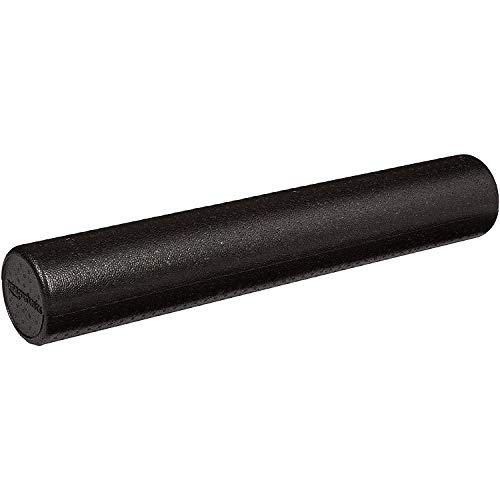
The Amazon Basics roller is the plain smooth option done properly: a single piece of molded high-density expanded polypropylene (EPP) foam, full round, with no core, no texture and nothing to charge or assemble. EPP is the bead foam used in the rollers that fill physical therapy clinics, and its virtue is shape retention — a solid EPP roller resists developing a soft, flattened side the way cheaper foams do.
At 36 inches this is the full-length format. You can lie along it for spinal mobility work, lie across it for chest opening, or roll the whole length of a hamstring or IT band without repositioning. The density is at the firm end of the smooth-roller range, which makes it effective on large, well-padded muscles like quads and glutes, and a lot for a beginner to take on the IT band or ribs. If you are new to rolling, this firmness is the honest trade: durable and effective, but earn your way into the tender spots gradually. The listing covers several sizes; the ASIN below is the 36-inch black variant, model ABU36BHPU.
Specs
- Type: Smooth solid foam, full round
- Length: 36 in
- Diameter: 6 in
- Core construction: Solid molded foam, no hollow core
- Material: Expanded polypropylene (EPP)
- Firmness: High density, as described by the maker
- Model: ABU36BHPU (part EPPBK-36-1)
- Colour of this variant: Black
2. TriggerPoint GRID 1.0 Foam Roller — 13 in

The GRID is the roller that defined its category: a rigid hollow core wrapped in EVA foam molded into a grid of zones at different densities. The flat areas are meant to feel like a palm, the raised tubes like fingers, and the firmer nodes like fingertips, so rolling across it varies the pressure instead of repeating one flat contact patch. Because the core is hollow plastic, it does not flex or soften under load — the feel on day one hundred is the feel on day one.
The honest limitation is the size. At 13 inches long and 5.5 inches across, the GRID is a spot and travel roller: superb on calves, glutes, lats and the upper back, and small enough for a gym bag or carry-on, but too short to lie across for full-back work. TriggerPoint lists a weight capacity of up to 300 lb for this roller, the highest-confidence figure in this guide because the rigid core, not foam, carries the load. The ASIN below is the 13-inch GRID 1.0, model 00201.
Specs
- Type: Grid-textured surface over a rigid core
- Length: 13 in
- Diameter: 5.5 in
- Core construction: Hollow rigid core that does not flex under load
- Material: EVA foam exterior over the core
- Surface: Multi-density zones (flat, tubular and firm nodes)
- Weight capacity: Up to 300 lb, as listed by the maker
- Weight: Approx. 1.4 lb
- Model: 00201 (part 15920)
3. RumbleRoller Original Textured Foam Roller — 22 in

The RumbleRoller replaces texture with protrusions: its surface is covered in firm but flexible bumps moulded from EVA and polyolefin, designed to knead soft tissue the way a therapist’s thumbs do. As you roll, the bumps press in and deflect sideways, stretching tissue in several directions at once rather than simply compressing it. By design the bumps are firmer than muscle but softer than bone, so they flex out of the way over the spine and other bony points.
This is the most aggressive roller in this guide, and it should be bought with clear eyes. It is a second roller, not a first one: people who already roll a smooth roller and find it too gentle are the audience. Used carelessly it will bruise, and the maker’s own directions say to stop if you feel pain and to keep sessions short. The variant pinned here is the 22-inch MidSize in the Original density — RumbleRoller’s gentler of its two firmness levels — in blue, model RRM226. The extra-firm black version exists, and most people should not start there.
Specs
- Type: Textured, raised flexible bumps
- Length: 22 in (midsize)
- Diameter: 5.5 in
- Core construction: Solid-core roller with moulded bump surface
- Material: EVA / polyolefin
- Firmness: Original density (the softer of the maker’s two densities)
- Weight: Approx. 1.8 lb (0.8 kg)
- Model: RRM226
- Colour of this variant: Blue
4. Hyperice Vyper 3 Vibrating Foam Roller — 13 in
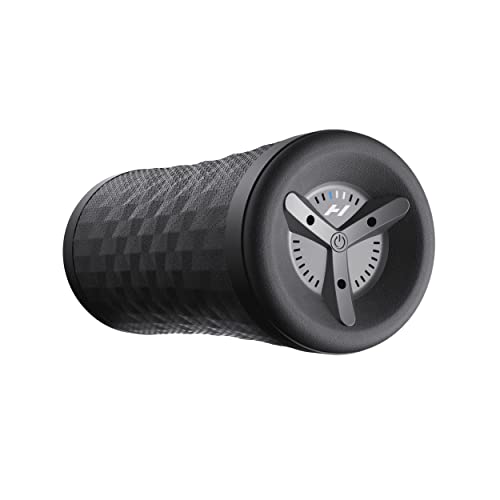
The Vyper 3 builds a motor into a contoured foam body. The roller is made from polypropylene with a shaped, ridged surface — the contour is designed to avoid loading the spine directly during back work — and inside sits a high-torque 34W motor driving three vibration speeds. It connects over Bluetooth to the maker’s app for guided warm-up and recovery routines, and the rechargeable battery runs for up to about two hours per charge.
Vibration changes the deal in a specific way: many people can tolerate firmer pressure with the motor running, because the vibration gives the nervous system something else to process. That makes the Vyper a reasonable step up for experienced rollers, and a poor first roller for everyone else — it is firm, it is ridged, and it adds charging and electronics to a product category whose charm is having neither. At roughly 13 by 5.4 inches it is a spot roller like the GRID, not a full-length back roller. The ASIN below is the standalone Vyper 3, model HIVYPER3, not the bundle listings that pair it with other devices.
Specs
- Type: Vibrating, contoured surface
- Length: Approx. 13 in
- Diameter: Approx. 5.4 in
- Core construction: Motor housed in a contoured foam body; does not flex like solid foam
- Material: Polypropylene body with rubber stability bands
- Vibration: 3 speeds, 34W high-torque motor
- Battery: Rechargeable, up to approx. 2 hours per charge
- Connectivity: Bluetooth, app-guided routines
- Weight: Approx. 2.7 lb
- Model: HIVYPER3
5. ProsourceFit High Density Half-Round Foam Roller — 36 in
The half-round is the odd shape in this guide, and the most beginner-friendly. It is a 36-inch EPP roller cut in half lengthwise: one flat face, one curved face. Flat side down, it cannot roll away from you, which turns it into a stable platform for balance work, core exercises, Pilates and gentle supported stretching. Curved side down, the instability becomes the exercise. Used on its own for rolling, the flat face also makes it the gentlest way to start, because you control the pressure without the roller escaping.
ProsourceFit moulds this one from high-density expanded polypropylene and describes the firmness as extra firm, with a lightly textured surface for grip — useful when it is under your feet. The trade-off is intensity: a half-round will never deliver the deep pressure of the GRID or the RumbleRoller, and that is precisely why it suits rehabilitation-style work, older users, and anyone whose first attempt at rolling should not hurt. The ASIN below is the 36-inch black variant, part ps-2118-foam-36×3-black; shorter 12- and 18-inch versions share the listing.
Specs
- Type: Half-round (one flat face, one curved face)
- Length: 36 in
- Profile: 6 in wide, 3 in high
- Core construction: Solid moulded foam
- Material: Expanded polypropylene (EPP), high density
- Firmness: Extra firm, as described by the maker
- Surface: Lightly textured for grip
- Weight: Approx. 0.84 lb
- Part number: ps-2118-foam-36×3-black
Bottom line
Match the roller to the job, not to the marketing. For a first and only roller, the full-length Amazon Basics EPP roller covers the whole body at a firm-but-fair density, and the ProsourceFit half-round is the gentler on-ramp for balance work and cautious beginners. The TriggerPoint GRID earns its place as the compact, non-flexing spot roller that travels. The RumbleRoller and the Vyper 3 are step-up tools for people who already roll: one concentrates pressure through its bumps, the other adds vibration — both are too much as a first purchase, and both reward slow, brief, careful sessions. Whichever you choose, start softer than you think you need, keep the pressure tolerable, and stop at pain.
More from Amazon
Programs that pair well with the guide above. Offers and eligibility are set by Amazon and may change.
Free shipping on eligible items, Prime Video and more. Eligible new members can start with a free trial.
Start a Prime free trialA Prime membership for ages 18-24 with a trial period. Eligibility is set by Amazon.
See Prime for Young AdultsAudiobooks and podcasts to listen to on the go. Eligible new members can start with a free trial.
Try Audible freeAd-free music streaming. Eligible new subscribers can start with a free trial.
Try Music Unlimited freeAs an Amazon Associate we earn from qualifying purchases.










Write Your Review
No reviews yet. Be the first to share your experience!