

Key takeaways
- Compare the best soldering stations for electronics and repair work: analog and digital iron stations plus a 2-in-1 hot air rework combo, with full specs.
As an Amazon Associate we earn from qualifying purchases.
Affiliate Disclosure: This article contains affiliate links. If you buy through a link on this page, we may earn a commission at no extra cost to you. That support helps keep this site running and our guides up to date.
A soldering station earns its bench space for one reason: control. A plain plug-in iron runs at whatever temperature its element settles at, and that temperature sags the moment the tip touches a ground plane or a thick connector shell. A station closes the loop. A sensor in or near the tip reports the actual temperature back to the base unit, and the base feeds power up or down many times per second to hold the set point. The result is faster recovery between joints, less time cooking pads, and tips that last longer because they are not idling hotter than they need to.
Before the picks, two honesty notes that matter more than any single specification. First, wattage is recovery speed, not maximum temperature. A 75 W station does not get hotter than a 40 W station set to the same temperature; it gets back to that temperature faster after a joint pulls heat out of the tip. Buy wattage for the size of the work, not for bragging rights. Second, on inexpensive stations the number on the display is the temperature the controller believes in, and it can drift from the real tip temperature by a noticeable margin, especially as tips wear and the sensor fit loosens. Brand-name stations publish a stability figure and hold it; budget stations rarely publish one at all. Keep that in mind as you compare the five stations below, which run from a simple analog power dial to a cartridge-tip professional unit and a 2-in-1 hot air rework combo.
1. Weller WLC100 — Analog Power-Control Station
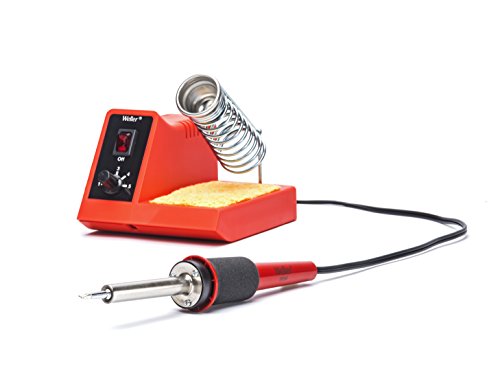
The WLC100 is the oldest design in this roundup, and it is important to understand what it actually is: this is not a closed-loop temperature station. The dial on the base adjusts power output from 5 to 40 watts, and the tip temperature floats with that setting and with the load on the joint. There is no sensor feedback and no display. For through-hole hobby work, model railroads, stained glass and basic wiring, that simplicity is genuinely fine, and the dial gives a useful coarse feel for hotter or cooler work. For temperature-sensitive surface-mount parts, the floating temperature is a real limitation, and no amount of dial practice fully fixes it.
What the WLC100 does offer is Weller’s build quality at the entry end of the range and the ST series tip system, a long-running screw-in tip family that is easy to source. The included ST3 screwdriver tip suits general work. The station ships with a spring-style iron holder and a cleaning sponge, and the SPG40 pencil iron is light with a cushioned grip. One caution: Weller does not publish an ESD-safe rating for this model, so it is not the right pick for static-sensitive board repair in a formal ESD workflow.
Specs
- Format: Iron-only station, analog variable power dial (no temperature feedback loop)
- Wattage: 5–40 W, adjustable from the dial
- Temperature: Up to roughly 900 °F depending on setting and load; no set-point control
- Tip system: Weller ST series (ST3 1/8 in screwdriver tip included)
- ESD safe: Not rated ESD safe by the manufacturer
- Holder and extras: Spring iron holder and cleaning sponge included; SPG40 pencil iron
2. Hakko FX-888D — Digital Station, T18 Tips

The FX-888D is the station most hobby benches end up with, and the reasons are structural rather than fashionable. It is a digital closed-loop station: push buttons set the temperature, the display shows the set point, and the controller holds idle temperature stability to a published ±1 °C. The 65 W ceramic element recovers quickly on typical through-hole and light surface-mount work, and the wide 120–899 °F range covers everything from delicate connector work to lead-free solder on chunky terminals.
The long-term ownership story is the T18 tip series. T18 tips are a mature, deep catalogue — chisels, bevels, conicals and hoof shapes in many widths — and they are sold everywhere soldering supplies are sold. That matters because tips are consumables: a station whose tips are cheap and permanently in stock costs less to own over five years than a slightly cheaper station with an orphaned tip line. The FX-888D is built with ESD-safe materials, and the iron holder includes both a cleaning sponge and a cleaning wire, which is kinder to tip plating than a sponge alone. The two-button interface is the one widely noted quirk: setting a temperature takes a deliberate button sequence rather than a knob turn, and there is no rotary encoder. Owners adapt quickly, but knob fans should know before buying.
Specs
- Format: Iron-only station, digital push-button control with temperature display
- Wattage: 65 W
- Temperature range: 120–899 °F (50–480 °C); published stability ±1 °C at idle
- Tip system: Hakko T18 series (T18-D16 chisel tip included)
- ESD safe: Yes, ESD-safe construction as published by Hakko
- Holder and extras: Iron holder with cleaning sponge and cleaning wire included
3. Weller WE1010NA — Digital Station, ET Tips
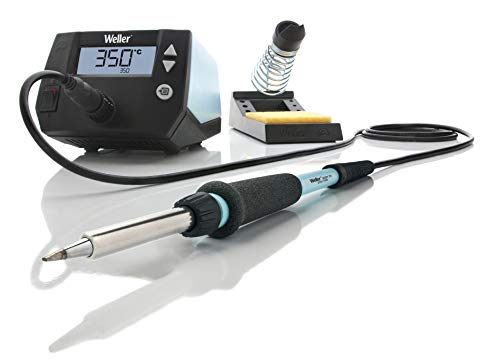
Weller’s WE1010NA is the direct answer to the FX-888D from the other great bench brand, and it edges ahead on published control figures. The 70 W station holds temperature stability to a published ±4 °F (±2 °C), heats noticeably faster than the older Weller stations it replaced, and adds features the Hakko lacks: a temperature lock so a set point cannot be bumped mid-job, a standby mode with automatic setback that drops the tip temperature when the iron sits idle, and optional password protection for shared or classroom benches. The three-button front panel with an LCD is straightforward to drive.
The ownership trade-off is the tip system. The WE1010NA uses Weller ET series tips, a quality line with good availability through electronics distributors, but the catalogue is narrower than Hakko’s T18 range and tips are strictly Weller-only — there is no cross-compatibility with the 900M-style tips that flood the budget market. The station is ESD certified, ships with the WEP 70 iron, the PH70 safety rest with sponge, and an ETA 1.6 mm screwdriver tip fitted. For a buyer who values the lock and standby behaviour and expects to buy tips from proper distributors anyway, this is the most polished mainstream station here.
Specs
- Format: Iron-only station, digital LCD control with three push buttons
- Wattage: 70 W
- Temperature range: 200–850 °F (100–450 °C); published stability ±4 °F (±2 °C)
- Tip system: Weller ET series (ETA 1.6 mm screwdriver tip included)
- ESD safe: Yes, ESD certified as published by Weller
- Holder and extras: PH70 safety rest with sponge; temperature lock, standby and auto setback modes
4. Hakko FX-951 — Cartridge-Tip Professional Station

The FX-951 is built around a different heating architecture, and it changes how the tool behaves. Instead of a separate element heating a passive copper tip, the FX-951 uses T15 composite cartridges: the heater and temperature sensor are integrated into the tip itself. Heat transfer is nearly direct, recovery on heavy joints is the fastest here, and changing tip shape is a seconds-long swap with the heat-resistant pad — no waiting for a barrel nut to cool, no tools. The digital controller reads the sensor in the cartridge, so the temperature it reports is measured where the work happens.
The honest cost of that architecture is per-tip pricing: a cartridge costs several times what a passive T18 or ET tip costs, because you are buying a heater every time. The counterweight is that the T15 family — sold as T12 in some regions, the same cartridge under a regional name — is one of the most widely cloned and stocked tip formats in the world, so shapes and stock are never a problem; do buy genuine cartridges from authorised sellers, because counterfeit cartridges are common and perform measurably worse. The station itself is compact, ESD safe, and adds a programmable sleep function plus automatic shut-off after 30 minutes in the holder, which stretches cartridge life considerably. Note that Hakko has newer stations above this model in its current catalogue, but the FX-951 remains on sale and its tip ecosystem remains fully supported.
Specs
- Format: Iron-only station, digital control; settings protected by control card
- Wattage: 75 W
- Temperature range: 400–840 °F (200–450 °C)
- Tip system: Hakko T15 composite cartridge tips, heater and sensor integrated in the tip (T15-D16 included)
- ESD safe: Yes, ESD-safe construction as published by Hakko
- Holder and extras: Iron holder included; programmable sleep mode and 30-minute auto shut-off
5. YIHUA 862BD+ — 2-in-1 Hot Air Rework Combo
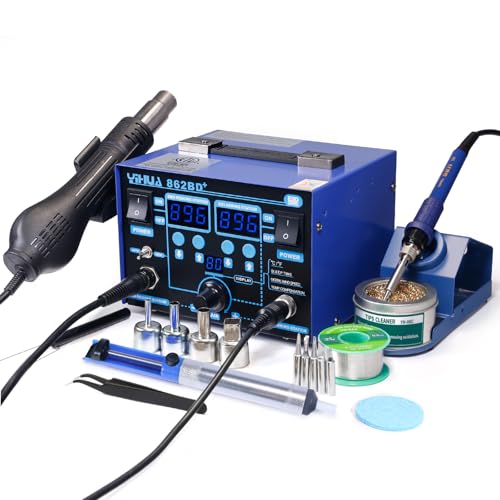
Everything above is an iron-only station. The 862BD+ is a different tool class: a 2-in-1 combo that pairs a 75 W soldering iron with a hot air gun in one base unit, with three digital displays covering both channels. If your repair work includes removing or reflowing surface-mount chips, shrinking connectors off phone and laptop boards, or reseating QFN packages, hot air is not optional — an iron alone cannot heat all the pins of a chip at once. Buying the combo is the standard way a home repair bench gets that capability without a second dedicated unit.
The iron side runs 392–896 °F with a fast PID control loop, and the hot air side runs 212–896 °F with adjustable airflow up to a published 120 L/min, which is the figure that decides whether the gun can float a large chip or only nudge small passives. Four air nozzles are included alongside five iron tips, a solder sucker, tweezers and a roll of lead-free solder, so the box is a working kit rather than a bare unit. The tips are the common 900M pattern, the cheapest and most widely stocked passive tip format anywhere — the opposite end of the ownership spectrum from the FX-951’s cartridges. YIHUA markets the station as ESD safe and it carries ETL certification. The standing budget-brand caveat applies: treat the displayed temperature as a close guide rather than a laboratory reading, and verify with a tip thermometer if your work is unforgiving.
Specs
- Format: 2-in-1 combo — soldering iron plus hot air rework gun, digital control, three displays
- Wattage: 750 W total system; iron 75 W
- Temperature range: Iron 392–896 °F (200–480 °C); hot air 212–896 °F (100–480 °C)
- Airflow: Adjustable, up to 120 L/min as published; 4 nozzles included
- Tip system: 900M series iron tips (5 included)
- ESD safe: Yes, marketed ESD safe; ETL certified
- Holder and extras: Iron holder and gun holder with sleep sensor; solder, sucker and tweezers included
How to Choose
Start with the work, not the wattage. Through-hole kits and wiring are comfortable on any station here. Dense modern boards with ground planes reward recovery speed, which is what the FX-951’s cartridge system and the higher-wattage digital stations actually sell. Surface-mount removal and rework require hot air, full stop — that decision alone points to the 862BD+ combo or to adding a separate rework unit later.
Control type is the second fork. The WLC100’s power dial is simple and repairable but floats with load. Digital stations hold a set temperature and are the correct default for electronics. If a specification sheet does not publish a temperature stability figure, assume the display is approximate.
The tip system is the long-term contract. T18 and ET tips are passive, durable and stocked by every distributor, with Hakko’s catalogue the deeper of the two. The 900M pattern on the YIHUA is the budget universal standard. T15 cartridges cost the most per tip and perform the best, because the heater lives in the tip. Whichever station you choose, you are really choosing which tips you will be buying for the next decade — check that the shapes you use exist in that family before you commit.
ESD and safety features close the decision. For work on modern boards, an ESD-safe station is the responsible default; four of the five here qualify, and the analog WLC100 is the exception to reserve for non-sensitive work. Standby setback, sleep-in-holder and auto shut-off are not luxuries — a tip left idling at full temperature oxidises and dies young, so those features pay for themselves in tip life alone.
FAQ
Can a 2-in-1 rework combo replace a separate iron station?
For most home repair benches, yes. The iron in a good combo is a full closed-loop iron, and the hot air channel adds SMD capability an iron-only station can never offer. Dedicated separate units still win on simultaneous use and on gun ergonomics for all-day rework.
Why does my cheap station’s display not match a tip thermometer?
The controller reads a sensor near the heater, not the tip face itself, and wear, tip fit and oxidation all widen the gap. Published stability figures from established brands describe how tightly the loop holds its own reading; a calibration check with a tip thermometer is the only way to know the true offset on any station.
How long should a soldering tip last?
A quality plated tip kept tinned, cleaned on wire or a damp sponge, and slept at reduced temperature lasts through years of hobby use. Tips die early from idling hot and dry, from aggressive abrasive cleaning, and from being used as pry tools — all habits, not defects.
Is a soldering gun a substitute for a station?
No. A gun is a high-power, trigger-fed tool for heavy electrical joints and stained glass leading; it has no fine temperature control and its tips are far too coarse for board work. It complements a station on a big bench; it does not replace one.
More from Amazon
Programs that pair well with the guide above. Offers and eligibility are set by Amazon and may change.
Free shipping on eligible items, Prime Video and more. Eligible new members can start with a free trial.
Start a Prime free trialA Prime membership for ages 18-24 with a trial period. Eligibility is set by Amazon.
See Prime for Young AdultsAudiobooks and podcasts to listen to on the go. Eligible new members can start with a free trial.
Try Audible freeAd-free music streaming. Eligible new subscribers can start with a free trial.
Try Music Unlimited freeAs an Amazon Associate we earn from qualifying purchases.







Write Your Review
No reviews yet. Be the first to share your experience!