

Key takeaways
- Compare five powered earth augers for fence posts, decks and planting, with engine sizes, torque, bit diameters, digging depth and kickback safety notes.
As an Amazon Associate we earn from qualifying purchases.
A powered earth auger is a powerhead — a gas engine or an electric motor on a frame with two handles — that spins a helical steel bit into the ground. It is a different tool from the small auger bits that chuck into a cordless drill for planting bulbs, and a different tool again from a manual clamshell post hole digger. Those have their place, and both are covered elsewhere on this site. This page is about the machines you reach for when the job is a fence line, a run of deck footings or a row of trees: holes from 4 to 12 inches across and deep enough to set a post below the frost line, dug without wrecking your shoulders.
The five picks below split across three power types. Gas two-strokes still deliver the most sustained torque and run all day on a fuel can. Corded electrics are simpler and cheaper but tie you to an outlet and a heavy extension cord. Cordless models in the 36 to 40 volt class have closed much of the gap and add the one safety feature gas cannot match: electronics that cut the motor when the bit jams. For every pick, the same figures are stated the same way — engine or motor, torque as the maker publishes it, the bit sizes the machine supports and the bit actually in the box, digging depth, weight and whether it is a one-person or two-person tool. Where a maker does not publish a figure, the Specs block says so instead of guessing.
One subject runs through this whole category: kickback. An earth auger concentrates serious twisting force at the end of two handles you are holding. When the bit catches a root or a rock, that force tries to spin the powerhead instead of the bit, and the operator’s wrists and shoulders take the difference. Torque is the spec that digs the hole, and it is also the spec that hurts people. Read the kickback section before you decide that the highest torque number wins.
Affiliate Disclosure: This article contains affiliate links. If you buy through a link on this page, the site may earn a commission at no extra cost to you.
1. Earthquake E43 — The Proven One-Person Gas Auger
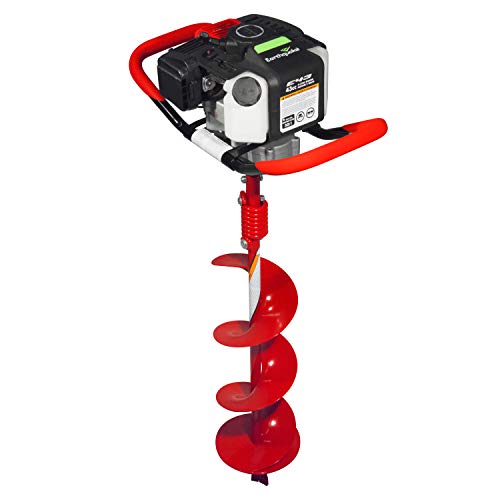
The Earthquake E43 is the reference point for homeowner gas augers, and it earns that position with gearing rather than engine size. Its 43cc Viper two-cycle engine is modest on paper, but a 30:1 transmission trades bit speed for twisting force, producing a published 46.5 ft-lb of torque — enough for one person to work an 8-inch bit through clay that stalls faster-spinning machines. Earthquake, made by Ardisam in Wisconsin, is the largest earth auger specialist, and the parts and support network behind the E43 is a real advantage over the generic gas augers sold under a dozen names.
The listing is built around the powerhead, with bit options at purchase; the common configuration pairs it with an 8-inch bit, and the powerhead also accepts Earthquake’s 4, 6 and 10 inch bits, so the same machine covers mailbox posts, 4×4 fence posts with room for concrete, and planting holes. The standard bit digs about 36 inches deep, and extension shafts take it further for deep frost lines. At roughly 34 pounds with the 8-inch bit fitted, it is the heaviest kind of one-person work: manageable, but you will feel a long fence line by the last hole. A five-year limited warranty backs the powerhead, the longest coverage on this page.
Specs
- Type: gas earth auger powerhead, one-person
- Engine: 43cc Viper 2-cycle (gas and oil mix)
- Transmission: 30:1 gear ratio
- Torque: 46.5 ft-lb (maker figure)
- Bit included: 8 in in the common kit configuration — confirm the bit option on the listing before ordering, as the powerhead is also sold on its own
- Bit sizes supported: 4, 6, 8 and 10 in Earthquake bits
- Max depth: about 36 in with the standard bit, deeper with extension shafts
- Weight: about 34 lb with the 8 in bit
- Warranty: 5-year limited
2. WORX Nitro WG865 — Cordless, With a Real Kickback Brake

The WORX WG865 is the pick that treats kickback as an engineering problem instead of a warning label. Its 40 volt brushless motor (two 20V PowerShare batteries working together) drives an 8-inch bit, and a sensor watches for the sudden load spike of a jammed bit and cuts the motor before the handles can wrench around. That single feature is why this machine, rather than a stronger gas unit, suits solo work in rooty or stony ground where jams are a matter of when, not if. A reverse gear backs the bit out of a hole it has wedged into, which is the other half of jam management.
WORX publishes up to 118 ft-lb (160 Nm) of torque and two no-load speeds, 145 and 220 RPM — the low speed for controlled digging in soil, the high speed for lighter work. Treat the torque figure the way you should treat every maker’s figure here: as a peak claim under the maker’s own conditions, not a laboratory comparison against the gas picks. The kit form includes the 8-inch bit, two 20V 4.0Ah batteries and a charger, and WORX rates the pair of batteries at up to 38 holes per charge in suitable soil. Bare, the tool weighs about 27 pounds, roughly 30 with both batteries fitted. A tool-only version (WG865.9) also exists, so check which configuration the listing describes before assuming batteries are in the box.
Specs
- Type: cordless earth auger, one-person
- Motor: 40V brushless (2 x 20V PowerShare)
- Torque: up to 118 ft-lb / 160 Nm (maker figure)
- Speeds: 2 speeds plus reverse, 145 / 220 RPM no-load
- Bit included: 8 in
- Batteries: kit includes two 20V 4.0Ah batteries and charger; a tool-only version is also sold — check the listing variant
- Runtime claim: up to 38 holes per charge (maker figure, soil-dependent)
- Kickback protection: sensor cuts the motor when the bit jams
- Weight: about 27 lb bare, about 30 lb with batteries
3. Makita XGD01Z — The Pro Cordless, Sold as a Bare Powerhead

The Makita XGD01Z is the professional entry: a 36 volt brushless powerhead running on two 18V LXT batteries, built for landscapers and fencing crews who already own a shelf of Makita packs. It is also the pick where the box contents need stating plainly. The XGD01Z is sold as a tool only — no batteries, no charger, and no auger bit in the box. Makita’s earth auger bits are separate purchases, in sizes up to the machine’s 8-inch maximum hole diameter. Budget for the complete working tool, not the powerhead alone, before comparing it with the kits elsewhere on this page.
What the money buys is depth and platform. Makita rates the auger for holes up to 41 inches deep with an extension shaft fitted, the deepest figure here, which matters wherever frost lines run three feet or more. The brushless motor and two-speed, reversible drive put it in the same working class as the WORX for solo operation, and for a crew already invested in 18V LXT batteries the marginal cost of adding this powerhead is lower than starting a second battery platform. Makita does not publish a single headline torque figure for this model in its listing data, so the Specs block says so rather than borrowing a number from a different Makita auger.
Specs
- Type: cordless earth auger powerhead, one-person
- Motor: 36V brushless (2 x 18V LXT batteries)
- Torque: not published as a single headline figure in the maker’s listing data
- Bit included: none — tool only; bits, batteries and charger are sold separately
- Bit sizes supported: Makita earth auger bits up to 8 in diameter
- Max depth: up to 41 in with extension shaft
- Drive: variable speed with reverse
- Weight: varies with the two 18V packs fitted; plan on a two-battery tool in the same carry class as the other cordless pick
4. XtremepowerUS 1500W — Corded Power Without Fuel or Batteries
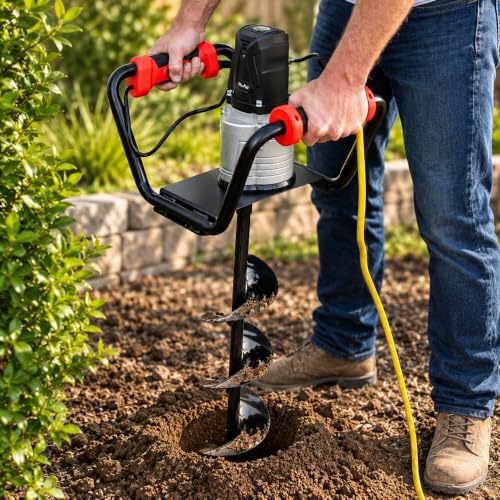
The XtremepowerUS 1500W is the straightforward answer for a yard where an outlet is always within cord reach. Its 1,500 watt corded motor draws 10.9 amps on a standard 110V circuit, needs no fuel mixing and no charging, and starts every time with the trigger. The maker publishes 90 ft-lb of torque and a 270 RPM rated speed, and the included 6-inch bit on a 3/4-inch shaft digs about 31.5 inches deep; XtremepowerUS sells larger and smaller bits on the same shaft fitting, so the machine is not limited to the one size in the box. A reverse function helps back a stuck bit out, and a safety lock keeps the trigger from being squeezed accidentally in transit.
The honest limitation is kickback. Unlike the WORX above, this auger has no jam sensor and no cutoff: when the bit catches, the full reaction arrives at the handles instantly, and at 90 ft-lb of published torque that is enough to sprain a wrist if your stance is lazy. Work it with a wide stance, both hands committed, and a finger discipline about the trigger in rocky soil. You will also need a heavy outdoor extension cord — a long, thin cord starves the motor and overheats — and the cord dictates how far from the house your fence line can run. Within those limits, at about 29 pounds it is a simple, strong digger for posts and planting near the house.
Specs
- Type: corded electric earth auger, one-person
- Motor: 1500W, 110V / 60Hz, 10.9A (1.6 HP class)
- Torque: 90 ft-lb (maker figure)
- Speed: 270 RPM (maker figure)
- Bit included: 6 in, on a 3/4 in shaft
- Bit sizes supported: other XtremepowerUS bits on the same 3/4 in shaft fitting
- Max depth: about 31.5 in with the included bit
- Kickback protection: none — reverse function and trigger safety lock only
- Weight: about 29 lb
5. DC HOUSE D52-F — The Big-Bit Gas Kit

The DC HOUSE D52-F competes on completeness. Its 52cc two-stroke engine is the largest here, and the box carries what the other listings make you buy separately: two auger bits, in 6-inch and 10-inch sizes, plus three extension rods for boring past standard bit depth. That makes it the natural pick for mixed work — 6-inch holes for posts in the morning, 10-inch holes for shrubs and small trees after lunch — and the engine meets federal emission rules and starts readily. The powerhead itself is light for a gas unit, at about 21 pounds before a bit is fitted.
The trade-off is build quality, and it deserves plain words. This is the generic end of the gas auger market, where several brands sell closely related machines, and the frame is the known weak point: handle welds on this class of auger have a documented habit of cracking after a few dozen hard holes. Inspect the welds and handle mounts before each job, and treat the kit as a strong-value tool for a season of projects rather than a decade-long investment like the Earthquake. Within that expectation, no other pick here puts two bits and extensions in the box.
Specs
- Type: gas earth auger kit, one-person
- Engine: 52cc 2-cycle (gas and oil mix), EPA compliant
- Torque: not published as a single headline figure in the maker’s listing data
- Bits included: 6 in and 10 in
- Extensions: 3 extension rods included
- Max depth: standard bit depth plus the three extension rods
- Weight: about 21 lb for the powerhead
- Known weak point: handle and frame welds — inspect before each job
How to Choose: Size the Bit to the Post, the Depth to the Frost Line
Bit diameter is about clearance, not just the post. A 4×4 post is 3.5 inches square, and a 6-inch hole leaves barely an inch of room per side for concrete or gravel — workable for a mailbox, tight for a fence post you want to set plumb in concrete. An 8-inch bit is the general-purpose choice for 4×4 posts, and 10 to 12 inch bits are for 6×6 posts, gate posts and planting. Every step up in diameter multiplies the torque the soil can throw back at you, which is why the widest bits are where one-person operation stops being sensible in hard ground.
Depth is set by your frost line, not by preference. A post whose footing sits above the frost depth will be heaved out of line by freezing soil within a few winters. Frost depth runs from a few inches in the deep South to three feet and more in the northern states, and your local building department publishes the figure for fences and decks. Match the machine to it: a standard bit on most of these augers digs roughly 31 to 36 inches, and anything deeper needs the extension shafts that the DC HOUSE bundles and the others sell as accessories.
Finally, count your holes. Three holes for a mailbox and two trees is manual-digger or drill-auger territory, and no powerhead earns its storage space. A fence line of thirty holes, a deck’s worth of footings or a windbreak row is where a powered auger pays for itself in a single weekend — and where the difference between a jam-sensing cordless tool and a strong, dumb gas or corded one becomes a safety decision rather than a convenience.
Kickback: The Spec That Isn’t on the Box
Every figure on a spec sheet describes what the auger does to the soil. Kickback is what the soil does back. The bit is a screw: when its edge wedges against a root, a buried rock or a lump of concrete rubble, the rotation has to go somewhere, and it goes into the powerhead and the handles you are holding. With 8-inch and wider bits in stony or root-filled ground this happens without warning, several times a day, and it is the main way earth augers injure people — wrenched wrists, strained shoulders, and operators knocked off balance.
Three things reduce the risk. The first is electronics: the WORX WG865 senses a jam and cuts its motor, the same approach as the auger brake on professional dealer machines, and it is the strongest argument for cordless in bad ground. The second is reverse: a bit that can be backed out under power does not have to be wrestled out by hand, and four of the five picks here offer it. The third is technique, and it applies to every machine on this page: call 811 before you dig so buried lines are marked, keep a wide stance with both hands on the grips, lift the bit every foot or so to clear loose soil instead of forcing depth, and if the bit locks solid, let go of the handles rather than fighting the machine for them. In genuinely rocky soil, drop a bit size or bring a second person for the wide holes.
A note on safety records: each pick on this page was checked against the U.S. Consumer Product Safety Commission’s recall database before inclusion, and none of the five models appears in it. The auger recalls on record involve other brands and older equipment, which is worth knowing mainly as a reminder that the category’s real risks are the everyday ones above, managed with stance, patience and the right bit.
The Short Version
Choose the Earthquake E43 for a gas auger with a real warranty and parts support behind it. Choose the WORX WG865 if you dig alone in rooty ground and want the machine itself watching for jams. Choose the Makita XGD01Z if your batteries are already Makita and your frost line runs deep — remembering it arrives as a bare powerhead. Choose the XtremepowerUS 1500W for strong, simple digging within extension-cord reach of the house, and respect its lack of a kickback cutoff. Choose the DC HOUSE D52-F when the job mixes post holes and planting holes and you want both bit sizes and the extensions in one box, with eyes open about the frame.
More from Amazon
Programs that pair well with the guide above. Offers and eligibility are set by Amazon and may change.
Free shipping on eligible items, Prime Video and more. Eligible new members can start with a free trial.
Start a Prime free trialA Prime membership for ages 18-24 with a trial period. Eligibility is set by Amazon.
See Prime for Young AdultsAudiobooks and podcasts to listen to on the go. Eligible new members can start with a free trial.
Try Audible freeAd-free music streaming. Eligible new subscribers can start with a free trial.
Try Music Unlimited freeAs an Amazon Associate we earn from qualifying purchases.










Write Your Review
No reviews yet. Be the first to share your experience!