

Key takeaways
- Five gun cleaning rods compared on material, length and thread standard: carbon fiber, coated steel and stainless picks for rifles, shotguns and pistols.
As an Amazon Associate we earn from qualifying purchases.
A cleaning rod is the one tool that travels the full length of the bore on every pass, which makes it the tool most capable of damaging the barrel it is meant to protect. The critical point is the muzzle crown — the chamfered edge where the rifling ends. That edge is the last thing the bullet touches as it leaves, and a nick or uneven wear there shows up directly in accuracy. A rod that is harder than the barrel, bent, jointed loosely, or carrying embedded grit can wear that crown and score the rifling lands a little more on every cleaning session.
That is why rod buying is mostly a materials decision. The shaft should be softer than barrel steel, coated against it, or made of a material that cannot pick up abrasive particles in the first place. Stiffness matters too: a rod that flexes under a tight patch bows sideways into the rifling instead of pushing straight. Pull-through systems such as bore snakes have their place for a quick field pass, but they cannot scrub with a brush or push a tight patch, so the rigid rod remains the deep-cleaning tool. The five picks below cover the main honest options — carbon fiber, nylon-coated steel, micro-polished stainless steel, coated steel, and a traditional sectional aluminum pistol rod — with the length, caliber range and thread standard of each stated as its listing gives them.
Affiliate Disclosure: This article contains affiliate links. If you buy a product through a link on this page, the site may earn a commission at no extra cost to you.
1. TuffMan Tools One Piece Carbon Fiber Cleaning Rod, 36″
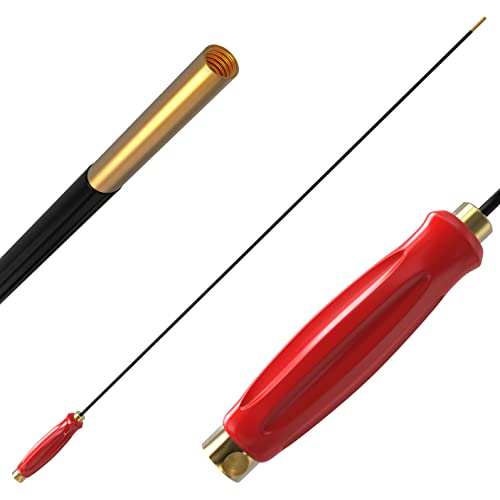
The TuffMan Tools rod is the carbon fiber argument in its simplest form. Carbon fiber cannot embed abrasive particles the way a coated rod can once its coating is scuffed, it cannot scratch rifling the way bare steel can, and when it is flexed it returns to straight instead of taking a permanent bend the way a metal shaft does. Those three properties map exactly onto the failure modes of cheaper rods.
This listing is a one-piece 36-inch rod rated by its maker for .22 to .50 caliber rifles and shotguns, a span that covers the great majority of rifle bores plus smoothbore use. The handle rotates, so a brush or jag can follow the rifling instead of being dragged across the lands, and a hanging hole in the handle covers storage. The listing’s included-components field names a brush alongside the rod. The honest limits are the ones the format imposes: a rigid 36-inch one-piece rod is a bench tool that travels awkwardly, and a single rod diameter stretched across a .22-to-.50 claim is a compromise at both ends of that range — snug in the small bores, loose in the large ones.
Specs
- Brand: TuffMan Tools
- Material: Carbon fiber
- Length: 36 in
- Construction: One piece
- Caliber range: .22 to .50 caliber rifles and shotguns (listing)
- Handle: Rotating handle with hanging hole
- Included components: Brush and handle (listing)
- Package weight: 0.45 kg (listing figure)
- Best for: One carbon rod across several rifle calibers
2. J. Dewey 22C-36 Nylon Coated Cleaning Rod

J. Dewey rods are the long-standing benchrest answer to the same problem: a spring steel core for stiffness, wrapped in a nylon coating so that what actually slides along the rifling is polymer rather than metal. The 22C-36 is the 36-inch version for .22 to .26 caliber bores, with a coated outside diameter of 0.205 to 0.210 inches — sized to pass a .22 bore with working clearance rather than sloppy play. The handle turns on ball bearings, so the rod rotates freely and a brush tracks the twist of the rifling on both the push and the pull.
Two details on this listing deserve attention before buying. First, the thread: Dewey’s .22-caliber rods use a #8-36 male thread, which is not the common #8-32 accessory standard, so brushes and jags must be Dewey-threaded or used through an adapter — the rod ships with a brass jag and a brush adapter to start from. Second, a coated rod’s protection lasts exactly as long as its coating. A cut, worn or peeling patch of nylon exposes the steel core and gives grit a place to lodge, so the coating should be inspected the way a shooter inspects a bore.
Specs
- Brand: J. Dewey Rods
- Model: 22C-36
- Material: Nylon-coated spring steel
- Length: 36 in
- Caliber range: .22 to .26 caliber
- Coated diameter: 0.205–0.210 in OD
- Thread: #8-36 male
- Handle: Ball-bearing handle
- Includes: Brass jag and brush adapter
- Best for: .22-caliber and small-centerfire precision rifles
3. Pro-Shot 1PS-26-22/26 Micro-Polished Stainless Steel Rod

Pro-Shot takes the opposite route from coating: leave the steel bare, but finish it so highly that there is nothing for grit to hold onto. The 1PS-26-22/26 is a one-piece stainless rod whose surface is micro-polished to a dense, mirror-like finish, on the maker’s reasoning that a polished rod does not pick up and carry abrasive fouling through the bore. Pro-Shot also states that its rod steel is made to a specification less hard than barrel steel, which addresses the hardness objection to bare steel directly. The full-size handle rotates so the brush can spiral with the rifling, and the rod arrives in a reusable storage tube with a brass patch holder included.
The defining number is the length: 26 inches. This is a short-rifle and carbine rod for .22 to .26 caliber bores, and it is the wrong tool for a long barrel — the working rule is that the rod must clear the barrel, the action and a bore guide with travel to spare, and 26 inches runs out quickly on a full-length rifle. For carbines, rimfire rifles and short-barreled .223-class rifles, though, the shorter shaft is stiffer and easier to keep straight than a long rod doing the same job, and the standard #8-32 thread takes the common run of brushes, jags and mops without adapters.
Specs
- Brand: Pro-Shot Products
- Model: 1PS-26-22/26
- Material: Micro-polished stainless steel
- Length: 26 in
- Caliber range: .22 to .26 caliber
- Thread: #8-32
- Handle: Full-size rotating handle
- Includes: Brass patch holder
- Storage: Reusable plastic tube
- Weight: 3.2 oz (listing figure)
- Origin: Made in USA
- Best for: Carbines and short .22 to .26 caliber rifles
4. Birchwood Casey Coated Cleaning Rod, 33″ (BC-41405)

The Birchwood Casey rod is the generalist of this group: a one-piece coated steel rod of 33 inches, listed for .22 caliber and up and positioned by the maker for rifles and shotguns from compact carbines to longer sporting guns. The coating is the working idea — a synthetic layer over the steel core that acts as a sacrificial barrier, keeping metal off the rifling while the core supplies the stiffness a push rod needs. The handle is free-spinning, so the rod can rotate as it travels rather than being twisted by hand, and the tip carries the standard 8-32 thread.
Thirty-three inches is a deliberate middle length. It reaches through most rifle barrels from the breech with room for the handle to work, covers shotgun barrels without the unwieldiness of a 44-inch rod, and stays short enough to store across a bench or in a hard case lid. The same coating discipline described for the Dewey applies here: the barrier only protects while it is intact, so a nicked or worn coating is a reason to retire or relegate the rod, not to keep pushing it through a good barrel.
Specs
- Brand: Birchwood Casey
- Model: BC-41405
- Material: Coated steel (synthetic coating over steel core)
- Length: 33 in
- Caliber range: .22 caliber and up
- Thread: 8-32
- Construction: One piece
- Handle: Free-spinning handle
- Best for: A single coated rod for mixed rifles and shotguns
5. Hoppe’s No. 9 Cleaning Kit with Aluminum Rod, .38/.357 and 9mm Pistol (PCO38)
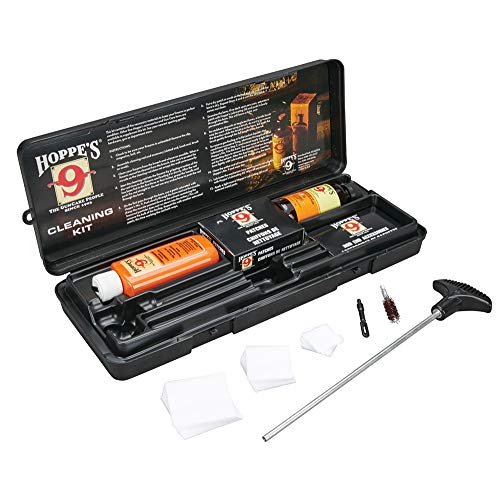
The Hoppe’s kit represents the traditional end of rod design, and it earns its place here by being the pistol-specific pick. The rod is aluminum — softer than barrel steel, which is the classic reason kit rods are made from it — and it is sectional, breaking down to live in the kit’s plastic box alongside a bore brush, two rod end pieces, and the consumables a handgun owner needs to start immediately: a bottle of No. 9 bore cleaner and a bottle of lubricating oil. The kit is built around .38 and .357 caliber and 9mm handguns, the most common service-pistol bores.
The honest framing of any sectional aluminum rod is that its joints are its weakness. A joint that is not fully seated can sit slightly off-axis and let the rod’s edge track against the bore, and soft aluminum can embed grit if it is dragged across a dirty bench and not wiped. For short pistol barrels the exposure is small — a few inches of travel, cleaned from the muzzle or breech with the barrel often removed — and the convenience of a complete, boxed kit is real. Wipe the rod sections before assembly, seat the joints fully, and this remains what it has been for generations of handgun shooters: the simple, complete way to clean a pistol.
Specs
- Brand: Hoppe’s
- Model: PCO38
- Rod: Aluminum cleaning rod with handle, sectional
- Firearm type: Pistol
- Caliber range: .38/.357 caliber and 9mm
- Includes: Bore brush, two rod end pieces, 2 oz No. 9 bore cleaner, 2.25 oz lubricating oil
- Case: Plastic box (packaging may vary)
- Best for: A complete starter kit for common pistol calibers
How to Choose
Start with material, because material decides bore safety. Carbon fiber cannot scratch rifling and cannot embed grit, and it springs back straight after flexing; its weakness is that it can be damaged by crushing or a hard sideways blow. Coated steel is stiff and precise, but the coating is a consumable surface — once it is cut or worn through, the rod should be retired. Micro-polished stainless avoids the coating problem with a finish that resists picking up grit, and better makers spec the steel softer than a barrel. Brass is soft and traditional but flexes under load. Bare unpolished steel and jointed aluminum sit at the risky end: both demand a straight shaft, clean surfaces and careful alignment to be used without cost to the bore.
Choose one-piece unless portability forces sections. A one-piece rod has no joint to misalign, flex or separate mid-bore, and it gives consistent feel along the whole stroke. Sectional rods exist because a 36-inch rod does not fit in a range bag or a kit box. If a sectional rod is the choice, seat every joint fully and wipe each section before assembly, because the joint faces are where grit collects.
Match length and diameter to the barrel. The rod must be long enough to push a patch fully out of the muzzle while the handle still has travel — barrel length plus action or bore-guide length plus working room. A rod that is too short gets pulled back through a fouled muzzle; a rod far longer than needed is harder to keep straight. Diameter follows caliber: the rod should be the largest that passes the bore freely, since an undersized rod bows against the rifling under pressure.
Insist on a rotating handle for rifled barrels. A handle that spins on bearings lets the brush and jag follow the rifling’s twist instead of being forced straight across the lands. It is the single feature that most reduces both effort and bore contact, and every rifle rod above includes some form of it.
Check the thread standard before buying accessories. Most rifle and pistol accessories use 8-32 thread, but the exceptions are common enough to matter: Dewey’s .22 rods use 8-36, small .17 and .20 caliber rods often use 5-40, and shotgun accessories use the larger 5/16-27 thread. An accessory that almost starts on the wrong thread will cross-thread and ruin both parts if it is forced.
Use a bore guide where the action allows one. A guide centers the rod in the chamber, keeps it off the crown and throat, and keeps solvent out of the action and trigger. It is the cheapest accuracy insurance in the cleaning kit, and it makes every rod in this roundup safer to use.
FAQ
Can a cleaning rod actually damage a barrel?
Yes. The damage is mechanical and cumulative: a hard, bent or grit-carrying rod rubs the muzzle crown and the tops of the rifling lands on every pass. Because the crown is the last surface the bullet touches, uneven wear there degrades accuracy out of proportion to how small the damage looks. A bore-safe material, a straight shaft, a rotating handle and cleaning from the breech end where the firearm allows it are the standard defenses.
Is carbon fiber better than coated steel?
They solve the same problem differently. Carbon fiber cannot scratch the bore and cannot embed particles, and it returns to straight after bending, but it costs more and can be hurt by crushing. Coated steel is stiff, precise and widely available in exact caliber sizes, but its protection ends where the coating is damaged. Either is a sound choice; the condition of the individual rod matters more than the category.
What length cleaning rod should you buy?
Long enough that a patch exits the muzzle while the handle still has room to move: barrel length, plus the length of the action or bore guide, plus a few inches of working travel. For most rifles that lands between 36 and 44 inches; carbines and short rifles are served by rods in the mid-20s to mid-30s, and pistols need only enough rod to clear the barrel and frame with the handle outside.
Why do cleaning rods use different threads?
Because the accessories grew up by caliber class rather than by one standard. Rifle and pistol accessories settled on 8-32, small-bore .17 and .20 rods use the finer 5-40, shotgun gear uses the heavier 5/16-27, and a few makers — Dewey’s .22 rods at 8-36 are the common example — use their own thread. The practical rule is to read the rod’s stated thread before ordering brushes and jags, and never force a fitting that does not start by hand.
Conclusion
The right cleaning rod is the one whose material cannot hurt the bore, whose length matches the barrel, and whose thread matches the accessories already on the bench. The TuffMan Tools carbon fiber rod covers the widest span — .22 to .50 caliber long guns — with the bore safety carbon fiber gives. The J. Dewey 22C-36 is the precision pick for .22 to .26 caliber rifles, provided its 8-36 thread is planned for. The Pro-Shot 1PS-26-22/26 brings micro-polished stainless and a standard 8-32 thread to carbines and short rifles. The Birchwood Casey 33-inch coated rod is the single-rod answer for a mixed rack of rifles and shotguns. And the Hoppe’s kit covers pistols the traditional way, with a soft aluminum rod and everything needed to use it in the box. Whichever one fits, the discipline is the same: keep the rod straight, keep it clean, and keep it off the crown.
More from Amazon
Programs that pair well with the guide above. Offers and eligibility are set by Amazon and may change.
Free shipping on eligible items, Prime Video and more. Eligible new members can start with a free trial.
Start a Prime free trialA Prime membership for ages 18-24 with a trial period. Eligibility is set by Amazon.
See Prime for Young AdultsAudiobooks and podcasts to listen to on the go. Eligible new members can start with a free trial.
Try Audible freeAd-free music streaming. Eligible new subscribers can start with a free trial.
Try Music Unlimited freeAs an Amazon Associate we earn from qualifying purchases.










Write Your Review
No reviews yet. Be the first to share your experience!