

Key takeaways
- Five fishing line cutters that shear braid instead of crushing it: serrated snips, micro scissors and shears compared on blades, line classes and carry.
As an Amazon Associate we earn from qualifying purchases.
Every knot you tie ends the same way: with a tag end that has to come off. Do that job badly and the cost shows up immediately. A cutter that crushes braided line instead of shearing it leaves a frayed, fuzzy tag that will not thread back through a hook eye, will not slide cleanly through a guide, and frays further every time it brushes a rod blank. Monofilament and fluorocarbon are forgiving — almost any sharp edge trims them — but braid is the real test of a line cutter, because its slippery polyethylene fibers slide sideways on smooth blades and squash flat instead of parting.
That is why purpose-built fishing line cutters almost always use a serrated or micro-serrated edge. The tiny teeth grip the braid so the fibers cannot skate along the blade, and the cut happens by shearing rather than squeezing. The five tools below cover the main forms the category takes: a retractable snip that lives on a vest or belt loop, a pocket-size micro scissor, a multi-function shear with rigging extras built in, a two-scissor kit that pairs a braid scissor with bait shears, and a full-size serrated shear for heavy line and leader work. Each one states its blade type and the line classes it is built for, because those two facts — not the handle color — decide whether it will still be cutting cleanly at the end of the season.
One caution applies to every pick: teeth and nail clippers are emergency substitutes, not tools. Teeth chip, and nail clippers are shaped to crush a curved nail, which is exactly the crushing action that ruins a braid tag. A dedicated cutter costs little space in a tackle bag and earns it back the first time a re-tie has to happen fast, in low light, with wet hands.
Affiliate Disclosure: This article contains affiliate links. If you buy a product through a link on this page, the site may earn a commission at no extra cost to you.
1. Boomerang Tool Company Long SNIP Fishing Line Cutter (BTC243)
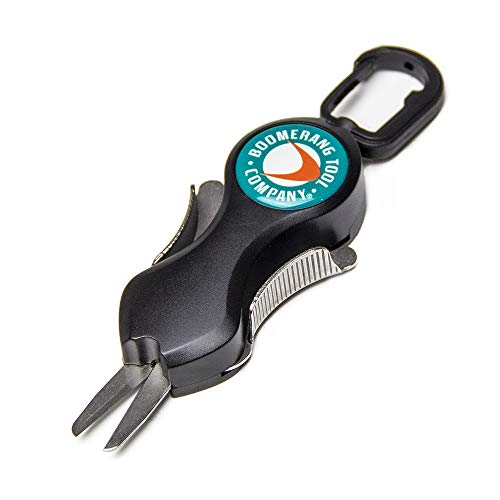
The Long SNIP is the tethered snip taken one step further: the same retractable format as the original Boomerang cutter, but with longer blades that give more cutting edge for anglers who trim heavier line and leaders rather than only fly tippets. The blades are 420 stainless steel with a serrated edge, the combination that grips braid instead of letting it slide, and Boomerang rates the tool for clean cuts through braid, monofilament and fluorocarbon up to 50 lb test.
The defining feature is the carry system. A 36-inch retractable tether with a carabiner clips to a vest, belt loop or tackle bag, so the snip is pulled out, used, and released — it reels itself back to the same spot every time. A slide lock keeps the blades closed while the tool hangs, so the serrated edge is not exposed against clothing or a boat seat. The honest trade-off of the format is built into that tether: retractors are wear items, and a tether mechanism that gets sand and salt inside it will eventually retract weakly or fail. Boomerang’s own care guidance — a freshwater rinse after use and an occasional anti-rust treatment — is worth following if the snip lives in a saltwater kit. For freshwater and light inshore work, though, the always-at-hand design solves the single most common cutter problem, which is the tool being somewhere else when a knot needs trimming.
Specs
- Type: Retractable line snip
- Blades: 420 stainless steel, serrated
- Line classes: Braid, monofilament and fluorocarbon up to 50 lb (maker figure)
- Tether: 36 in retractable, with carabiner
- Blade lock: Slide lock keeps blades closed
- Model: BTC243
- Best for: Vest, belt and kayak carry; frequent re-tying
2. Cuda 3-Inch Micro Scissors (18826)

The Cuda Micro Scissors are the tackle-box staple of this group: a three-inch scissor small enough to live in a shirt pocket, a fly box lid or the corner of a tray, yet built around blades meant specifically for braided line. The blades are titanium-bonded stainless steel, a surface treatment Cuda rates at three times the hardness of untreated steel, and both blades carry micro-serrations. That dual-serrated layout matters more than the coating: with teeth on both edges, the line is gripped from both sides and cannot roll or slide as the handles close, which is what produces a square, unfrayed end on light braid and fluorocarbon.
The handles are oversized non-slip bows relative to the tool’s size, so cold or wet fingers still get a usable grip, and at roughly half an ounce the scissors add nothing noticeable to a pocket or pack. The limits are the ones the size implies. A three-inch scissor has short blades and modest leverage, so it is a trimming tool — tag ends, light leaders, tippet-class material — rather than the tool for cutting down heavy saltwater braid or wire. Anglers who rig big-game tackle will want one of the full-size shears below for that work and keep the Cuda for the close, precise cuts it is shaped for.
Specs
- Length: 3 in
- Blades: Titanium-bonded stainless steel, dual micro-serrated edges
- Line classes: Braid, monofilament and fluorocarbon
- Handles: Oversized non-slip bows
- Weight: 0.5 oz (listing figure)
- Model: 18826
- Best for: Tag-end trimming, light leaders, pocket carry
3. BUBBA Medium Shears

The BUBBA Medium Shears take the opposite approach to the micro tools: instead of doing one job in the smallest possible package, they fold the small rigging jobs around the scissors into a single multi-tool. The micro-serrated blades cut monofilament, fluorocarbon and braided line, and the titanium-bonded blade finish is there for the saltwater environment this brand builds for. Built into the same tool are a hook eye cleaner for clearing paint and epoxy out of jig and hook eyes, a hook sharpener for touching up a dulled point at the rail, and a descaler for the catch itself.
That combination suits boat anglers, who rig, re-rig and process fish in the same small workspace and benefit from not hunting through a drawer for three separate tools. The non-slip grip follows the brand’s familiar handle design, with a lanyard loop for a wrist cord over the side of the boat. The trade-off is size and specialization: the shears are bulkier than a dedicated snip, they will not ride comfortably on a vest, and a multi-tool’s blades are a compromise next to a purpose-built braid scissor of the same size. Choose them when the extras will genuinely be used — the eye cleaner and sharpener earn their keep on painted jig heads especially — rather than as a pure line cutter.
Specs
- Type: Multi-function fishing shears
- Blades: Micro-serrated, titanium-bonded finish
- Line classes: Braid, monofilament and fluorocarbon
- Built-in tools: Hook eye cleaner, hook sharpener, descaler
- Handle: Non-slip grip with lanyard loop
- Model: 1099914
- Best for: Boat rigging stations, saltwater use
4. KastKing Paradox 9-Inch and 6-Inch Fishing Scissors

The Paradox set pairs the two scissor sizes a rigging bench actually uses. The six-inch scissors are the line tool of the pair: 420 stainless steel blades, serrated to cut braided, monofilament and fluorocarbon line, with a non-slip rubber handle and a custom molded sheath that carries a built-in hook sharpener. The nine-inch tool is a bait shear, sized for cutting bait and heavier material, and it adds its own sheath with a carabiner plus small extras such as a bottle opener and bait tuner.
For line cutting alone, the six-inch Paradox is the relevant half of the kit, and it follows the pattern that works for braid: serrations to hold the fibers, stainless construction for corrosion resistance, and a sheath so the edge is protected in a bag rather than dulling against other tackle. Buying the set makes sense for anglers who cut bait as well as line — shore and boat anglers preparing natural baits will use both tools weekly. Anglers who never touch bait are paying for a second tool they will not use, and one of the single-purpose picks above or below will suit them better. That is the honest framing of any combo: the value is real only if both halves have a job.
Specs
- Contents: 6 in braid scissors and 9 in bait shears
- Scissor blades: 420 stainless steel, serrated
- Line classes: Braid, monofilament and fluorocarbon
- Sheath: Molded sheath with built-in hook sharpener (6 in); sheath with carabiner (9 in)
- Extras: Bottle opener and bait tuner on the bait shears
- Handle: Non-slip rubber
- Best for: Anglers who cut both line and bait
5. SAMSFX 6.5-Inch Fishing Braid Line Scissors (SFA558S)

The SAMSFX shears are the full-size, heavy-duty option: six and a half inches of stainless steel with a titanium coating over the blades for corrosion resistance, and a dual-serrated blade profile — serrations along the cutting edges that bite into braid from both sides as the handles close. SAMSFX rates the shears for braided, monofilament and fluorocarbon line, and the same edges are built to handle the heavier trimming around a rigging bench, including leader material and rig sleeves that would overwhelm a micro scissor.
The handles are non-slip Kraton with enlarged finger holes, a detail that matters when the shears are used with gloves or with hands wet from handling fish, and the package includes the two carry items a tool this size needs: a hard sheath that locks over the blades and a coiled lanyard to keep the shears attached to a belt or bag. The size is the compromise. At six and a half inches these are tackle-bag or boat tools, not vest tools, and trimming a fine tippet tag with them is clumsier than with the snips above. Within their intended role — a primary shear for braid and leaders that stays sharp and resists rust — the specification is complete and honestly matched to the job.
Specs
- Length: 6.5 in
- Blades: Stainless steel with titanium coating, dual-serrated
- Line classes: Braid, monofilament and fluorocarbon; leader material and rig sleeves
- Handle: Non-slip Kraton, enlarged finger holes
- Included: Hard sheath and coiled lanyard
- Model: SFA558S
- Best for: Heavy braid and leader work, tackle-bag carry
How to Choose
Start with the blade, not the brand. Braid is the deciding test for any fishing line cutter. Its fibers are strong, thin and slippery, so a smooth-edged scissor tends to push them aside and crush them flat, leaving the frayed tag described in the introduction. A serrated or micro-serrated edge grips the fibers and shears them. If a cutter’s listing does not mention serrations, assume it is a mono and fluoro tool and treat braid claims with skepticism.
Match the tool to the line class. Snips and micro scissors are built for tag ends and light-to-medium line; the Boomerang above is maker-rated to 50 lb braid, which covers most freshwater and inshore rigging. Heavy offshore braid, thick fluorocarbon leaders and wire are shear work — longer blades and real leverage, as on the SAMSFX. Cutting wire with a braid scissor will notch the edge and ruin it for line, so keep a separate tool for wire if you rig with it.
Decide how the tool will be carried. A cutter that is not within reach does not get used, and anglers fall back on teeth and pliers. Tethered snips suit anglers who re-tie constantly while wading or kayaking. Sheathed scissors suit tackle bags and boats. Whichever form you pick, remember that retractor mechanisms and lanyard coils are the parts that wear out first — a tethered tool should be rinsed and checked like any other tackle.
Plan for corrosion honestly. Stainless steel resists rust; it does not ignore it, and coatings such as titanium bonding or titanium finishes add a harder, more resistant surface. Any cutter used in saltwater should be rinsed in fresh water and dried, including the pivot, where crevice corrosion starts. A dull or corroded pivot makes even good blades cut badly, because the edges no longer meet squarely.
FAQ
Why do ordinary scissors fray braided line?
Braid is made of many fine, slick fibers with almost no stiffness. A smooth scissor edge lets those fibers slide along the blade and bunch up, so the cut is partly a crush and partly a tear. Serrated blades trap the fibers in their teeth and shear them in place, which is why braid-specific cutters almost always have serrated or micro-serrated edges.
Can one cutter handle braid, mono and fluorocarbon?
Yes — every tool in this roundup is listed for all three. Monofilament and fluorocarbon are single-strand lines and cut easily on any sharp edge. The differences between cutters show up on braid, and on how heavy a line the tool’s size and leverage can manage, not on whether mono will cut.
Are tethered snips better than scissors?
They are better at being present. A snip on a retractor is always in the same place, which suits anglers who trim tag ends dozens of times a day. Scissors give a longer edge, more leverage and a cleaner cut on heavy line. Many anglers carry both: the snip for tags, the shears for rigging work at the bench or in the boat.
How should line cutters be maintained?
Rinse them in fresh water after use — always after saltwater — dry them fully, and work a drop of oil into the pivot occasionally. Store scissors in their sheath so the edges are not dulled by contact with other tackle, and retire or sharpen a cutter once it starts folding braid instead of cutting it; a fraying cutter is telling you the edge or the pivot is done.
Conclusion
The right fishing line cutter is the one whose blade matches your line and whose carry style matches your fishing. For a cutter that is always clipped and ready, the Boomerang Long SNIP’s serrated 420 stainless blades and retractable tether are the practical pick. For precise trimming in the smallest package, the Cuda Micro Scissors bring dual-serrated, titanium-bonded blades to a three-inch tool. The BUBBA Medium Shears suit boat anglers who will use the eye cleaner, sharpener and descaler alongside the blades. The KastKing Paradox set covers line and bait in one purchase, with the six-inch serrated scissor doing the line work. And for heavy braid and leader material, the SAMSFX shears offer full-size leverage, dual serrations and a corrosion-resistant coating. Whichever you choose, judge it by the braid test: a clean, square tag end that threads a hook eye on the first try.
More from Amazon
Programs that pair well with the guide above. Offers and eligibility are set by Amazon and may change.
Free shipping on eligible items, Prime Video and more. Eligible new members can start with a free trial.
Start a Prime free trialA Prime membership for ages 18-24 with a trial period. Eligibility is set by Amazon.
See Prime for Young AdultsAudiobooks and podcasts to listen to on the go. Eligible new members can start with a free trial.
Try Audible freeAd-free music streaming. Eligible new subscribers can start with a free trial.
Try Music Unlimited freeAs an Amazon Associate we earn from qualifying purchases.










Write Your Review
No reviews yet. Be the first to share your experience!