

Key takeaways
- Compare the best fishing gaffs for saltwater and big freshwater fish, with hook size, shaft material, length and telescoping specs for five proven picks.
As an Amazon Associate we earn from qualifying purchases.
Affiliate Disclosure: This article contains affiliate links. If you buy through a link on this page, the site may earn a commission at no extra cost to you.
A gaff does one job: it ends the fight at boatside. When a heavy fish is played out at the surface but still too strong, too toothy, or too valuable on the table to risk on a leader grab, a gaff hook placed behind the head or through the lower jaw puts the fish in the boat in one motion. The tool is simple — a large, sharp, barbless hook on a rigid shaft — but the details decide whether it works. Hook gap has to match the fish, shaft length has to match the boat’s freeboard, and the material has to survive salt water and the sideways load of a thrashing fish.
The five gaffs below cover the classes most anglers actually buy: a fixed fiberglass boat gaff, two telescopic mid-length models for boats and piers, a compact floating hand gaff for kayaks and close work, and a long stainless pole for docks and high banks. One class is deliberately absent: flying gaffs, whose detachable heads and rope systems are specialist big-game equipment for marlin-class fish and experienced crews. Every gaff here is a fixed-head tool, and every one is a harvest tool — a gaffed fish is a kept fish, which the buying guidance below treats as the first decision, not an afterthought.
1. Fiblink Fishing Gaff (3 ft)

The Fiblink is the traditional pattern in this roundup: a one-piece fiberglass shaft with a stainless steel hook and a non-slip grip, sold in 3, 5, and 6 ft lengths on the same listing. The 3 ft version covered here is the close-quarters size for low-freeboard boats, where the fish comes to hand quickly and a long pole only gets in the way; the longer versions on the listing serve higher-sided boats without changing the design.
Fiberglass is the right shaft material for this role. It is rigid under a straight lift, shrugs off the knocks a fixed gaff takes in a cockpit, and does not corrode. The hook is a 4-inch stainless pattern, a gap that suits the kingfish, cobia, mahi, and larger striped bass class of fish this size of gaff is aimed at, and the listing pairs it with a protective hook tip for storage. There is no mechanism to fail and nothing to extend: the gaff hangs ready and works the moment it is picked up, which is exactly what a fixed boat gaff is for.
Specs
- Type: Fixed, one-piece
- Length: 3 ft (also sold in 5 ft and 6 ft on the same listing)
- Shaft material: Fiberglass
- Hook: Stainless steel, 4 in gap, protective tip cover
- Grip: Non-slip handle
- Use class: Low-freeboard boats, close-quarters landing
2. SANLIKE SC-128 Telescopic Gaff

The SC-128 is the telescopic answer to the same mid-size job. Its aluminum and stainless steel pole extends to 47.2 inches — just under 4 ft of reach — and collapses to roughly 17 inches, short enough to stow in a hatch, a rod locker, or a pier cart rather than living across the cockpit. At 8.8 ounces it is light enough to swing one-handed while the other hand holds the rod or the leader.
The hook is a single stainless spear point rather than a wide cradle, so placement matters more than it does with a broad-gap gaff: the strike goes in behind the gill plate or into the shoulder of a played-out fish. The telescopic format carries the usual trade — a locking section that must be kept clean and checked before the trip — in exchange for storage that a fixed 4 ft pole cannot match. For center consoles, bay boats, and pier anglers who carry their gear to the rail, that trade is usually the deciding one.
Specs
- Type: Telescopic
- Extended length: 47.2 in
- Collapsed length: About 17.3 in
- Shaft material: Aluminum with stainless steel hook
- Hook: Stainless steel spear point
- Weight: 8.8 oz
- Use class: Boats and piers where storage space is tight
3. SAN LIKE SC-78 Telescopic Hand Gaff

The SC-78 is the compact end of the category: an aluminum alloy hand gaff that telescopes from 11.4 inches out to 24 inches. That is not reach in the boat-gaff sense — it is a control tool for fish that are already at the side of a kayak, a canoe, a low dock, or the bank, where a full-length pole is unusable and a bare hand near hooks and teeth is a bad idea. The stainless hook attaches with an M8 screw thread, the standard fitting shared with many landing-tool heads.
Two details separate it from generic mini gaffs. First, the listing states the gaff floats when extended, which matters in a kayak where anything dropped is usually gone. Second, the hook ships with a protective tip and the handle carries a lanyard, so the point can stay covered until the moment it is needed — important in a seated position with the tool between the angler’s legs. It is sized for inshore and freshwater fish of moderate size: redfish, snook, pike, catfish, and salmon-class fish at close range, not offshore work.
Specs
- Type: Telescopic hand gaff
- Length range: 11.4 to 24 in
- Shaft material: Aluminum alloy
- Hook: Stainless steel, M8 screw fitting, protective tip included
- Buoyancy: Floats when extended (per listing)
- Extras: Wrist lanyard
- Use class: Kayaks, canoes, low docks, bank fishing
4. SANLIKE Telescopic Fish Gaff (Fiberglass)

This second SANLIKE entry reaches the same 47.2 inches as the SC-128 but builds the shaft from fiberglass instead of aluminum, and ships as a two-piece kit with a spare stainless spear hook in the box. The soft EVA handle is the other difference: a full-length foam grip that stays holdable with wet, slimy hands and cushions the strike when the hook goes home.
The spare hook is a practical inclusion rather than a bonus. Gaff points bend on gunwales, dull on bone, and occasionally meet a fish heavier than the hook was built for; a threaded replacement turns a ruined trip into a two-minute repair. At 9.5 ounces the fiberglass build gives up nothing in handling to the aluminum version, and fiberglass tolerates the flexing load of a lifting fish without taking the permanent bend that an overloaded aluminum pole can. The two-piece layout packs down for transport at the cost of one threaded joint to keep snug.
Specs
- Type: Telescopic, two-piece
- Extended length: 47.2 in
- Shaft material: Fiberglass
- Hook: Stainless steel spear hook, spare hook included
- Grip: Soft EVA handle
- Weight: 9.5 oz
- Use class: Boat and pier landing, spear-hook technique
5. Cyfie 6 Feet Extending Pole Gaff
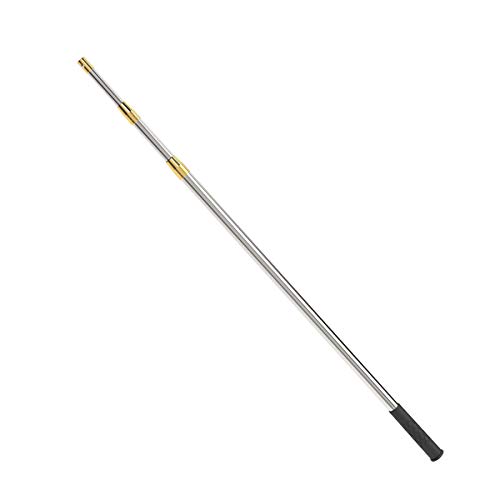
The Cyfie is the reach pick. Its stainless steel telescopic pole extends to a full 6 ft, the length class for fishing off high docks, piers, jetties, and steep banks, and for boats with enough freeboard that a 4 ft gaff leaves the angler leaning over the rail. At 5.6 ounces it is light for its length, and the pole collapses down to roughly 30 inches for transport, judging by the package dimensions on the listing.
The head fitting is an 8 mm screw thread, and the listing is sold as a system: the pole accepts interchangeable gaff and harpoon-style heads on that thread, so one pole can carry a single-point gaff hook for boat work or a multi-prong head for flounder and frog gigging in the shallows. Stainless construction throughout suits salt water, with the standing advice that telescopic sections need a rinse and a dry before storage, since grit in the joints is what shortens the life of every extending pole in this roundup.
Specs
- Type: Telescopic pole with interchangeable heads
- Extended length: 6 ft
- Shaft material: Stainless steel
- Head fitting: 8 mm screw thread (gaff and gig heads interchangeable)
- Weight: 5.6 oz
- Model: Retractable Fishing Gaff, part TP-CEA-1161-1.9
- Use class: Docks, piers, jetties, high banks, gigging
How to Choose a Fishing Gaff
Decide gaff versus net first. A gaff is a harvest tool. The hook wounds the fish, and a gaffed fish should be considered a kept fish, so any fish that might be released — undersized, over the limit, or caught for sport — belongs in a landing net, not on a gaff. Anglers who release most of what they catch do not need a gaff at all; anglers filling a fish box do.
Match length to freeboard, not to fish size. The right length is set by the distance from the angler’s hand to the water. Kayaks and low skiffs work with hand gaffs and 3 ft poles. Typical center consoles want about 4 ft. High docks, piers, and tall hulls need 6 ft or more. A gaff that is too long for the boat is clumsy at close quarters; one that is too short forces a lean over the rail at the worst moment.
Match hook gap to the target fish. The gap — the opening between point and shaft — should be wide enough to take a solid bite behind the head of the largest fish the gaff will meet, without being so wide it skates off smaller fish. Around 3 to 4 inches covers most inshore and mid-size offshore work. Hooks are measured by that opening, not by their overall length.
Pick the shaft material for the job. Fiberglass is rigid, durable, and the standard for fixed boat gaffs. Aluminum is lighter and dominates telescopic designs but can take a permanent bend under a heavy sideways load. Stainless steel poles are strong and corrosion-proof but appear mostly in extending gig-style poles. Carbon fiber exists at the premium end — stiff and very light — but none of the verified listings in this roundup use it.
Fixed versus telescopic is a storage decision. Fixed gaffs are stronger, simpler, and ready instantly; telescopic gaffs stow in a fraction of the space and suit smaller boats, kayaks, and shore anglers who carry gear. If the boat has room to hang a fixed gaff safely, it is the better tool. If it does not, a telescopic model that is actually aboard beats a fixed model left at the dock.
Check the rules before the trip. Gaffing is restricted or prohibited in a number of fisheries. Some states ban gaffs on inland waters entirely or restrict them to specific waters, several salmon fisheries prohibit gaffing, and fish that must be released — protected species, out-of-season fish, fish outside a slot limit — may not legally be gaffed in many places. Regulations differ by state, species, and water, so check the current local rules for the exact fishery before carrying one.
Plan for the point. A gaff hook is a large, exposed point in a moving boat. Models with a tip cover or guard, like the Fiblink and the SC-78 above, should keep it fitted until the gaff is in hand; uncovered gaffs should be stored where nobody steps, sits, or reaches blindly. At boatside, the gaff goes in once, decisively, with the fish led head-first and the crew clear of the swing.
FAQ
What size gaff hook do I need?
For most saltwater and big freshwater use, a hook with a 3 to 4 inch gap is the working range. Smaller gaps suit panfish-sized and inshore fish at close range; larger gaps are for thick-bodied offshore fish. Judge by the gap (the opening), not the hook’s total length, and match it to the biggest fish the gaff will realistically meet.
Is a gaff better than a landing net?
They do different jobs. A net lands a fish alive and releasable; a gaff lands a fish that is being kept, quickly and securely, including toothy or heavy fish that are risky to lift by the leader. Boats that do both kinds of fishing commonly carry both and choose at boatside.
Are fishing gaffs legal everywhere?
No. Saltwater rules are generally permissive, but freshwater gaff rules vary widely by state and water, some fisheries prohibit gaffs outright, and gaffing is prohibited for certain species and for fish that must be released. The rules for the specific water and species govern, so check them before fishing a gaff there.
Why is there no flying gaff in this roundup?
Flying gaffs are a specialist class: the head detaches on a rope of up to 30 ft under game-fishing rules, they are sold as separate hooks and handles, and they are intended for marlin-sized fish handled by experienced crews. None of the verified listings for this article is a flying gaff, and most anglers landing fish under roughly 100 lb are better served by the fixed gaffs above.
How should a gaff be stored on the boat?
Point covered or guarded, secured against sliding, and out of foot traffic — ideally in a rack, a rod holder, or along a gunwale where the hook cannot reach a leg or a hand. Telescopic models should be rinsed, dried, and collapsed; fixed models should hang where the point stays covered until the gaff is lifted for use.
Conclusion
For a dedicated boat gaff, the Fiblink’s fixed fiberglass build in the length that matches the hull is the straightforward choice. The SANLIKE SC-128 covers the same mid-size work in a telescopic aluminum format that stows almost anywhere, while its fiberglass SANLIKE sibling adds an EVA grip and a spare hook for anglers who would rather repair than replace. The SAN LIKE SC-78 shrinks the idea down to a floating hand gaff for kayaks and close bank work, and the Cyfie pole reaches 6 ft for docks and piers, with interchangeable heads that double it as a gig. Match the length to the boat, the hook to the fish, confirm the local rules allow a gaff at all — and reserve it, always, for fish that are coming home.
More from Amazon
Programs that pair well with the guide above. Offers and eligibility are set by Amazon and may change.
Free shipping on eligible items, Prime Video and more. Eligible new members can start with a free trial.
Start a Prime free trialA Prime membership for ages 18-24 with a trial period. Eligibility is set by Amazon.
See Prime for Young AdultsAudiobooks and podcasts to listen to on the go. Eligible new members can start with a free trial.
Try Audible freeAd-free music streaming. Eligible new subscribers can start with a free trial.
Try Music Unlimited freeAs an Amazon Associate we earn from qualifying purchases.

Write Your Review
No reviews yet. Be the first to share your experience!