

Key takeaways
- Electronic callers and mouth calls for coyote, bobcat and fox compared, covering remote range, sound libraries, volume, battery life and stand setup tips.
As an Amazon Associate we earn from qualifying purchases.
Calling turns a quiet sit into a close encounter. A coyote that would never wander past your stand will often come trotting in to investigate a rabbit in distress, and a bobcat can be pulled out of thick cover by the same sounds played longer and softer. The tool making those sounds matters, because the call is the whole reason the animal shows up.
Predator calls split into two families. Electronic callers play recorded sounds from a speaker you set away from your position and run by remote. Mouth calls are reed instruments you blow yourself, and they reward practice. This guide compares five calls spanning both families, from a full-featured electronic unit with a built-in decoy to a pocket-size single-reed mouth call.
Affiliate Disclosure: This article contains affiliate links. If you buy through links on this page, we may earn a commission at no extra cost to you. This helps support our work. Products are selected independently, and we do not let commissions influence our recommendations.
Electronic Callers vs. Mouth Calls
An electronic caller separates the sound from the shooter. You set the speaker where you want the predator’s eyes and ears to go, walk back to your rifle, and work the remote. That distance is a real advantage with coyotes, which circle downwind and stare at the source of the sound. E-callers also play long, consistent sequences tirelessly, and the better ones store whole sequences in advance.
Mouth calls trade that separation for control. A good caller can stretch a distress cry, cut it short, or slide into a howl in ways a recording cannot, and there are no batteries to die in the cold. The honest catch is the learning curve: a reed call in untrained hands can sound wrong enough to educate every coyote in the drainage. Most beginners produce their first convincing sounds on an e-caller, while experienced hunters often carry both.
The Sounds That Do the Work
Nearly every productive stand is built from three sound families. Prey distress — cottontail, jackrabbit, rodent, or bird sounds — is the bread and butter for coyotes, bobcats, and foxes alike, because it promises an easy meal. Pup distress is the follow-up sound: it pulls in territorial adults, works well after a shot, and stays productive late in the season. Vocals — interrogation howls, invitation howls, and serenades — locate coyotes and shine during the winter breeding period.
Bobcats deserve a special note. They respond to the same distress sounds but come in slower, quieter, and more visually than coyotes. High-pitched bird and rodent distress, played with more patience and longer pauses, plus a moving decoy to hold a cat’s eyes, is the classic bobcat recipe. Library depth matters most for coyotes; volume control and decoy pairing matter most for cats.
The 5 Best Predator Calls
1. FOXPRO HammerJack — The Full-Featured Electronic Caller

The HammerJack suits hunters who want one caller for wide-open coyote country and close timber alike. It arrives with 100 preloaded sounds plus a set of free bonus sounds, holds up to 300 in total, and accepts downloadable FOXPRO sounds over USB. Two amplified speakers — a front horn that carries the high distress notes and a rear cone speaker that handles the low end — give it reach and body, keeping the sound clear instead of thin at distance.
The FoxJack 4 decoy is included and attaches directly to the caller, adding the visual motion that bobcats and hung-up coyotes key on. FOXCAST builds full stand sequences in advance, and FOXBANG automatically switches to a preset sound — pup distress is the usual choice — when it detects a shot. The TX915 remote displays sound categories. The trade-off is battery appetite — eight AA batteries in the caller and three in the remote — so carry a spare set on multi-day trips.
Specs
- Brand: FOXPRO
- Preloaded sounds: 100, plus 111 free bonus sounds
- Sound capacity: 300 sounds
- Speakers: Dual amplified (front horn speaker, rear cone speaker)
- Decoy: FoxJack 4 included, attaches to the caller
- Features: FOXCAST sequences, FOXBANG shot-activated sound switch
- Power: 8 AA batteries (caller), 3 AA (remote)
2. ICOtec 300+ — Compact Caller With a 300-Yard Remote

The 300+ (GEN2 GC300) is built around distance and simplicity. Its remote works out to 300 yards without line of sight, the longest reach in this roundup, letting you set the caller well away from the gun. Bluetooth control adds a second option at shorter range, up to about 100 yards. Fifteen professional calls come preloaded, covering the core distress and vocal categories most stands actually use.
The remote can play two sounds at the same time, useful for layering a distress cry over a second prey sound to fake a busier scene. Backlit buttons make low-light changes easy without a headlamp flare, and a decoy port accepts ICOtec’s AD400 motion decoy (sold separately). Power draw is light — four AA batteries in the unit, one A23 in the remote.
Specs
- Brand: ICOtec
- Model: 300+ (GEN2 GC300), part ICO10303
- Preloaded sounds: 15 professional calls
- Remote range: Up to 300 yards, non-line-of-sight
- Bluetooth range: Up to 100 yards
- Playback: Two sounds simultaneously
- Remote: Backlit buttons
- Decoy port: AD400 compatible (sold separately)
- Power: 4 AA batteries (unit), 1 A23 battery (remote), not included
3. Lucky Duck Rebel — Caller and Motion Decoy in One Unit

The Rebel answers the bobcat problem straight out of the box: it pairs an electronic caller with a motorized decoy, so sound and movement live in a single package you drop at the edge of cover. Its 12 preloaded sounds were recorded by Rick Paillet, known as The Verminator, and concentrate on proven distress categories. For cats that approach slowly and stare hard at the source, that built-in motion is often the difference between a sighting and a shot.
Setup is deliberately simple. The remote works past 300 feet, and when the stand ends, both the remote and the decoy store inside the caller body. The caller runs on ten AA batteries — a lot of cells, but they give it the runtime for long, patient bobcat stands. The remote’s 23A battery is included. For a first e-caller with a decoy included, the Rebel is the most direct route.
Specs
- Brand: Lucky Duck
- Model: 20117-6
- Preloaded sounds: 12, recorded by Rick Paillet (The Verminator)
- Decoy: Motorized decoy included; remote and decoy store in the caller
- Remote range: 300+ feet
- Power: 10 AA batteries (caller, not included)
- Remote battery: 1 x 23A (included)
4. Primos Dogg Catcher 2 — The Simple 12-Sound Caller

The Dogg Catcher 2 keeps the electronic formula small and light. It carries 12 sounds from Randy Anderson’s library that cover a full coyote vocabulary: interrogation howls, female invitation howls, a coyote serenade, adult coyote distress, pup distress, cottontail and jackrabbit distress in adult and baby versions, fawn distress, rodent distress, and woodpecker distress for bobcats. It can play two at once for a more convincing scene.
The remote reaches 100 yards, enough to park the caller across a small clearing or down a sendero while you stay hidden with the rifle. The compact body suits hunters who walk between many short stands, where a big caller becomes dead weight. If your hunting is mostly coyotes in broken country and farm edges rather than huge open basins, the Dogg Catcher 2 covers the sounds you will actually press, in a unit that disappears into a vest pocket.
Specs
- Brand: Primos
- Model: 3851
- Preloaded sounds: 12 Randy Anderson sounds
- Sound types: Howls, serenade, pup distress, cottontail, jackrabbit, fawn, rodent and woodpecker distress
- Remote range: Up to 100 yards
- Playback: Two sounds simultaneously
5. Primos The Third Degree — The Extra-Loud Mouth Call
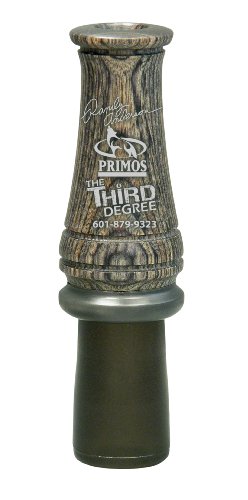
Every kit needs a call that cannot run out of battery, and The Third Degree is the classic choice. Part of the Randy Anderson series, it is a single-reed mouth call with a laminated barrel, voiced to be extra loud and super high-pitched with a raspy cottontail distress tone. That piercing pitch is built for reach: it carries across wide, open country where coyotes hear it long before they see anything, and the rasp keeps it sounding like a struggling animal, not a whistle.
The trade-offs are the honest ones that come with any reed call. Volume and tone live in your hands and breath, so the first week with it should happen in the truck and the backyard, not on a stand. It also puts the sound at your position, which is why many hunters pair it with an e-caller set downwind as the visual focus. As a stand-alone call or a featherweight backup, it earns its pocket space.
Specs
- Brand: Primos
- Model: 372 (Randy Anderson Series)
- Type: Mouth call, single reed
- Barrel: Laminated barrel
- Sound profile: Extra loud, super high-pitched, raspy cottontail distress
- Power: None required
How to Choose the Right Predator Call
Start with the country, not the catalog. Open basins and windy plains reward volume, speaker clarity, and remote range, because the caller may sit 100 yards or more from the gun and the sound has to stay clean at distance. Tight timber and brushy draws reward finer volume steps for close work, a decoy to hold attention in thick cover, and a compact unit that sets up fast.
Judge the library by coverage, not count. A caller earns its keep with strong prey distress, pup distress, and a few vocals. A tight library of 12 to 15 well-recorded sounds covering all three families will work all season; a library of hundreds only helps if those families run deep. Check that new sounds can be added if you want room to grow.
Plan the battery side honestly. Cold weather shortens AA battery life fast. Note how many cells each unit and remote need, carry a full spare set, and consider rechargeable AAs for high-volume use. A mouth call on the lanyard is cheap insurance: it weighs almost nothing and works at any temperature.
Use the decoy where it matters. Motion decoys help most on bobcats, which hunt with their eyes, and on coyotes that hang up at the edge of rifle range. An included or compatible decoy saves a second purchase.
Check the rules before the season. Whether electronic calls are allowed, and for which species and seasons, varies by state and sometimes by management unit. Read the current regulations for the exact area you will hunt before relying on an e-caller.
FAQ
Are electronic predator calls legal everywhere?
No. Rules on electronic calls differ by state, species, and season. Coyotes are regulated more loosely than bobcats in many places. Check the current regulations for the state and unit you plan to hunt before the season opens.
What sounds work best for bobcats?
High-pitched prey distress — bird, rodent, and rabbit sounds — played on longer stands with patient pauses. Bobcats approach slowly and rely on their eyes, so pairing those sounds with a motion decoy, like the Rebel’s built-in unit, helps at close range.
How far from the shooter should the caller sit?
Far enough that the predator’s attention lands away from the gun, within easy remote range. Many hunters set an e-caller a few dozen yards out, slightly crosswind, so an approaching coyote circling for scent exposes itself broadside. Mouth-call users accept the sound at their position and rely on stillness and cover instead.
How long should one stand last?
Coyotes that are coming usually show within the first several minutes, so many stands run about 15 to 20 minutes before moving. Bobcats are slower and quieter; stands of 30 minutes or more are common for cats. Leaving too early is the most common bobcat mistake.
If I own an electronic caller, do I still need a mouth call?
It is worth carrying one. A mouth call covers a dead-battery failure, adds finishing sounds with a personal touch, and weighs almost nothing. Many experienced hunters run the e-caller as the main sound source and keep a reed call like The Third Degree on the lanyard for close finishing work.
Conclusion
The right predator call is the one matched to your ground and your patience for practice. The FOXPRO HammerJack is the complete electronic package, with a deep library, dual speakers, and a decoy included. The ICOtec 300+ stretches remote range to 300 yards for wide-country setups, while the Lucky Duck Rebel folds a motion decoy into a simple first caller. The Primos Dogg Catcher 2 trims the formula down to a compact dozen proven sounds, and The Third Degree proves a single reed, honestly practiced, still calls coyotes. Pick the family that fits your style, learn its sounds at home, check your local rules, and get out before daylight.
More from Amazon
Programs that pair well with the guide above. Offers and eligibility are set by Amazon and may change.
Free shipping on eligible items, Prime Video and more. Eligible new members can start with a free trial.
Start a Prime free trialA Prime membership for ages 18-24 with a trial period. Eligibility is set by Amazon.
See Prime for Young AdultsAudiobooks and podcasts to listen to on the go. Eligible new members can start with a free trial.
Try Audible freeAd-free music streaming. Eligible new subscribers can start with a free trial.
Try Music Unlimited freeAs an Amazon Associate we earn from qualifying purchases.










Write Your Review
No reviews yet. Be the first to share your experience!