

Key takeaways
- Compare propane CO2 traps, UV fan traps and grid zappers for a fixed campsite, patio or cabin, with honest advice on placement, upkeep and limits.
As an Amazon Associate we earn from qualifying purchases.
A mosquito trap is a background tool, not a shield. That single fact decides whether any of the machines below will feel like money well spent or like a plastic monument to wishful thinking. A trap sits in one place, runs for days or weeks, and slowly removes biting insects from the area around a fixed base: a seasonal campsite, a cabin porch, a patio where the same people gather every evening. It does almost nothing for a camper who arrives at dusk, cooks dinner, and leaves in the morning. For that person, repellent on skin and a spatial repellent device around the picnic table are the honest answers, and no trap on this list pretends otherwise.
There is a second fact worth stating before any product names. Biting female mosquitoes do not hunt by light. They hunt by carbon dioxide, body heat, moisture, and skin odors. Ultraviolet light, by contrast, is a powerful attractant for moths, beetles, crane flies, and a long list of insects that never bite anyone. Entomology research on light-based traps has been blunt about this for decades: a UV trap’s catch is dominated by non-biting insects, and the mosquitoes in the tray are mostly there by accident or because the trap also emits heat or CO2. The traps that genuinely target host-seeking females are the ones that imitate a breathing animal, and they are the most expensive and the most logistically demanding machines in this roundup.
So the five picks below fall into three honest categories. One propane trap imitates breath and hunts mosquitoes specifically. Two UV fan traps catch a broad mix of flying insects quietly and cheaply, with a small CO2 assist. One classic grid zapper kills whatever flies into it, mosquitoes largely excluded. And one indoor grid unit belongs inside a cabin, where the calculus changes because the room is enclosed. Read the trade-offs, pick for your actual setup, and place whatever you buy with care, because placement matters more than the brand on the box.
Affiliate Disclosure: This article contains affiliate links. If you buy through a link on this page, the site may earn a commission at no extra cost to you. Products are chosen on their published specifications and suitability for campsite and cabin use, not on commission rates.
1. Mosquito Magnet Patriot Plus (MM4200B) — The CO2 Trap That Actually Hunts Mosquitoes

The Patriot Plus is the only machine here built around how mosquitoes actually find people. It burns propane in a catalytic converter and releases a steady plume of carbon dioxide, heat, and moisture, a combination the maker calls CounterFlow technology. An optional octenol attractant cartridge adds a scent cue. A fan then vacuums insects that come to investigate into a rigid net, where they dehydrate and die. There is no light involved in the attraction at all, which is exactly the point.
This is also the most demanding device in the roundup by a wide margin. It needs a standard grill-style propane tank, which is not included, and a tank lasts roughly three weeks of continuous running. It also needs mains power through a long outdoor cord for the fan and ignition, so it is a cabin, homestead, or long-term basecamp tool, not something for a weekend tent site. The nets and attractant cartridges are consumables that need regular replacement, and the nozzle and burner need periodic cleaning or the CO2 output drops and the catch falls with it. Propane appliances are also restricted or outright banned in many campgrounds and during fire bans, so check the rules of wherever you plan to run it.
Run continuously from early in the season, a CO2 trap interrupts the local breeding cycle by removing egg-laying females day after day, and the effect builds over four to six weeks. That timeline is the honest headline: this is a season-long commitment for a fixed property, and judged that way it is the strongest mosquito-specific tool here. Judged as a camping gadget for short trips, it is heavy, thirsty, and pointless.
Specs
- Trap type: Propane CO2 trap with vacuum fan and catch net (CounterFlow)
- Coverage claim: Up to 1 acre
- Power: Propane tank (not included) plus 12V supply via 50 ft outdoor cord
- Attractants: CO2, heat, moisture; optional octenol cartridge
- Operation: Continuous, 24 hours a day, all season
2. DynaTrap DT1050 — The Quiet Fan Trap for a Half-Acre Basecamp

The DT1050 takes the opposite approach to the Mosquito Magnet: no propane, no flame, no consumable attractant cartridges. A UV fluorescent bulb draws flying insects toward the unit, a titanium dioxide-coated surface reacts with the light to produce a small amount of CO2, and a quiet fan pulls insects down into a retaining cage where they dehydrate. It runs on ordinary mains power and is silent enough to sit near a porch without the crackle and pop of a grid zapper.
The honesty test matters here. The UV light is doing most of the attracting, which means the cage fills with moths, beetles, gnats, and flies, and the mosquito share of the catch is modest. The CO2 produced by the coated surface is a trace compared with what a propane trap or a human being emits. What the DT1050 genuinely delivers is steady, silent, low-effort reduction of general flying insect pressure around a patio, cabin deck, or a powered campsite, with no zapping noise and no dead insects scattered below the unit. For a family that eats outside every night in one place, that is a real quality-of-life improvement, as long as nobody expects it to create a mosquito-free zone.
It is weatherproof, can hang or stand, and the bulb needs replacing after a season or so of use because UV output fades before the bulb visibly burns out. The cage twists off for emptying, a job worth doing weekly in peak season before the catch starts to block airflow.
Specs
- Trap type: UV light and fan trap with retaining cage (no grid)
- Coverage claim: Up to 1/2 acre
- Power: Mains electricity, standard outdoor cord
- Attractants: UV light, heat, trace CO2 from TiO2-coated surface
- Operation: Continuous, whisper-quiet fan
3. DynaTrap DT2000XL — The Same Idea, Scaled to a Full Acre

The DT2000XL is the DT1050’s bigger sibling: a larger UV lamp, a stronger fan, a much bigger catch chamber, and a coverage claim of a full acre. For a large rural cabin lot, a lakeside property, or a group campground area with power, the extra capacity means the cage can go longer between emptyings and the trap can work a bigger area from one well-chosen spot.
Everything said about its smaller sibling applies with the volume turned up. The catch will still be dominated by non-biting insects. The larger lamp draws more of everything, including beneficial insects, which is a genuine ecological downside of all light traps and worth weighing if your property borders a garden or natural area you care about. The unit is also physically large, so it suits a permanent post or hanging point rather than anything portable.
Where the XL earns its place is endurance. Run from spring through autumn on a fixed property, emptied regularly, with the bulb replaced on schedule, it quietly takes a share of the flying insect population out of circulation every night. That is the ceiling of what fan traps do, and this model does it at the largest scale in its class.
Specs
- Trap type: UV light and fan trap with extra-large retaining cage (no grid)
- Coverage claim: Up to 1 acre
- Power: Mains electricity, standard outdoor cord
- Attractants: UV light, heat, trace CO2 from TiO2-coated surface
- Operation: Continuous, quiet fan, all-weather housing
4. Flowtron BK-40D — The Classic Grid Zapper, With Its Limits Stated Plainly

The BK-40D is the lantern-style electric grid zapper that has hung in American yards for decades. A 40-watt UV bulb lures insects to a high-voltage grid, and a removable octenol cartridge slot lets you add a mosquito attractant lure that the maker recommends replacing about once a month. The housing is weatherproof, the grid is non-clogging by design, and the coverage claim is one acre.
Now the plain truth, because this product category survives on a misconception. Studies of grid zappers consistently find that biting mosquitoes make up a tiny fraction of the kill, while moths, beetles, and other harmless or beneficial insects make up most of it. The satisfying zap is mostly the sound of insects that were never going to bite you. The octenol lure helps at the margins, but it does not turn a light trap into a host-seeking trap. A zapper can even work against you if it hangs near where people sit, since it pulls insects into the area faster than it kills them.
So why is it here? Because for the right job it is still useful. Hung well away from seating, near a treeline or the far side of a large lot, it intercepts general flying insect traffic around barns, big patios, and cabin outbuildings, and it does so cheaply, ruggedly, and with no fan noise in the sleeping area. Buy it as a general insect reducer for a big fixed property, never as mosquito protection for the people at the table.
Specs
- Trap type: Electric grid zapper with UV bulb
- Coverage claim: Up to 1 acre
- Power: Mains electricity, outdoor cord
- Grid: 5,600V killing grid, non-clogging vertical rods
- Attractants: 40W UV light; slot for replaceable octenol lure cartridge
5. ASPECTEK 20W Electronic Insect Killer — For Inside the Cabin
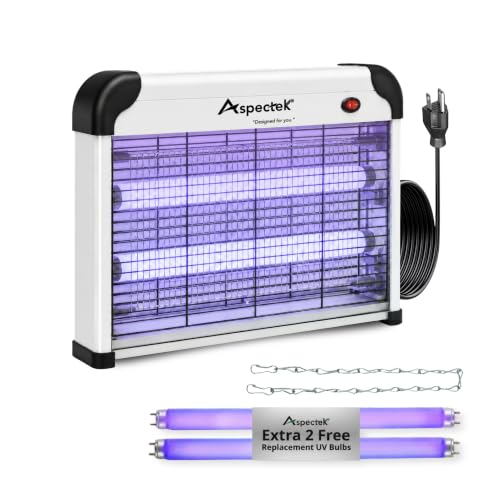
The ASPECTEK is an indoor-only grid unit: two 10-watt UV tubes behind a protective mesh, a high-voltage grid, and a removable tray that catches the debris. It is not weatherproof and must never be hung outside in the rain, which is why its job in this roundup is specific: the inside of a cabin, bunkhouse, or screened shelter.
Indoors, the math of light traps changes. A mosquito that has gotten inside a cabin is trapped in a small enclosed volume with the light, and over a night in a closed room the unit will clear most of the flying insects sharing your sleeping space. It also handles the moths and gnats that gather around cabin lights and kitchen areas. The mesh guard makes it reasonable around children and pets, though the grid is live behind it and the unit should sit out of reach, on a shelf or hung high.
Its limits are simple. It does nothing for the porch or the fire ring. It needs a mains outlet. And the tray needs regular emptying, because a full tray in a warm cabin is its own small hygiene problem. As an indoor complement to whatever you run outside, though, it solves the one problem campers actually lose sleep over: the mosquito already inside, whining past an ear at 3 a.m.
Specs
- Trap type: Indoor electric grid insect killer
- Coverage claim: Large indoor rooms (indoor use only)
- Power: Mains electricity
- Bulbs: Two 10W UV tubes (20W total); replacement bulbs included in some listings
- Grid: High-voltage grid behind protective mesh, removable catch tray
How to Choose
Start with how long you stay. Every trap in this article is a fixed-site tool. If your camping means moving every night or two, skip this category entirely and spend the money on repellent and a spatial repellent for the table. If you have a cabin, a seasonal site, or a home patio, a trap can earn its keep over a season.
Match the attractant to the target. If mosquitoes specifically are the problem, only a CO2-emitting trap is hunting the same cues they hunt you by. That means propane, with its tank changes, consumables, and campground restrictions. UV fan traps and grid zappers reduce general flying insect numbers, which many people find perfectly satisfactory on a porch, but they should be bought with clear eyes about what fills the tray.
Placement decides more than the model does. Put the trap between the insects and the people: between the treeline, pond, or brush where mosquitoes rest and breed, and the deck or fire ring where you sit. Hang or stand it roughly 20 to 40 feet away from seating, never beside the picnic table, because a trap beside people draws insects through the crowd on their way to it. Keep it a few feet off the ground, out of competing light from porch bulbs, and run it continuously rather than switching it on when you sit down.
Count the running costs honestly. Propane traps consume tanks, nets, and attractant cartridges. UV traps consume bulbs, which lose attractant power long before they visibly fail. Grid zappers consume bulbs and lure cartridges. None of these costs is hidden, but all of them are permanent, and a trap that stops being maintained stops working within a season.
Respect the rules and the ecology. Many campgrounds prohibit propane pest devices, and fire bans can too. Light traps kill large numbers of non-biting insects, including species that feed birds and bats. The least-bad setup is the smallest trap that does your job, placed carefully, run only where people actually live and gather.
FAQ
Will a mosquito trap make my campsite bite-free this weekend?
No. Traps reduce background insect pressure over weeks of continuous running at one fixed site. For a single weekend, protect people directly with repellent and a spatial repellent around the seating area, and treat a trap as a long-term addition for a site you return to.
Do UV bug zappers actually kill mosquitoes?
They kill a few, but research on their catch consistently shows biting mosquitoes are a very small share of the total, while moths, beetles, and other non-biting insects dominate. A zapper is a general insect reducer, not a mosquito control device, and it should be hung far from where people sit.
Where exactly should I place a trap at a cabin or campsite?
Between the breeding and resting areas — brush, treeline, standing water — and your seating, roughly 20 to 40 feet from where people gather, a few feet off the ground, and away from competing porch lights. Never place it right next to the table; it will pull insects toward you.
Are propane CO2 traps allowed in campgrounds?
Often not. Many campgrounds restrict or ban propane pest-control appliances, and fire bans can prohibit them too. Always check the rules of the specific campground or land manager before buying or bringing one.
Conclusion
For a fixed cabin or basecamp with serious mosquito pressure, the Mosquito Magnet Patriot Plus is the only machine here that targets mosquitoes the way mosquitoes target you, and its propane logistics are the price of that focus. For most patios, decks, and powered campsites, a DynaTrap fan trap — the DT1050 for a half acre, the DT2000XL for a full acre — gives quiet, low-maintenance relief from general flying insects. The Flowtron BK-40D remains a rugged general-purpose zapper for big properties when its limits are understood, and the ASPECTEK 20W handles the inside of the cabin. Whichever you choose, place it between the bugs and the people, run it all season, and keep direct protection on the people themselves. Traps thin the crowd; they do not stand guard.
More from Amazon
Programs that pair well with the guide above. Offers and eligibility are set by Amazon and may change.
Free shipping on eligible items, Prime Video and more. Eligible new members can start with a free trial.
Start a Prime free trialA Prime membership for ages 18-24 with a trial period. Eligibility is set by Amazon.
See Prime for Young AdultsAudiobooks and podcasts to listen to on the go. Eligible new members can start with a free trial.
Try Audible freeAd-free music streaming. Eligible new subscribers can start with a free trial.
Try Music Unlimited freeAs an Amazon Associate we earn from qualifying purchases.







Write Your Review
No reviews yet. Be the first to share your experience!