

Our Top Picks
 Collapsible Portable LED Camping Lantern XTAUTO Lightweight Waterproof4-pack3.54 x 3.54 x 7.68 inchesCheck on Amazon

The Glocusent LED Rechargeable Camping Lantern is the best overall pick in this group for most campers, because it combines a large 5000mAh battery with three color temperatures, five brightness levels and an SOS mode. A rechargeable camping lantern is a battery-powered light you refill through a USB or solar input instead of replacing disposable cells, and the best ones double as a small power source. If you want two lanterns for a family tent, a very bright flood, or a collapsible light that packs flat, the other five picks below suit those jobs better.
Quick List
- XTAUTO Collapsible Solar Lantern – best for packing flat and backup solar charging
- Glocusent 5000mAh Lantern – best for tent comfort with warm, neutral and cool light
- 2-Pack Rechargeable Hurricane-Style Lanterns – best for lighting two spots, such as tent and table
- Xynover 1000-Lumen Lantern – best for brighter campsite lighting with an IP44 rating
- Consciot 2-Pack Lanterns – best for families who want a pair with six light modes
- 1800-Lumen Power Bank Lantern – best for the brightest output and phone top-ups
Which One Is Right for You?
| If you… | Choose |
|---|---|
| want warm light for reading in the tent and a big battery | Glocusent 5000mAh Lantern |
| need to light a table and a tent at the same time | 2-Pack Hurricane-Style Lanterns |
| want the highest listed brightness and a power bank function | 1800-Lumen Power Bank Lantern |
| prefer a lantern that collapses and can top up from the sun | XTAUTO Collapsible Solar Lantern |
| need a middle-of-the-road flood with weather protection | Xynover 1000-Lumen Lantern |
| share a campsite and want two matched lanterns with several modes | Consciot 2-Pack Lanterns |
Brightness numbers on listings are peak figures, so decide first how you will use the light. Reading in a tent needs a warm, dim setting; cooking at a picnic table needs a wide, brighter beam; an emergency kit needs reliable battery life. Pick the lantern whose strongest feature matches your main use.
All 6 Picks in Detail
1. XTAUTO Collapsible Solar Lantern – Best for Compact Storage and Solar Backup
As an Amazon Associate we earn from qualifying purchases at no extra cost to you.

The listing describes a collapsible, lightweight, waterproof LED lantern that charges by solar and USB and also works as a flashlight, aimed at survival kits and indoor and outdoor use. The collapsing body packs flat, which is a real benefit in a crowded bag. Solar charging is best treated as a top-up: panels on small lanterns are slow, so rely on USB for a full charge and use the sun when you cannot reach an outlet.
- Charging: solar and USB per the listing
- Design: collapsible, lightweight
- Water resistance: described as waterproof, rating to confirm on listing
- Use: lantern and flashlight functions
- Battery capacity and lumens: confirm on listing
Pros:
- Packs flat for storage
- Solar input gives a backup way to charge
Cons:
- Solar charging is slow in practice
- Battery size is not clearly stated
It is more compact than the Glocusent but offers less documented battery capacity. Think of it as a backup lantern for a glove box, a go-bag or a hurricane kit rather than the main tent light. Before relying on it, charge it fully by USB, then check how long each mode lasts, because small collapsible designs often have modest runtimes. The flashlight function is also a convenient bonus when you need a directed beam.
2. Glocusent 5000mAh Lantern – Best for Comfortable Tent Light
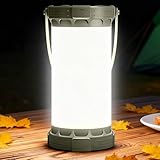
Glocusent’s rechargeable lantern lists a 5000mAh battery, three color modes, five brightness levels and an SOS signal. The three colors are the standout, because a warm tone is gentler on the eyes and attracts fewer insects than cool white. A 5000mAh cell at the common 3.7 volts holds roughly 18.5 watt-hours, which is the largest capacity in the group. Check whether it can charge a phone through a USB output.
- Battery: 5000mAh per the listing
- Light colors: three
- Brightness levels: five
- Extra mode: SOS
- Waterproof rating and lumens: confirm on listing
Pros:
- Largest stated battery in this list
- Warm light option for relaxing evenings
Cons:
- Peak brightness is not stated in the title
- One lantern only, no pair
Next to the 1800-lumen model it prioritizes color control and battery size over raw peak output. That focus makes it the easiest lantern here to live with for several evenings: you can dim to a warm glow for reading, then step up to a brighter neutral setting for cooking. If the listing shows a USB output, it also gives you a phone top-up in a pinch, with the caveat that charging a phone drains the lantern.
3. 2-Pack Rechargeable Hurricane-Style Lanterns – Best for Lighting Two Spots
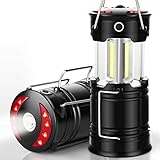
This product is sold as a two-pack of rechargeable camping lanterns, billed as 2-in-1 and styled after a hurricane lamp. A pair lets you leave one in the tent and one on the table instead of carrying a single light around. The listing text available does not state battery capacity, lumens or water rating, so confirm those on the product page. Look for an easy-to-reach switch and a hook or handle that suits a tent loop.
- Pack: two lanterns
- Style: hurricane-lamp look, rechargeable
- Function: 2-in-1 lantern per the listing
- Battery capacity: confirm on listing
- Lumens and waterproof rating: confirm on listing
Pros:
- Two lights for different areas
- Classic look suits a camp table
Cons:
- Key specs are not clear from the title
- May be less bright than single high-output models
Choose it over the Consciot pair if the vintage look matters, though the Consciot’s specs are better documented. Before buying, look for the battery size, the charging method and the water rating on the product page, since the title leaves them out. A pair also gives you redundancy: if one runs flat, the other can cover the tent while the first charges.
4. Xynover 1000-Lumen Lantern – Best for Weather-Resistant Campsite Light

Xynover’s lantern lists 1000 lumens, five light modes, a 4400mAh battery and an IP44 rating, with use cases such as power outages and tent lighting. IP44 means the case resists solid objects over one millimeter and splashing water from any direction, so rain is fine but submersion is not. A thousand lumens is a large peak figure, and you will probably use lower modes most of the time to save battery.
- Brightness: up to 1000 lumens per the listing
- Modes: five
- Battery: 4400mAh
- Protection: IP44
- Charging port type: confirm on listing
Pros:
- Clear spec list including ingress rating
- Useful for power outages as well as camping
Cons:
- High brightness drains battery faster
- No pair included
It is brighter than the Consciot lanterns but offers a lower battery capacity than the Glocusent. Use the lower modes for tent light and save the top setting for finding the path to the restroom or lighting up a gear check. Because it carries an IP44 rating, wiping off rain or morning dew is fine, but do not leave it sitting in a puddle.
5. Consciot 2-Pack Lanterns – Best for Families Sharing a Campsite

The Consciot set includes two LED lantern flashlights with six light modes, a 3600mAh battery that doubles as a portable battery pack, and an IPX4 waterproof rating. Giving each of two tents or two kids a lantern is easier than passing one around. IPX4 means protection against splashing water from any angle but says nothing about dust, so keep them out of heavy sand and dirt. A 3600mAh cell is about 13.3 watt-hours.
- Pack: two lanterns
- Modes: six per the listing
- Battery: 3600mAh with power bank function
- Protection: IPX4
- Peak lumens: confirm on listing
Pros:
- Two lights with six modes
- Power bank feature for phones
Cons:
- Smaller battery per lantern
- No dust rating
Between the pair options, it states more specifications than the hurricane-style set. Giving each adult a lantern means no one is hunting for light while the other person cooks. Because each unit has a power bank function, you can also use one lantern as a phone charger in the evening and keep the other fully charged for the tent.
6. 1800-Lumen Power Bank Lantern – Best for Maximum Brightness

This lantern, whose listing title does not name a brand, lists 1800 lumens, four light modes, a 4400mAh power bank battery and an IP44 rating, marketed for hurricane and emergency use. It claims the highest brightness of the six, though lumens are usually a peak figure that falls off as the battery drains or the lantern heats up. Like the Xynover, it shares the 4400mAh capacity, so expect shorter runtimes at the top setting.
- Brightness: up to 1800 lumens per the listing
- Modes: four
- Battery: 4400mAh, with power bank use
- Protection: IP44
- Brand and warranty details: confirm on listing
Pros:
- Highest listed peak brightness
- Doubles as a small power bank
Cons:
- Less brand information available
- Battery may drain quickly on high
It outputs more peak light than the Xynover on the same battery, so run time at the top setting is the trade-off. Since the brand is not named, check the return policy and look for safety markings on the product page, and do not leave the lantern charging unattended. If your priority is a trusted name with documented specs, the Glocusent or Xynover listings give you more to go on.
Specs Compared
| Lantern | Battery | Listed brightness | Modes | Weather rating | Charging |
|---|---|---|---|---|---|
| XTAUTO Collapsible Solar | Confirm on listing | Confirm on listing | Confirm on listing | Waterproof (rating confirm on listing) | Solar and USB |
| Glocusent 5000mAh | 5000mAh | Confirm on listing | 3 colors, 5 brightness levels, SOS | Confirm on listing | USB rechargeable |
| 2-Pack Hurricane-Style | Confirm on listing | Confirm on listing | Confirm on listing | Confirm on listing | Rechargeable |
| Xynover 1000-Lumen | 4400mAh | 1000 lumens | 5 | IP44 | Rechargeable |
| Consciot 2-Pack | 3600mAh each | Confirm on listing | 6 | IPX4 | Rechargeable, power bank |
| 1800-Lumen Power Bank | 4400mAh | 1800 lumens | 4 | IP44 | Rechargeable, power bank |
How We Chose These
We built this guide from published information rather than direct use. For each lantern we read the title and specification fields, looked at battery capacity, listed brightness, number of modes, water resistance rating and charging method, and compared them with how campers typically use lanterns. We favored listings that state battery size and an ingress rating, noted when lumen figures are peak claims, and flagged anything unclear for you to confirm. Pairs are credited for covering two spots, while single lanterns are judged on battery size and light quality.
What to Look For
Battery capacity and runtime
Milliamp-hours are only half the story. Multiply the mAh by the nominal 3.7 volts and divide by 1000 to get watt-hours: 4400mAh is about 16.3 Wh, 5000mAh is about 18.5 Wh and 3600mAh is about 13.3 Wh. Runtime is roughly watt-hours divided by the light’s draw in watts. A lantern pulling 2 watts on a medium setting could last around eight hours from a 16 Wh pack, while a high setting drawing 10 watts would drain it in under two. Real lanterns lose some energy to conversion, so treat these as ballpark figures and expect less.
Brightness, color and beam
Lumens measure total light output, but usable light depends on the setting. A tent needs 50 to 150 lumens, a picnic table 200 to 400, and a larger campsite more. Peak figures such as 1000 or 1800 lumens apply only briefly. Color temperature matters too: warm light around 2700 to 3000 kelvin is easier on the eyes at night and draws fewer insects, while cool white around 5000 to 6000 kelvin shows detail better for cooking and repairs. A diffuser or frosted lens spreads light evenly, whereas a bare LED array can glare.
Water and dust protection
The IP code has two digits: the first covers solids and the second covers water. IP44 means protection against objects larger than one millimeter and water splashes from any direction. IPX4 means the same splash protection with no dust rating. Neither is meant for immersion. If the listing only says “waterproof” with no code, treat that as a marketing word and keep the lantern out of heavy downpours. Check that the charging port has a cover or sits in a recessed spot so water cannot reach the contacts.
Lithium battery safety
Rechargeable lanterns use lithium-ion cells, which are safe when used as intended but can overheat if damaged, overcharged or left in a hot car. Charge on a hard, non-flammable surface and not under bedding or inside a sleeping bag. Do not leave a lantern charging while you sleep or unattended, use the charging cable and adapter recommended by the maker, and stop using any unit that swells, smells odd or gets hot. Store lanterns at moderate temperature, partly charged, for long periods. If you travel by air, carry spare lithium batteries and power banks in your carry-on, following airline rules.
Power bank function and charging ports
A lantern that doubles as a power bank is handy for topping up a phone, but each charge draws on the same battery that lights the tent. Treat the power bank as an emergency feature and keep a dedicated power bank for devices. Check whether the lantern charges through USB-C or older Micro-USB, since USB-C cables are easier to share with your phone. Solar panels on small lanterns are slow, so use them as a supplement.
Hanging, stability and form factor
Where the light sits changes how useful it is. A lantern hung from the tent ceiling spreads light downward and avoids shadows, while one on a table lights food and cards but casts a dark ring behind it. Check for a sturdy hook or loop, a flat base that will not tip on uneven ground, and a handle that does not get hot. Collapsible bodies shrink for packing but should lock open firmly. Magnetic bases and tripod threads are nice extras, though they are not stated for these listings, so look for them on the product page if you need them.
Planning charging on a multi-day trip
Bring a way to refill the lanterns, not just a full charge. A car USB port, a power bank or a small solar panel can all do the job, but each has limits: car chargers only help when the engine runs or the accessory port is live, and power banks are finite. Charge every lantern fully before leaving, use the lowest setting that works for the task, and keep a spare light such as a headlamp in case one fails. Cold weather reduces battery performance, so keep lanterns inside your sleeping bag or jacket on freezing nights until you need them.
Kids, tents and fire safety
One reason campers choose LED lanterns is that they are cooler and safer in a tent than flame-based lights. Even so, a lantern is not a toy: teach children not to cover it, to avoid chewing cables, and to switch it off when leaving the tent. Keep the unit away from stove fuel, and never use a damaged unit near bedding. If a lantern also features an SOS or strobe mode, show everyone how to switch it off before bedtime so nobody is startled in the night.
A worked example
Imagine a three-night trip for a family of four. You want one lantern for the tent and one for the table, each run for four hours a night at medium output. With two lanterns holding roughly 13 to 16 watt-hours each and drawing about 2 to 3 watts at medium, each lasts well beyond a night, so you could recharge only every two nights from a power bank or car charger. That is why a pair of mid-range lanterns often beats a single high-output unit.
Questions
How many lumens do I need for camping?
For a tent, 50 to 150 lumens is plenty, and for a picnic table 200 to 400 lumens works well. Higher figures are useful only for a short flood of light. Choose a lantern with adjustable levels so you can match the brightness to the task.
What does IP44 mean on a camping lantern?
The first 4 means the case resists solid objects larger than one millimeter, and the second 4 means it handles water splashing from any direction. It is fine in light rain but not for submerging. IPX4 has the same water rating without a dust rating.
Is it safe to charge a lantern overnight?
It is better not to leave lithium-ion devices charging unattended or while you sleep. Charge them during the day or while you are awake, on a hard surface away from fabric. If a lantern gets hot or swells, stop using it.
Can I use a lantern as a power bank?
Some can charge a phone through a USB port, which is handy in an emergency. Each charge reduces the light’s runtime, so keep a separate power bank for devices on longer trips. Check the output rating on the listing.
Do solar camping lanterns work well?
Small solar panels trickle charge slowly and depend on strong sun. Treat solar as a supplement or backup and charge by USB before the trip. A full charge from the sun can take a long time.
How should I store a rechargeable lantern?
Keep it somewhere cool and dry at partial charge, and avoid hot cars. Top it up every few months. Remove any removable batteries if the manufacturer recommends it.
Update History
- October 14, 2026 – Initial publication; product set drawn from current catalog listings.
- Check the product page for current specifications and availability before buying.
Sources
- Retailer listing titles and specification fields for each listed lantern
- IEC ingress protection (IP code) definitions for dust and water ratings
- General lithium-ion battery safety guidance from consumer safety agencies



Write Your Review
No reviews yet. Be the first to share your experience!