

Key takeaways
- Choose a hardwired LED lantern for a primary entrance that must work every night, a solar motion lantern for a sunny remote location, and a rechargeable battery lantern for camping or rental properties. Prioritize the complete combination of lumens, beam spread, IP rating, mounting fit,…
Best Outdoor Wall Lantern Lights
The best outdoor wall lantern lights for most homes and campsites are weather-resistant LED fixtures rated at least IP44, producing roughly 400–800 lumens, with a downward or adjustable beam and a mounting plate that fits your existing electrical box; solar and battery models are better when wiring is impractical.
Quick picks by situation
| Situation | Best lantern type | Target specification | Why it fits |
|---|---|---|---|
| Main front entry | Hardwired LED wall lantern | 600–1,000 lumens, 2700–3000K, IP44 or higher | Reliable daily lighting with enough brightness for steps, locks, and faces |
| Small porch or side door | Compact hardwired lantern | 300–600 lumens, 150–250 mm tall, 90°–120° beam | Provides useful light without overwhelming a narrow wall |
| Rental, shed, or remote gate | Rechargeable battery lantern | 300–800 lumens, 6–20 hours claimed runtime, USB-C charging | No permanent wiring and easy to reposition |
| Camp kitchen or fixed campsite shelter | Solar wall lantern with motion sensor | 100–400 lumens, 6–10 hours after a sunny day | Automatic short bursts conserve energy and avoid cables |
| Decorative pathway or tent entrance | Low-output solar lantern | 20–150 lumens, warm white, downward shield | Improves orientation without producing harsh glare |
What to look for before buying
Brightness: lumens are more useful than wattage
Lumens describe the amount of visible light. Watts describe energy consumption, so wattage alone does not tell you whether a lantern is bright enough. For an entryway, 400–800 lumens is a practical range. Choose about 800–1,200 lumens when the light must cover a wide porch, several steps, or a driveway edge. For a tent vestibule, campsite table, or small shed door, 100–400 lumens is usually more comfortable.
Our top picks

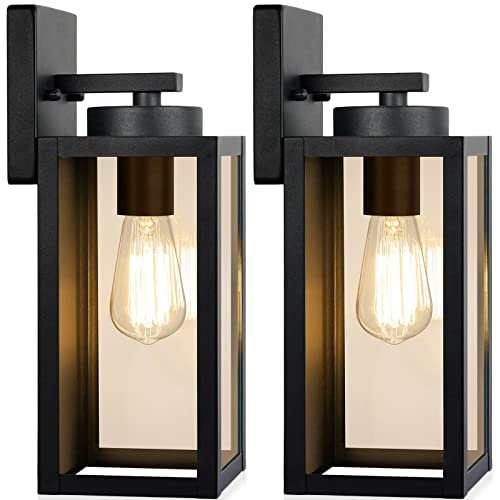


As an Amazon Associate we earn from qualifying purchases at no extra cost to you. Ratings are shown as listed on Amazon.
Very bright is not always better. A clear lens and exposed LED can create glare while leaving areas outside the narrow beam dark. A frosted diffuser, downward shade, or indirect reflector often makes a 500-lumen lantern more useful than an unshielded 1,000-lumen unit.
Power source and running cost
Hardwired lanterns are the most dependable choice for a frequently used entrance. They need a suitable outdoor electrical box, supply cable, switch or sensor, and a safe installation. If the existing wiring is old, damaged, or absent, use a qualified electrician rather than adapting indoor components for outdoor use.
Solar lanterns avoid wiring and have no electricity cost, but their performance depends on panel exposure, season, shade, and dirt. A model that works well in midsummer may provide less light during short winter days or after several cloudy days. Solar is most suitable for short illumination periods, motion-triggered operation, and locations with unobstructed sun.
Battery lanterns are flexible but require charging or replacement cells. Consider the operating mode carefully: a lantern rated for 12 hours at its lowest setting may run for only 3–5 hours at maximum brightness. Rechargeable models with USB-C are convenient for camping, while replaceable AA or D-cell designs can be easier to keep operating away from mains power.
Weather resistance: IP ratings are only part of the answer
For a sheltered porch, IP44 is a reasonable minimum because it resists splashing water and objects larger than 1 mm. For an exposed wall, look for IP54, IP65, or better. IP65 indicates protection against dust and water jets; it does not mean the fixture can be submerged or left in standing water.
Also inspect the construction. Powder-coated aluminum or corrosion-resistant metal generally lasts longer than thin uncoated steel. UV-resistant polycarbonate is often a practical diffuser material. Stainless steel hardware is valuable near coastal air, where salt can attack ordinary fasteners and painted surfaces.
The weakest points are usually the gasket, cable entry, battery door seal, and finish around screws. A high IP number cannot compensate for a badly sealed installation. Keep the cable entry facing downward where possible, fit the supplied gasket correctly, and do not drill additional holes through the housing.
Beam spread and placement
A narrow beam concentrates light near the door and can be useful for a keyhole or step, but it may leave the surrounding path dark. A broad 90°–120° spread is better for a porch or campsite shelter. Up-and-down lanterns can illuminate both the wall and nearby ground, while a fully exposed globe spreads light widely but may cause glare.
For a residential doorway, mount the light so its center is approximately 1.8–2.2 meters above the ground, adjusting for the door frame and local requirements. Two smaller lanterns on either side of a wide entrance often produce more even coverage than one extremely bright light. At a campsite, position the lantern above eye level and aim it downward to reduce glare inside tents and across neighboring pitches.
Head-to-head: hardwired, solar, and battery lanterns
| Feature | Hardwired LED | Solar | Rechargeable battery |
|---|---|---|---|
| Typical brightness | 400–1,200 lumens | 20–500 lumens | 100–1,000 lumens |
| Typical operating time | Continuous while powered | 6–12 hours after adequate sunlight | 3–20 hours, depending on mode |
| Installation | Electrical box and outdoor wiring required | Wall fixing and sun-facing panel | Wall fixing; charging access required |
| Common purchase range | $40–$180 | $20–$100 | $30–$150 |
| Best use | Daily entry lighting | Remote or low-maintenance locations | Temporary, rental, or camping use |
A simple coverage and runtime check
Suppose a rechargeable lantern has a 5,000 mAh battery at 3.7 volts. Its nominal energy is approximately:
5 Ah × 3.7 V = 18.5 watt-hours.
If the LED and electronics consume an estimated 2 watts at the chosen brightness, the theoretical runtime is 18.5 ÷ 2, or about 9.25 hours. Allowing for conversion losses, battery aging, cold weather, and automatic controls, planning for roughly 7–8 hours is more realistic.
For a campsite, that could mean four hours of light while cooking and socializing, followed by motion-triggered operation overnight. At a house entrance used for 20 minutes each evening, the same battery could last many days, although self-discharge and standby electronics will reduce the actual interval between charges.
Installation and maintenance that affect lifespan
- Check the mounting surface. Brick, concrete, timber, and siding require different anchors. A lantern that moves in the wind can loosen its seal and strain its cable.
- Confirm the electrical box or fixing plate. Measure the screw spacing and wall clearance before buying. Some decorative lanterns cover only a small area and may not hide an existing box or patch marks.
- Keep water away from cable entries. Use the supplied grommet, gasket, and weatherproof connectors. Avoid routing a cable upward into the housing where water can run along it.
- Clean the diffuser and solar panel. Dust, pollen, and insect residue reduce light output. Use a soft damp cloth; abrasive cleaners can cloud plastic and weaken protective coatings.
- Inspect seals and fasteners twice a year. Replace cracked gaskets, rusting screws, or a swollen battery promptly. Do not keep using a battery compartment that shows corrosion or water intrusion.
Common mistakes include installing a solar panel under an eave, placing a motion sensor toward a busy road, choosing a cool 5000K light for a relaxing porch, and mounting a lantern where its beam shines directly into eye level. Warm white light around 2700–3000K is usually more comfortable for homes and campsites, while neutral white around 3500–4000K can make task areas appear clearer.
Bottom line
Choose a hardwired LED lantern for a primary entrance that must work every night, a solar motion lantern for a sunny remote location, and a rechargeable battery lantern for camping or rental properties. Prioritize the complete combination of lumens, beam spread, IP rating, mounting fit, and realistic runtime rather than choosing by appearance or maximum brightness alone. The right lantern should light the surface people need to see, withstand the local weather, and remain easy to clean, recharge, or repair over several seasons.


Write Your Review
No reviews yet. Be the first to share your experience!