

Key takeaways
- Compare the best car leather conditioners for coated and uncoated seats: two-step kits, one-step sprays, and a deep conditioner for dry, older hides.
As an Amazon Associate we earn from qualifying purchases.
Affiliate Disclosure: This article contains affiliate links. If you buy through them, we may earn a commission at no extra cost to you.
Start with the honest part, because it decides which bottle you should buy. The leather in nearly every modern car is coated leather. The hide is dyed, then sealed under a pigmented, protective topcoat, and it is that coating you touch when you sit down. A conditioner applied to coated seats mostly works on the coating itself: it keeps the surface flexible, helps it resist cracking and UV fade, and leaves the seat feeling less dry and plasticky. It does not soak through and “feed” the hide the way conditioner feeds an uncoated saddle or a vintage aniline seat, because the coating is in the way. That is not a reason to skip conditioning. It is a reason to choose products honestly: on coated seats, a light water-based conditioner or a cleaner-conditioner combo does the real job, while heavy oil-rich conditioners are built for uncoated leather and can sit greasy on a coated seat.
The five picks below are split along exactly that line. Three are cleaner-and-conditioner products suited to the coated seats in most cars, one is a conditioner-only bottle for owners who already own a cleaner, and one is a deep penetrating conditioner aimed at uncoated, aniline, or genuinely dry older leather. Each pick states which type it is, because a combo and a conditioner-only bottle are different purchases.
Know Your Seat Before You Buy
Coated versus uncoated leather
A simple check tells you which leather you have. Put a drop of water on an inconspicuous spot. On coated leather, the drop beads and sits on the surface. On uncoated or aniline leather, it soaks in and darkens the spot. Most factory car seats from the last few decades are coated. Uncoated leather shows up in some premium trims, older vehicles, and aftermarket reupholstery. Match the product to the result: combos and light conditioners for coated seats, the deep conditioner for uncoated hides.
The vinyl problem
Many “leather” interiors are leather only where your body touches, with matching vinyl on seat sides, backs, and rear benches, and some trims are leatherette throughout. Conditioner does no harm to vinyl, but it does not nourish it either, and one pick below, Leather Honey, is explicitly not made for faux leather or vinyl at all. Check your owner’s manual or trim specification before treating a whole interior as hide.
What none of these are for
None of the picks in this guide are made for suede or Alcantara, and Leather Honey and Weiman both say so in their own directions in substance: finished, smooth leather only. Nubuck, suede, and microfiber seat inserts need dedicated fabric or suede products. Unfinished aniline also deserves a patch test anywhere visible, because oils can darken it unevenly.
Cleaner first, always
Conditioner over dirt seals the dirt in. If a seat is visibly soiled, shiny from body oils, or new to you, clean it first with a dedicated leather cleaner or choose one of the combo products below. Conditioning is the second step of the routine, not a substitute for the first.
The 5 Picks
1. Chemical Guys Leather Cleaner and Conditioner Kit
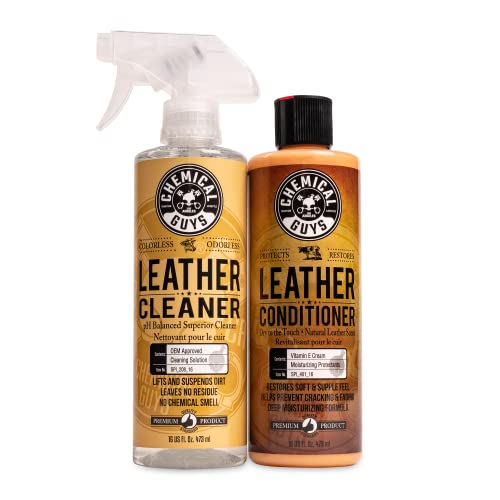
This is the cleaner-and-conditioner combo in the truest sense: two separate full-size bottles, one a dedicated cleaner and one a dedicated conditioner, rather than a single compromise formula. The cleaner is pH-balanced, colorless, and odorless, made to lift dirt and body oils out of the grain without leaving residue behind. The conditioner follows with Vitamin E and aloe extracts, restoring surface flexibility and a soft, natural feel. Because the steps are separate, you can clean as often as the seats need it and condition on a slower schedule, which matches how coated seats actually wear.
For most car owners starting from nothing, this is the complete routine in one box: vacuum, clean, wipe down, then condition. The maker positions the kit for natural, synthetic, and sealed leather, which covers the coated seats in the great majority of cars. Apply the conditioner thin and buff off the excess after it sets; over-application on coated leather is the main way owners end up with a slick seat. Note the packaging point: Chemical Guys has reshuffled its leather kits over the years, so confirm on the listing that the box in front of you holds the two 16-ounce bottles described here.
Specs
- Type: Cleaner + conditioner combo (two separate bottles)
- Contents: 16 fl oz Leather Cleaner, 16 fl oz Leather Conditioner
- Model: SPI_109_16
- Cleaner: pH-balanced, colorless, odorless
- Conditioner ingredients: Vitamin E, aloe extracts
- Surfaces: Natural, synthetic, and sealed (coated) leather
2. Lexol All Leather Conditioner

Lexol is the long-standing conditioner-only standard in automotive leather care, and this 16.9-ounce bottle is Step 2 of the maker’s two-step regimen; the matching cleaner is a separate product. The formula is a water-based emulsion of fine oil droplets designed to spread evenly, absorb quickly, and leave a matte, non-greasy finish, which is exactly the behavior you want on coated seats where heavy oils have nowhere to go. It preserves flexibility and helps guard the surface against cracking without building up a shiny film.
Because it contains no cleaner, this bottle is the right pick for seats that are already clean or already maintained with a cleaner you own. Work it in with an applicator sponge or microfiber, let it absorb, and buff lightly. On uncoated leather it also performs as a straightforward maintenance conditioner, though for genuinely dried-out uncoated hides the deeper pick at the end of this list is the stronger tool.
Specs
- Type: Conditioner only (Step 2 of 2; cleaner sold separately)
- Size: 16.9 fl oz bottle
- Formula: Water-based emulsion
- Finish: Matte, non-greasy
- Surfaces: Finished and coated leather upholstery
3. Meguiar’s Gold Class Rich Leather Cleaner and Conditioner Spray

Meguiar’s takes the opposite approach to the two-bottle kit: one spray that cleans, conditions, and protects in a single step. The 15.2-ounce trigger bottle combines gentle cleaning agents with aloe and moisturizing oils, and adds UV protection aimed at the sun exposure that fades and dries out seat tops and headrests. The finish is natural rather than glossy, and the formula is made to wipe on and buff off without greasy residue or white streaks in the stitching and grain.
A one-step spray is a maintenance product, and it should be judged as one. It is well matched to coated seats that get regular attention and light soiling, and it suits quick upkeep between deeper cleans. It is not a substitute for a dedicated cleaner on heavily soiled seats, and on uncoated leather a dedicated conditioner gives you more control. Within its lane, though, the combination of cleaning, conditioning, and UV screening in one pass is the appeal.
Specs
- Type: Cleaner + conditioner combo (3-in-1 spray)
- Size: 15.2 fl oz spray bottle
- Model: G10916
- UV protection: Yes, per maker
- Conditioning agents: Aloe and moisturizing oils
- Finish: Natural, non-greasy
4. Weiman Leather Cleaner & Conditioner

Weiman’s entry is the simple one-step option: a 12-ounce trigger spray that cleans, conditions, and protects finished leather in a single application, with UV protectants included to help slow cracking and fading. The directions are as plain as the formula: spray, wipe, buff. It suits owners who will only maintain seats if the job takes a few minutes.
The limit is in the maker’s own wording: this spray is for smooth, finished leather surfaces. That covers the coated seats in most cars, furniture, and shoes, and it excludes suede, nubuck, and unfinished hides, which should go to the specialist products instead. Like the Meguiar’s spray above, it is a maintenance cleaner-conditioner rather than a deep restoration product, and heavily soiled seats still deserve a dedicated cleaning step first.
Specs
- Type: Cleaner + conditioner combo (one-step spray)
- Size: 12 fl oz trigger spray
- UV protection: Yes, UV protectants per maker
- Surfaces: Smooth finished leather only
- Not for: Suede, nubuck, unfinished leather
5. Leather Honey Leather Conditioner

Leather Honey is the specialist pick, and its lane is different from everything above it. This is a conditioner only, with no cleaning action, in a thick, clear, honey-textured formula that has been made in the USA by the same family business since 1968. It is non-toxic and silicone-free, and it is designed to penetrate and saturate dry leather fibers, which makes it the pick for uncoated and aniline hides, older car seats that have genuinely dried out, and restoration work on vintage interiors.
That strength comes with rules. The maker states the conditioner is for all types and colors of leather but not suede, and not for faux leather or vinyl, so leatherette interiors are out. On coated modern seats it is usually more product than the surface can take up; it needs to be applied very thin, given a long dwell to absorb, and wiped down thoroughly, and even then the lighter conditioners above are the better everyday match. Used on the leather it was made for, one treatment is long-lasting, and the maker suggests intervals of six months or more between applications.
Specs
- Type: Conditioner only (no cleaning action)
- Size: 8 fl oz bottle
- Model: LHHP1001
- Formula: Non-toxic, silicone-free, penetrating conditioner
- Origin: Made in the USA, formula since 1968
- Surfaces: All leather types and colors except suede; not for faux leather or vinyl
How to Apply Any of These
Vacuum first, including the seams and creases where grit collects, because rubbing grit across a coating with an applicator is how scratches happen. If the seats are soiled, clean them and let them dry fully. Apply conditioner to the applicator, not directly to the seat, and work in thin, even coats panel by panel. Perforated seats deserve a lighter hand so product does not pack into the holes. Give the conditioner the dwell time its label asks for, then buff with a clean microfiber to remove whatever the surface did not take up; on coated leather, what you buff off was never going to soak in anyway. Keep the routine modest and regular: a light conditioning every few months suits most daily-driven cars better than a heavy annual soaking.
A Note on Safety Checks
Each brand in this guide was checked against recall records before inclusion. None of the five products listed here is under a recall. For completeness: Chemical Guys has had Health Canada labelling and packaging recalls covering other products in its range, such as its all-purpose cleaner and water spot remover; the leather kit in this guide is not among the recalled items. Meguiar’s previously recalled a headlight sealant over child-resistant packaging; that is a different product from the leather spray listed here. As with any detailing chemical, store bottles away from children and follow the label directions for the product in hand.
Frequently Asked Questions
How often should car leather seats be conditioned?
For coated seats in a daily-driven car, every three to six months is a sensible rhythm, adjusted for sun exposure and use. The deep conditioner in this guide is the exception: its maker suggests six months or more between treatments on the uncoated leather it is made for.
Can these products be used on leatherette or vinyl seats?
The combos from Chemical Guys are positioned by their maker for synthetic as well as natural leather. Leather Honey is not: its maker excludes faux leather and vinyl. When in doubt, check the trim specification for your car and the directions on the bottle before treating a full interior.
Will conditioner darken my seats?
On coated leather, a light conditioner that is properly buffed should not change the color. On uncoated and aniline leather, oil-rich conditioners can darken the hide, sometimes unevenly, which is why a hidden patch test matters before a full application.
Do I still need a separate cleaner if I buy a combo spray?
For routine maintenance on lightly soiled seats, no; that is what the one-step sprays are for. For seats with ground-in dirt, dye transfer from clothing, or a shiny film of body oils, yes: clean thoroughly first with a dedicated leather cleaner, then condition.
The Bottom Line
Match the product to the leather, not to the marketing. Coated seats, which are most seats, are best served by the Chemical Guys two-step kit for a full routine, the Lexol conditioner for clean seats that only need maintaining, or the Meguiar’s and Weiman one-step sprays for quick upkeep with UV protection. Uncoated, aniline, and dried-out older leather is Leather Honey’s territory, used thin and given time to work. Buy the type your seats actually need, apply less than you think, and buff off the rest.
More from Amazon
Programs that pair well with the guide above. Offers and eligibility are set by Amazon and may change.
Free shipping on eligible items, Prime Video and more. Eligible new members can start with a free trial.
Start a Prime free trialA Prime membership for ages 18-24 with a trial period. Eligibility is set by Amazon.
See Prime for Young AdultsAudiobooks and podcasts to listen to on the go. Eligible new members can start with a free trial.
Try Audible freeAd-free music streaming. Eligible new subscribers can start with a free trial.
Try Music Unlimited freeAs an Amazon Associate we earn from qualifying purchases.

Write Your Review
No reviews yet. Be the first to share your experience!