

Key takeaways
- Automatic shutoff, preferably with a selectable timer of at least two hours.
- Overheat protection and a thermostat-controlled heating system.
- Clearly marked electrical certification appropriate to your country.
- A detachable controller and removable battery or power pack before washing.
- A cable and connector that are not cracked, crushed, discolored, or unusually hot.
The best heated throw blankets for most homes are machine-washable 50-by-60-inch models with six or more heat settings, a detachable controller, automatic shutoff, and a low-power setting suitable for several hours of sofa use.
A heated throw is smaller and easier to manage than an electric bed blanket, but the differences between models matter. A throw that is warm enough for a reading chair may leave your feet uncovered in bed; a compact controller may be convenient yet difficult to use at night; and a blanket that is technically washable can still become troublesome if its connector is bulky or its wiring cannot be removed easily.
Our top picks
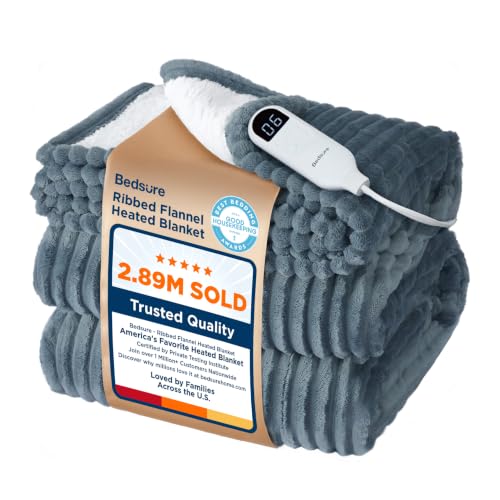


As an Amazon Associate we earn from qualifying purchases at no extra cost to you. Ratings are shown as listed on Amazon.
Quick comparison of the main heated-throw types
| Type | Typical size | Heat settings | Typical power | Best for | Main compromise |
|---|---|---|---|---|---|
| Standard plug-in throw | 50 × 60 in | 3–6 | 80–150 W | Sofas, recliners, reading chairs | Needs a nearby outlet |
| Oversized plug-in throw | 60 × 70 in or larger | 5–10 | 100–180 W | Two people or sofa-to-bed coverage | Heavier and less portable |
| Wearable heated wrap | Approximately 50 × 60 in, shaped or fastened | 3–6 | 80–150 W | Hands-free television, reading, desk work | Less useful as a conventional blanket |
| Battery-powered heated blanket | Usually 50 × 60 in | 3–5 | Varies by battery | Camping, patios, power outages | Limited runtime and extra battery cost |
These are market-typical ranges rather than specifications for one particular model. Sunbeam, Biddeford, Serta, Beautyrest, and Pure Enrichment are established names commonly associated with heated bedding and throws, but specifications vary considerably between their product lines. Check the label and manual for the exact model before buying.
Best heated throw blankets by situation
Best overall: a washable 50-by-60-inch plug-in throw
For ordinary sofa use, choose a standard throw with six or more heat levels, a detachable controller, a two- to four-hour automatic shutoff, and a soft polyester or microplush face. The 50-by-60-inch format covers the torso and legs of one seated adult without becoming awkwardly bulky.
Look for a controller with raised buttons or clear tactile markings. A bright display can be useful in daylight but distracting in a dark room, so a dim or display-free controller is often more comfortable for evening use. A single controller is adequate for a one-person throw; dual controls are generally unnecessary unless the blanket is large enough for two people.
Best for a large sofa or occasional bed use: an oversized throw
If you want one blanket to span a loveseat or cover your body while lying across a bed, consider a 60-by-70-inch or larger throw. Extra width improves coverage, but it also increases weight and the amount of fabric that must be washed. It may be a poor choice for a small recliner, where excess material can bunch near the floor or become trapped in moving parts.
For two people, do not assume that an oversized throw provides the same control as a heated blanket designed for a bed. One controller means both users receive the same temperature setting, and the heating zones may be concentrated toward the center rather than distributed evenly across the full width.
Best for camping and patios: a battery-powered heated throw
A battery-powered model makes sense where an outlet is unavailable, but it should be selected for runtime rather than the highest heat setting. Many use a separate rechargeable power bank or proprietary battery pack. Confirm whether the battery is included, whether it can be removed before washing, and whether charging uses USB-C or a model-specific adapter.
Battery blankets are usually less powerful than plug-in versions. They are useful for taking the chill off a lap or torso, not for replacing a sleeping bag or providing whole-body insulation. Keep the battery dry, protect its cable from sharp bends, and follow the manufacturer’s temperature and charging instructions outdoors.
What to compare before buying
Size and coverage
Measure the chair or sofa rather than relying on the word “throw.” A 50-by-60-inch blanket is roughly 20.8 square feet. If it is laid lengthwise over a 30-inch-wide recliner, it leaves approximately 15 inches of fabric on each side before accounting for folds. That is usually enough for a seated user, but not enough to tuck around two adults.
For bed use, place the throw on top of existing bedding and keep it below the shoulders. A throw is not a substitute for a fitted heated mattress pad, and it should never be tucked tightly around a sleeping person unless the instructions specifically permit that use.
Heat settings and warmth distribution
More settings offer finer adjustment, but the maximum number is less important than useful low and medium levels. A blanket with six settings may be easier to live with than one with ten settings if its increments are clearly spaced and the controller remembers the selected setting.
Inspect the construction when possible. Heating wires can feel more noticeable in thin fleece, while thicker sherpa or plush fabrics conceal them better but retain more heat and take longer to dry. A good design spreads warmth across the main body area rather than concentrating it in a narrow strip.
Controller and cable design
The controller should be detachable at the blanket connector, not permanently fixed to the fabric. A long enough cable allows the controller to rest beside a sofa user without pulling at the connector. Look for an insulated connector that does not create a hard lump under the neck or back.
Common annoyances include small unlabeled buttons, a controller that resets to a high setting after every power cycle, and a short lead that forces the blanket to sit close to the outlet. If two controllers are included, confirm that each one operates an independent heating zone.
Power use
Electric throws are relatively low-power appliances. For example, a 100-watt blanket used for three hours consumes:
0.1 kW × 3 hours = 0.3 kWh per use.
At an electricity rate of $0.20 per kWh, that is about six cents per use, or approximately $11 for 180 uses. Actual consumption may be lower if the thermostat cycles the heating elements or if you use a low setting. A 150-watt model used for four hours would consume 0.6 kWh, costing about 12 cents at the same rate.
Battery models require a different calculation because charging losses and battery capacity affect the result. Treat the advertised runtime as a maximum or low-heat estimate, particularly in cold outdoor conditions.
Safety features that should be non-negotiable
- Automatic shutoff, preferably with a selectable timer of at least two hours.
- Overheat protection and a thermostat-controlled heating system.
- Clearly marked electrical certification appropriate to your country.
- A detachable controller and removable battery or power pack before washing.
- A cable and connector that are not cracked, crushed, discolored, or unusually hot.
Do not fold or bunch a powered blanket, place heavy objects on it, sit directly on a controller, or use it with a damaged cord. Keep pets from chewing the cable. Follow the instructions concerning children, people with reduced heat sensation, and anyone who may not be able to respond quickly to overheating. If you have a health condition affecting temperature sensation or circulation, ask a qualified professional whether heated bedding is appropriate.
Washing, storage, and durability
Washability is valuable only when the electrical parts can be removed completely. Before washing, unplug the blanket, disconnect the controller, inspect the connector for moisture or damage, and follow the care label. Use a gentle cycle if permitted, avoid bleach and fabric softener unless the manufacturer allows them, and dry the blanket fully before reconnecting power.
The parts most likely to wear first are the controller buttons, cable near the connector, and fabric around the connector opening. Repeatedly pulling the blanket by its cord places stress on the wiring. Store it loosely folded or rolled; avoid sharp creases through the same heating zone every time. Never store it damp.
Plush fabrics can flatten before the heating system fails. That is mainly a comfort issue, but exposed or sharply felt wires are a reason to retire the blanket. Replace it if it develops hot spots, a persistent electrical smell, flickering operation, damaged insulation, or a controller that becomes unusually warm.
Bottom line
Choose a washable 50-by-60-inch plug-in throw with six or more settings for regular sofa use. Move up to an oversized version when coverage matters more than portability, and choose a battery model only when freedom from an outlet outweighs shorter runtime and higher ownership complexity. The best heated throw blankets are not necessarily the ones with the most heat levels; they are the ones with even warmth, an intuitive controller, dependable shutoff, removable electrical parts, and a size that fits the way you actually sit or sleep.



Write Your Review
No reviews yet. Be the first to share your experience!