
Key takeaways
- The best compression socks for hiking, compared by compression level, fabric, fit, and trail comfort — five knee-high picks for long days on the trail.
Long climbs, uneven ground, and hours on your feet ask a lot of your lower legs. A good pair of hiking compression socks supports the calf, helps manage the heavy-legged feeling that builds up over a long day, and stays in place inside a hiking boot instead of sliding down or bunching at the ankle. The wrong pair can be worse than a regular hiking sock: too tight and it distracts within the first mile, too loose and it offers nothing a normal sock does not.
The five socks in this guide are all knee-high graduated compression socks sold on Amazon, and they cover the two compression levels most hikers actually choose between: moderate 15-20 mmHg and firm 20-30 mmHg. They range from a budget single pair to a three-pair multi-pack and a premium merino-blend upgrade. Every pick below is described from its listing — compression level, fabric blend, sizing, and care instructions — so you can compare them on the same terms.
Compression level is a personal choice, not a badge of toughness. Firmer is not automatically better for hiking. A moderate sock you can wear comfortably for eight hours beats a firm sock you want to peel off at lunchtime. If you have a circulation condition, a history of blood clots, diabetes-related foot concerns, or any medical reason to wear compression, talk to a doctor before choosing a firm 20-30 mmHg sock. The guidance in this article is general hiking-gear advice, not medical advice.
Disclosure: As an Amazon Associate, we earn from qualifying purchases.
Quick Picks
Our Short List of 3
All 5 Picks at a Glance
| Product | Specs | Action |
|---|---|---|
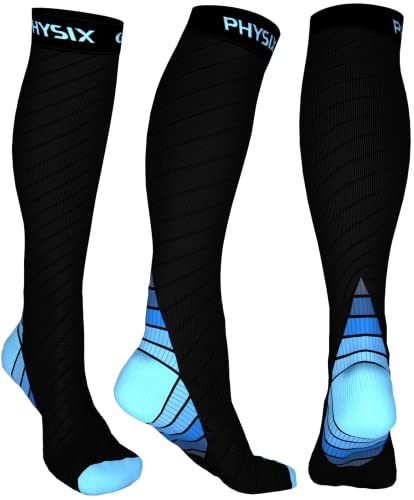
| 1. Physix Gear Sport Compression Socks — Best Overall Firm Compression | Check price on Amazon | |
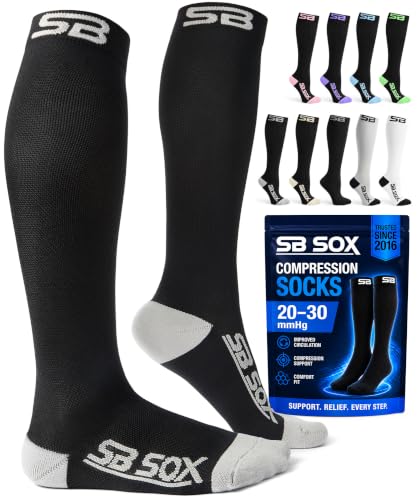
| 2. SB SOX Compression Socks — Best Fit for Wide Calves | Check price on Amazon | |
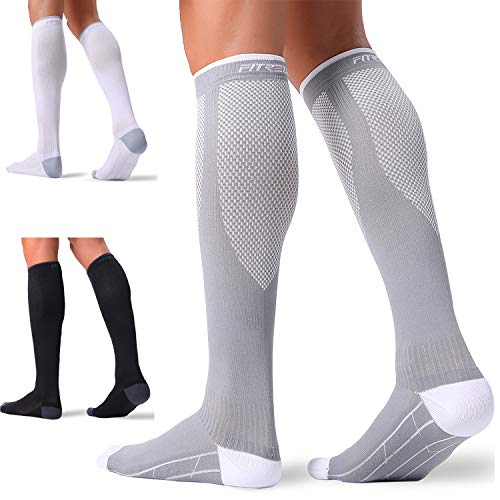 3. FITRELL Compression Socks, 3 Pairs — Best Multi-Pair Value | Check price on Amazon | |
 4. CHARMKING Compression Socks, 3 Pairs — Best Moderate Compression | Check price on Amazon | |
 5. Sockwell Elevation — Best Premium Merino Blend | Check price on Amazon |
In-Depth Reviews
1. Physix Gear Sport Compression Socks — Best Overall Firm Compression
Physix Gear Sport delivers true 20-30 mmHg graduated compression in a simple, no-frills knee-high sock, in sizes that cover a wide range of calves. The listing describes graduated compression that is strongest at the ankle and eases as it rises up the calf. The knit is nylon and spandex, with a seamless toe and double-stitched seams, and the heel and toe are reinforced — the two areas that take the most punishment inside a hiking boot.
Sizing is one of this sock’s genuine strengths: S/M, L/XL, and XXL, with the XXL fitting calves up to 24 inches. Getting the size right matters more here than with a regular sock — at 20-30 mmHg, a size too small is hard to put on and uncomfortable on a long climb, while a size too large will not hold its graduated pressure. Measure your calf at its widest point before ordering, and size up if you sit between sizes.
For hiking, the firm pressure is the point — and also the trade-off. The snug calf support is what many hikers want on long ascents, and the sock is built to stay up without rolling down over a full day. The plain nylon-and-spandex fabric is durable and easy to care for: the listing says machine wash cold and tumble dry low, more forgiving than the hand-wash-only care of several rivals here.
What it does not offer is natural-fibre comfort. There is no merino wool in this blend, so it will not regulate temperature or manage odour the way a wool-blend sock does. It is also a single pair per order, so building a rotation for a week-long hike means buying several pairs. But as a first firm compression sock for hiking, it is a proven option here: a clear compression rating, wide-calf sizing, and a fabric that is built to last.
2. SB SOX Compression Socks — Best Fit for Wide Calves
SB SOX takes a different approach to fit: instead of a generic small, medium, or large, its size chart pairs calf circumference with shoe size. Small covers an 11- to 14-inch calf, and the range runs through XX-Large at 20-24 inches, with a note to size up when your shoe size runs past the range for your calf. That two-number system is genuinely useful at 20-30 mmHg, where a small difference in calf size makes the difference between a sock that supports and a sock that strangles.
The sock itself is a knee-high, closed-toe design in 80% nylon and 20% spandex, with a cushioned sole and a reinforced, padded heel and toe. The listing states 20-30 mmHg graduated compression, strongest at the ankle and easing toward the knee, and describes a wide-calf fit as a deliberate feature. The cushioned foot is a real hiking advantage: inside a stiff hiking boot, a lightly cushioned sole adds a buffer on long descents, when your foot slides forward with every step.
Care is the main compromise: the listing says hand wash only, and at this pressure level that instruction is worth following — heat and agitation take the spring out of elastic fibres over time. On a multi-day hike that means a sink rinse and an overnight dry rather than a machine cycle. The cuff also sits high, and on shorter legs the top edge can land near the crease behind the knee, so check the length against your own leg before a long trip.
For all that, SB SOX earns its place as the fit-first pick: a proper calf-and-shoe size chart, sizes up to a 24-inch calf, a cushioned foot, and a dense nylon-spandex knit that holds its pressure.
3. FITRELL Compression Socks, 3 Pairs — Best Multi-Pair Value
FITRELL is the practical pick in this guide: three pairs of 20-30 mmHg knee-high compression socks in a single order, so you can rotate through a multi-day hike without washing every night. The listing describes graduated compression that helps relieve shin splints, joint and muscle stiffness, and fatigue, and that supports recovery after long days on your feet.
Sizing is by calf first, which is the right way to choose a compression sock. S/M fits a calf of 9-15 inches with men’s shoe sizes 6-8.5 and women’s 7-9.5, while L/XL fits a calf of 14-16 inches with men’s shoe sizes 9-12 and women’s 10-13. The listing suggests going one size smaller for tighter compression — but be cautious with that on a hiking trip, where a sock that is hard to put on in the morning will be harder still after a long day when your legs are tired and slightly swollen.
The knit is a lightweight, breathable microfibre nylon blend with moisture-wicking properties, designed to keep feet drier during long activity. That thin, light construction is a genuine hiking advantage in warm weather: it layers well inside a hiking boot without adding bulk, and it dries faster than a thick wool-blend sock. The trade-off is less cushioning and insulation than the merino-blend Sockwell, so on cold mornings or rough, rocky descents you may want a cushioned pick instead.
Three pairs also changes the economics of the whole guide. A single pair of premium compression socks can cost as much as this entire three-pack, so FITRELL is the sensible way to find out whether firm compression suits your hiking style before investing in a premium pair.
4. CHARMKING Compression Socks, 3 Pairs — Best Moderate Compression
CHARMKING is the only moderate-compression pick in this guide, and that is exactly why it belongs here. At 15-20 mmHg, it is the gentlest sock of the five, and for many hikers that is the right level: enough support to notice on a long day, without the effort of pulling on a firm 20-30 mmHg sock. If you are new to compression socks, or you want support for a long day hike rather than firm therapeutic pressure, start here.
The listing describes a three-pair pack of knee-high graduated compression socks in 85% nylon and 15% spandex, with 360-degree stretch, a breathable performance fabric, and a lightweight, form-fitting feel. The socks come in two unisex sizes — Small-Medium and Large-X-Large — with a wide range of colour options across the three pairs, and the listing notes they are recommended by trainers and suitable for running, cycling, hiking, travel, and long days on your feet.
That breadth is both the strength and the weakness of this pick. A sock designed for everything is not optimised for hiking specifically: there is no hiking-specific cushioning, no merino for temperature regulation, and no calf-circumference size chart, just two broad sizes. Sizing can run small, according to buyer feedback patterns, so measure your calf and check the size guide rather than assuming your usual sock size will fit.
What CHARMKING does offer is an easy first step into compression for hiking: three pairs, moderate pressure, a breathable nylon-spandex knit, and a very large base of buyer feedback behind it. For a day hiker who wants a little extra support without committing to firm compression, it is the most forgiving choice in this guide.
5. Sockwell Elevation — Best Premium Merino Blend
Sockwell Elevation is the premium pick in this guide, and the difference is in the fabric. Where the other four socks are built from nylon and spandex, the Elevation is a 31% merino wool, 31% rayon from bamboo, 30% nylon, and 8% spandex blend, made in the USA. That merino-bamboo knit is softer against the skin, regulates temperature better across a day that starts cold and ends warm, and manages odour better than a purely synthetic sock — three things that matter on a multi-day hike.
The compression is firm: 20-30 mmHg graduated, strongest at the ankle and easing up the calf, in a knee-high, over-the-calf design with a seamless toe, arch support, and an ultralight cushioned sole. The arch support is a thoughtful addition for hikers, since the arch takes a beating on long descents. The version linked here is the women’s Elevation; a men’s version is sold separately, so make sure you order the right cut.
Sizing is by shoe size rather than calf circumference, which is the main weakness of this pick at firm pressure. Calf size matters more than shoe size when the pressure is 20-30 mmHg, and there is no wide-calf option, so hikers with large calves for their shoe size should consider the SB SOX or Physix Gear instead. Care is also more demanding: the listing says hand wash only, and merino needs gentler washing than nylon in any case.
For the hiker who already knows firm compression works for them and wants the most comfortable version of it, the Elevation is the upgrade. It is sold as a single pair, so it is not a rotation pack — it is the one pair you reach for on the biggest day of the trip.
How to Choose Compression Socks for Hiking
Choosing the right compression sock for hiking comes down to compression level, fit, fabric, and height.
Compression level: 15-20 or 20-30 mmHg. The mmHg number is the pressure the sock applies, measured in millimetres of mercury. A 15-20 mmHg sock is moderate: noticeable support that most healthy hikers can wear all day without thinking about it. A 20-30 mmHg sock is firm: stronger support, but harder to put on and more demanding to wear for eight hours. If you are new to compression, start with 15-20 mmHg — the CHARMKING in this guide — and only move up to 20-30 mmHg if you want more support and have tried moderate compression first. If you have a medical condition that affects circulation, ask a doctor which level is appropriate before buying a firm sock.
Fit: measure your calf, not just your shoe size. Compression only works when the pressure gradient is right, and that depends on the sock matching your calf. Measure your calf at its widest point, in the morning before your legs swell, and compare it against the listing’s size chart — not against your usual sock size. If you fall between sizes, size up: a slightly looser compression sock still supports, while a too-tight one is miserable. Wide-calf hikers should prioritise the SB SOX, with its calf-and-shoe chart and sizes up to a 24-inch calf, or the Physix Gear XXL. And check the length: a knee-high sock should end just below the knee, not in the crease behind it.
Fabric: synthetic, merino blend, or a mix. Pure nylon-and-spandex socks, like the Physix Gear, SB SOX, and FITRELL, are durable, dry fast, and easy to wash. Merino-blend socks, like the Sockwell Elevation, are softer, regulate temperature better, and manage odour better on multi-day trips, but need gentler care. For warm-weather hiking, a thin synthetic sock is hard to beat. For cold mornings and multi-day trips where you cannot wash often, merino earns its keep.
Height and construction: knee-high, cushioned, and seamless. For hiking, knee-high is the standard: it covers the whole calf, which is where graduated compression does its work, and it protects the shin inside a tall hiking boot. Look for a seamless toe, which reduces the risk of blisters on long descents, and a reinforced heel and toe, which are the first places a hiking sock wears through. A cushioned sole, like the one on the SB SOX and the ultralight cushioning on the Sockwell, adds comfort on rocky ground; a thin sock, like the FITRELL, layers better inside a tight boot.
Pack size and rotation. One pair is enough for a day hike. For a multi-day trip, you want at least two pairs — one to wear, one drying — and ideally three. That is where the three-pair packs in this guide, FITRELL and CHARMKING, make sense. Whichever you choose, break the socks in before a big trip: wear them on a training walk first, check for rubbing at the toe seam and the top band, and make sure you can get them on and off without a struggle when your legs are tired.
A note on hiking-specific claims. Most compression socks are not designed for hiking alone — they are sold for running, travel, nursing, and everyday wear as well. That does not make them unsuitable for hiking; the features that matter on the trail (graduated pressure, a knee-high cut, a seamless toe, a durable heel and toe) are the same features that matter in those other uses. Judge each sock on its listed specs, not on a hiking label.
Frequently Asked Questions
Are compression socks good for hiking?
For many hikers, yes. A knee-high graduated compression sock supports the calf during long climbs and descents, and many hikers find it helps with the heavy, tired feeling that builds up over a long day on the trail. It is not a substitute for fitness, good boots, or proper pacing, and it will not prevent blisters or sore knees on its own. If you have a medical condition affecting your legs or circulation, check with a doctor before relying on compression for hiking.
What compression level should I choose for hiking?
Most hikers start with 15-20 mmHg, which is moderate support that is comfortable for a full day. The 20-30 mmHg level is firmer and gives stronger support, but it is harder to put on and can feel too tight if the fit is not right. Choose 15-20 mmHg if you are new to compression or want support for day hikes. Choose 20-30 mmHg if you have worn compression before and have measured your calf against the size chart. Never size down to get more pressure — a too-tight sock is uncomfortable and counterproductive.
Should compression socks for hiking be knee-high or crew length?
Knee-high is the better choice for hiking. Graduated compression works by applying pressure along the full calf, strongest at the ankle and lighter toward the knee, and a crew-length sock cannot cover that whole area. Knee-high socks also protect the shin inside a tall hiking boot and stay in place better on long climbs.
How do I wash compression socks on a multi-day hike?
Follow the listing’s care instructions first. Machine-washable socks, like the Physix Gear, can go through a cold wash and tumble dry low. Hand-wash-only socks, like the SB SOX and Sockwell, should be rinsed in cool water with a little soap, gently squeezed — never wrung out hard — and hung to dry overnight. Avoid hot water and high dryer heat, which degrade the elastic fibres. On a multi-day trip, carry at least two pairs so one can dry while you wear the other.
Verdict
The best compression socks for hiking depend on how much support you want and how your calves measure. If you want firm support and a proven, durable sock, start with the Physix Gear Sport: 20-30 mmHg, wide-calf sizing up to 24 inches, and machine-washable fabric. If your calves have never matched a standard size chart, the SB SOX is the fit-first alternative, with its calf-and-shoe sizing and cushioned foot. For a multi-day rotation, the FITRELL three-pack gives you firm compression in three pairs, while the CHARMKING three-pack is the gentlest introduction at 15-20 mmHg. And if you already know firm compression works for you and want the most comfortable version of it, the Sockwell Elevation’s merino-bamboo blend is the premium upgrade.
Whichever pair you choose, measure your calf before you order and break the socks in on a training walk. The right compression sock should disappear into your hiking setup — supportive on the climb, comfortable on the descent, and dry by morning.
More from Amazon
Programs that pair well with the guide above. Offers and eligibility are set by Amazon and may change.
Free shipping on eligible items, Prime Video and more. Eligible new members can start with a free trial.
Start a Prime free trialA Prime membership for ages 18-24 with a trial period. Eligibility is set by Amazon.
See Prime for Young AdultsAudiobooks and podcasts to listen to on the go. Eligible new members can start with a free trial.
Try Audible freeAd-free music streaming. Eligible new subscribers can start with a free trial.
Try Music Unlimited freeAs an Amazon Associate we earn from qualifying purchases.

Write Your Review
No reviews yet. Be the first to share your experience!