

Key takeaways
- Compare portable bubble balancers and a compact electronic spin balancer for home tire swaps, with hub ranges, static-balance limits and setup tips.
As an Amazon Associate we earn from qualifying purchases.
Anyone who mounts tires at home eventually faces the same question: how to balance the finished wheel without a trip to a tire shop. A wheel balancer sized for a home garage answers it in one of two ways. Portable bubble balancers use a bull’s eye level and gravity to find the heavy spot on a stationary wheel, while a small electronic spin balancer rotates the wheel and calculates correction weight for both rim faces. This guide compares four portable bubble balancers and one compact electronic machine, with the hub and rim ranges that decide fit, and an honest account of what each type can and cannot correct.


Affiliate Disclosure: This article contains affiliate links. If you buy through a link on this page, we may earn a commission at no extra cost to you.
Static Balance, Dynamic Balance, and the Honest Limit of a Bubble
Balancing vocabulary matters before any product comparison, because the two machine types in this guide do different jobs. Static imbalance is a single heavy spot that makes a stationary wheel want to rotate until the heavy spot hangs at the bottom. A bubble balancer corrects exactly this: the wheel sits horizontally on a pivoting cone, the heavy side tips the head, and the bubble drifts away from center until clip-on weights on the light side bring it back.
Dynamic imbalance is different. It is a couple imbalance — one heavy spot on the inner rim face and another, offset, on the outer face — that only appears when the wheel spins, producing a wobble rather than a simple bounce. A bubble balancer cannot detect or correct a couple imbalance, because the wheel never rotates during the check. That limitation should be stated plainly: a bubble balancer performs static balance only. On narrow steel wheels and older light-truck fitments, static correction is often enough to remove a noticeable shake. On wide modern alloy wheels, a residual steering-wheel shimmy at highway speed after a careful bubble balance usually points to couple imbalance, and the fix is a spin balancer, not more patience with the bubble.
The electronic machine in this guide spins the wheel on a shaft and measures both planes, which is why it carries a rim diameter range instead of a hub range and needs mains power, a level mounting surface, and periodic self-calibration with a reference weight.
The Level-Floor Discipline Every Bubble Balancer Demands
A bubble balancer is a level measuring a level problem, so the floor underneath it is part of the instrument. The base must sit on a flat, hard, level patch of concrete; a sloped garage floor, a cracked pad, or a sheet of plywood under one edge will bias every reading the tool gives. The working routine is consistent across the four bubble models below. Assemble the shaft and cone set, set the balancer down, and confirm the bubble centers with nothing mounted — that is the zero check. Rotate the empty head a quarter turn and check again; a bubble that follows the rotation indicates a floor or base problem, not a balancer fault. Only then mount the wheel, let the head settle fully, tap the base lightly to break pivot friction, and read the bubble. Weights go on the rim flange on the side the bubble leans away from, in small increments, rechecking after each addition. Rushing the settle time is the most common home-garage error: a head that is still rocking gives a reading that belongs to the last nudge, not to the wheel.
Two further habits separate a good result from a frustrating one. First, clean the hub bore and the cone before mounting, because a single chip of rust under the cone tilts the wheel and invents an imbalance that is not there. Second, recheck after rotating the wheel 180 degrees on the cone; a genuine heavy spot stays with the wheel, while a seating error moves.
1. Acymner Portable Bubble Wheel Balancer
The Acymner follows the classic portable pattern: an aluminum alloy base with a rust-resistant enamel finish, chrome-plated rods and springs, and a machined head carrying a bull’s eye level. It is a static-only bubble balancer for hubs from 1-1/2 to 4 inches, which covers the center bores of most passenger cars and light trucks. The base diameter is 11.5 inches and the assembled height is 24 inches, so it stores on a shelf or in a corner rather than claiming floor space, and at roughly 11 pounds it is easy to carry to wherever the wheel work is happening.
Specs
- Type: Portable bubble balancer (static balance only)
- Hub range: 1-1/2 to 4 in diameter
- Base: Aluminum alloy, rust-resistant enamel finish, 11.5 in diameter
- Assembled height: 24 in
- Center rod diameter: 0.813 in
- Weight: Approx. 11 lb
- Power: None required
2. Hkysnoa Portable Bubble Wheel Balancer
The Hkysnoa is another static bubble balancer built on the same proven layout, with an anti-rust enamel-finished base and a machined aluminum head. Its hub range is likewise 1-1/2 to 4 inches, aimed at most automobiles and light trucks. The enamel base finish is the detail worth noting for garages that double as storage for damp outdoor gear: the coating is there to keep the base from corroding between uses, which matters because a corroded, uneven base quietly destroys the level-floor discipline described above. As with every bubble unit here, the honest note applies — it corrects static imbalance only and cannot address a dynamic couple imbalance on wide wheels.
Specs
- Type: Portable bubble balancer (static balance only)
- Hub range: 1-1/2 to 4 in diameter
- Base: Steel with anti-rust enamel finish
- Head: Machined aluminum
- Level: Built-in bull’s eye bubble level
- Application: Automobiles and light trucks
- Power: None required
3. DASBET Portable Bubble Wheel Balancer
The DASBET variant distinguishes itself in the head hardware: a machine steel head with plated steel guide rods and zinc support springs, where several rivals use aluminum at the head. Steel at the pivot head is a durability choice — the head is the part that takes the knocks when wheels are lifted on and off — while the base stays aluminum to keep the tool portable. Hub capacity is 1.5 to 4 inches (38 to 102 mm), the center rod is 0.813 inches (20.7 mm), and the assembled tool stands 24 inches tall on an 11.5-inch base at about 11 pounds (5 kg). It remains, like the other bubble models, a static-only instrument whose accuracy is earned through a level floor, a clean cone, and unhurried settle time.
Specs
- Type: Portable bubble balancer (static balance only)
- Hub capacity: 1.5 to 4 in (38 to 102 mm)
- Head: Machine steel
- Guide rods: Plated steel with zinc support springs
- Center rod diameter: 0.813 in (20.7 mm)
- Dimensions: 24 in high, 11.5 in base diameter
- Weight: Approx. 11 lb (5 kg)
4. ATPEAM Portable Bubble Wheel Balancer

The ATPEAM rounds out the bubble group with an aluminum alloy base under an anti-rust enamel finish and chrome-plated, blackened rods and springs. Its stated fitment again centers on hubs from 1-1/2 to 4 inches for cars and light trucks, with a 24-inch assembled height, an 11.5-inch base, and a 0.813-inch center rod. Listing data for this pattern of balancer notes a hub flange diameter of about 1.495 inches at the cone seat, which is the dimension to compare against a wheel’s center bore before assuming a fit. Buyers choosing among these four bubble models are really choosing build details — head material, spring and rod finish, and how the base coating suits their garage — because the balancing method, the hub range, and the static-only limit are shared across all of them.
Specs
- Type: Portable bubble balancer (static balance only)
- Hub range: 1-1/2 to 4 in diameter
- Base: Aluminum alloy with anti-rust enamel finish
- Rods and springs: Chrome-plated and blackened
- Assembled height: 24 in
- Base diameter: 11.5 in
- Center rod diameter: 0.813 in
- Weight: Approx. 11 lb
5. MechMaxx WB857 Electronic Wheel Balancer
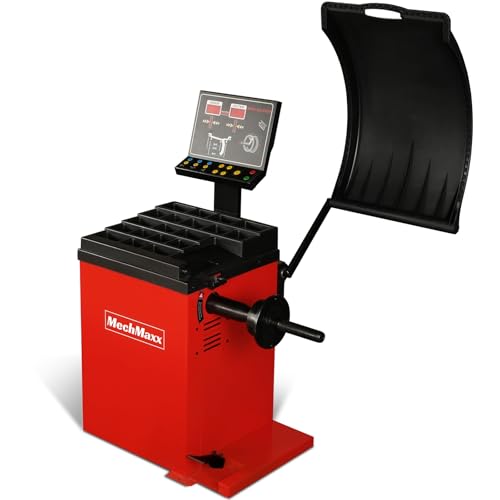
The WB857 is the step up for garages that balance wheels often enough that couple imbalance matters. It is a motorized electronic spin balancer on a 40 mm shaft, covering rim diameters from 10 to 24 inches, with a foot pedal brake and a laser guide with LED illumination to show where the correction weight belongs on the rim. Because it measures the spinning wheel in two planes, it performs the dynamic balancing that no bubble balancer can, and it indicates weight amount and position digitally instead of asking the operator to iterate against a bubble. The trade-offs are the expected ones: it needs mains power, a fixed and level spot in the garage, and a motorcycle rim adapter is a separate accessory rather than part of the base machine. For a household running several vehicles or project cars, it is the only pick here that closes the dynamic-balance gap; for a single set of winter wheels swapped twice a year, it is more machine than the job asks for.
Specs
- Type: Electronic spin balancer (dynamic and static modes)
- Rim diameter range: 10 to 24 in
- Shaft size: 40 mm
- Brake: Foot pedal brake
- Weight placement: Laser guided with LED illuminator
- Model: WB857 (manufacturer part 200010)
- Motorcycle adapter: Optional, sold separately
- Power: Mains powered
How to Choose Between Them
Start with the wheel, not the tool. Measure the center bore: if it falls inside 1-1/2 to 4 inches, any of the four bubble balancers will physically mount the wheel. Then decide how much balance the vehicle actually needs. Narrow wheels on a trailer, a farm truck, or an older car are realistic bubble-balancer work. Wide, low-profile alloys on a daily driver are where static-only correction most often leaves a highway-speed shimmy behind, and that is the case for the MechMaxx. Frequency settles the rest: occasional seasonal swaps favor a portable tool that stores on a shelf, while weekly wheel work justifies the electronic machine’s footprint and calibration routine.
Whichever type is chosen, budget bench space for the supporting supplies the listings do not bundle: an assortment of clip-on weights in the rim style the vehicle uses, a weight hammer or pliers for fitting and removing them, and a valve-core tool and pressure gauge so the tire is at a consistent pressure before balancing. An unbalanced reading taken on a soft tire is a reading of the tire’s shape that day, not of the wheel.
A Note on Recalls
Wheel balancers are a mature, low-incident tool class. A check of the U.S. Consumer Product Safety Commission recall records for wheel and tire balancers returned no recalls covering any model in this guide. The realistic hazards are procedural rather than product defects: a wheel that is not seated squarely on the cone, a balancer rocked by an unlevel floor, and loose clip-on weights fitted to the wrong rim flange style. The discipline sections above address each of those directly.
Frequently Asked Questions
Can a bubble balancer replace a shop spin balance entirely?
For static imbalance, yes; for dynamic couple imbalance, no. A bubble balancer cannot see an offset pair of heavy spots on opposite rim faces. If a careful bubble balance still leaves a speed-dependent shimmy, the remaining fault is dynamic and needs a spin balancer such as the WB857.
Why does the bubble never settle in the same place twice?
Usually the floor or the seating, not the wheel. Check the empty-head zero at two rotations, clean the cone and hub bore, let the head settle fully, and tap the base lightly to break pivot friction before reading.
Do these balancers work on motorcycle wheels?
The bubble models here are hub-type tools sized for car and light-truck center bores, not motorcycle axles. The WB857 accepts an optional motorcycle adapter sold separately; dedicated motorcycle balancing stands are a separate tool class.
What weights should be used with a bubble balancer?
Clip-on weights matched to the rim flange style — steel-wheel and alloy-wheel clip profiles differ. Add weight in small steps on the light side, opposite the direction the bubble leans, and recheck after each change.
Bottom Line
For most home garages, a portable bubble balancer is the sensible default: the Acymner, Hkysnoa, DASBET, and ATPEAM all deliver static balancing for 1-1/2 to 4 inch hubs with no power, no calibration, and shelf-sized storage, differing mainly in head material and finish. Their shared limit is real and worth repeating — static balance only, never dynamic. Garages that balance wide modern wheels regularly, or that have chased a highway shimmy a bubble could not fix, should look at the MechMaxx WB857, whose two-plane electronic measurement is the capability the bubble tools structurally lack.
More from Amazon
Programs that pair well with the guide above. Offers and eligibility are set by Amazon and may change.
Free shipping on eligible items, Prime Video and more. Eligible new members can start with a free trial.
Start a Prime free trialA Prime membership for ages 18-24 with a trial period. Eligibility is set by Amazon.
See Prime for Young AdultsAudiobooks and podcasts to listen to on the go. Eligible new members can start with a free trial.
Try Audible freeAd-free music streaming. Eligible new subscribers can start with a free trial.
Try Music Unlimited freeAs an Amazon Associate we earn from qualifying purchases.

Write Your Review
No reviews yet. Be the first to share your experience!