

Key takeaways
- Compare TPMS relearn tools for home use: GM and Ford trigger tools, an OBD reset tool for Asian imports, plus tools that activate and program sensors.
As an Amazon Associate we earn from qualifying purchases.
Rotate your tires or swap a winter wheel set onto a modern car and the tire pressure warning light often stays on, not because a tire is low, but because the car no longer knows which sensor sits at which corner. A TPMS relearn tool fixes that by waking each sensor up in the order the car expects, so the ECU can register the sensor IDs and their positions.

Two limits are worth stating before any product names. First, a simple trigger tool cannot program a blank sensor. Trigger tools only wake up sensors that are already programmed for the vehicle; writing an ID or a vehicle protocol to a new universal sensor takes a programming tool, and each programming tool only supports the sensor brands its maker lists. Second, a relearn is not a diagnosis. If a sensor battery has died or a sensor is damaged, no relearn procedure will register it, and the light will come back. The tools below cover the full range, from one-button triggers for a single brand to workshop-style tools that read sensor data, program replacements, and write IDs through the OBD port.
Affiliate Disclosure: This article contains affiliate links. If you buy through them, we may earn a commission at no extra cost to you.
How TPMS relearns actually work
Cars learn sensor positions in three ways, and the right tool depends on which one your car uses. Many GM and Ford models use a stationary relearn: you put the car into learn mode, then trigger each sensor in a set order, usually starting at the front left, and the horn chirps as each sensor registers. Some cars relearn automatically while driving. Others, including most Asian imports, keep the sensor IDs stored in the ECU and require those IDs to be written through the OBDII port whenever a sensor is replaced. A trigger tool handles the first case only. An OBD reset tool handles the third. Full-service tools combine triggering, reading, and OBD writing in one unit.
Frequency matters too. North American sensors transmit on 315 MHz, while many European and some newer applications use 433 MHz. Every tool below works with both frequencies where the maker states it, but a tool can only activate a sensor that is already programmed for your car.
1. JDIAG EL-50448 — the one-button GM trigger
The EL-50448 is the tool pattern GM dealers use for stationary relearns, and JDIAG’s version keeps the format simple: one button, one job. You put the vehicle into TPMS learn mode, hold the tool against the tire sidewall next to the valve stem, and press the button to activate the sensor. Move around the car in the order the vehicle specifies and each sensor registers in turn.
Coverage is deliberately narrow. This is a GM tool, aimed at Buick, Chevrolet, Cadillac, GMC, and Opel vehicles with 315 MHz or 433 MHz sensors. It has no screen, reads no sensor data, and cannot program a replacement sensor. If your only TPMS chore is a seasonal wheel swap or a rotation on a GM car, that narrow focus is exactly the point; if you own anything else, skip to the tools further down the list.
Specs
- Model: EL-50448 (OEC-T5)
- Vehicle coverage: GM brands — Buick, Chevrolet, Cadillac, GMC, Opel
- Sensor frequency: 315 MHz and 433 MHz
- Function: sensor activation for stationary relearn only
- Programming: none — cannot program or write sensor IDs
- Display: none, single-button operation with indicator light
2. JDIAG Super EL50448 — one trigger for GM and Ford households
The Super EL50448 adds a second mode to the same one-button format, so a single tool covers both GM and Ford vehicles. Separate indicator lights mark the GM mode and the Ford mode, and holding the power button for about five seconds switches between them. Ford coverage extends to Lincoln, Mercury, and Mazda models that share Ford’s relearn procedure, alongside the Ford range itself.
Like the GM-only version, this is a trigger and nothing more. It activates sensors during a stationary relearn, and the maker is explicit that it cannot program sensors, so replacements must arrive pre-programmed and matched to the vehicle’s frequency. It is also a light-duty tool: JDIAG states it is not made for heavy trucks or vehicles with more than four tires. Power comes from a 9V battery that is not included, and the maker stresses using a fresh battery, because a weak one reduces the activation signal strength.
Specs
- Model: Super EL50448 (part US-SU-super 50448)
- Vehicle coverage: GM (Buick, Cadillac, Chevrolet, GMC, Opel) and Ford (Ford, Lincoln, Mercury, Mazda)
- Sensor frequency: 315 MHz and 433 MHz
- Function: sensor activation for stationary relearn, GM and Ford modes
- Programming: none — cannot program sensors
- Power: 1 x 9V battery, required, not included
- Dimensions: 2.12 x 1.25 x 6.02 in; weight 5 oz
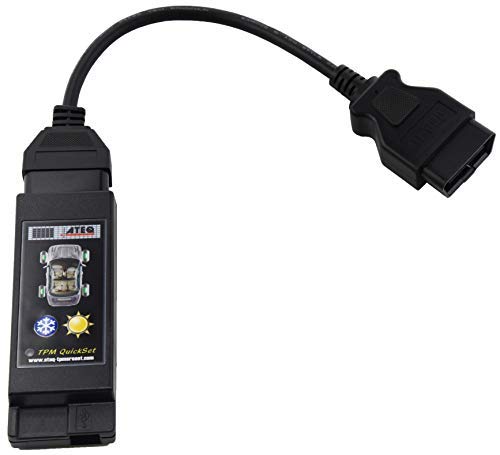
3. ATEQ Quickset — OBD reset for Asian imports
Most Asian imports do not offer a button-press learn mode at all. Their ECUs store the four sensor IDs, and when you fit a second wheel set or replace a sensor, the stored IDs have to be rewritten through the OBDII port. That is the single job the ATEQ Quickset does. It connects to the car’s OBDII port and to a PC, and it writes the sensor IDs you supply into the ECU so the warning light clears after a rotation, a seasonal swap, or a sensor replacement.
The honest caveat is in the workflow: the Quickset does not activate or read sensors itself. You need the sensor IDs from the sensor labels or from any activation tool that can read them, and you enter or transfer those IDs through ATEQ’s PC software. Owners who swap between summer and winter sets on a Toyota, Honda, or Nissan often keep one ID set saved per wheel set, which turns the seasonal change into a short OBD session instead of a dealer visit. If your car is a GM or Ford with a stationary learn mode, this tool is not the one you need; if your import demands OBD ID writing and you already have a way to read IDs, it fills the gap the trigger tools cannot.
Specs
- Model: ATEQ Quickset (part OBD3-0000)
- Vehicle coverage: most Asian import vehicles
- Function: writes sensor IDs to the ECU via the OBDII port to reset the TPMS system
- Sensor activation: none — sensor IDs are supplied via PC software
- Connection: OBDII cable to vehicle, USB to PC
- Typical use: seasonal wheel swaps and sensor replacement on import vehicles
4. ATEQ VT37 — activation and programming across sensor brands
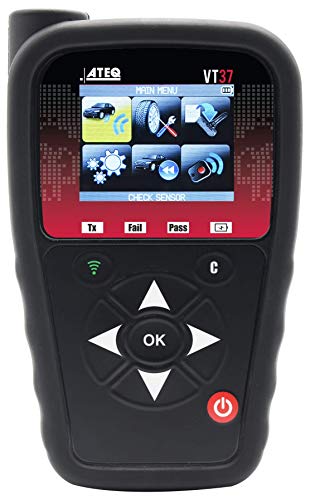
The VT37 is the step up from trigger tools: a handheld unit with a color screen that activates and reads sensors, then shows you what it found. In seconds it displays the sensor ID, tire pressure, tire temperature, battery status, and frequency, which turns the pre-relearn check into a real inspection — a sensor with a dead battery shows itself before you waste time on a relearn that cannot succeed.
Where the VT37 separates itself from the Autel below is programming breadth. It programs more than 20 universal aftermarket sensor brands, including Schrader EZ-sensor, Huf IntelliSens, Alligator, Hamaton, and VDO REDI-Sensor, and it can write a new ID or clone an existing one. On-screen relearn procedures cover manual, automatic, and indirect methods, and for domestic and European vehicles with those procedures it works as a standalone reset tool. For imports whose relearn requires writing IDs through OBD, ATEQ directs you to pair it with a Quickset or a bidirectional scan tool, since the base VT37 has no OBD connection of its own. Quarterly database updates arrive through the PC software, and the listing includes two years of software updates.
Specs
- Part number: VT37-0000
- Display: 2.8 in color screen
- Radio reception: 315 MHz and 433 MHz
- Sensor data shown: ID, pressure, temperature, battery status, frequency
- Programming: 20+ universal aftermarket sensor brands, new or cloned IDs
- Relearn: on-screen manual, automatic, and indirect procedures; standalone reset for domestic and European vehicles
- Power: rechargeable lithium-ion battery, included
- Updates: quarterly via PC software; two years of software updates included
- Weight: 12.8 oz
5. Autel MaxiTPMS TS508WF — the full-service option

The TS508WF is Autel’s complete TPMS service tool in a handheld body. It activates and reads all known OE and aftermarket sensors, checks TPMS system health, and reads and clears TPMS fault codes, so it covers the diagnostic side that relearn-only tools leave out. All three relearn methods are built in: stationary relearn, automatic relearn, and OBD relearn, which writes the sensor IDs directly to the ECU through the OBD port — the step that import vehicles require and that the VT37 needs a partner tool for.
Programming is the one boundary to understand before buying. The TS508WF programs Autel MX-Sensors, the maker’s own dual-frequency 315/433 MHz universal sensors, and no other brand of universal sensor. If your shop standardizes on MX-Sensors, that is no hardship, and the tool can copy an old sensor’s ID to a new MX-Sensor so the car often needs no relearn at all. If you need to program Schrader, Huf, or other universal brands, the ATEQ above is the correct pick instead. Updates are the Autel’s other strong point: it refreshes over WiFi with free lifetime updates according to the listing, so there is no PC tether in the update process.
Specs
- Model: Autel MaxiTPMS TS508WF
- Activation: triggers and reads all known OE and aftermarket TPMS sensors
- Programming: Autel MX-Sensors only, 315 MHz and 433 MHz
- Relearn: stationary, automatic, and OBD relearn with ID writing via OBD
- Diagnostics: TPMS system health check, read and clear TPMS fault codes
- Updates: WiFi, free lifetime updates per the listing
How to choose
Start with your car’s relearn method, not with the tool. Check the owner’s manual: if the car has a learn mode and a stated sensor order, a trigger tool is enough, and the only question is brand coverage — the JDIAG EL-50448 for GM-only households, the Super EL50448 if a Ford shares the driveway. If the car stores IDs in the ECU and has no learn mode, you need OBD writing: the ATEQ Quickset if you already have the IDs, or the Autel TS508WF if you want reading, writing, and code diagnostics in one unit.
Choose a programming tool when you replace sensors rather than just rotating them, and match the tool to the sensor brand you intend to fit. The VT37 covers the widest spread of universal sensor brands; the TS508WF is committed to Autel MX-Sensors in exchange for OBD relearn and code reading. In every case, remember the two limits from the top: a trigger cannot program a blank sensor, and a relearn cannot revive a dead one. Check sensor battery status with a reading tool first, and the relearn that follows will usually take minutes.
More from Amazon
Programs that pair well with the guide above. Offers and eligibility are set by Amazon and may change.
Free shipping on eligible items, Prime Video and more. Eligible new members can start with a free trial.
Start a Prime free trialA Prime membership for ages 18-24 with a trial period. Eligibility is set by Amazon.
See Prime for Young AdultsAudiobooks and podcasts to listen to on the go. Eligible new members can start with a free trial.
Try Audible freeAd-free music streaming. Eligible new subscribers can start with a free trial.
Try Music Unlimited freeAs an Amazon Associate we earn from qualifying purchases.


Write Your Review
No reviews yet. Be the first to share your experience!