

Our Short List of 3

- Feed type: Gravity feed, with siphon pickup capability in kit form
- Operating pressure: 90 PSI; maximum 150 PSI
- Required compressor: At least 4 CFM at 90 PSI, per maker
- Nozzle: Ceramic nozzle
- Feed type: Gravity feed
- Operating pressure: 90 PSI
- Required compressor: 7 SCFM at 90 PSI, per maker figures
- Nozzle: Replaceable steel nozzle, 5.0 mm class
- Feed type: Siphon feed with pickup tube
- Hose length: 10 feet
- Required compressor: About 9 CFM at 90 PSI, per published model figures
- Model: AT122601AV
All 4 Picks at a Glance
| Product | Specs | Action |
|---|---|---|
| 1. LE LEMATEC AS118 Portable Sand Blaster Gun Kit — flexible gravity gun for detail work |
| Check price on Amazon |
| 3. NEIKO 30068A Air Sand Blaster Gun — simple gravity gun for occasional jobs |
| Check price on Amazon |
| 4. Campbell Hausfeld AT122601AV Siphon Feed Sand Blaster — continuous pickup from a bucket |
| Check price on Amazon |
 5. VEVOR 20 Gallon Sand Blaster, model FF-Q903 — pressure pot for large surfaces |
| Check price on Amazon |
Key takeaways
- Compare the best sand blasters for rust and paint removal, from gravity guns to a 20-gallon pressure pot, with CFM needs, media types and safety notes.
As an Amazon Associate we earn from qualifying purchases.
A sand blaster does work that wire wheels, flap discs and chemical strippers struggle with: it reaches into corners, follows curves, and leaves a uniform profile that primer can grip. The trade-off is that blasting is unforgiving about setup. Match the wrong feed type to the job, undersize the compressor, or load the wrong media, and the gun sputters, clogs, or barely marks the surface. This guide compares five distinct designs — three gravity-feed guns, one siphon-feed gun, and one wheeled pressure-pot system — so the choice starts with how much surface needs cleaning and how much air is available to clean it.
Affiliate Disclosure: This article contains affiliate links. If you buy through a link, we may earn a commission at no extra cost to you.
Safety first: silica dust and respiratory protection
Blasting creates airborne dust from both the media and the coating being removed, and that dust is the main hazard of the work. Never use ordinary play sand or beach sand as blasting media. Those sands contain free crystalline silica, and breathing silica dust can cause silicosis, a serious and irreversible lung disease. Every blaster in this guide accepts manufactured abrasives — aluminum oxide, glass bead, garnet, baking soda, or crushed walnut shell, depending on the model — that are sold specifically for blasting. Use those products instead, and check the media bag for its own safety data before loading.
A respirator is required equipment, not an optional accessory. Work with a properly fitted respirator rated for fine particulate, sealed eye protection or a blasting hood, heavy gloves, and hearing protection. Blast outdoors or with strong extraction, keep bystanders out of the dust plume, and remember that old paint can contain lead: if a coating is suspected to contain lead, stop and follow local testing and disposal rules rather than turning it into airborne dust. Treat every pressurized pot and hose as stored energy: depressurize before opening a tank, refilling media, or changing a nozzle.
How the three feed types differ
Gravity-feed guns carry a small hopper on top of the gun. Media falls into the airstream by weight, which gives a simple, self-contained tool for spot rust, small parts, and touch-up work. The limit is capacity: a hopper measured in ounces empties quickly on a large panel, so gravity guns suit intermittent work best.
Siphon-feed guns draw media up a pickup tube from a separate bucket or bag. The gun itself stays light, the supply can be much larger than a top hopper, and the operator can keep blasting without stopping to refill the gun. The trade-off is a hose to manage and a gentler media delivery than a pressurized system.
Pressure-pot blasters pressurize the media tank itself. Air pushes abrasive through the hose under pressure, producing a denser, more consistent stream that strips large, heavily corroded surfaces faster. Pots need far more compressor capacity, take longer to set up and depressurize, and create more mess, so they belong on frames, trailers, gates, and machinery rather than on a single rusty bolt.
1. LE LEMATEC AS118 Portable Sand Blaster Gun Kit — flexible gravity gun for detail work
- Feed type: Gravity feed, with siphon pickup capability in kit form
- Operating pressure: 90 PSI; maximum 150 PSI
- Required compressor: At least 4 CFM at 90 PSI, per maker
- Nozzle: Ceramic nozzle
The LE LEMATEC AS118 is the most versatile handheld option here. In gravity mode it works as a compact spot blaster for brackets, hardware, and small rust patches, and the kit form also supports siphon-style pickup for longer runs. A ceramic nozzle resists wear better than a plain steel tip, and the light body suits overhead or vertical work.
The maker states a minimum of 4 CFM at 90 PSI for continuous operation, with a maximum pressure of 150 PSI, and advises against very small pancake compressors. That makes it a realistic match for a mid-size home compressor, in controlled bursts. Keep media dry and screened: damp aluminum oxide or soda will bridge in any small gravity gun.
2. Zendex SpeedBlaster Gravity Feed Blaster — hardened mixing chamber for fine media
The Zendex SpeedBlaster has been built around one idea: wear parts should be replaceable, and the mixing chamber should not be the first thing to fail. Media drops from the 26-ounce container into a hardened steel mixing chamber and exits through an alumina ceramic nozzle. That combination suits repeated spot work on body panels, brackets, and machinery parts where a consistent, narrow blast pattern matters more than raw coverage.
This is also the most air-hungry handheld gun here relative to its size. Maker specifications call for about 3 horsepower of compressor, with air consumption figures around 10 CFM at 100 PSI and up to 12 CFM at 125 PSI depending on the setting used. A small compressor will run it in short bursts only. Media size is a hard limit, not a suggestion: the maker caps particle size at 14 grit, and finer, dry media flows most reliably. Within that limit, the SpeedBlaster handles common fine blasting abrasives and soda-type media for lighter cleaning.
Specs
- Feed type: Gravity feed, self-contained gun
- Container capacity: 26 oz by volume
- Operating pressure: 60 to 100 PSI; working range up to 125 PSI in maker literature
- Required compressor: About 3 HP suggested; about 10 CFM at 100 PSI, up to 12 CFM at 125 PSI
- Nozzle and chamber: Alumina ceramic nozzle; hardened steel mixing chamber
- Fitting: 1/4 inch NPT
- Media accepted: Dry blasting media no coarser than 14 grit, including fine aluminum oxide, glass bead, and soda media within that size limit
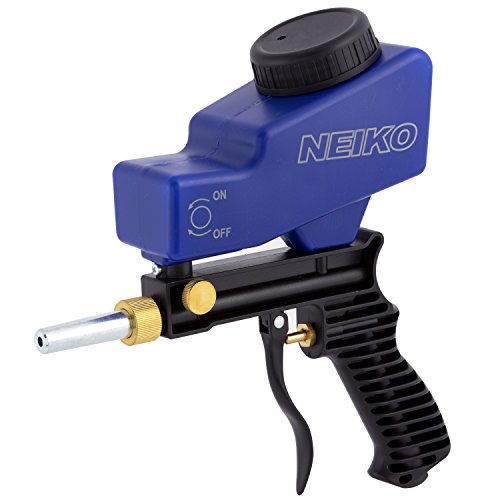
3. NEIKO 30068A Air Sand Blaster Gun — simple gravity gun for occasional jobs
- Feed type: Gravity feed
- Operating pressure: 90 PSI
- Required compressor: 7 SCFM at 90 PSI, per maker figures
- Nozzle: Replaceable steel nozzle, 5.0 mm class
The NEIKO 30068A keeps the design basic: a top hopper, a replaceable steel nozzle, and a gravity feed that needs no separate tank or pickup assembly. That simplicity is its appeal for occasional work — cleaning a rusty tool, prepping a small bracket before paint, or etching a small area — where setting up a pot or siphon system would take longer than the blasting itself.
The maker rates the gun at 90 PSI with an airflow requirement of 7 SCFM, so it still needs a real compressor rather than a small inflator, and it will cycle a modest tank quickly during continuous use. The steel nozzle is replaceable, which matters because nozzle bore grows with use and an enlarged bore wastes air while reducing impact. Media choice should stay conservative: medium-grit aluminum oxide is the maker-suggested direction, with glass bead for a smoother finish and soda for gentler cleaning on softer surfaces.
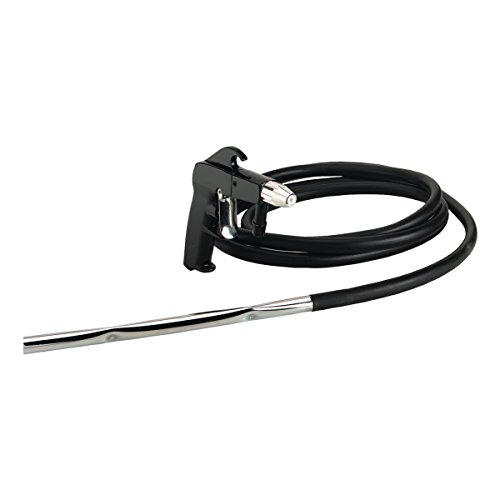
4. Campbell Hausfeld AT122601AV Siphon Feed Sand Blaster — continuous pickup from a bucket
- Feed type: Siphon feed with pickup tube
- Hose length: 10 feet
- Required compressor: About 9 CFM at 90 PSI, per published model figures
- Model: AT122601AV
The Campbell Hausfeld AT122601AV separates the gun from the media supply. A 10-foot hose and pickup tube draw abrasive from a bucket or bag placed beside the work, so the operator is not limited to a small top hopper and does not have to stop and refill the gun every few minutes. For cleaning a set of wheels, a trailer frame section, or a run of fencing hardware, that continuous supply is more useful than a slightly more powerful gravity gun that keeps running dry.
Siphon delivery is gentler than pressure-pot delivery, and the system needs enough air to maintain suction and velocity. Published figures for this model put consumption at about 9 CFM at 90 PSI, which places it firmly in mid-size to large home compressor territory. Keep the pickup tube fully buried in dry media, keep the media container covered between sessions, and expect to sieve reclaimed media before reuse so scale and paint flakes do not block the pickup or nozzle.
5. VEVOR 20 Gallon Sand Blaster, model FF-Q903 — pressure pot for large surfaces
- Feed type: Pressure pot, wheeled tank
- Tank capacity: 20 gallons
- Working pressure: 60 to 110 PSI
- Required compressor: 6 to 25 CFM depending on nozzle, per maker; a large shop compressor is required for sustained use at larger nozzle sizes
The VEVOR 20-gallon pressure pot is a different class of tool. The steel tank pressurizes, a hose delivers media to a die-cast gun, and an oil-water separator helps keep compressor moisture out of the abrasive — a major cause of clogging in pot systems. Four ceramic nozzles are included, and the wheeled tank is built for outdoor work on frames, trailers, gates, and heavy equipment parts.
The maker gives a working pressure of 60 to 110 PSI and air consumption of 6 to 25 CFM depending on nozzle size. At larger nozzles that demand requires a large shop compressor. The maker also states the pot is not meant for wood. Allow time for safe filling and depressurizing, and inspect hose and fittings before each session.
Choosing media: cut, finish, and surface damage
Media choice changes the result as much as the gun does. Aluminum oxide cuts fast and leaves a profile coatings grip well, making it the default for rust and paint on steel, but it can be too aggressive for thin sheet or soft metals. Garnet also cuts well and is a common pressure-pot choice for heavier outdoor work. Glass bead peens rather than cuts, cleaning light oxidation and leaving a smoother finish. Baking soda and crushed walnut shell sit at the gentle end: they remove paint and grime from softer surfaces without aggressive profiling, but they are not the choice for heavy rust scale.
Three rules apply across all five blasters. Keep media dry; moisture is the most common cause of clogging. Respect nozzle and grit limits, especially the SpeedBlaster limit of no coarser than 14 grit. Never substitute play sand for a manufactured abrasive, for the silica reason covered above.
Matching the blaster to the compressor
Compare the gun requirement at its stated pressure with the compressor delivery at the same pressure, not with a maximum figure. The LE LEMATEC AS118 states the lowest threshold here, at least 4 CFM at 90 PSI. The NEIKO 30068A states 7 SCFM at 90 PSI, the Campbell Hausfeld siphon gun sits around 9 CFM at 90 PSI, and the SpeedBlaster needs roughly 10 CFM at 100 PSI despite its small hopper. The VEVOR pot spans 6 to 25 CFM depending on nozzle, so nozzle selection is effectively compressor selection. A compressor that falls short turns continuous work into short bursts separated by waiting.
Recall check and exclusions
Each model in this lineup was checked against the SaferProducts.gov recall database for this product class, using sand blaster, sandblaster, and abrasive blaster queries. Those queries returned no matching recalls for the five models included here, and no pick was excluded on recall grounds. That check covers United States consumer product recalls in that database; it does not replace reading the safety instructions supplied with a specific unit, particularly the pressure-vessel, hose-inspection, and respiratory-protection instructions supplied with the pressure pot.
Verdict: which feed type fits the job
For small spot work, choose a gravity gun: the LE LEMATEC AS118 for the lowest air threshold, the SpeedBlaster for fine-media control, or the NEIKO 30068A for occasional use. For longer handheld sessions, the Campbell Hausfeld siphon system is the step up. For large, heavily rusted metal, the VEVOR 20-gallon pressure pot is the only design here built for that scale. In every case, pair the blaster with manufactured media, a fitted respirator, and sealed eye protection.
More from Amazon
Programs that pair well with the guide above. Offers and eligibility are set by Amazon and may change.
Free shipping on eligible items, Prime Video and more. Eligible new members can start with a free trial.
Start a Prime free trialA Prime membership for ages 18-24 with a trial period. Eligibility is set by Amazon.
See Prime for Young AdultsAudiobooks and podcasts to listen to on the go. Eligible new members can start with a free trial.
Try Audible freeAd-free music streaming. Eligible new subscribers can start with a free trial.
Try Music Unlimited freeAs an Amazon Associate we earn from qualifying purchases.
Write Your Review
No reviews yet. Be the first to share your experience!