

Our Short List of 3

- Format: plug-in indoor ultrasonic emitter
- Pack count: 4 units
- Model: EM-001677
- Power source: standard AC wall outlet, continuous operation
- Format: plug-in indoor ultrasonic emitter
- Pack count: 1 unit
- Model: Neat-002
- Power source: AC wall outlet (maker states 90–250V compatibility)

- Format: plug-in indoor emitter with smart night light
- Pack count: 1 unit
- Model: HR2124-VC
- Frequency range: 20–75 kHz ultrasonic, per the maker’s manual; electromagnetic pulses and negative-ion function also claimed
All 4 Picks at a Glance
| Product | Specs | Action |
|---|---|---|
| 1. Bell+Howell Ultrasonic Pest Repeller, 4 Pack — the default indoor experiment |
| Check price on Amazon |
| 2. Neatmaster Ultrasonic Pest Repeller — the three-mode single unit |
| Check price on Amazon |
| 3. Aspectek Home Sentinel 5-in-1 — the multi-technology plug-in |
| Check price on Amazon |
 4. Aspectek Yard Sentinel — the adjustable outdoor unit |
| Check price on Amazon |
Key takeaways
- Five ultrasonic pest repellers compared with the evidence kept in view: three plug-ins, two outdoor units, maker coverage claims, and what studies found.
As an Amazon Associate we earn from qualifying purchases.
Ultrasonic pest repellers are small emitters that produce sound above the range of human hearing, sold on the idea that the noise drives rodents and insects away. Indoor models plug into a wall outlet and run continuously. Outdoor models sit on a stake or a wall, watch for movement with an infrared sensor, and fire a burst of ultrasound — often with a flashing strobe — when an animal wanders into range. They ask nothing of the owner: no refills, no bait, no chemicals. That convenience is the entire appeal.
What is not established is whether the sound does what the packaging says. This guide therefore puts the evidence first, before the products. The short version: controlled studies and US regulators have been unimpressed by this category for four decades. The five devices below are the most representative examples of each format, presented as what they honestly are — an inexpensive, non-chemical experiment some households run alongside the methods that demonstrably work, not a substitute for them.
Affiliate Disclosure: This article contains affiliate links. If you buy through them, we may earn a commission at no extra cost to you.
Read this first: what the evidence actually says
The Federal Trade Commission has challenged ultrasonic pest-control claims longer than most of these brands have existed. Between 1985 and 1997 the FTC brought enforcement actions against six companies over unsubstantiated claims for ultrasonic devices, each resolved by consent order. In May 2001 it sent warning letters to more than 60 manufacturers and retailers, stating that efficacy claims must be backed by scientific evidence. The FTC’s complaints made two points that still define the category. First, any reaction rodents show to ultrasound is temporary at best, because rodents become accustomed to the sound and return to their nesting and feeding areas with the device still running. Second, the agency alleged that ultrasonic devices do not control insects at all — which removes half of what the typical listing promises.
University extension services, which have no product to sell, land in the same place. A University of Arizona extension review concluded that commercially available sonic pest devices have not been shown effective in scientific studies and advised against relying on them. A Cochrane systematic review of electronic mosquito repellents found no difference in mosquito landings with or without the devices, and university pest-management programs have likewise found no effect on cockroaches, bed bugs, ants, or established mouse infestations.
There is also a physics problem no brand can engineer around. Ultrasound does not pass through walls, doors, cabinets, or upholstered furniture, and it weakens quickly with distance. When a maker states a coverage figure, it describes at best one open room with a clear line of sight — so read every coverage number in the Specs blocks below as “one unobstructed space, according to the maker.”
Finally, regulation. Pest-repelling devices are not registered by the EPA the way chemical pesticides are, and sellers do not submit efficacy data before sale. An EPA establishment number printed on a box identifies the facility that made the device; it is not an approval and not evidence the device works.
1. Bell+Howell Ultrasonic Pest Repeller, 4 Pack — the default indoor experiment
- Format: plug-in indoor ultrasonic emitter
- Pack count: 4 units
- Model: EM-001677
- Power source: standard AC wall outlet, continuous operation
Bell+Howell is the name most buyers meet first in this category, and its four-pack of plug-in emitters is the standard way households try the idea: one unit for the kitchen, one for the bedroom, one for the living room, one spare. Each unit plugs directly into a wall outlet and runs continuously, emitting a variable ultrasonic tone the maker says rodents and insects find intolerable. There are no settings to manage and nothing to refill.
Frame it correctly — a set-and-forget experiment in rooms where entry points are already sealed and food sources removed — and it is a reasonable purchase. Frame it the way the listing does — as a way to drive out an active infestation — and it runs straight into the FTC’s habituation point. The pack format also quietly admits the physics: because ultrasound cannot cross a wall, whole-home coverage means one unit per room, exactly as this pack assumes.
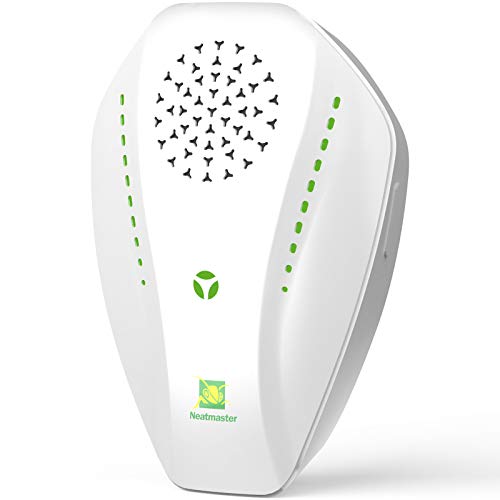
2. Neatmaster Ultrasonic Pest Repeller — the three-mode single unit
- Format: plug-in indoor ultrasonic emitter
- Pack count: 1 unit
- Model: Neat-002
- Power source: AC wall outlet (maker states 90–250V compatibility)
The Neatmaster takes the same plug-in format and adds the one feature the Bell+Howell lacks: selectable modes. A button cycles through three operating modes, which the maker describes as combining bionic wave, ultrasonic, and electromagnetic output at different intensities. The logic of the modes is the habituation problem — varying the signal is an attempt to slow the process by which rodents stop reacting to a constant tone. A sensible design response — though no independent study has shown mode-switching rescues the underlying effect.
The maker states coverage of up to 120 square metres for a single unit. Read that against the physics above: even at face value it describes open-plan space, not a house of separate rooms, and the electromagnetic component is a claim regulators treat with the same scepticism as the ultrasonic one. As a single-unit trial for one problem room — a kitchen, a garage, a pantry — it is the most flexible indoor pick. Judge it by whether droppings and sightings actually stop.
3. Aspectek Home Sentinel 5-in-1 — the multi-technology plug-in
- Format: plug-in indoor emitter with smart night light
- Pack count: 1 unit
- Model: HR2124-VC
- Frequency range: 20–75 kHz ultrasonic, per the maker’s manual; electromagnetic pulses and negative-ion function also claimed
Aspectek’s Home Sentinel is the kitchen-sink entry in the category: a single plug-in unit combining ultrasonic speakers, electromagnetic pulses, a negative-ion function, and an automatic night light. The maker’s manual gives an ultrasonic frequency range of 20–75 kHz, the widest stated range among the indoor picks here. The multi-technology pitch — pests escaping one signal meet another — has the same evidential status as each technology separately: unproven in controlled testing.
Its practical virtues are mundane but real: one unit rather than a pack, a single outlet occupied, and a night light that is genuinely useful in a hallway or bathroom regardless of what the emitters do. The ioniser is aimed at airborne particles rather than pests, so treat it as a bonus appliance feature, not pest control.
4. Aspectek Yard Sentinel — the adjustable outdoor unit
- Format: outdoor ultrasonic emitter with PIR motion sensor
- Pack count: 1 unit
- Frequency range: 15–20 kHz, adjustable by dial, per the maker’s manual
- Output: up to 110 dB, per the maker’s manual
The Yard Sentinel is the long-running outdoor design in this category, built differently from the solar stakes: a weather-resistant box with an adjustable frequency dial (15–20 kHz per the owner’s manual), a volume control, and an infrared motion sensor that triggers the output when something moves within range — up to 45 feet away across a 120-degree arc, per the manual. Power is flexible: an AC adapter with a 33-foot extension cord for placement near a building, or four C batteries for spots without an outlet.
The outdoor use case deserves a fairer hearing than the indoor one. A motion-triggered burst aimed at a deer or raccoon approaching a garden bed is a startle device, closer in spirit to a sprinkler scarecrow than to a whole-house rodent cure. Even so, habituation is the standing objection outdoors too: animals that learn the noise is harmless, especially where food is worth the annoyance, resume feeding. The maker’s stated coverage of up to 5,000 square feet should be read as the sensor’s best-case geometry, not a guarantee. Treat it as one movable layer around a bed or bin area, with fencing doing the real work.
5. X-PEST Solar Ultrasonic Animal Repellent AR02, 4 Pack — the solar stake set
The X-PEST AR02 is the format most gardeners end up with: a solar-topped stake that pushes into the soil wherever animals are causing damage. A PIR motion sensor watches the area, and when it trips, the unit fires an ultrasonic burst across a maker-stated 18–45 kHz range together with a flashing LED strobe. Five selectable modes shift the frequency pattern — the anti-habituation idea again. The housing is rated IP65 by the maker, and the solar panel charges an internal battery the maker says can carry the unit for up to 30 days through cloudy weather.
Four stakes let you ring a vegetable bed, a bin store, or the gap under a deck rather than defending a single point, and repositioning them every week or two is the cheapest anti-habituation measure available — a moved stimulus reads as a new one. The honest limits are the familiar ones: the burst may shift a cat or raccoon’s route for a while, deer under real feeding pressure commonly push through. Solar output depends on the panel seeing the sun, so a stake in permanent shade goes quiet. As a humane first attempt around a garden it is coherent; as a deer-fence substitute, it is not.
Specs
- Format: solar stake, outdoor ultrasonic emitter with PIR motion sensor
- Pack count: 4 units
- Model: AR02
- Frequency range: 18–45 kHz, per the maker
- Motion sensor: PIR-triggered ultrasonic burst plus LED strobe
- Modes: 5 selectable modes, per the maker
- Weather rating: IP65, per the maker
- Power source: solar panel with rechargeable battery; maker states up to 30 days of operation through cloudy weather
If you run the experiment: placement rules and a pet warning
Placement decides what little chance these devices have. Indoors, use the outlet in the room where activity is worst, with nothing in front of it — a unit behind a sofa is emitting into upholstery. One unit per enclosed room is the physical reality. Give any device several weeks, and judge it on evidence — droppings, sightings, damage — not on the absence of noise, because silence is the one thing it always delivers.
One warning is not optional. The animals these devices target are, in many homes, also the pets. Pet rodents — mice, rats, hamsters, gerbils, guinea pigs — along with rabbits, ferrets, and hedgehogs can hear into the ultrasonic range, and a continuous emitter in their room is a continuous stressor they cannot escape. Never run a plug-in unit in a room that houses small pet mammals, and be cautious with outdoor stakes near hutches and runs.
Outdoors, rotate modes and move stakes periodically, and keep solar panels in sun. None of this converts an unproven device into a proven one — it just runs the experiment properly instead of badly.
What actually works
Every regulator statement and extension guide on this category ends at the same place, and so does this article. Mice enter through gaps a quarter of an inch wide; sealing entry points with copper mesh, sealant, and door sweeps is the most effective rodent measure there is. Removing access to food — sealed containers, managed pet food, clean recycling, fixed leaks — removes the reason to stay. Snap traps and live traps placed along walls and runways demonstrably reduce established populations in a way no emitter has been shown to do. In the garden, a physical fence is the reliable answer to deer and rabbits.
Use an ultrasonic repeller, if you use one, as the last and lightest layer on top of that work — never instead of it. A growing infestation is a job for exclusion, trapping, or a licensed pest professional.
Bottom line
Bought with open eyes, these five devices are inexpensive, harmless to deploy, and occasionally — for a particular animal, in a particular spot, for a while — apparently helpful. The Bell+Howell pack is the simplest indoor trial, the Neatmaster adds mode-switching, the Home Sentinel bundles every technology in the category into one outlet, and the Yard Sentinel and X-PEST stakes take the experiment outdoors, where the startle logic is at least plausible. Seal the gaps and store the food first, and let the emitter be the experiment, not the plan.
More from Amazon
Programs that pair well with the guide above. Offers and eligibility are set by Amazon and may change.
Free shipping on eligible items, Prime Video and more. Eligible new members can start with a free trial.
Start a Prime free trialA Prime membership for ages 18-24 with a trial period. Eligibility is set by Amazon.
See Prime for Young AdultsAudiobooks and podcasts to listen to on the go. Eligible new members can start with a free trial.
Try Audible freeAd-free music streaming. Eligible new subscribers can start with a free trial.
Try Music Unlimited freeAs an Amazon Associate we earn from qualifying purchases.


Write Your Review
No reviews yet. Be the first to share your experience!