

Our Short List of 3
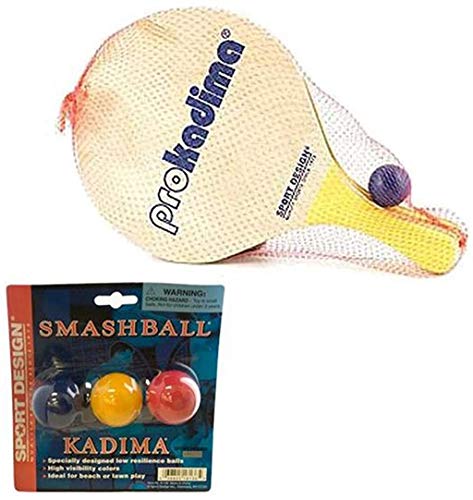
- Contents: 2 wooden paddles, 1 rubber ball, 3 replacement smash balls
- Paddle material: Wood with plastic-supported handles
- Ball type: Small hard rubber rally ball
- Players: 2
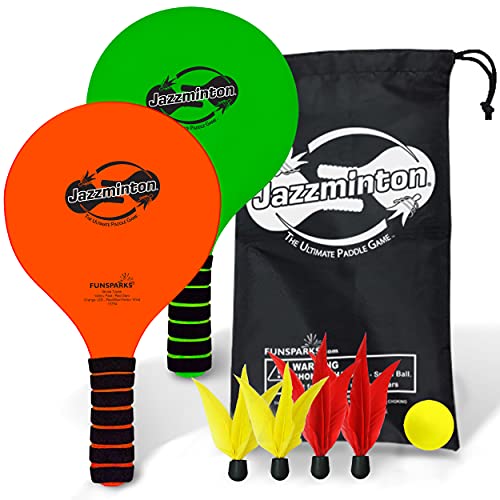
- Contents: 2 wooden paddles, 4 feathered birdies, 1 ball, carry bag
- Paddle material: Wood with foam-covered handles; water-resistant finish
- Grip size: 3.75 in; set weight 10.6 oz
- Players: 2

- Contents: 2 neon paddles, 1 neon Koosh ball
- Ball type: Soft rubber-filament Koosh ball
- Play modes: Solo bounce streaks or two-player rallies
- Age range: 4 years and up (maker’s guidance)
All 4 Picks at a Glance
| Product | Specs | Action |
|---|---|---|
| 1. Pro Kadima Paddle Set Plus Replacement Smash Balls Bundle |
| Check price on Amazon |
| 2. Funsparks Jazzminton Select Paddle Ball Game |
| Check price on Amazon |
| 4. Koosh Paddle Playset |
| Check price on Amazon |
 5. JA-RU Paddle Ball with String (Pack of 3) |
| Check price on Amazon |
Key takeaways
- Compare the best paddle ball sets for backyard and campsite games: a classic ball-on-string toy, wooden Kadima paddles, Jazzminton, Koosh and more.
As an Amazon Associate we earn from qualifying purchases.
Paddle ball is one of the oldest campsite games there is, and it needs almost nothing: no net, no court lines, no batteries, and a patch of ground big enough to swing an arm. It is also two different games sharing one name. The first is the classic solo toy — a flat wooden paddle with a small rubber ball tethered to it on an elastic string, bounced over and over while you count how long the streak lasts. The second is the two-player rally game: a pair of solid paddles and a loose ball, knocked back and forth between partners for as long as the rally survives. Both belong in a camp game bin, but they play differently, pack differently, and suit different ages.
The five sets below cover both games and the ground between them. There is a three-pack of the classic ball-on-a-string toy, the long-running wooden Kadima rally set, a birdie-based paddle game that slows the rally down for beginners, a four-paddle family set with birdies and balls in one bag, and a soft-ball paddle set that younger kids can play indoors without endangering a lamp. Each Specs block lists what is actually in the package, what the paddles and balls are made of, and who the set is built for, so the differences are visible before you choose.
Affiliate Disclosure: This article contains affiliate links. If you buy a paddle ball set through a link on this page, we may earn a commission at no additional cost to you. Product specifications are taken from the manufacturers’ listings at the time of writing.
Two games, one name: solo paddle ball and rally sets
The solo paddle ball dates to the 1920s and has barely changed since: a paddle roughly the size of a table tennis bat, a rubber ball, and an elastic cord joining them. The skill is rhythm — small, even taps that keep the ball returning to the same spot on the paddle face. It is a one-person game that works in a space the size of a picnic table, which is exactly why it survives at campsites: one person can play it in the shade while everyone else is doing something else, and it passes hand to hand as a streak-counting contest. The weak point of every set in this style is the cord, which stretches and eventually snaps; multi-packs exist precisely because the toy is treated as semi-disposable.
The rally game — Kadima in the United States, frescobol in Brazil, matkot in Israel — is cooperative rather than competitive. Two players stand a few paces apart and try to keep a small, hard rubber ball moving between their paddles for as many consecutive hits as possible. There is no scoring against each other and nothing to set up; the game is the rally itself. Solid wood paddles give the ball a crisp, predictable rebound, and the small ball travels fast, so this style rewards quick hands and suits older kids and adults better than small children.
Between those poles sit the modern variations. Birdie-based sets swap the ball for feathered or foam shuttlecocks that float and decelerate, which stretches reaction time and makes rallies forgiving for beginners. Soft-ball sets use a fuzzy or foam ball that cannot crack a window or sting a bare leg, trading speed for safety. Knowing which of the three paces you want — fast ball, floating birdie, or soft ball — narrows the choice more than any other decision.
How to choose a paddle ball set
Start with the players, not the paddles. A solo ball-on-string toy entertains one person at a time and is the right call for a single camper, a long car ride, or a stocking-stuffer style gift. Rally sets need a partner and open ground. If the group is a family with mixed ages, a set with four paddles or a slow birdie option keeps more people playing at once.
Paddle material decides feel and lifespan. Solid wood paddles are the traditional choice for rally games: they return the ball with a clean pop, shrug off being dropped on gravel, and only ask to be kept dry. Plywood-faced paddles with foam-wrapped handles are lighter and kinder to younger hands. Plastic paddles are the lightest of all and fine for the solo string toy, where impact forces are small.
Match the ball to the setting. The small hard rubber ball of a Kadima-style set is fast and lively on sand or grass but bounces unpredictably on pavement and stings on a bare shin. Feather birdies fly slowly and drop steeply, which is a gift for beginners and a frustration on windy days — some sets include a heavier wind birdie for exactly that reason. Soft fabric or foam balls are the indoor and small-child option; they will not mark walls or break anything when a rally goes wrong.
Think about the pack-down. Every set here is small, but the details differ: a mesh or drawstring carry bag keeps paddles, balls, and birdies from scattering through a gear bin, and spare balls matter more than spare anything else, because the ball is the piece that rolls under the car. Sets that bundle replacement balls are quietly the better travel buy.
Plan for the consumables. Elastic cords on solo paddles and feather birdies on rally sets both wear out. Neither is a defect — they are the moving parts of the game — but a set that includes extras, or a brand whose replacements are easy to find, will still be playable next season.
The 5 best paddle ball sets for backyard and campsite games
1. Pro Kadima Paddle Set Plus Replacement Smash Balls Bundle
- Contents: 2 wooden paddles, 1 rubber ball, 3 replacement smash balls
- Paddle material: Wood with plastic-supported handles
- Ball type: Small hard rubber rally ball
- Players: 2
Pro Kadima is the name most people mean when they say paddle ball at the beach. The game has been sold under the Sport Design label for decades, and this bundle is the classic format: two solid wooden paddles and a small rubber ball, with three extra replacement balls packed in — a useful inclusion, since the ball is the one component guaranteed to get lost in the grass eventually. There is no net, no frame, and nothing to assemble; two people, a few paces of open ground, and the rally starts.
The paddles are thick wooden construction with plastic-supported handles, a combination that has kept the design in production while lighter imitations came and went. The small, hard ball — Kadima players call it a smash ball — comes off the wood fast and low, which makes the game genuinely quick once both players find the rhythm. That pace is the honest caveat: this is a set for older kids and adults. Younger children will spend more time fetching the ball than hitting it, and the soft-ball and birdie sets below exist for them.
2. Funsparks Jazzminton Select Paddle Ball Game
- Contents: 2 wooden paddles, 4 feathered birdies, 1 ball, carry bag
- Paddle material: Wood with foam-covered handles; water-resistant finish
- Grip size: 3.75 in; set weight 10.6 oz
- Players: 2
Jazzminton keeps the two-paddle rally format but replaces the ball’s pace with a birdie’s patience. The Select set pairs two wooden paddles with four feathered shuttlecocks and one ball, plus a carry bag. The birdies are the point: they are built to slow down in flight, which stretches each exchange and gives a beginner time to get the paddle into place. Players who want a quicker game switch to the included ball, and the paddles themselves are water-resistant, so a set that gets left out in overnight dew is not ruined by morning.
The paddles are wood with foam-covered handles and a grip size of 3.75 in, sized for adult hands but light enough — the whole set weighs 10.6 oz — for kids to manage. Because the birdie drops rather than rolls when a rally ends, less time goes to chasing equipment across the campsite, and the game works in a smaller clearing than a hard-ball set needs. Wind is the limitation to know about: feather birdies drift in a breeze, so on exposed sites the ball gets more use than the birdies do.
3. EVERICH TOY Paddle Ball Set
This is the set built for a group. The package holds two pairs of paddles — four in total — along with four balls, eight birdies, and a mesh bag to keep the whole collection in one place. With four paddles out, two pairs can rally side by side or a single game can rotate players, which makes it the natural pick for a family campsite where a two-paddle set would leave half the group watching.
The paddle faces are a thick layer of plywood, chosen to resist the splitting and peeling that thin wooden paddles suffer, and the handles carry non-slip foam for a secure grip. The projectile mix covers both paces of play: the balls are thick, durable hollow PVC, while the birdies combine three real feathers with a rubber base that gives them a higher, slower bounce suited to windy days and younger players. It is a lot of small pieces to keep track of — the mesh bag is doing real work here — but as a single purchase that outfits a whole family, nothing else in this list matches it.
Specs
- Contents: 4 paddles (2 pairs), 4 balls, 8 birdies, mesh carry bag
- Paddle material: Plywood faces with non-slip foam handles
- Ball type: Hollow PVC balls; feather birdies with rubber base
- Players: 2 or more
- Best for: Families and groups who want four paddles and both play styles in one bag
4. Koosh Paddle Playset
- Contents: 2 neon paddles, 1 neon Koosh ball
- Ball type: Soft rubber-filament Koosh ball
- Play modes: Solo bounce streaks or two-player rallies
- Age range: 4 years and up (maker’s guidance)
The Koosh playset replaces the hard ball with the famous Koosh ball — a soft bundle of rubber filaments that cannot sting, mark a wall, or crack anything it hits. Two neon paddles and one neon Koosh ball make up the set, and the game flexes between two modes: bounce the ball on your own paddle to build a solo streak, or rally head-to-head with a partner. Because a missed Koosh ball drops softly instead of rolling away, rallies restart in seconds and the set works in the small clearings and tent vestibules where a hard ball would be a nuisance.
It is the youngest-skewing set here, aimed at ages 4 and up, and the lightweight paddles are easy for small hands to swing. The honest trade is pace and precision: a Koosh ball floats and wobbles compared with a rubber ball, so older kids and adults looking for a fast rally will outgrow it. As a first paddle set that can move indoors on a rainy afternoon without anyone worrying about the furniture, it fills a role none of the wooden sets can.
5. JA-RU Paddle Ball with String (Pack of 3)
- Contents: 3 classic paddle ball toys (paddle with ball attached on string)
- Design: Solo skill toy; ball tethered to the paddle on an elastic cord
- Item number: 1994-3s
- Play setting: Indoor or outdoor; one player per paddle
This is the original article: the classic paddle ball toy, sold here as a pack of three. Each toy is a flat paddle with a small ball tethered to it on an elastic string, played solo by bouncing the ball off the paddle face in a steady rhythm and counting consecutive hits. JA-RU has made this style of retro toy for generations — this is item 1994-3s in its catalog — and the three-pack format acknowledges the toy’s one known weakness, which is that the elastic cord is a consumable that stretches out and snaps with heavy use.
Three paddles also turn a solitary toy into a campsite contest: hand one to each player and the game becomes a simultaneous streak competition, first to fifty unbroken bounces wins. The toys are small and flat, so the pack disappears into a glove box, a daypack pocket, or the camp kitchen bin, ready for the odd ten minutes while dinner cooks. There are no parts to lose except the toy itself, no setup, and no partner required — of everything in this list, it is the one that will actually get used on a solo trip.
Making a game of it at the campsite
Paddle ball sets earn their space in the gear bin when they come with a structure, and both styles here support one. For rally sets, the standard camp game is the cooperative streak: the pair counts consecutive hits out loud, and the evening’s record goes on the camp kitchen whiteboard or gets carved into memory for the next trip. Rotating a third player in as the challenger — winner stays on — keeps a group moving. For the solo string toys, hand one to everyone at the picnic table at once and run a first-to-fifty race; it is loud, ridiculous, and reliably the highlight of a slow afternoon.
Care is minimal but not zero. Wooden paddles should go back in the bag dry and stay out of standing water, which swells and eventually splits them; a quick wipe is all the cleaning they need. Feather birdies survive longer if they are stored in the bag rather than crushed under heavier gear. Elastic cords and spare balls are the two things to check when the bin comes out each spring — both are cheap to replace and annoying to discover missing at the site.
However your group plays it, paddle ball asks for nothing but a few square feet of ground and a few spare minutes, and it scales from a four-year-old bouncing a soft ball to two adults defending a streak record as the light fades. That range is why the game has outlived a century of trendier camp toys, and why one of these five sets belongs in the bin.
More from Amazon
Programs that pair well with the guide above. Offers and eligibility are set by Amazon and may change.
Free shipping on eligible items, Prime Video and more. Eligible new members can start with a free trial.
Start a Prime free trialA Prime membership for ages 18-24 with a trial period. Eligibility is set by Amazon.
See Prime for Young AdultsAudiobooks and podcasts to listen to on the go. Eligible new members can start with a free trial.
Try Audible freeAd-free music streaming. Eligible new subscribers can start with a free trial.
Try Music Unlimited freeAs an Amazon Associate we earn from qualifying purchases.
Write Your Review
No reviews yet. Be the first to share your experience!