

Key takeaways
- Compare the best RV fridge fans for even cooling, from battery interior circulation fans to 12V vent exhaust fans that clear heat behind the fridge.
As an Amazon Associate we earn from qualifying purchases.
Affiliate Disclosure: This article contains affiliate links. If you buy through a link on this page, we may earn a commission at no extra cost to you.
An RV absorption fridge has no fan inside the box. Cold air sinks from the cooling fins at the top, warm air rises off the door shelves, and on a hot day the compartment stratifies: the crisper can sit near freezing while the top of the door runs warm enough to spoil milk. A small fridge fan fixes the stratification problem by keeping the air moving, and a vent fan behind the fridge helps the cooling unit shed the heat it pulls out of the box.
One caution comes first, because it decides whether a fan is the right purchase at all. If an absorption fridge cannot hold temperature in hot weather, the cause is usually a ventilation or leveling problem: a blocked or poorly baffled rear vent stack, a rig parked well off level, or a cooling unit that is starting to fail. A fan improves circulation and can help a healthy fridge work noticeably better, but it does not repair a failing cooling unit, and it will not rescue a fridge whose rear compartment cannot vent. Check the level, clear the vent path, and confirm the fridge cools properly on both power sources before spending on airflow.
The five fans below split into the two jobs. Interior circulation fans sit inside the fridge and even out the temperature from shelf to shelf. Exterior vent fans mount behind the fridge, in the side vent or roof vent path, and exhaust hot air from the compartment so the absorption system can work against less heat. Many owners end up with one of each.
1. Beech Lane RV Fridge Fan — Interior Circulation, Battery Powered
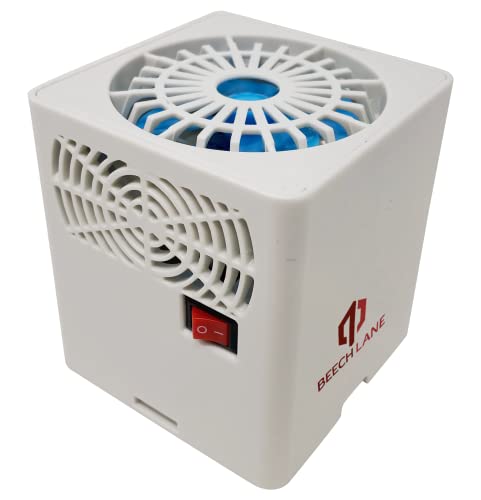
The Beech Lane fridge fan is the interior pick for owners who want stronger circulation than the basic low-speed fans in this class. Its motor is rated at 3,000 RPM, where many competing interior fans run far slower, and the housing draws air through multiple side vents and a re-engineered top opening so cold air is pushed around the compartment instead of pooling under the fins. It runs on two D-cell batteries, so there is no wiring through the door seal and no draw on the house battery, and a simple on-and-off switch lets it be shut down when the rig is parked. Beech Lane backs it with a lifetime manufacturer warranty and USA-based customer service.
Specs
- Type: Interior circulation fan
- Power source: 2 D-cell batteries (not included)
- Fan count: 1
- Motor speed: 3,000 RPM
- Wattage: 5 W
- Controls: On/off switch
- Dimensions: 3.78 × 3.31 × 3.23 in
- Warranty: Lifetime manufacturer warranty
2. Camco Fridge Airator (44124) — Interior Circulation With Odor Control

Camco’s Fridge Airator does the same interior circulation job as the Beech Lane and adds a second function: a replaceable activated charcoal pack that absorbs refrigerator odors while the fan runs. That combination suits small RV fridges and mini fridges, where a single strong-smelling item can scent everything else in the box. The fan runs on two D batteries, has an on-and-off switch, and its compact housing takes up little shelf space. The charcoal pack is a consumable, so factor in periodic replacement packs if the odor control is the reason for choosing it.
Specs
- Type: Interior circulation fan with odor absorber
- Power source: 2 D batteries (not included)
- Fan count: 1
- Odor control: Replaceable activated charcoal pack
- Controls: On/off switch
- Model: 44124
3. Valterra FridgeCool Exhaust Fan (A10-2618VP) — Exterior Vent, Thermostat Controlled

The Valterra FridgeCool A10-2618VP works on the other side of the fridge wall. It is a small 12V exhaust fan that mounts in the refrigerator’s exterior vent path — at the roof vent or low behind the coils — and moves hot air out of the compartment so the cooling unit is not working against its own waste heat. A built-in thermostat switches the fan on automatically as compartment heat builds and off again as it cools, so there is nothing to remember and no battery to change. At 12.5 CFM its airflow rating is modest on paper, but the space behind an RV fridge is small, and steady exhaust matters more than volume. It hardwires into the fridge’s 12V supply.
Specs
- Type: Exterior vent/exhaust fan
- Power source: 12V DC hardwire
- Fan count: 1
- Airflow: 12.5 CFM
- Controls: Built-in automatic thermostat
- Dimensions: 2.75 × 3.5 in
- Model: A10-2618VP
4. Beech Lane 12V RV Fridge Ventilation Cooling Fan 5.5 Inch — Exterior Vent With Remote
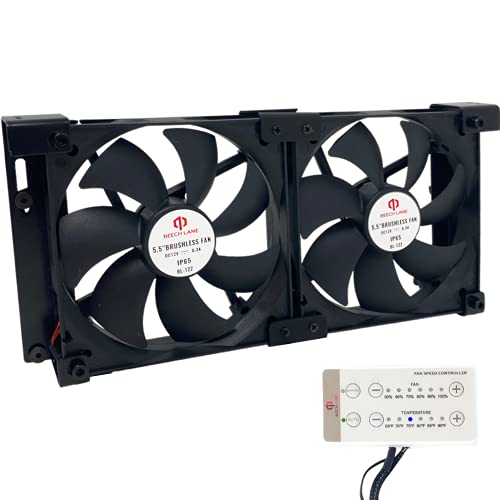
Beech Lane’s ventilation fan is the exterior counterpart to its interior fan: a single 5.5-inch (140mm) 12V fan built for the side vent opening on American RVs, with custom mounts shaped for those vents. Where the Valterra is automatic-only, this fan adds control — a remote with manual and auto modes and adjustable temperature settings, so the owner decides the temperature at which the fan cuts in. The listing rates it at 1,800 RPM maximum and 25 decibels, and the housing is waterproof, which matters in an exterior vent that sees road spray and rain. It wires to a 12V connection behind the fridge.
Specs
- Type: Exterior vent/exhaust fan
- Power source: 12V DC hardwire (2-pin connector)
- Fan count: 1 (5.5 in / 140 mm)
- Maximum speed: 1,800 RPM
- Noise level: 25 dB
- Controls: Remote with manual/auto modes, adjustable temperature settings
- Housing: Waterproof, custom mounts for American RV side vents
5. TITAN 12V DC Double Rack Mount Ventilation Cooling Fan (90mm) — Exterior Vent, Twin Fan
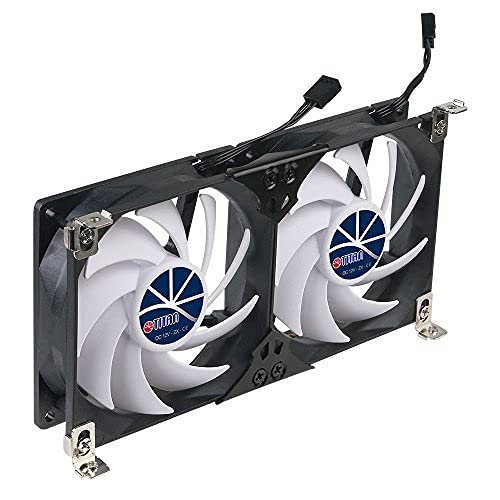
The TITAN double rack mount fan takes the exterior job further with two 90mm fans in a single rack frame that mounts across the fridge’s rear vent grille. Twin fans move more air than the single-fan units above, which suits larger fridges, fridge compartments that bake in direct sun, and owners who run the fridge hard in desert heat. The kit includes a controller with speed settings and a thermostat for automatic operation, so the fans can run at full speed on a parked, hot afternoon and cycle down when the compartment cools. It is a 12V hardwired install, like the other exterior picks.
Specs
- Type: Exterior vent/exhaust fan
- Power source: 12V DC hardwire
- Fan count: 2 (twin 90mm fans)
- Controls: Speed controller with thermostat for auto operation
- Mounting: Rack-mount frame for the refrigerator vent grille
How to Choose an RV Fridge Fan
Start by locating the problem. Warm door shelves and a cold crisper mean the air inside the box is stratifying — an interior circulation fan is the fix, and between the two here, the choice is motor strength and simplicity (Beech Lane) versus built-in odor absorption (Camco). A fridge that cools acceptably in mild weather but loses ground on hot afternoons, especially with the sun on the fridge wall, has a compartment heat problem — an exterior vent fan is the fix, and the choice is between automatic simplicity (Valterra), adjustable control with a remote (Beech Lane), and maximum airflow from twin fans (TITAN).
Power source is the second decision. Battery interior fans need no installation and no wiring, but they consume D cells on a cycle of weeks of continuous running, and they stop helping the day the batteries die unnoticed. Hardwired 12V fans — all three exterior picks and the wired interior alternatives in this class — run whenever the fridge runs and never need batteries, at the cost of a one-time wiring job behind the fridge or through to its 12V supply.
Fan count matters mainly outside the box. Inside a sealed fridge compartment, one small fan is enough to keep air mixed. Behind the fridge, the compartment volume is larger and the heat load higher, so a twin-fan unit has a real edge in extreme heat, while a single thermostat fan is enough for moderate climates.
Finally, set expectations correctly. A fan helps a sound fridge cool faster, hold a more even temperature, and work less hard in heat. It does not fix a fridge that will not cool on either power source, a compartment with a blocked vent, or a rig parked far off level — absorption units need to sit close to level to circulate their refrigerant. Rule those out first, and the fan becomes what it should be: a cheap, effective finishing touch on a fridge that already basically works.
The Bottom Line
For most owners, the Beech Lane interior fan is the first purchase: no wiring, a strong motor, and even temperatures from shelf to shelf. Add the Valterra exhaust fan if hot-weather performance still lags, or step up to the TITAN twin fan if the fridge wall bakes in the sun. Choose the Camco when odor control matters as much as circulation, and the Beech Lane ventilation fan when you want to set the cut-in temperature yourself.
More from Amazon
Programs that pair well with the guide above. Offers and eligibility are set by Amazon and may change.
Free shipping on eligible items, Prime Video and more. Eligible new members can start with a free trial.
Start a Prime free trialA Prime membership for ages 18-24 with a trial period. Eligibility is set by Amazon.
See Prime for Young AdultsAudiobooks and podcasts to listen to on the go. Eligible new members can start with a free trial.
Try Audible freeAd-free music streaming. Eligible new subscribers can start with a free trial.
Try Music Unlimited freeAs an Amazon Associate we earn from qualifying purchases.







Write Your Review
No reviews yet. Be the first to share your experience!