

Key takeaways
- The best engine support bars for transverse engines compared by maker-rated capacity, span and design, with the safety rules this tool demands.
As an Amazon Associate we earn from qualifying purchases.
An engine support bar solves a problem that only exists on transverse-engine cars. When the transaxle comes out from underneath, or the subframe drops, or an engine mount is unbolted, the engine loses the structure that was holding it up — and on a front-wheel-drive car there is no room for a jack underneath and no hoist point that helps. The support bar spans the engine bay from fender to fender, and chains or hooks drop from the bar to the engine’s lifting points, so the engine hangs from above while the work happens below. It is a simple tool doing an unforgiving job: everything it holds is heavy, and everything under it is breakable, including the person doing the work if the setup is wrong.
Safety framing comes first, before any pick, because this tool’s whole working life is spent holding a load over an open engine bay. The rule that governs everything else: the bar supports the engine, never a person. Never put any part of your body under an engine that is held only by a support bar and the car’s fender lips — if the job needs you underneath, the engine must also rest on a proper stand or the mounts must be back in. Every capacity figure in this article is a maker rating, stated as such; it is a ceiling, not a target, and the real limit is often the fender itself, which must be straight, rust-free and strong enough to carry its share of the load on the bar’s feet. Before each use, inspect chains link by link, run hooks and screws through their full travel, check feet pads, and confirm the engine’s own lifting eyes are sound. Take up the load slowly, confirm the engine is balanced before unbolting anything else, and lower it the moment the job allows.
Two design families appear below. Single-bar designs span the bay on two feet and lift at two points along the beam, usually with screw hooks or rotating hoists; they are the general-purpose pattern. Three-point designs add a support arm that reaches to a third contact point, which steadies off-center loads — the normal situation on a transverse engine, whose weight is never evenly distributed between its two ends. Neither family is better in the abstract; the three-point arm earns its keep on transaxle work, and the simpler dual-hook bar is easier to position on crowded bays.
Affiliate Disclosure: This article contains affiliate links. If you buy through a link, the site may earn a commission at no additional cost to you.
1. Astro Pneumatic 5820 — the three-point FWD specialist
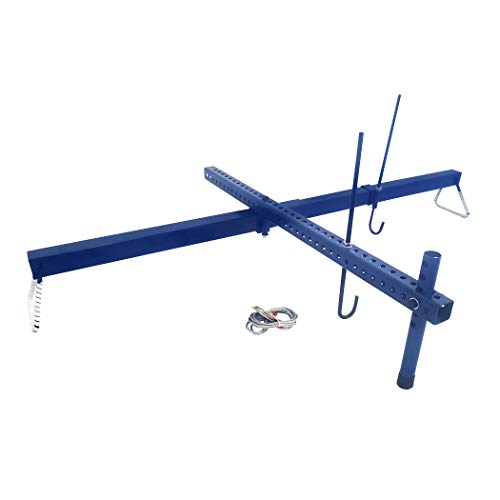
The Astro Pneumatic 5820 is the bar this category was arguably built around: a transverse bar with a support arm, designed specifically to hold a front-wheel-drive engine while its transaxle is removed. The arm is the point. On a transverse powertrain the heavy end is the transaxle end, so a two-point bar rigged level will let the engine hang crooked and shift as bolts come out; the 5820’s third support point takes that off-center load and keeps the engine sitting where it was bolted, which is what makes mating the transaxle back up a one-person job instead of a wrestling match.
Astro rates the 5820 at 700 lb. Attachment is by 1/8-inch braided steel cables and 14-inch adjustable hooks rather than chains, and the bar adjusts across a wide span — roughly 31 to 64 inches — so it covers compact cars through larger front-drive vehicles. The cables are worth a specific inspection habit: braided cable that has started to fray or kink has lost strength invisibly, and it should be retired, not straightened and reused.
Choose the 5820 if front-wheel-drive transaxle work is the main job. Its honest limit is the 700 lb maker rating: it is a car tool, not a truck tool, and a dressed V6 with accessories sits closer to that ceiling than a four-cylinder does, so weigh what is actually hanging before assuming.
Specs
- Maker-rated capacity: 700 lb
- Design: Transverse bar with support arm (three-point support)
- Attachment: 1/8 in braided steel cables, 14 in adjustable hooks
- Span adjustment: Approximately 31 to 64 in
- Intended use: Supporting FWD engines during transaxle removal
- Weight: About 21 lb
2. Omega 44700 — three-point support with the widest span

The Omega 44700 follows the same three-point pattern as the Astro — a transverse bar with an arm for off-center loads — and stretches the idea: the bar expands from 38 to 61 inches, the widest span in this group, which matters on the broad engine bays of larger front-drive cars and crossovers where a shorter bar’s feet land on curved, weak sheet metal instead of the reinforced fender lip. Fit is a safety feature on this tool, not a convenience: feet that sit flat on structure carry the load; feet perched on a curve concentrate it.
Omega rates the 44700 at 700 lb. Two 14-inch adjustable hook screws handle the lifting points, turning down to take the load in small, controlled increments, and the heavy-duty steel frame is built to resist the twisting that an uneven transverse load applies to a long bar. Like the Astro, it uses braided steel cables in its rigging, so the same fray-and-kink inspection applies before every use.
Choose the Omega when the vehicle is wide or when the support arm’s third point needs to reach further than the Astro’s layout allows. The same 700 lb ceiling applies, stated as a maker rating — plan the job around the dressed weight of the engine actually being held, not the bare block figure in a spec sheet.
Specs
- Maker-rated capacity: 700 lb
- Design: Transverse bar with support arm (three-point support)
- Span adjustment: 38 to 61 in
- Attachment: Two 14 in adjustable hook screws, braided steel cables
- Construction: Heavy-duty steel frame
- Intended use: FWD engine support for transaxle and mount service
3. SPECSTAR 1100 Lb Engine Support Bar — the double-beam lifter
The SPECSTAR moves to the second design family: a single transverse beam — in this case a double-beam steel structure — with two independent threaded hooks and no support arm. Where the three-point bars above are specialists, this is the generalist pattern, and its numbers are the strongest here: a listed capacity of 1,100 lb and a beam that works across vehicles up to 57 inches wide, with the base adjustable from 21 to 57 inches.
The two threaded hooks adjust continuously through a lift range of 0 to 7.9 inches, which gives the fine control that mount and clutch work actually needs: the engine can be raised a few millimetres to unload a mount bolt, or tipped slightly by running one hook further than the other. That independent adjustment is also the design’s demand — with no third point, balance is the operator’s job, set at rigging time by where the hooks are placed along the beam and checked again once the load is on.
Choose the SPECSTAR for heavier transverse engines and for general support work across several vehicles, where the adjustable base earns its keep. The 1,100 lb figure is a maker rating; the fenders still carry it, and a wide span on a small car puts the feet near the ends of the fender lips, where the metal is least willing.
Specs
- Maker-rated capacity: 1,100 lb
- Design: Single transverse double-beam bar, two lift points (no support arm)
- Base adjustment: 21 to 57 in; suits vehicles under 57 in wide
- Hooks: Two threaded hooks, continuous lift range 0 to 7.9 in
- Construction: Double-beam steel, rust-resistant coating
- Stated fitment: Sedans, SUVs, sports cars and light trucks
4. VEVOR Engine Support Bar 1100 Lbs — dual rotating hoists

VEVOR’s support bar is the same single-bar, two-point family as the SPECSTAR, with a different lift mechanism: two rotating hoists, turned by handles, each adjusting from 0 to 7.87 inches. Rotating hoists wind the lift point up or down under load with a geared feel, which makes small corrections — the last few millimetres while a transaxle is being lined up — easier to meter out than with a threaded hook that must be turned against friction. Dual hooks and a pair of iron binding chains complete the rigging; the chains secure the engine to the bar so the load cannot roll or walk sideways in its hooks while the car is being worked around.
VEVOR rates the bar at 1,100 lb. Construction is steel, and the whole tool weighs about 28.8 lb — noticeable when carrying it across the shop and positioning it over a bay alone, worth knowing if the bar will be fitted and removed several times a day. As with every bar here, the rating is the maker’s; the chains and hooks supplied are part of that rated system, and substituting longer or lighter hardware breaks the arithmetic.
Choose the VEVOR if the work involves frequent small height changes under load — transaxle mating, mount replacement, subframe drops — where the rotating hoists save repeated re-rigging. For a static hold on a wide bay, the bars with broader stated spans above may fit better.
Specs
- Maker-rated capacity: 1,100 lb
- Design: Single transverse bar, two lift points (no support arm)
- Lift mechanism: Two rotating hoists, 0 to 7.87 in adjustment
- Rigging: Dual hooks and double iron binding chains included
- Construction: Steel
- Item weight: About 28.8 lb
5. ECOTRIC 1100LBS Engine Support Bar — padded triangular feet

The ECOTRIC entry in this class is another single-bar, two-point design rated at a listed 1,100 lb, and its distinguishing hardware is at the bottom rather than the top: a triangular base fitted with thickened rubber feet. On a support bar, the feet are where the tool meets the car, and they do two jobs — spreading the load over the fender lip and gripping it so the bar cannot skate sideways when the load shifts. Rubber padding also protects the painted surface the bar sits on, a small thing that matters on a customer’s car or a keeper project.
The frame is steel with a black powder coating against rust and shop wear. ECOTRIC describes the bar for a broad range of engines — sports cars, SUVs and sedans are named — which is the generalist pitch again: one bar, many bays, with positioning precision coming from careful rigging rather than a third support point. The listed package is compact for the class, which helps storage in a home garage where a 5-foot bar has to live somewhere between jobs.
Choose the ECOTRIC if fender protection and a stable, non-slip footing are priorities, or if the bar will serve several different cars. Its rating is a maker figure like the rest, and the generalist design means off-center transverse loads need the same deliberate hook placement described for the SPECSTAR — the feet keep the bar planted, but balance is still set by hand.
Specs
- Maker-rated capacity: 1,100 lb
- Design: Single transverse bar, two lift points (no support arm)
- Feet: Triangular base with thickened rubber feet
- Construction: Steel, black powder-coated finish
- Stated fitment: Sports cars, SUVs and sedans
- Item weight: About 18 lb
Which design for which job
For a front-wheel-drive transaxle removal — the job this tool class exists for — the three-point bars (Astro 5820, Omega 44700) are the natural picks: the support arm takes the off-center load that a transverse powertrain always presents, and their 700 lb maker ratings cover most car engines as dressed. Pick between them on span: measure across the fender lips where the feet will actually sit, not across the widest part of the bay.
For heavier engines, mount work, clutch jobs and general support across different vehicles, the 1,100 lb single-bar designs (SPECSTAR, VEVOR, ECOTRIC) trade the third point for capacity and simpler rigging. Among them, the choice is mechanical: threaded hooks for set-and-hold work, rotating hoists for jobs that need repeated small adjustments under load, and padded triangular feet where the car’s fenders need protection and grip.
Whichever bar is chosen, the closing checks are the same. Confirm the maker rating exceeds the dressed weight of what will hang, with margin. Set the feet on reinforced fender structure, never on plastic trim or a curved outer panel. Rig to the engine maker’s lifting points, take the load up slowly, and confirm the balance before the last mount bolt comes out. And keep the standing rule in view for the whole job: the bar holds the engine so the work can happen around it — nobody works under a load that hangs from a bar and two fender lips alone.
More from Amazon
Programs that pair well with the guide above. Offers and eligibility are set by Amazon and may change.
Free shipping on eligible items, Prime Video and more. Eligible new members can start with a free trial.
Start a Prime free trialA Prime membership for ages 18-24 with a trial period. Eligibility is set by Amazon.
See Prime for Young AdultsAudiobooks and podcasts to listen to on the go. Eligible new members can start with a free trial.
Try Audible freeAd-free music streaming. Eligible new subscribers can start with a free trial.
Try Music Unlimited freeAs an Amazon Associate we earn from qualifying purchases.
Write Your Review
No reviews yet. Be the first to share your experience!