

Key takeaways
- Compare valve spring compressors for rebuilds: C-clamp kits for bench work and on-head Ford tools, with jaw ranges, adapters and safety notes.
As an Amazon Associate we earn from qualifying purchases.
A valve spring compressor squeezes a valve spring far enough that the two small keepers, also called collets, can be lifted off the valve stem so the retainer, spring and seal can be removed. That sounds simple until spring rates are considered. A stock spring can press back with well over a hundred pounds of force at installed height and far more when compressed further, and a performance dual spring pushes back harder still. The tool has to hold that load, stay square on the retainer, and release slowly. A compressor that flexes, slips off the retainer edge, or lets go suddenly can launch a retainer across the workshop and bend a valve stem.
This guide covers both formats, and each pick is labelled clearly. C-clamp and lever tools are for heads already off the engine on a bench, the normal situation during a full rebuild. Bolt-down on-head tools are for work with the head still fitted, typically a keeper, seal or single-spring swap on a specific engine family. The formats are not interchangeable: a C-clamp cannot reach a spring with the head bolted down, and a small bolt-down Ford tool cannot service a bare head on a bench.
Safety comes before speed. Valve springs store serious energy, so eye protection is essential whenever a spring is under load, because keepers are tiny and easy to launch. Compression should be applied in small increments, checking that the adapter sits flat on the retainer and that the valve head is supported on the opposite side of a bench head. Release should be just as slow. For on-head work there is an additional rule that cannot be skipped: the valve must be held closed while its spring is off, or it will drop into the cylinder. That is done either by pressurising the cylinder with compressed air through a spark plug adapter or by feeding clean rope into the cylinder through the plug hole and bringing the piston up gently to trap the rope against the valves.
One honesty note applies to the budget end of this class. Lightweight C-clamp frames flex on high-rate springs. A frame adequate for a stock single spring may bow visibly on a stiff dual spring, and once a frame bows the adapter walks off centre. The picks below state where that limit sits for each tool rather than presenting every compressor as universal.
Affiliate Disclosure: This article contains affiliate links. If you buy through these links, we may earn a commission at no extra cost to you.
1. Orion Motor Tech 10-Piece Valve Spring Compressor Kit — C-Clamp Format for Bench Heads

Format: C-clamp style, for heads off the engine on a bench.
The Orion Motor Tech 10-piece kit is the broadest bench option here. It is built around a wide solid C-clamp with a screw drive, three extension rods and five collet pusher adapters, so one frame covers a run of retainer diameters instead of forcing a single fixed cup onto every head. The maker lists the kit for motorcycles, ATVs, cars and small-engine equipment, which matches the adapter spread.
The frame and adapters are described as forged, heat-treated carbon steel with a black oxide finish. The maker manual for this kit family specifies AISI 1045 steel, adapter diameters of 16, 19, 23, 25 and 30 mm, and extension bolts that lengthen reach for recessed springs. On a bench rebuild that range is useful, because a project often moves between intake and exhaust retainers of slightly different size, and a workshop that also services a motorcycle or mower engine does not need a second compressor.
The limit is shared by every screw-driven C-clamp in this class. The deeper the spring pocket and the stiffer the spring, the more the frame is loaded in bending. On stock-rate car springs the kit is in its intended territory. On high-rate performance dual springs, compression should be taken in small steps and the frame watched for flex; if the clamp bows and the adapter sits at an angle, stop and move to a heavier bench compressor rather than keep winding.
Specs
- Format: C-clamp, bench use with head removed
- Material: AISI 1045 carbon steel, heat-treated, black oxide finish
- Adapters: 5 collet pushers, 16, 19, 23, 25 and 30 mm
- Extension rods: 3 included
- Hand lever: 4 in
- Item weight: 4.62 lb
- Package dimensions: 13.98 x 8.07 x 2.36 in
- Model / part number: FBA-SCK000100
- Applications listed: motorcycle, ATV, car and small-engine heads
2. ARES 15017 Valve Spring Compressor — Lever Format for Overhead Valve Heads

Format: Direct-action lever style, for overhead valve heads, principally bench work with the head removed.
The ARES 15017 uses a direct-action compressor lever instead of a screw. The practical advantage the maker claims is visibility: the lever geometry leaves a clearer view of the retainer and keepers while the spring is compressed, which matters because keeper removal is fiddly work done with a small magnet or pick in a confined space.
Published figures give a jaw opening from 1-3/8 in to 5-5/8 in and a throat clearance of 5-7/8 in, with two adapters covering retainers up to 1 in and 1-3/16 in. That range is aimed at overhead valve engines in cars and light trucks, including springs set deep in a head casting where a shallow tool cannot reach. At just over five pounds, the tool reflects its leverage mechanism rather than a light pressed frame.
Lever tools reward a steady hand. Because the lever can apply compression quickly, it can also overshoot quickly, so the spring should be brought down gradually and the tool locked in its compressed position before keeper work starts. The same caution about spring rate applies: the published range describes the sizes the jaws can reach, not a promise that the frame will stay rigid on the stiffest aftermarket dual spring. For stock and mildly uprated overhead valve springs in its size range, the ARES layout is the fastest bench pick to work with across a full set of sixteen valves.
Specs
- Format: Direct-action lever, overhead valve engines
- Jaw opening: 1-3/8 in to 5-5/8 in (35 mm to 142 mm)
- Throat clearance: 5-7/8 in (150 mm)
- Adapters: 2, for retainers up to 1 in (25 mm) and 1-3/16 in (30 mm)
- Item weight: 5.24 lb
- Product dimensions: 15 x 8.4 x 1.3 in
- Model / part number: 15017
- Applications listed: overhead valve car and light truck engines
3. Lisle 23300 Small Engine Valve Spring Compressor — C-Clamp Format for Small Engines
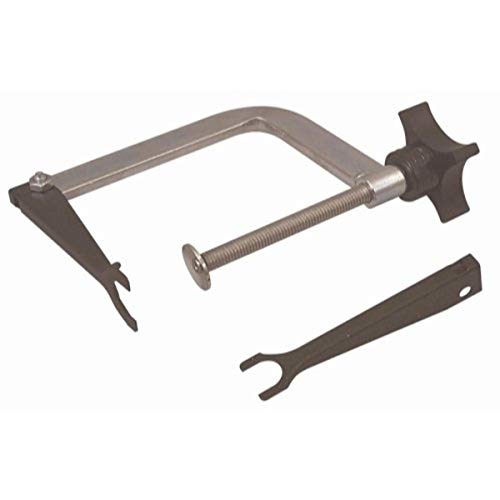
Format: Compact C-clamp style, for small-engine heads off the engine.
Not every rebuild job is a car engine. Lawnmowers, generators, go-karts and small motorcycles use much smaller valve springs, and a full-size car compressor is clumsy on them; its adapters are too large to sit properly on a small retainer. The Lisle 23300 is a compact alloy steel compressor sized for springs from 3/4 in to 1-1/16 in, positioned by the maker for small engines including Briggs and Stratton, Tecumseh, Honda small motors and older Harley-Davidson applications.
At well under a pound, the tool is small enough to keep in a small-engine toolbox. That size is also its boundary. It is not a car-engine tool that happens to be small, and it should not be asked to compress automotive springs, which are larger and far stiffer. Within its class, a dedicated small compressor is safer than improvising with a large clamp and an adapter that does not fit, because a properly seated small jaw holds the retainer square instead of bearing on one edge.
For a workshop whose work is mostly small equipment, this is the correctly sized pick. For a mixed workshop it pairs with one of the larger bench tools above rather than replacing it: the Lisle handles small-engine heads, and the C-clamp kit handles car heads.
Specs
- Format: Compact C-clamp, bench use on small-engine heads
- Spring size range: 3/4 in to 1-1/16 in
- Material: Alloy steel
- Item weight: 0.63 lb
- Model / part number: 23300
- UPC: 083045233008
- Applications listed: small engines including Briggs and Stratton, Tecumseh and Honda small motors
4. OEMTOOLS 24434 Ford Valve Spring Compressor — On-Head Format for Ford 2-Valve V8 Engines

Format: Bolt-down on-head style, for Ford 2-valve modular V8 engines with the head still fitted.
The OEMTOOLS 24434 is a specialist tool, and its value is that specialisation. It compresses valve springs on Ford, Lincoln and Mercury vehicles with 2-valve V8 engines without removing the cylinder head, covering the 4.6L 2-valve V8 and related 5.4L V8 and 6.8L V10 applications from 1991 to 2004. The maker is explicit about one exclusion: the tool is not for the Triton 5.4L 3-valve engine, which needs the different tool covered next. Checking that distinction before ordering is essential.
The tool is a single small steel piece with a black oxide finish, weighing a fraction of a pound. It services camshafts, valve seals, valve springs and retainers in place. That in-place ability is the point: a leaking valve stem seal or a single broken spring on a 2-valve modular engine can be addressed without pulling the head.
The on-head safety rule applies in full here. Before a spring is compressed with the head fitted, the cylinder must be supported with compressed air or the rope method so the valve cannot drop, and keeper handling deserves extra care because access around an installed engine is tighter than on a bench. This tool also does one engine family only, so it is the right purchase for servicing these Ford modular 2-valve engines and the wrong purchase as a general compressor for other makes.
Specs
- Format: On-head, head stays fitted
- Material: Steel, black oxide finish
- Compatibility: Ford, Lincoln and Mercury 2-valve V8 engines, 1991-2004, including 4.6L 2V, 5.4L V8 and 6.8L V10 applications listed by the maker
- Exclusion stated by maker: Not for Triton 5.4L 3-valve
- Item weight: 0.3 lb
- Item dimensions: 3.6 x 2.7 x 1 in
- Model / part number: 24434
- Warranty listed: OEMTOOLS Limited Lifetime
5. OEMTOOLS 24429 Spring Compressor — On-Head Format for Ford 3-Valve Modular Engines

Format: Bolt-down on-head style, for Ford 4.6L and 5.4L 3-valve modular engines with the head still fitted.
The OEMTOOLS 24429 is the companion specialist to the pick above, built for the other modular family. It is designed specifically for Ford 4.6L and 5.4L 3-valve modular engines, and the maker states it is not compatible with 2-valve or 4-valve engines. One defining feature is that the camshaft stays installed while the springs are compressed, which simplifies the procedure compared with tools that require cam removal first. It also functions as a rocker arm remover within that service work.
Construction is alloy steel and the tool is compact at twelve ounces, consistent with a single-purpose on-head tool that has to work in the confined space above an installed head. As with the 2-valve version, the job it enables is in-place service of valve springs, retainers and seals, avoiding a head removal that would otherwise dominate the labour on a seal or spring fault.
Two cautions are worth repeating. First, fitment is narrow by design: a 3-valve tool does not become a universal compressor, and it should only be bought against a confirmed 4.6L or 5.4L 3-valve application. Second, on-head work requires the valve to be held up with cylinder pressure or the rope method for the entire time its keepers are off, and keepers should be handled with a magnet and patience, because a keeper dropped into an open oil drainback hole is a serious problem.
Specs
- Format: On-head, head stays fitted, camshaft stays installed
- Material: Alloy steel
- Compatibility: Ford 4.6L and 5.4L 3-valve modular engines
- Exclusions stated by maker: Not compatible with 2-valve or 4-valve engines
- Item weight: 12 oz
- Model / part number: 24429
- UPC: 076812244291
- Warranty listed: OEMTOOLS Limited Lifetime
How to Choose Between Bench and On-Head Compressors
Start with the state of the engine. If the head is already off for a rebuild, a bench format is correct: the Orion Motor Tech C-clamp kit for the widest adapter coverage, the ARES lever tool where retainer visibility and throat depth matter, and the Lisle 23300 where the work is small engines only. If the head is staying on and the engine is a Ford modular V8, the choice narrows to engine family: 2-valve engines take the OEMTOOLS 24434 and 3-valve engines take the OEMTOOLS 24429, and the two are not substitutes.
Next, check the spring itself. Match the adapter diameter to the retainer, confirm jaw opening and throat depth can reach the spring in its pocket, and be realistic about spring rate. Published size ranges describe reach, not rigidity. Finally, plan the supporting steps before the first spring is compressed: eye protection, a magnetic keeper tool, a tray for keepers and retainers kept in cylinder order, and, for any on-head job, the air hold fitting or rope ready before the first keeper comes off.
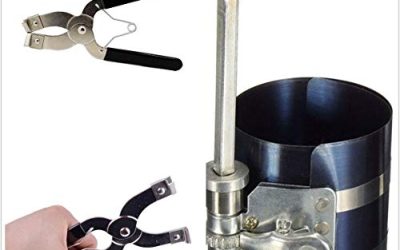
A note on scope: this guide covers valve spring compressors only. Valve grinding and lapping tools are a different class and are not substitutes for a compressor, and piston ring compressors are covered in a separate guide. A recall check for this tool class was run against the SaferProducts.gov database for valve spring compressors and returned no matching recalls for the products listed, so no pick required exclusion on recall grounds.
Frequently Asked Questions
Can a C-clamp compressor be used with the head still on the engine? No. A C-clamp needs access to both sides of the head, the retainer on one side and the valve head on the other, so it is a bench tool for removed heads only.
Why does on-head work need compressed air or rope in the cylinder? With the spring and keepers removed, nothing holds the valve up. Air pressure or rope packed above the piston keeps the valve seated while its spring is off; without one of those methods the valve can drop into the cylinder.
Are the Ford 2-valve and 3-valve compressors interchangeable? No. The OEMTOOLS 24434 is made for 2-valve modular engines and the 24429 for 3-valve modular engines, and each maker listing excludes the other families.
What should be done if a compressor frame starts to flex on a stiff spring? Stop, release the load slowly, and move to a heavier compressor. Flex means the adapter is no longer sitting square on the retainer, and continuing risks the tool slipping off under load.
More from Amazon
Programs that pair well with the guide above. Offers and eligibility are set by Amazon and may change.
Free shipping on eligible items, Prime Video and more. Eligible new members can start with a free trial.
Start a Prime free trialA Prime membership for ages 18-24 with a trial period. Eligibility is set by Amazon.
See Prime for Young AdultsAudiobooks and podcasts to listen to on the go. Eligible new members can start with a free trial.
Try Audible freeAd-free music streaming. Eligible new subscribers can start with a free trial.
Try Music Unlimited freeAs an Amazon Associate we earn from qualifying purchases.
Write Your Review
No reviews yet. Be the first to share your experience!