

Key takeaways
- Compare band, tapered and plier-type piston ring compressors by bore range, format and fit, so pistons slide into the bore without breaking rings.
As an Amazon Associate we earn from qualifying purchases.
Affiliate Disclosure: This article contains affiliate links. If you buy through a link, a commission may be earned at no extra cost to you.
A piston only goes home cleanly when every ring is squeezed flush into its groove as the piston meets the bore. A piston ring compressor holds the ring pack down while the piston slides from the tool into the cylinder. Seat the tool square to the deck, keep the rings oiled, and tap the crown gently, and the assembly drops in. Let the band sit crooked, leave a gap at the deck, or force a tilted piston, and a ring can spring out, catch the deck edge, and snap — costing a ring set and possibly scoring a bore.
This guide covers the three formats that actually compress rings for installation: adjustable band compressors tightened around the piston, tapered sleeves machined for one bore size, and plier-type sets that clamp interchangeable bands. Each pick below is labelled by format and by its exact bore coverage, because coverage is the whole decision. A band tool that adjusts across several inches serves a builder who sees many engines. A tapered sleeve serves one bore size only, and serves it very well, but a sleeve bought for the wrong bore is simply the wrong tool. A small-engine kit serves bores far below car sizes and should never be stretched into automotive work.
Two neighbouring tools are not in this guide. A ring expander is the small plier that spreads a ring so it can be slipped over the piston into its groove, before compression happens; some kits below include one only as an accessory. A groove cleaner and a valve spring compressor belong to other jobs. Neither substitutes for a ring compressor.
How to Choose a Piston Ring Compressor
Start with the bore. Measure the finished bore diameter and match the tool to that figure. For an adjustable band, the bore should sit comfortably inside the stated range, not at its edge, because the band needs overlap and even tension. For a tapered sleeve, the bore must match exactly — there is no adjustment to forgive a mismatch.
Next, consider band height. Taller bands cover wider ring packs but need clear deck space and can foul on block studs. Shorter bands seat more easily in tight decks. Check stud clearance before assembly day, not during it.
Technique matters as much as the tool. Clean the bore and grooves, stagger the ring gaps as the maker directs, oil the rings, skirt and bore, and seat the compressor flat on the deck with no gap. Tighten evenly until the rings are flush, then drive the piston with steady, light taps. If resistance rises sharply, stop — a ring has probably escaped. Back out and start again rather than pushing harder. A builder repeating one engine family gains speed from a dedicated sleeve; a general workshop gains more from a wide-range band or multi-band set.
1. Plum Garden Piston Ring Compressor Tool and Pliers Set — Adjustable Band, Wide Range
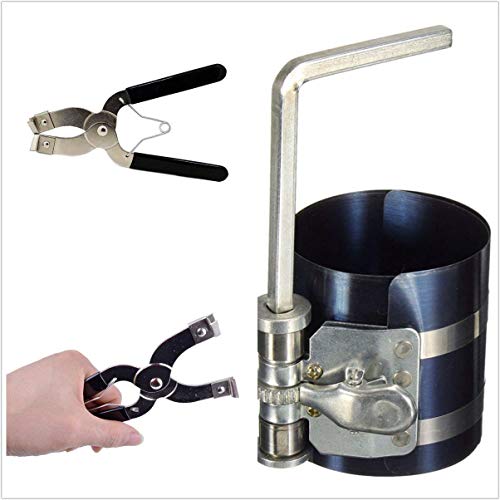
The Plum Garden set is built around a single adjustable spring steel band compressor with a three-inch band height, paired with ring pliers and a tightening wrench. It is the straightforward general-purpose format: wrap the band around the ring pack, tighten it with the wrench until the rings sit flush, seat the band flat on the deck, and tap the piston through. The stated compressor coverage runs from small automotive bores up through large ones, which makes this a sensible one-tool choice for a home builder whose next engine is not yet known.
The included pliers handle rings up to the stated jaw capacity and carry adjustable safety screws intended to limit how far a ring is spread when rings are being fitted onto the piston. Treat that plier as the fitting accessory described in the introduction, not as the compressor itself. The compressor band does the installation work. The band is listed in strong spring steel with a nickel plated finish, and the pliers are carbon steel with vinyl dipped handles.
In use, tighten gradually, check that no ring edge shows below the band, and confirm the band sits square before tapping. Near the small end of the range, take extra care that excess band does not wrinkle or overlap unevenly.
Specs
- Format: Adjustable band compressor with ring pliers and wrench
- Compressor bore range: 2-1/8 to 7 inches (53 to 175 mm)
- Band height: 3 inches (75 mm)
- Compressor material: Strong spring steel, nickel plated finish
- Plier capacity: Up to 6.4 mm jaw capacity; ring range 1.2 to 6.4 mm
- Plier length: 17 cm (6.69 inches)
- Manufacturer part number: PL-140901
- Contents: 1 compressor, 1 ring pliers, 1 wrench
2. Swpeet 8-Piece Piston Ring Compressor Kit — Three Band Heights in One Kit

The Swpeet kit answers a different problem: band height. It supplies three separate band compressors in three, four and six inch heights, plus ring pliers, a stainless steel feeler gauge and three wrenches. A short band suits a shallow deck and a compact ring pack. A tall band gives more guidance on a taller piston and helps keep the piston straight as it leaves the tool. Having the heights side by side means the builder chooses guidance length per engine instead of forcing one band to do everything.
The three and four inch compressors share the same stated diameter coverage, while the six inch compressor starts slightly higher and extends further. The feeler gauge, with dual metric and imperial markings, is a useful companion for checking ring end gaps before the rings go onto the piston.
The listing also notes use on lawn mower and tractor pistons within the stated ranges. Stay inside those ranges. The six inch band needs a flat, clear deck to sit square, and its height is a drawback on a crowded block. Choose the shortest band that fully covers the ring pack.
Specs
- Format: Set of three adjustable band compressors with accessories
- Band heights: 3 inches, 4 inches and 6 inches
- Bore range, 3-inch and 4-inch bands: 2-1/8 to 7 inches (53 to 175 mm)
- Bore range, 6-inch band: 60 to 195 mm as listed
- Feeler gauge range: 0.0015 inch (0.04 mm) to 0.035 inch (0.88 mm)
- Manufacturer part number: S1819
- Item weight: 2.99 pounds
- Contents: 3 compressors, 1 ring pliers, 1 feeler gauge, 3 wrenches; 8 pieces total
3. Hypertune Piston Ring Compressor Tool Set — Plier-Type with Fourteen Bands

The Hypertune set uses the plier-type format. Instead of one band tightened by a wrench, it provides fourteen sized bands and a plier that clamps the chosen band around the piston. The plier can be worked parallel or perpendicular to the cylinder, which helps when deck access is awkward or when the engine is still in a chassis and approach angles are limited. A storage case keeps the band set together, which matters because a missing middle band is usually discovered mid-assembly.
Coverage sits squarely in the common car and light truck bore span. Select the band nearest the bore, clamp with the plier, and hold compression while guiding the piston in. Because the plier supplies the clamping force, a steady hold is part of the technique — keep it closed until the rings have entered the bore.
The bands and pliers are listed in manganese steel and iron, with a forged steel plier handle. This set rewards organisation: return each band to the case, and check band condition before the next build, since a bent band will not compress evenly.
Specs
- Format: Plier-type compressor set with interchangeable bands
- Applicable piston diameter: 62 to 145 mm (2.44 to 5.71 inches)
- Bands included: 14 sized bands, plus 1 plier
- Materials: Manganese steel and iron; forged steel plier handle
- Part number: H-SLW05
- Product dimensions: 10.7 x 8.7 x 2.3 inches
- Item weight: 3.23 pounds
- Storage: Case included
4. LVOUP Tapered Engine Piston Ring Compressor — Dedicated 4.000-Inch Sleeve

The LVOUP tool is the tapered sleeve in this lineup, machined for a single bore size of exactly 4.000 inches. There is no range to quote and no adjustment to set. The sleeve sits over the bore, the piston is placed into its wider top, and the internal taper compresses the rings progressively as the piston is pushed through, until the rings pass into the bore at the sleeve base. For a builder repeatedly assembling engines at this bore, that repeatability is the appeal: the same motion, the same alignment, piston after piston.
That precision comes with a plain limit: this sleeve fits 4.000-inch bores only — not a 4.030-inch overbore or any other engine. Measure the finished bore after honing before ordering. The sleeve is listed in 6061 aluminium alloy with a red anodised finish. Keep it clean, lightly oiled in use, and stored where the machined bore cannot be dented; a nick inside the taper can mark rings.
Specs
- Format: Tapered sleeve compressor, single size
- Bore size: 4.000 inches only; not adjustable
- Material: 6061 aluminium alloy
- Finish: Red anodised
- Part number: AP146
- Package dimensions: 5 x 4.49 x 3.23 inches
- Item weight: 5.8 ounces
- Contents: 1 tapered ring compressor
5. GardenPal Ring Compressor Kit — Small-Engine Bores from 40 to 60 mm

The GardenPal kit is the small-engine pick, sized for the pistons found in chainsaws, blowers and similar equipment rather than car engines. Its stated compression range is 40 to 60 mm in diameter, which sits far below every other pick in this guide. Small two-stroke pistons are light, rings are thin, and the cylinder often comes to the piston rather than the piston dropping into a block deck, so a small dedicated kit fits the work better than a large automotive band cinched down to its limit.
The kit is listed as a replacement for Husqvarna 502507001 (502 50 70-01) and Stens 751-045, with stated compatibility across Husqvarna, Stihl, Echo and Honda small engines. It also includes plastic piston stops, which lock the piston for other service tasks such as flywheel work — an accessory; the compressor ring does the squeezing for cylinder fitting.
Because the range tops out at 60 mm, this kit must not be used on automotive pistons. Work gently — small rings break with very little force — and confirm the cylinder slides over the compressed rings without rocking.
Specs
- Format: Small-engine ring compressor kit with piston stops
- Compression range: 40 to 60 mm diameter
- Replaces: Husqvarna 502507001 (502 50 70-01); Stens 751-045
- Stated compatibility: Husqvarna, Stihl, Echo and Honda small engines
- Package dimensions: 5.43 x 4.92 x 1.54 inches
- Item weight: 1.76 ounces
- Contents: Ring compressor and plastic piston stops
Which Format Fits the Build?
For a first engine or a mixed workshop, the Plum Garden adjustable band covers the widest span with the simplest kit. For builders who want band height choice, the Swpeet kit adds four and six inch options and a gap gauge. For a shop that prefers sized bands and flexible plier access, the Hypertune fourteen-band set is the organised option. For repeated assembly at exactly 4.000 inches, the LVOUP tapered sleeve removes adjustment entirely and is the most repeatable motion here. For saws, blowers and other small engines, the GardenPal kit is the only pick sized for the job.
The rules do not change with format. Match the tool to the measured bore, seat it square with no gap, oil the parts, stagger the gaps, and stop the moment resistance spikes. A compressor cannot correct a wrong ring set, wrong end gap or damaged bore. Used patiently, it makes piston installation the calmest step of the build.
Frequently Asked Questions
Can one adjustable band really cover every engine?
No. It covers bores inside its stated range, with even tension and a square seat. At the extremes, check for wrinkles or uneven overlap, and choose a sized tool when the bore sits at the edge.
Why buy a tapered sleeve that fits only one bore?
Repeatability. With no adjustment to drift, every piston in a set is compressed the same way, which suits repeated builds of one engine family. The trade-off is absolute: the sleeve fits that bore size only.
Is a ring expander the same tool?
No. An expander spreads a ring so it can be fitted onto the piston. A compressor squeezes the fitted rings so the piston can enter the bore. Assembly normally needs the fitting step first and the compression step second.
What breaks rings during installation?
A compressor that is not flat on the deck, a gap that lets a ring spring out and catch the deck edge, misaligned ring gaps, dry rings, and forcing a tilted piston. Stopping at the first sharp rise in resistance prevents most breakage.
More from Amazon
Programs that pair well with the guide above. Offers and eligibility are set by Amazon and may change.
Free shipping on eligible items, Prime Video and more. Eligible new members can start with a free trial.
Start a Prime free trialA Prime membership for ages 18-24 with a trial period. Eligibility is set by Amazon.
See Prime for Young AdultsAudiobooks and podcasts to listen to on the go. Eligible new members can start with a free trial.
Try Audible freeAd-free music streaming. Eligible new subscribers can start with a free trial.
Try Music Unlimited freeAs an Amazon Associate we earn from qualifying purchases.







Write Your Review
No reviews yet. Be the first to share your experience!